Canada sits at a crossroads. As one of the most energy-rich nations on Earth — blessed with abundant hydroelectric power, cold climates that slash cooling costs, and a population that increasingly understands the value of decentralized money — this country should be the undisputed global capital of Bitcoin mining. Instead, Canadian Bitcoin miners find themselves navigating a political landscape where some leaders embrace the technology while others treat it like a threat.
This is not an article about price speculation or investment returns. This is about something far more important: the right to run open-source software, the freedom to convert energy into sound money, and whether Canadian policy will empower or crush the most significant technological revolution since the internet.
The Political Divide: Technology Freedom vs. Central Control
The Canadian political landscape has produced two fundamentally different visions for Bitcoin’s role in society.
On one side, voices within the Liberal government have historically framed Bitcoin through the lens of consumer risk and financial volatility — treating it as a speculative gamble that needs to be reined in. Former Prime Minister Justin Trudeau publicly cautioned Canadians against cryptocurrency, calling the promotion of such assets “not responsible leadership.” This framing ignores what Bitcoin actually is at its core: a decentralized, censorship-resistant protocol that anyone can participate in by running a node or mining blocks.
On the other side, Conservative leader Pierre Poilievre has championed what he calls “financial freedom” — the idea that Canadians should have the right to opt out of centralized monetary systems and use alternative currencies, including Bitcoin. Poilievre has gone further than rhetoric, proposing to block the Bank of Canada from creating a Central Bank Digital Currency (CBDC) and positioning himself as a defender of monetary sovereignty.
For those of us in the mining community, the distinction matters enormously. One vision leads to more regulation, more barriers to running mining hardware at home, and more friction for peer-to-peer transactions. The other opens the door to a Canada where running a Bitaxe solo miner at home is as unremarkable as running a space heater — because in many cases, it literally is a space heater.
Why Canadian Miners Have a Unique Advantage
Forget the political noise for a moment. Let us talk about the raw fundamentals that make Canada one of the best places on Earth to mine Bitcoin:
| Factor | Canada’s Advantage |
|---|---|
| Climate | Cold temperatures 6-8 months per year drastically reduce cooling costs — the #1 operational expense for miners |
| Energy Mix | ~60% hydroelectric nationally, with Quebec at 94% hydro. Clean, abundant, and cheap |
| Electricity Rates | Quebec residential rates around $0.07-0.08 CAD/kWh — among the lowest in North America |
| Legal Framework | Bitcoin mining is legal. No licensing required for home miners. Clear tax guidance from CRA |
| Dual-Purpose Mining | Long winters mean mining heat is useful heat. A miner that heats your home effectively mines at a net-zero energy cost for heating |
| Infrastructure | Reliable grid, strong internet infrastructure, proximity to US markets |
These advantages are not theoretical. D-Central Technologies has operated from Canada since 2016, and we have built our entire business around the thesis that Canada — particularly Quebec — is the ideal environment for Bitcoin mining at every scale, from a single Bitaxe on your desk to a rack of Antminers in a hosted facility in Montreal.
The CBDC Question: Why Miners Should Pay Attention
One of the most consequential policy debates in Canadian politics right now is the question of Central Bank Digital Currencies. The Bank of Canada has been researching a digital Canadian dollar for years, and the implications for Bitcoin miners are significant.
A CBDC is, by design, the opposite of Bitcoin. Where Bitcoin is decentralized, permissionless, and censorship-resistant, a CBDC would give the central bank unprecedented visibility into — and control over — every transaction. Programmable money controlled by a central authority is not an upgrade to the financial system. It is a surveillance tool.
For Bitcoin miners, the rise of a CBDC could mean:
- Increased regulatory pressure on peer-to-peer Bitcoin transactions
- KYC requirements extended to mining pool payouts or on-chain transactions
- Energy usage reporting requirements that disproportionately target home miners
- Tax complexity as the government seeks to track every satoshi earned
Poilievre’s pledge to block a CBDC is, from a miner’s perspective, a pledge to preserve the open, permissionless environment that makes home mining viable. Whether you agree with his broader political platform or not, on this specific issue, the mining community has a clear interest.
The Regulatory Landscape for Canadian Bitcoin Miners in 2026
Let us cut through the uncertainty and lay out what the current regulatory environment actually looks like for Canadian miners:
| Area | Current Status | What It Means for Miners |
|---|---|---|
| Home Mining Legality | Fully legal, no license required | You can run miners at home without government approval |
| Tax Treatment | Mining income is business income (CRA) | Hardware, electricity, and repairs are deductible business expenses |
| GST/HST | Mining hardware purchases subject to GST/HST | ITCs available if registered for GST/HST |
| Energy Regulations | No federal mining-specific energy rules; some provinces have rate tiers | Quebec has imposed moratoriums on new large-scale crypto mining (35+ MW) but home miners are unaffected |
| CBDC Status | Research phase; no firm launch timeline | Political opposition may delay or block implementation |
| Node Operation | Fully legal, no restrictions | Running a full node strengthens the network and is entirely within your rights |
The key takeaway: as of 2026, Canada remains one of the most miner-friendly jurisdictions in the world for home-scale operations. The political risk is not that mining will be banned — it is that creeping regulation could make it incrementally more difficult, more expensive, and more surveilled.
How Political Outcomes Affect Your Mining Operation
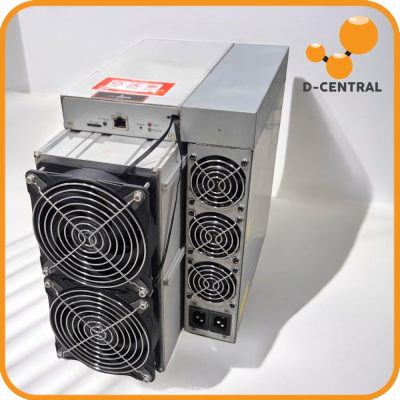
Whether you are running a single Bitaxe pulling 500 GH/s on solo mining, or a fleet of Antminer S21s behind a Bitcoin Space Heater setup, political decisions ripple through your operation in concrete ways:
Energy Policy: Carbon taxes, grid access rules, and renewable energy incentives all affect your cost per kilowatt-hour. A government that subsidizes home solar and wind installations indirectly subsidizes your mining operation. A government that piles carbon taxes onto electricity makes every hash more expensive.
Trade Policy: Mining hardware is manufactured primarily in China. Tariffs, import restrictions, and trade tensions directly affect the price you pay for an Antminer, a Bitaxe, or replacement hashboards. Canadian miners benefit from relatively open trade — but that could change.
Financial Regulation: How easily you can convert mined BTC to Canadian dollars, whether exchanges face additional compliance burdens, and whether peer-to-peer transactions are scrutinized all affect the practical value of your mining rewards.
Municipal Bylaws: Noise regulations, zoning rules, and electrical codes are set at the municipal level. A sympathetic political environment at the federal level means nothing if your city council decides ASIC miners constitute a nuisance. This is one reason why mining consulting matters — understanding local regulations before you deploy is essential.
The Decentralization Imperative
Here is where we strip away the political horse race and get to what actually matters.
The Bitcoin network’s hashrate currently exceeds 800 EH/s. The vast majority of that hashrate is concentrated in a handful of large-scale industrial operations — many of them publicly traded companies answerable to shareholders and, increasingly, to regulators. When a government can pressure five companies to censor transactions or redirect hashrate, Bitcoin’s censorship resistance is compromised.
Every home miner who plugs in a machine contributes to fixing this problem.
That Bitaxe on your desk, pulling half a terahash, is not going to find a block every day. But it is a node of resistance in a distributed network. It is hashrate that no government can seize, no corporation can redirect, and no regulator can shut down without knocking on your door. Multiply that by thousands of home miners across Canada, and you have a meaningful layer of decentralized hashrate that makes the entire network more robust.
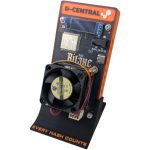
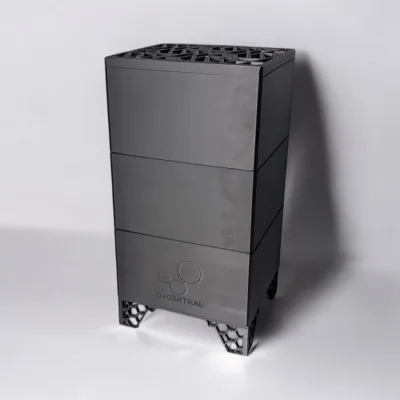
This is why D-Central exists. Since 2016, we have been building, repairing, and hacking mining hardware to make it accessible to individual miners. We created the original Bitaxe Mesh Stand. We repair ASIC miners that the manufacturer would tell you to throw away. We build Bitcoin Space Heaters that turn your mining operation into your home heating system.
We are not neutral observers of Canadian Bitcoin politics. We are participants. Every miner we ship, every hashboard we repair, every guide we publish is an act of decentralization.
What Canadian Bitcoin Miners Should Do Right Now
Regardless of which party holds power, here are concrete steps every Canadian miner should take to protect their operation and strengthen the network:
- Start mining at home. Even a single open-source miner adds decentralized hashrate. Solo mining with a Bitaxe is both a statement and a lottery ticket — with the current 3.125 BTC block reward, every hash counts.
- Run a full node. Mining without verifying your own blocks is trusting someone else’s rules. A full node costs almost nothing to run and makes you a first-class participant in the network.
- Understand your tax obligations. Mining income is taxable in Canada. Keep records of your hardware costs, electricity consumption, and BTC earned. Claim your deductions. A well-documented mining operation is a defensible one.
- Engage locally. Municipal bylaws matter more than federal politics for your day-to-day operation. Attend council meetings. Educate your representatives. A neighbor who understands that your miner is heating your home is an ally, not a complainant.
- Use dual-purpose mining. A Bitcoin miner that heats your home is not “wasting” energy — it is monetizing it. This narrative is powerful in policy conversations and it is factually correct. Every watt consumed by a miner becomes heat. In a Canadian winter, that heat has value.
- Support open-source hardware. The Bitaxe ecosystem — fully open-source ASIC miners — represents the decentralization of mining hardware manufacturing itself. No single company controls the design. No government can pressure a manufacturer to add backdoors.
- Stay informed. Follow policy developments. Understand what CBDCs mean. Know your rights. The cypherpunk ethos is not just about code — it is about knowledge.
FAQ
Is Bitcoin mining legal in Canada?
Yes. Bitcoin mining is fully legal in Canada at both the federal and provincial levels. There are no licensing requirements for home miners. Some provinces, like Quebec, have imposed restrictions on large-scale mining operations (35+ MW), but these do not affect residential or small-scale mining. You can legally operate miners in your home, garage, or workshop without government approval.
How is mining income taxed in Canada?
The Canada Revenue Agency (CRA) treats mining income as business income. The fair market value of Bitcoin at the time you receive it from mining is considered income. Hardware purchases, electricity costs, internet, repair expenses, and hosting fees are all deductible business expenses. If you later sell the mined BTC, any gain or loss from the point of receipt is a capital event. Keep detailed records of all costs and earnings.
What is a CBDC and why should miners care?
A Central Bank Digital Currency (CBDC) is a digital form of fiat currency issued and controlled by a central bank. Unlike Bitcoin, a CBDC would be fully centralized, surveilled, and programmable by the issuing authority. For miners, a CBDC could lead to increased regulatory pressure on Bitcoin transactions, additional KYC requirements for mining payouts, and a political environment less friendly to decentralized alternatives. The existence of Bitcoin as an alternative to state-controlled money is precisely why some politicians oppose it.
Does it matter which political party is in power for Bitcoin mining?
Yes, but perhaps not as dramatically as headlines suggest. The fundamentals that make Canada great for mining — cheap hydro, cold climate, legal framework — exist regardless of who is in power. However, energy policy, carbon taxes, trade policy (affecting hardware imports), and financial regulation all shift with political leadership. A government hostile to Bitcoin could make mining incrementally more expensive and complex without outright banning it. Staying informed and engaged at both federal and municipal levels is the best defense.
Can I mine Bitcoin at home in Quebec?
Absolutely. Quebec’s restrictions on crypto mining apply only to large-scale industrial operations seeking dedicated power allocations from Hydro-Quebec. Residential miners using standard household electrical service are completely unaffected. In fact, Quebec is one of the best places in the world for home mining thanks to electricity rates around $0.07-0.08 CAD/kWh and long, cold winters that make mining heat genuinely useful.
How does Bitcoin mining help decentralization?
Every miner that operates independently — outside of large corporate mining farms — adds to the geographic and organizational diversity of the Bitcoin network’s hashrate. When hashrate is concentrated in a few large operations, those operations become targets for regulatory pressure, censorship demands, or seizure. Home miners, distributed across thousands of locations, create a resilient base layer of hashrate that is practically impossible to shut down. Even a small Bitaxe contributing 500 GH/s is a meaningful act of decentralization.