How to Use a Bitcoin Space Heater: Setup, Efficiency, and ROI
Every watt of electricity that passes through an electronic device becomes heat. This is not a flaw — it is physics. A 1,500-watt electric space heater converts 1,500 watts into heat. A 1,400-watt Bitcoin miner also converts 1,400 watts into heat. The difference is that the miner performs trillions of SHA-256 computations per second while it does it, earning Bitcoin in the process. A bitcoin space heater takes this reality and turns it into a practical home heating solution: the same electricity that warms your room also mines Bitcoin, giving every watt a dual purpose.
This is not a gimmick or a novelty. It is thermodynamics applied with intention. D-Central Technologies has been building and shipping bitcoin space heaters since the concept was barely a whisper in mining forums. For Canadians facing 6 to 8 months of heating season, the math is compelling. You are going to spend money on electricity to heat your home regardless. A bitcoin space heater lets that electricity do double duty — producing warmth and hashing simultaneously.
This guide covers everything you need to know: what a bitcoin space heater actually is, which models D-Central offers, how to set one up properly, the BTU math behind heating performance, and a realistic look at the economics. No hype. No promises of riches. Just the technology, the physics, and the practical knowledge you need to run one effectively.
What Is a Bitcoin Space Heater?
A bitcoin space heater is an ASIC (Application-Specific Integrated Circuit) miner that has been repurposed, enclosed, or configured specifically for home heating use. At its core, it is the same mining hardware used in industrial facilities — SHA-256 ASIC chips performing proof-of-work calculations — but adapted for a residential environment where the heat output is the primary feature and mining revenue is a secondary benefit.
The concept works because of a fundamental principle: all electricity consumed by a resistive device becomes heat. An electric space heater is 100% efficient at converting electricity to heat. An ASIC miner is also 100% efficient at converting electricity to heat. There is no thermodynamic difference between the two. The miner simply does useful computational work during the conversion, which the traditional heater does not.
Traditional space heaters use resistive coils or ceramic elements. A bitcoin space heater uses ASIC chips, heatsinks, and fans. Both produce the same BTU output per watt consumed. The miner just happens to earn satoshis while it keeps you warm.
This makes bitcoin space heaters especially interesting for:
- Home miners who want to offset electricity costs through heat utility
- Bitcoiners who believe in decentralizing hash rate and want to contribute from home
- Energy-conscious homeowners who already pay for electric heating and want that electricity to do more
- Cold-climate residents who face long heating seasons and high energy bills
D-Central’s Bitcoin Space Heater Lineup
D-Central Technologies assembles, tunes, and ships several bitcoin space heater models designed for different use cases, noise tolerances, and budgets. Each unit is tested and configured before it leaves the workshop.
S9 Space Heater Edition — $755
The S9 Space Heater Edition is built around the legendary Antminer S9, one of the most widely deployed ASIC miners in history. D-Central takes the S9 platform and configures it specifically for home heating use. At approximately 1,400 watts, it produces roughly 4,776 BTU/hr — enough to heat a 200 square foot room. The S9’s mature platform means extensive firmware support, including options like Braiins OS+ for fine-tuned power management. This is the workhorse option: proven, reliable, and well-understood.
StealthMiner — $849
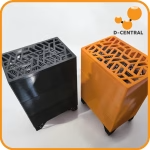
The StealthMiner is D-Central’s noise-optimized bitcoin space heater. It is built with a custom enclosure specifically designed to reduce acoustic output while maintaining effective heat distribution. D-Central assembles and tunes each unit for optimal balance between hash rate, noise level, and thermal performance. For anyone placing a miner in a living space, bedroom, or home office where noise is a primary concern, the StealthMiner is the premium choice. It proves that mining and domestic comfort are not mutually exclusive.
BitChimney — $540
The BitChimney takes a different approach to the heat management problem. Rather than enclosing the miner, it redirects hot exhaust air through a chimney-style duct system, allowing you to channel heat where you want it — into adjacent rooms, through walls, or into specific zones of your home. D-Central assembles and ships the BitChimney, and it pairs well with multiple ASIC models. At $540, it is the most affordable entry point into directed bitcoin heating, and its modular design gives you flexibility in how you integrate mining heat into your home’s thermal envelope.
| Model | Price | Best For | Heat Output | Key Feature |
|---|---|---|---|---|
| S9 Space Heater Edition | $755 | Dedicated heating rooms, workshops | ~4,776 BTU/hr | Proven S9 platform, firmware flexibility |
| StealthMiner | $849 | Living spaces, bedrooms, offices | Varies by configuration | Noise-optimized enclosure |
| BitChimney | $540 | Multi-room heating, duct integration | Varies by paired miner | Directed heat channeling |
Setup Guide: Getting Your Bitcoin Space Heater Running
Setting up a bitcoin space heater is more involved than plugging in a standard electric heater, but it is well within the capability of anyone comfortable with basic home networking and electrical awareness. Here is the process, step by step.
1. Location Selection
Choose the room carefully. The ideal location balances heating need with practical constraints:
- Room size: A 1,400W miner produces approximately 4,776 BTU/hr, which is suitable for a room of roughly 150 to 250 square feet depending on insulation, ceiling height, and climate. Placing a unit in a room that is too small will result in overheating; too large and the effect will be underwhelming.
- Ventilation: ASIC miners pull air through the front and exhaust hot air from the rear. Ensure there is adequate airflow. Do not place the unit in a sealed closet. The exhaust side needs at least 12 inches of clearance from any wall or obstruction.
- Flooring: Place the unit on a hard, stable surface. Avoid carpet directly under the miner, as it restricts airflow and collects dust. A small shelf or stand works well.
- Dust considerations: Miners pull air constantly. Pet hair, dust, and debris will accumulate on the intake side. Choose a location where you can clean the filters or intake regularly, and avoid placing it near litter boxes, workshops with sawdust, or other particulate-heavy environments.
2. Electrical Requirements
This is the most critical step. ASIC miners draw significant power, and improper electrical setup is the most common source of problems.
- Dedicated circuit: A 1,400W miner draws approximately 12 amps on a 120V circuit. This is close to the 80% continuous load rating of a standard 15A breaker. A dedicated 20A circuit is strongly recommended. Do not share the circuit with other high-draw appliances.
- Power supply: ASIC miners use specialized power supplies (typically APW-series or equivalent). The power supply is included or specified with each D-Central space heater model. Ensure the PSU is rated for your local voltage (120V in North America).
- Surge protection: Use a quality surge protector or UPS. ASIC chips are sensitive to power fluctuations. A sudden spike can damage hashboards.
- Electrical inspection: If you are unsure about your home’s wiring capacity, consult a licensed electrician before plugging in. This is especially important in older homes with aluminum wiring or undersized panels.
3. Network Setup
Your bitcoin space heater needs a constant internet connection to communicate with a mining pool (or the Bitcoin network if solo mining).
- Ethernet is preferred: A wired ethernet connection provides the most reliable, lowest-latency connection. Run a Cat5e or Cat6 cable from your router to the miner. Stale shares and rejected work cost you hash rate, and WiFi instability is the most common cause.
- WiFi adapter: If running ethernet is not feasible, some miners support USB WiFi adapters, and certain firmware (like Braiins OS+) has built-in WiFi support. A dedicated WiFi bridge or powerline ethernet adapter is another option. WiFi works but expect occasional connectivity hiccups.
- Static IP or DHCP reservation: Assign a static IP or create a DHCP reservation on your router for the miner. This makes it easier to access the miner’s web interface for monitoring and configuration.
4. Pool Configuration or Solo Mining
Once powered on and connected to your network, access the miner’s web interface (typically by navigating to its IP address in a browser) and configure your mining destination:
- Pool mining: Join a mining pool to receive regular, smaller payouts proportional to your contributed hash rate. Popular pools include Braiins Pool, Ocean, and others. You will need a pool URL, your Bitcoin wallet address, and a worker name. Pool mining provides consistent income.
- Solo mining: Point your miner directly at the Bitcoin network (via a solo mining pool like Solo CKPool or your own Bitcoin node). The probability of finding a block is low with a single S9-class device, but the reward is the full block subsidy — currently 3.125 BTC. Solo mining is the lottery ticket approach. Every hash counts.
5. Noise Management
ASIC miners are loud. A stock Antminer S9 can produce 75+ dB — roughly the volume of a vacuum cleaner running continuously. This is the single biggest challenge for home deployment.
- Custom firmware: Braiins OS+ and similar firmware allow you to underclock the miner, reducing both power consumption and noise. Dropping from 1,400W to 1,000W reduces noise significantly while still producing substantial heat.
- Enclosures: The StealthMiner exists specifically to address this. Purpose-built enclosures with sound-dampening materials and optimized airflow can reduce noise by 15 to 25 dB.
- Fan replacement: Replacing stock fans with quieter aftermarket alternatives (Noctua fans with 3D-printed adapters) is a common modification. D-Central offers accessories for this.
- Location isolation: Placing the miner in a basement, garage, utility room, or insulated closet (with proper ventilation) keeps noise away from living spaces while still capturing the heat.
BTU Calculations: The Physics of Mining Heat
Understanding the heating capacity of your bitcoin space heater requires one simple formula:
Watts x 3.412 = BTU/hr
This conversion is exact, rooted in the definition of a BTU (British Thermal Unit). One watt of continuous power equals 3.412 BTU per hour of heat output. There is no efficiency loss to account for because all electrical energy consumed by the miner becomes thermal energy — the laws of thermodynamics guarantee it.
| Power Consumption | BTU/hr Output | Approximate Room Coverage |
|---|---|---|
| 800W (underclocked S9) | 2,730 BTU/hr | 100–150 sq ft |
| 1,000W | 3,412 BTU/hr | 150–180 sq ft |
| 1,400W (stock S9) | 4,776 BTU/hr | 180–250 sq ft |
| 1,500W (typical electric heater) | 5,118 BTU/hr | 200–250 sq ft |
Notice that an S9 running at 1,400W produces nearly the same heat output as a standard 1,500W electric space heater. The difference is marginal — about 340 BTU/hr — and can be closed entirely by adjusting the firmware to run at a slightly higher power target. From a pure heating perspective, a bitcoin space heater is functionally equivalent to a conventional electric heater.
The key insight: you are not paying extra for heat. If you were going to run a 1,400W electric heater anyway, replacing it with a 1,400W bitcoin miner costs you nothing additional in electricity while adding mining revenue to the equation. The heat is identical. The electricity cost is identical. The only difference is that one device earns Bitcoin and the other does not.
ROI Analysis: Heating Economics, Not Speculation
This section discusses the technological and practical economics of bitcoin space heaters. It is not investment advice. Bitcoin mining revenue varies with network difficulty, Bitcoin price, and electricity costs. D-Central focuses on the technology — we do not make promises about financial returns.
The correct way to evaluate a bitcoin space heater is through heat offset value, not mining revenue projections. Here is the framework:
Step 1: Calculate Your Heating Cost Baseline
Determine what you currently spend to heat the space where you plan to deploy the miner. If you use electric baseboard heaters, the calculation is straightforward: a 1,500W baseboard running 12 hours per day at $0.07/kWh costs approximately $1.26/day or $38/month. Over a 7-month Canadian heating season, that is $266 for a single room.
Step 2: Recognize the Heat Offset
When you replace that electric heater with a bitcoin space heater of equivalent wattage, your heating cost does not change. You spend the same amount on electricity and receive the same heat. The entire mining revenue is pure bonus — income that did not exist when you were using a conventional heater. This is the foundational economic argument: the miner does not cost more to operate than what it replaces.
Step 3: Mining Revenue as Supplementary Value
Mining revenue from a single S9-class device at current difficulty levels is modest. Using the standard formula:
daily_btc = (hashrate_TH x 10^12 x 86,400 x block_reward) / (difficulty x 2^32)
An S9 hashing at approximately 13.5 TH/s with the current block reward of 3.125 BTC will earn a small amount of Bitcoin daily. The exact amount fluctuates with network difficulty adjustments. This revenue should be viewed as a technological bonus — your heater is earning Bitcoin that a traditional heater never could. Whether that Bitcoin appreciates or not over time is outside the scope of heating economics.
Step 4: Consider the Full Picture
- Hardware cost: D-Central’s space heater models range from $540 to $849. A comparable high-quality electric space heater costs $50 to $150. The premium is the mining capability.
- Maintenance: ASIC miners require periodic dust cleaning (monthly is recommended) and occasional fan maintenance. Budget 15 minutes per month.
- Lifespan: S9-class hardware has proven remarkably durable. Many units have been running continuously since 2017. With proper care, expect years of service.
- Summer consideration: During warm months, you likely do not want to run a 1,400W heat source indoors. Many operators shut down for summer, move miners to garages or basements, or reduce power via firmware. This seasonal pattern is normal and expected.
The Canadian Advantage
Canada is uniquely positioned for bitcoin space heating, and D-Central is proud to serve this market from our base in Quebec.
- Long heating season: Most of Canada requires active heating for 6 to 8 months of the year. In provinces like Quebec, Ontario, and the Maritimes, heating is not optional — it is survival. This extended season maximizes the value proposition of dual-purpose mining.
- Affordable hydroelectricity: Quebec offers some of the cheapest electricity in North America, with residential rates averaging around $0.07/kWh. At this rate, running a 1,400W miner 24/7 costs approximately $2.35/day. Compare this to rates of $0.15 to $0.30/kWh in many US states and the economic advantage becomes clear.
- Existing electric heating infrastructure: Many Canadian homes already use electric baseboard heaters. Replacing one baseboard with a bitcoin space heater requires no changes to your heating system — just swap the heat source. The electrical infrastructure is already in place.
- Cold climate = better cooling: During winter, the ambient air feeding your miner is cold, which improves thermal performance and can extend chip lifespan. Your miner runs cooler and more efficiently when the intake air is -10C versus +30C.
- Hash rate sovereignty: Every Canadian running a miner at home contributes to the geographic decentralization of Bitcoin’s hash rate. This is not just economics — it is supporting the security and resilience of the Bitcoin network from the Great White North.
Frequently Asked Questions
Is a bitcoin space heater as efficient as a regular electric heater?
Yes, exactly as efficient. Both devices convert 100% of consumed electricity into heat. A 1,400W ASIC miner produces the same BTU output as a 1,400W electric heater — approximately 4,776 BTU/hr. The laws of thermodynamics apply equally. The miner simply performs useful computation during the energy conversion, which a resistive heater does not. There is no efficiency penalty for mining while heating.
How loud are bitcoin space heaters? Can I use one in a bedroom?
A stock Antminer S9 produces approximately 75 dB, which is comparable to a running vacuum cleaner — too loud for most living spaces. However, there are effective solutions. Custom firmware like Braiins OS+ allows underclocking, which significantly reduces fan speed and noise. The StealthMiner is specifically engineered with a noise-dampening enclosure for residential use. Aftermarket fan replacements can also reduce noise substantially. With the right configuration or enclosure, bedroom use is achievable.
What happens in summer when I do not need heating?
Most operators either shut down their miners during warm months or relocate them to areas where the heat is less problematic — garages, basements, or well-ventilated utility rooms. Some operators reduce power consumption via firmware to lower heat output while maintaining some hash rate. The seasonal nature of bitcoin space heating is expected and factored into the value proposition. The primary economic benefit is realized during the heating season when the electricity would be spent on heating regardless.
Do I need any special internet connection or technical knowledge?
A standard home internet connection is sufficient. The miner itself uses minimal bandwidth — typically less than 1 Mbps. An ethernet connection is recommended for reliability, but WiFi works with the right adapter or firmware support. The setup process involves accessing a web interface through your browser, entering pool details and your Bitcoin wallet address, and adjusting power settings. D-Central provides documentation with every unit, and our support team is available if you need assistance with configuration.
Get Started with Bitcoin Space Heating
D-Central Technologies has been building bitcoin space heaters since the concept was in its infancy. Every unit we ship is assembled, tested, and tuned in Canada. Whether you are a Bitcoin maximalist who wants to decentralize hash rate from your living room, a pragmatic homeowner looking to make your heating bill work harder, or a tinkerer who loves the idea of a heater that earns satoshis — we have a model for you.
- Browse all Bitcoin Space Heaters — see every model, configuration, and price
- Space Heater BTU Calculator — calculate exact heating capacity for your room
- Mining Profitability Calculator — estimate mining output based on your hardware and electricity rate
- Visit the Shop — explore D-Central’s full catalog of mining hardware and accessories
Every watt you spend on heating can mine Bitcoin. The physics is on your side. The technology is proven. The only question is whether your heater is going to work for you — or just sit there glowing red.