If you mine Bitcoin, you need to secure what you mine. That statement should be as obvious as breathing, but an alarming number of home miners leave their hard-earned sats sitting on exchanges, in hot wallets, or — worst of all — on the pool’s custodial balance. Every hash you compute is an act of sovereignty. The moment those sats land in a wallet whose keys you don’t control, you’ve surrendered that sovereignty to a third party.
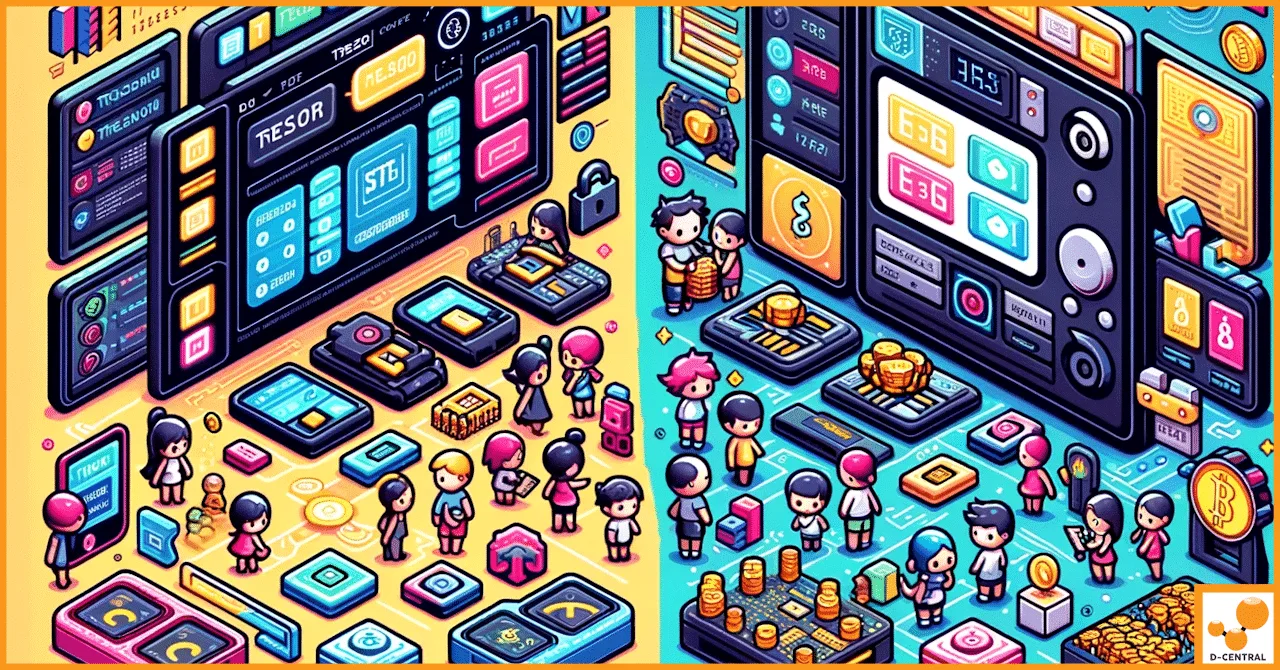
Hardware wallets exist to solve this problem. They keep your private keys offline, isolated from internet-connected attack surfaces, and require physical confirmation before signing any transaction. Among the most trusted names in the space is Trezor, built by SatoshiLabs — the company that shipped the world’s first commercially available hardware wallet back in 2014. Today, their two primary devices — the Trezor Model One and the Trezor Model T — remain solid options for Bitcoiners who want battle-tested, open-source self-custody.
At D-Central Technologies, we’ve been in the Bitcoin mining trenches since 2016. As Canada’s premier Bitcoin mining operation — from ASIC repair to custom hardware builds to mining hosting — we understand that mining is only half the equation. The other half is securing what you mine. This guide breaks down both Trezor models through the lens of a Bitcoin miner: what matters, what doesn’t, and which device fits your setup.
Why Self-Custody Matters for Bitcoin Miners
In 2026, the Bitcoin network hashrate exceeds 800 EH/s, difficulty has pushed past 110 trillion, and the block reward sits at 3.125 BTC following the April 2024 halving. Whether you’re running a full-scale Antminer S21 operation or a solo-mining Bitaxe on your desk, every satoshi you earn represents real proof-of-work — your electricity, your hardware, your contribution to the network’s security.
Leaving those sats on an exchange or in a software wallet connected to the internet introduces counterparty risk. We’ve seen this play out repeatedly:
- Exchange collapses — Mt. Gox, QuadrigaCX, FTX. “Not your keys, not your coins” isn’t a slogan. It’s a hard lesson learned by millions.
- Hot wallet compromises — Malware, phishing, clipboard hijacking. If your private key touches an internet-connected device, it’s a target.
- Custodial pool balances — Many miners leave sats on pool dashboards for convenience. If the pool gets hacked or shuts down, those sats are gone.
A hardware wallet eliminates these attack vectors. Your private keys are generated on the device, stored on the device, and never leave the device. Transactions are signed within the secure element or microcontroller, then broadcast to the network. The computer or phone you plug the hardware wallet into never sees your keys — it only sees the signed transaction.
For miners specifically, establishing a solid self-custody workflow means configuring your mining pool payouts to go directly to an address controlled by your hardware wallet. No intermediaries. No custodians. Pure peer-to-peer value transfer from the Bitcoin network to your sovereign cold storage.
Trezor Model One: The Pioneer
The Trezor Model One holds a unique place in Bitcoin history. Released in 2014, it was the first commercially produced hardware wallet — period. Before Trezor, Bitcoiners secured their keys with paper wallets, encrypted USB drives, and brain wallets (please don’t). The Model One introduced a standardized, purpose-built device for key management, and its fundamental architecture has proven remarkably resilient over a decade of real-world use.
Hardware and Design
The Model One is deliberately minimalist. It features a small monochrome OLED display (128×64 pixels), two physical buttons, and a micro-USB port for connection. The casing is impact-resistant ABS plastic, compact enough to fit on a keychain. There are no batteries — the device is powered entirely through USB when connected.
This simplicity is a feature, not a limitation. Fewer components mean a smaller attack surface. The Model One runs on an ARM Cortex-M3 processor with a straightforward firmware that handles key generation, transaction signing, and PIN verification. The entire firmware is open-source, meaning anyone can audit the code — a critical property for a device entrusted with your Bitcoin.
Security Architecture
- PIN protection — A customizable PIN (up to 50 digits) is required to access the device. The PIN entry uses a randomized keypad displayed on the Trezor screen, so even if your computer is compromised, an attacker can’t observe which numbers you’re pressing.
- 24-word recovery seed — Standard BIP-39 mnemonic generated offline on the device. This seed is your ultimate backup — it can restore your entire wallet on any BIP-39-compatible device if your Trezor is lost or destroyed.
- Passphrase support — An optional 25th word (passphrase) that creates an entirely separate wallet. This provides plausible deniability and protection against physical theft — even if someone obtains your 24-word seed, they can’t access the passphrase-protected wallet without the additional word.
- On-device verification — Every transaction displays the recipient address and amount on the Trezor’s screen. You physically confirm by pressing a button on the device. This prevents man-in-the-middle attacks where malware on your computer substitutes a different address.
Bitcoin-Specific Capabilities
For Bitcoin-focused users, the Model One handles everything you need: native SegWit (bech32) addresses, legacy addresses, full transaction signing, message signing, and multi-account management. It works with Trezor Suite (SatoshiLabs’ official software), as well as third-party Bitcoin wallets like Sparrow, Electrum, and Wasabi — all of which offer advanced features like coin control, UTXO management, and CoinJoin integration.
Strengths and Limitations
| Strengths | Limitations |
|---|---|
| Proven 10+ year track record | Small monochrome display |
| Fully open-source firmware | Micro-USB (not USB-C) |
| Compact, durable design | No Shamir Backup support |
| Lower price point (~$69 USD) | Buttons-only navigation |
| Works with all major Bitcoin wallets | No SD card slot for backups |
Trezor Model T: The Advanced Option
Released in 2018, the Trezor Model T represents SatoshiLabs’ answer to users who wanted more from their hardware wallet without compromising on the open-source, security-first philosophy. The Model T isn’t a replacement for the Model One — it’s an upgrade path for users who want additional security features, a better interface, and more connectivity options.
Hardware and Design
The most immediately obvious difference is the full-color touchscreen (240×240 pixels LCD). This replaces the Model One’s buttons-and-OLED setup with a more intuitive interface for PIN entry, passphrase input, and transaction verification. All sensitive input happens directly on the touchscreen — your computer’s keyboard is never used for security-critical operations.
Under the hood, the Model T runs an ARM Cortex-M4 processor, a meaningful step up from the Model One’s M3. It connects via USB-C (a welcome modernization) and includes a microSD card slot that can be used for encrypted backups and advanced features. The casing is reinforced ABS+PC plastic with a slightly larger footprint to accommodate the screen.
Security Architecture
The Model T inherits all of the Model One’s security features — PIN protection, 24-word seed, passphrase support, on-device verification — and adds several significant upgrades:
- Shamir Backup (SLIP-39) — This is the Model T’s headline security feature. Instead of a single 24-word seed that represents a single point of failure, Shamir Backup lets you split your recovery seed into multiple shares (e.g., 5 shares where any 3 are needed to recover). You can distribute these shares across different physical locations — a bank safe deposit box, a family member, a separate property — so that no single compromised location can expose your keys.
- On-device passphrase entry — The Model One requires you to type your passphrase on your computer’s keyboard (which could be keylogged). The Model T lets you enter your passphrase directly on the touchscreen, keeping it entirely within the secure device.
- FIDO2/WebAuthn support — The Model T can serve as a hardware security key for two-factor authentication on web services, adding another layer to your overall security posture.
Bitcoin-Specific Capabilities
Everything the Model One does for Bitcoin, the Model T does as well — native SegWit, full transaction signing, compatibility with Sparrow, Electrum, Wasabi, and Trezor Suite. The touchscreen makes the experience smoother, particularly when verifying long bech32 addresses character by character. The faster processor also handles complex transactions (like those with many inputs from mining pool payouts) more efficiently.
Strengths and Limitations
| Strengths | Limitations |
|---|---|
| Full-color touchscreen for all input | Higher price (~$219 USD) |
| Shamir Backup (distributed recovery) | Larger form factor |
| On-device passphrase entry | Touchscreen adds complexity |
| USB-C connectivity | More surface area for potential firmware bugs |
| FIDO2 hardware security key | Overkill for simple cold storage |
| MicroSD card slot | Same open-source firmware (no secure element) |
Head-to-Head Comparison: Model One vs. Model T
Let’s cut through the noise and compare these devices on the specifications that actually matter for Bitcoiners.
| Feature | Trezor Model One | Trezor Model T |
|---|---|---|
| Price | ~$69 USD | ~$219 USD |
| Display | 128×64 OLED monochrome | 240×240 LCD full-color touchscreen |
| Input | 2 physical buttons | Touchscreen |
| Processor | ARM Cortex-M3 | ARM Cortex-M4 |
| Connection | Micro-USB | USB-C |
| Recovery | BIP-39 (24 words) | BIP-39 + Shamir Backup (SLIP-39) |
| Passphrase Entry | On computer keyboard | On-device touchscreen |
| SD Card Slot | No | Yes (microSD) |
| FIDO2 Support | No | Yes |
| Open-Source | Yes (fully) | Yes (fully) |
| Bitcoin Support | Full (SegWit, legacy, multisig) | Full (SegWit, legacy, multisig) |
| Third-Party Wallets | Sparrow, Electrum, Wasabi | Sparrow, Electrum, Wasabi |
Which Trezor Is Right for You? A Miner’s Decision Framework
Both devices are solid choices. The question isn’t which one is “better” — it’s which one matches your threat model and operational needs.
Choose the Model One If:
- You want proven, no-frills cold storage. The Model One has been securing Bitcoin for over a decade. It does one thing and does it well.
- Budget matters. At roughly $69, the Model One is the most cost-effective entry into proper hardware wallet security. If you’re a home miner running a single Bitaxe and accumulating sats gradually, the Model One gets the job done.
- You value simplicity. Two buttons, a small screen, and a USB cable. No touchscreen calibration, no extra slots, no complexity. Plug in, verify, sign, done.
- You already have a security setup. If you’re using Sparrow Wallet with coin control and CoinJoin, the Model One integrates seamlessly without requiring the Model T’s extras.
Choose the Model T If:
- Shamir Backup is important to you. If you hold significant Bitcoin and want geographically distributed recovery shares instead of a single seed phrase stored in one location, the Model T’s SLIP-39 support is the deciding factor.
- You want on-device passphrase entry. For serious operational security (OpSec), entering your passphrase on the Trezor’s touchscreen rather than your computer’s keyboard eliminates an entire attack vector.
- You’re building a professional mining operation. If you’re running multiple ASICs, managing larger balances from hosted mining payouts, or operating a mining business, the Model T’s advanced features match the higher-stakes use case.
- USB-C matters. If you’ve already moved your entire setup to USB-C and don’t want to carry a micro-USB cable for a single device, the Model T modernizes the connection.
Setting Up Your Trezor for Mining Payouts
Regardless of which model you choose, here’s how to integrate your Trezor into your mining workflow:
Step 1: Initialize and Secure the Device
- Download Trezor Suite from the official trezor.io website. Verify the download hash.
- Connect your Trezor and follow the on-screen setup. The device will generate your 24-word recovery seed.
- Write down your seed on physical media — metal plates are ideal, as they resist fire and water. Never photograph it, type it into a computer, or store it digitally.
- Set a strong PIN (at least 6 digits, ideally more).
- Consider setting up a passphrase for an additional hidden wallet.
Step 2: Generate a Receive Address
- In Trezor Suite (or your preferred wallet software like Sparrow), navigate to your Bitcoin account.
- Generate a new receive address. Verify the address on your Trezor’s display — this is critical. If your computer is compromised, the displayed address on screen could be different from what your Trezor shows.
- Copy the verified address.
Step 3: Configure Pool Payouts
- Log into your mining pool dashboard.
- Set the payout address to your Trezor-controlled Bitcoin address.
- Set a reasonable payout threshold. For solo miners using a Bitaxe, you might set a lower threshold to see sats flow more frequently. For larger operations, a higher threshold reduces transaction fees.
- Enable any available security features on the pool side (2FA for address changes, email confirmations).
Step 4: Ongoing Security Practices
- Rotate receive addresses — Use a new address for each payout to improve privacy. Both Trezor models support HD wallets (BIP-44/84) with practically unlimited addresses from a single seed.
- Verify firmware updates — Only update Trezor firmware through the official Trezor Suite application. Verify the changelog before updating.
- Test your backup — Periodically verify that your seed backup is intact and legible. You don’t need to restore it — just confirm the physical media hasn’t degraded.
- Consider multisig — For larger holdings, a multisig setup using multiple hardware wallets (e.g., 2-of-3) provides even stronger security than a single device. Sparrow Wallet makes multisig relatively straightforward.
Open-Source Matters: Why Trezor Aligns with Bitcoin’s Ethos
Both Trezor models run fully open-source firmware. This is a non-trivial distinction in the hardware wallet market, where some competitors use proprietary secure elements with closed-source code that users cannot independently audit.
Open-source means:
- Transparency — Anyone can review the code for vulnerabilities, backdoors, or design flaws.
- Community auditing — Security researchers worldwide contribute to finding and fixing bugs.
- Trust minimization — You don’t have to trust SatoshiLabs’ word that the device is secure. You can verify it yourself.
This philosophy aligns directly with Bitcoin’s own ethos: don’t trust, verify. At D-Central, we operate with the same principle. Our work in the open-source mining space — from being a pioneer manufacturer of the Bitaxe to supporting the broader open-source mining ecosystem — reflects the same commitment to transparency and verifiability. The tools that secure Bitcoin’s network and the tools that secure your personal Bitcoin holdings should both be auditable by the people who depend on them.
Beyond the Wallet: Complete Mining Security
A hardware wallet is one piece of a broader security strategy for Bitcoin miners. Here are additional considerations:
- Network security — Your miners are network devices. Ensure your mining hardware is on a segmented network or VLAN, with firmware kept up to date. A compromised miner could be redirected to mine for an attacker’s pool.
- Physical security — Both your mining hardware and your hardware wallet need physical protection. For home miners using Bitcoin space heaters, the miner is inherently visible in your living space. Keep your Trezor in a separate, secure location.
- Operational security — Don’t publicly disclose your hashrate, your payout addresses, or the amount of Bitcoin you hold. In the Bitcoin community, this is known as not painting a target on your back.
- Redundancy — Consider having two hardware wallets: one active and one as a backup initialized with the same seed. If your primary device fails, you can immediately access your funds without the stress of a full seed recovery.
- Regular maintenance — Just as your ASICs need periodic maintenance and repair, your security practices need regular review. Update firmware, check your seed backups, and review your pool’s payout configuration quarterly.
Frequently Asked Questions
Can I use a Trezor to receive mining pool payouts directly?
Yes. Generate a Bitcoin receive address from your Trezor using Trezor Suite or a compatible wallet like Sparrow, then set that address as your payout destination in your mining pool’s dashboard. The Trezor doesn’t need to be connected to receive payments — it only needs to be connected when you want to spend or move your Bitcoin. Your sats are secured by the private key stored on the device regardless of whether it’s plugged in.
Is the Trezor Model One still worth buying in 2026?
Absolutely. The Model One’s core security architecture remains sound after more than a decade. For Bitcoin-only cold storage, it does everything you need: secure key generation, transaction signing, seed backup, and passphrase protection. The Model T’s advantages — Shamir Backup, touchscreen, USB-C — are genuine improvements, but they’re upgrades to convenience and advanced recovery options, not to fundamental security. If your budget is limited or you prefer simplicity, the Model One remains an excellent choice.
What is the difference between BIP-39 and Shamir Backup (SLIP-39)?
BIP-39 generates a single 24-word recovery phrase that fully restores your wallet. It is a single point of failure — anyone with those 24 words controls your Bitcoin. Shamir Backup (SLIP-39), available only on the Model T, splits your recovery into multiple shares with a configurable threshold. For example, you can create 5 shares and require any 3 to restore. This means you can distribute shares across multiple secure locations, and the compromise of 1 or 2 shares alone is insufficient to access your funds.
Should I use Trezor Suite or a third-party wallet like Sparrow?
Both work well. Trezor Suite is the official software from SatoshiLabs and provides a polished, beginner-friendly experience with portfolio tracking and in-app exchange features. Sparrow Wallet is a Bitcoin-focused desktop wallet preferred by users who want advanced features like coin control, UTXO labeling, fee estimation, CoinJoin, and multisig coordination. Many experienced Bitcoiners use Sparrow with their Trezor for the added control over transaction construction and privacy. For miners who want to carefully manage UTXOs from pool payouts, Sparrow’s granular controls are particularly valuable.
How does a hardware wallet protect against the $5 wrench attack?
The $5 wrench attack — physical coercion to hand over your keys — is the one threat model that no hardware wallet fully solves on its own. However, both Trezor models offer passphrase protection, which creates a hidden wallet. Under duress, you can reveal the PIN-protected wallet (which you would keep a small decoy amount in) while the passphrase-protected wallet containing your main holdings remains invisible. The Model T’s Shamir Backup adds another layer: even if an attacker obtains one or two shares of your recovery seed, they cannot reconstruct the full key without meeting the threshold.
Can I use a Trezor for multisig setups?
Yes. Both the Model One and Model T support multisig transactions. Using a wallet like Sparrow, you can set up a multi-signature vault (e.g., 2-of-3) where transactions require signatures from multiple hardware wallets. This is one of the strongest security configurations available — even if one device is compromised or lost, your funds remain secure. For miners holding significant amounts of Bitcoin, multisig provides an additional layer of protection beyond what any single hardware wallet offers.
What happens if my Trezor breaks or is lost?
Your Bitcoin is not stored on the Trezor itself — it is on the Bitcoin blockchain. The Trezor stores only the private keys needed to access and move that Bitcoin. If your device is lost, stolen, or damaged, you can purchase a new Trezor (or any BIP-39-compatible hardware wallet) and restore your wallet using your 24-word recovery seed. This is why securely storing your seed phrase — ideally on a metal backup plate in a fireproof location — is arguably more important than the hardware wallet itself.
Final Thoughts: Secure What You Mine
Mining Bitcoin is an act of conviction. You are contributing hashrate to the most decentralized monetary network in human history, converting electricity into sound money, and strengthening the protocol’s security with every hash. Whether you are running a Bitaxe on your desk for the love of solo mining or operating a rack of S21s at a hosting facility, the Bitcoin you earn deserves proper custody.
The Trezor Model One and Model T both deliver on the fundamental promise of self-custody: your keys, your coins. The Model One does it with elegant simplicity and a proven track record. The Model T does it with advanced features that serve more complex security requirements. Neither is a wrong choice — they are different tools for different threat models.
At D-Central Technologies, we have been building, repairing, and deploying Bitcoin mining hardware across Canada since 2016. We are Bitcoin Mining Hackers — we take institutional-grade technology and make it accessible for home miners, plebs, and sovereignty-maximizing Bitcoiners. That same philosophy applies to security: you do not need a corporate security team to protect your Bitcoin. You need a hardware wallet, a properly stored seed phrase, and the discipline to use them.
If you are setting up your first mining operation and need guidance on everything from hardware selection to payout configuration, our consulting team is here to help. And if you want to learn the ins and outs of mining from the ground up, check out our mining training resources.
Every hash counts. Every sat deserves sovereignty.