The Galactic Empire did not rule through brute force alone. Its true weapon was information architecture — Imperial Chain-Codes, a biometric-digital identity system that tracked every citizen from Coruscant to the Outer Rim. Every transaction logged. Every movement cataloged. Every being reduced to a string of characters in a centralized database controlled by a single authority.
If that sounds familiar, it should. Strip away the Star Destroyers and replace them with server farms, and you are looking at the modern financial surveillance apparatus. Central banks, payment processors, and government agencies maintain their own chain-codes — your Social Insurance Number, your bank account, your credit score, your transaction history. Every dollar you spend passes through intermediaries who can freeze your funds, reverse your transactions, or simply deny you access at will.
Bitcoin was built to break that chain. Not with blasters, but with mathematics. Not by hiding from the system, but by replacing it entirely with one that requires no permission, no identity verification, and no trust in any central authority. This is not a metaphor. This is the most consequential monetary technology shift in human history, and D-Central Technologies exists to put this power directly into your hands — or more precisely, into your home.
Imperial Chain-Codes: Fiction That Became Fact
In the Star Wars universe, Imperial Chain-Codes served a straightforward purpose: total population surveillance under the guise of security and order. Every citizen’s biometric data, travel history, and financial activity funneled into Imperial databases. Step out of line, and the Empire could freeze your identity, seize your assets, or simply make you disappear from the system entirely. No trial. No appeal. Just a keystroke.
Now consider the world you live in today. In 2026, the global push toward Central Bank Digital Currencies (CBDCs) represents the most sophisticated chain-code system ever conceived. Unlike cash, which is bearer-based and anonymous, CBDCs give central banks programmable control over money itself. They can set expiration dates on your savings, restrict what you can purchase, apply negative interest rates in real time, and revoke your financial access entirely. The Bank of International Settlements has openly described these capabilities as features, not bugs.
The Canadian trucker convoy of 2022 gave the world a preview of what financial chain-codes look like in practice. Bank accounts frozen without judicial proceedings. Crowdfunding platforms pressured to return donations. Payment processors cutting off access to individuals based on political association. The message was unmistakable: your money is not yours if someone else controls the ledger.
This is not a Star Wars plotline. This is the financial reality that billions of people live under today. And it is precisely why Bitcoin matters more than any science fiction narrative could capture.
Bitcoin: The Protocol of Rebellion
On January 3, 2009, Satoshi Nakamoto mined the Bitcoin genesis block, embedding a message in its coinbase transaction: “The Times 03/Jan/2009 Chancellor on brink of second bailout for banks.” That timestamp was not decorative. It was a declaration of war against the centralized financial order.
Bitcoin’s architecture is the antithesis of every surveillance system the Empire — or any government — has ever built. There is no central server to seize. No CEO to subpoena. No board of directors to pressure. The network runs on roughly 60,000 reachable nodes spread across the globe, each independently verifying every transaction against the same consensus rules. No single entity controls more than a fraction of the network’s hashpower, which now exceeds 800 EH/s globally.
The blockchain itself is a radical departure from centralized ledgers. Every transaction is cryptographically linked to the one before it, creating an immutable chain of proof that no authority can alter retroactively. When you hold Bitcoin in a self-custody wallet, you hold bearer assets secured by 256-bit elliptic curve cryptography. No government, no bank, no empire can confiscate what they cannot access. Your keys, your coins — a concept so simple and so powerful that it terrifies every centralized authority on the planet.
With the current block reward at 3.125 BTC and mining difficulty exceeding 110 trillion, the network has never been more secure. Every ten minutes, a new block is added. Every ten minutes, the chain grows longer. Every ten minutes, the Empire’s grip on money weakens just a little more.
Proof of Work: The Shield Against Tyranny
Here is what most people miss about Bitcoin mining: it is not just transaction processing. It is the mechanism that makes Bitcoin uncensorable. Proof of Work requires real energy expenditure to produce valid blocks. This physical cost is what prevents any actor — state or corporate — from rewriting the ledger. To attack Bitcoin’s blockchain, you would need to outspend the entire network’s cumulative energy output. At 800+ EH/s, that is a thermodynamic impossibility for any single entity.
This is why mining decentralization matters so profoundly. When mining is concentrated in a few industrial facilities controlled by a handful of corporations, the network becomes vulnerable to the same centralized pressure that Bitcoin was designed to resist. Governments can regulate those facilities, seize those machines, and coerce those operators. But when mining is distributed across thousands of homes, garages, basements, and workshops around the world? That is a network no empire can shut down.
This is the mission that drives D-Central Technologies. Not mining as a financial instrument. Mining as a tool of sovereignty. Every home miner running a machine in their basement is a node of resistance in a decentralized network that no central authority can control. Every hash generated from a bedroom in Montreal or a garage in Calgary is a vote cast for financial freedom.
D-Central Technologies: Building the Rebel Infrastructure
D-Central Technologies has been in this fight since 2016 — long before Bitcoin home mining was trendy, long before “pleb mining” entered the vocabulary, and long before most companies recognized that decentralization requires infrastructure, not just ideology.
Founded in Canada, D-Central operates as what we call “Bitcoin Mining Hackers.” We take institutional-grade mining technology — machines designed for massive industrial deployments — and hack them into solutions that work for the individual. The home miner. The sovereignty seeker. The person who understands that running your own mining hardware is not just about earning sats; it is about participating directly in the security of the most important monetary network ever created.
Open-Source Mining: The Bitaxe Revolution
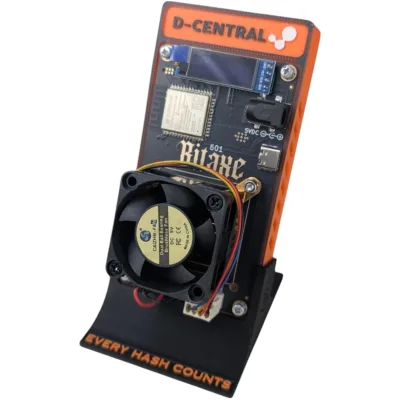
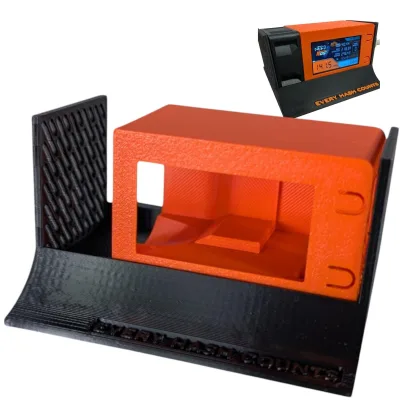
D-Central is a pioneer in the Bitaxe ecosystem, involved since its earliest days. We created the original Bitaxe Mesh Stand — the first company to manufacture it — and have developed leading solutions including custom heatsinks for Bitaxe and Bitaxe Hex, specialized cases, and a full range of accessories. We stock every Bitaxe variant: Supra, Ultra, Hex, Gamma, and GT.
The Bitaxe represents something profound in the mining world. It is fully open-source hardware — schematics, firmware, and PCB designs all publicly available. Anyone can manufacture one. But D-Central competes on pioneering history, ecosystem breadth, quality control, and genuine expertise born from years at the bleeding edge. When you buy a Bitaxe from D-Central, you are not just getting a device. You are getting the backing of a team that has been building, testing, and refining open-source mining solutions since the beginning.
Solo mining with a Bitaxe is the purest expression of the Bitcoin rebellion. You are pointing your hashrate directly at the network, rolling the dice for a full 3.125 BTC block reward with no pool, no intermediary, and no permission required. Every hash counts.
Bitcoin Space Heaters: Mining That Heats Your Home
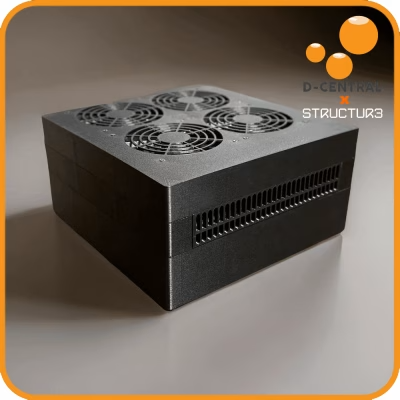
One of D-Central’s most revolutionary innovations is the Bitcoin Space Heater line. The concept is elegantly simple: ASIC miners convert electricity into heat as a byproduct of mining. Instead of venting that heat into the atmosphere like an industrial facility, we channel it directly into your living space. Your mining rig becomes your space heater. Your electricity bill pays for heating AND earns you Bitcoin simultaneously.
For Canadians especially, this is transformative. We heat our homes for six to eight months of the year. Bitcoin space heaters turn that unavoidable energy expenditure into productive hashrate that secures the network and generates sats. You are not wasting energy — you are monetizing it. The thermodynamic efficiency approaches 100% because every joule of electricity that enters the miner exits as useful heat, with Bitcoin accumulation as a bonus.
ASIC Repair: Keeping the Rebellion Running
Miners break. Hashboards fail. Control boards malfunction. Fans seize. And when your mining hardware goes down, you need someone who can diagnose the problem at the component level and get you back online fast. D-Central’s ASIC Repair service is the most comprehensive in North America, covering 38+ specific models across Bitmain, MicroBT, Innosilicon, Canaan, and more.
This is not generic electronics repair. Our technicians work with ASIC-specific diagnostics, replacement chips, and custom firmware daily. We repair hashboards down to the individual BM1397 or BM1366 chip level. We reflash firmware, replace thermal compounds, rebuild power delivery sections, and test every unit under full load before it ships back. Retail-focused and individual-miner friendly — because keeping home miners online is how you keep the network decentralized.
Why Home Mining Is an Act of Resistance
The centralization of Bitcoin mining into mega-facilities is the single greatest threat to Bitcoin’s censorship resistance. When a handful of publicly traded companies control a significant percentage of global hashrate, they become targets for regulation, coercion, and ultimately control. A government does not need to attack Bitcoin’s protocol — it just needs to knock on the door of the five largest mining operators and hand them compliance requirements.
Home mining breaks this attack vector. A hundred thousand individual miners scattered across residential addresses in every province, state, and country on Earth cannot be systematically targeted, regulated, or shut down. Each home miner is a independent node of hashrate that contributes to network security while remaining below the threshold of institutional attention.
This is not theoretical. The 2021 China mining ban demonstrated exactly what happens when mining is concentrated: a single government decree wiped out over 50% of global hashrate overnight. The machines moved, the hashrate recovered, but the lesson was clear. Geographic and operational distribution is not a nice-to-have — it is an existential requirement for Bitcoin’s long-term censorship resistance.
When you set up a miner in your home, you are not just running a machine. You are casting a vote for the kind of financial system you want to live under. One where no emperor, no chancellor, and no central bank can freeze your assets, inflate away your savings, or deny you access to your own money.
Canada: The Ideal Rebel Base
Canada occupies a unique position in the global mining landscape. Cold climate reduces cooling costs dramatically — for six or more months of the year, Canadian miners can use ambient air for cooling, slashing electricity consumption on fans and environmental controls. Abundant hydroelectric power in Quebec and British Columbia provides some of the cheapest and cleanest electricity on the continent. And the dual-purpose mining-heating model is practically designed for the Canadian winter.
D-Central operates mining hosting facilities in Quebec, but our greater mission is to empower Canadians to mine at home. The infrastructure is here. The climate is ideal. The energy is clean. And the need for financial sovereignty is as urgent in Canada as anywhere on Earth — perhaps more so, given the precedent set by government financial interventions in recent years.
From Imperial Chain-Codes to Individual Sovereignty
The Star Wars analogy is fun, but the reality is more urgent than any fiction. We are living through the construction of the most comprehensive financial surveillance infrastructure in human history. CBDCs, digital identity systems, social credit frameworks, and programmable money are not science fiction — they are active policy initiatives in dozens of countries worldwide.
Bitcoin is the exit. Not an investment vehicle, not a speculative asset, not “digital gold” in some portfolio allocation strategy. Bitcoin is a complete monetary system that operates outside the jurisdiction of any government, corporation, or international body. And mining is the mechanism that makes this system unkillable.
D-Central Technologies exists to put mining hardware in the hands of individuals. To repair the machines that keep the network running. To educate home miners on how to optimize their setups. To build the tools and accessories that make home mining practical, efficient, and accessible. We have been doing this since 2016, and we will keep doing it as long as the fight for decentralization continues.
The Empire always has a chain-code. The rebellion always has Bitcoin. And every hash you generate from your home is proof that the rebellion is winning.
Frequently Asked Questions
What are Imperial Chain-Codes and how do they relate to modern financial surveillance?
Imperial Chain-Codes are a Star Wars concept — biometric-digital identity systems used by the Galactic Empire to track and control citizens. In our world, the parallels are Central Bank Digital Currencies (CBDCs), digital identity frameworks, and transaction monitoring systems that give governments and financial institutions the ability to surveil, freeze, or restrict individual financial activity without due process.
How does Bitcoin mining protect against centralized financial control?
Bitcoin mining secures the network through Proof of Work, which requires real energy expenditure to produce valid blocks. This makes the blockchain practically impossible to alter or censor. When mining is distributed across thousands of home miners worldwide rather than concentrated in a few industrial facilities, no single government or corporation can exert control over the network. With global hashrate exceeding 800 EH/s and difficulty above 110 trillion, Bitcoin’s security has never been stronger.
What is a Bitaxe and why does it matter for decentralization?
A Bitaxe is an open-source solo Bitcoin miner that allows individuals to mine directly on the Bitcoin network without relying on a mining pool. D-Central Technologies is a pioneer in the Bitaxe ecosystem, having created the original Bitaxe Mesh Stand and developing leading accessories. Solo mining with a Bitaxe means you are pointing your hashrate at the network independently — every hash is a direct contribution to decentralization, with the chance of earning a full 3.125 BTC block reward.
How do Bitcoin Space Heaters work?
Bitcoin Space Heaters repurpose the thermal output of ASIC mining hardware as home heating. Since miners convert virtually 100% of electrical input into heat, a Bitcoin Space Heater functions as both a mining rig and a heater simultaneously. Instead of paying for heating alone, you are mining Bitcoin with that same energy. For Canadians heating their homes six to eight months per year, this dual-purpose approach turns an unavoidable expense into productive hashrate.
Why should I mine Bitcoin at home instead of just buying it on an exchange?
Buying Bitcoin on an exchange requires identity verification (KYC), creates a permanent link between your identity and your holdings, and leaves you dependent on a third party for access. Home mining produces non-KYC Bitcoin directly — coins that have no transaction history linking them to your identity. More importantly, every home miner adds hashrate to the network in a geographically distributed manner, strengthening Bitcoin’s censorship resistance against the kind of centralized attacks that threaten the entire system.
What ASIC repair services does D-Central offer?
D-Central Technologies provides the most comprehensive ASIC repair service in North America, covering 38+ specific miner models from Bitmain, MicroBT, Innosilicon, Canaan, and more. Services include hashboard-level component repair, chip replacement, firmware reflashing, thermal compound replacement, power delivery rebuilds, and full-load testing. The service is retail-focused, designed to support individual home miners rather than just institutional operations.