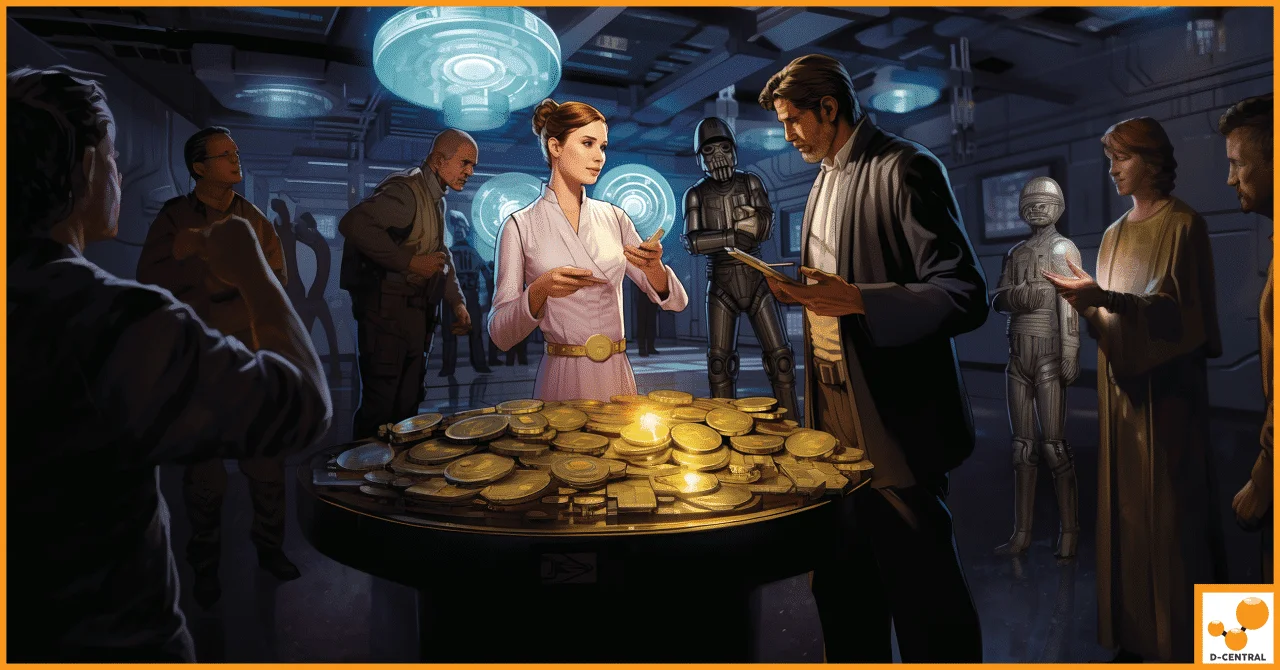
In a galaxy far, far away, a small group of rebels dared to challenge the most powerful empire ever assembled. They had no central command worth a damn, operated from hidden bases, and relied on decentralized cells of resistance fighters who often did not even know each other existed. Sound familiar?
If you have spent any time in the Bitcoin trenches, you already recognize this story. It is not just the plot of Star Wars Episode IV. It is the origin story of the cypherpunk movement, the white paper that started it all, and the ongoing war for financial sovereignty that every home miner fights every single day.
Welcome to Episode IV of our Star Wars Bitcoin series. Grab your hardware wallet and your lightsaber. We are going deep.
The White Paper and the Stolen Plans: How Revolutions Begin
Every rebellion starts with an idea dangerous enough to threaten the establishment.
In A New Hope, Princess Leia smuggles the Death Star plans inside R2-D2 — a tiny droid carrying information powerful enough to destroy the Empire’s ultimate weapon. The plans were not a weapon themselves. They were knowledge, freely shared with those willing to act on it.
On October 31, 2008, a pseudonymous figure named Satoshi Nakamoto published a nine-page document to a cryptography mailing list: “Bitcoin: A Peer-to-Peer Electronic Cash System.” No venture capital. No corporate backing. No permission from any government. Just a white paper — open-source blueprints for a monetary Death Star that could dismantle the centralized financial empire.
The parallels are unmistakable:
| Star Wars | Bitcoin |
|---|---|
| Death Star plans hidden in R2-D2 | Bitcoin white paper published to cypherpunk mailing list |
| Transmitted freely to the Rebel Alliance | Open-source code released to anyone willing to run it |
| The Empire cannot un-share the plans | No government can un-publish the Bitcoin protocol |
| Leia’s identity hidden to protect the mission | Satoshi’s identity remains unknown to protect the network |
| Small thermal exhaust port = single point of failure | Bitcoin has no single point of failure — that is the entire point |
The Death Star’s fatal flaw was centralization: one critical vulnerability, one well-placed shot, total destruction. Bitcoin was engineered from day one to have no thermal exhaust port. No CEO to subpoena. No server to seize. No kill switch. The network currently runs at over 800 EH/s of combined hashpower, distributed across the planet. Try blowing that up with a single proton torpedo.
The Jedi Code and the Cypherpunk Manifesto: Philosophies of Resistance
The Jedi Order was not just a fighting force. It was a philosophical movement built on principles that directly opposed the Sith’s hunger for centralized power. The Jedi Code demanded selflessness, discipline, and a commitment to balance — serving the Force rather than bending it to personal will.
The cypherpunk movement operates on strikingly similar principles. Before Bitcoin existed, cryptographers like Eric Hughes, Timothy C. May, and David Chaum were building the philosophical and technical foundations for digital sovereignty. Hughes wrote in the 1993 Cypherpunk Manifesto:
“Privacy is necessary for an open society in the electronic age… We cannot expect governments, corporations, or other large, faceless organizations to grant us privacy out of their beneficence.”
Replace “privacy” with “the Force” and you have something Yoda would say without hesitation.
| Jedi Code Principle | Cypherpunk / Bitcoin Equivalent |
|---|---|
| There is no emotion, there is peace | Low time preference — do not panic sell, think in decades |
| There is no ignorance, there is knowledge | Verify, don’t trust — run your own node, read the code |
| There is no passion, there is serenity | HODL through volatility — conviction over speculation |
| There is no chaos, there is harmony | Consensus rules — the protocol enforces harmony mathematically |
| There is no death, there is the Force | Satoshi disappeared, but Bitcoin lives forever on the blockchain |
The Jedi did not seek to control the galaxy. They sought to protect individual freedom and maintain balance. Bitcoin does not seek to replace the financial system with another centralized alternative. It offers a parallel system — opt-in, permissionless, and incorruptible — where every participant is both user and guardian.
Imperial Chain Codes vs. CBDCs: The Dark Side of Digital Currency
Here is where the Star Wars metaphor stops being fun and starts being uncomfortably real.
In the Star Wars universe, the Galactic Empire uses chain codes — unique digital identifiers assigned to every citizen. These codes track movement, employment, financial transactions, and loyalty. They are the Empire’s panopticon: total surveillance dressed up as administrative efficiency.
Now consider Central Bank Digital Currencies. CBDCs are digital currencies issued and controlled by central banks. Unlike Bitcoin, they are programmable by the issuer. That means the entity that controls your money can also:
- Track every transaction you make in real time
- Freeze your funds if you attend the wrong protest or donate to the wrong cause
- Set expiration dates on your money to force spending
- Apply negative interest rates to punish saving
- Restrict purchases — no more than X liters of fuel this month, citizen
This is not speculative fiction. China’s digital yuan already implements transaction tracking and programmable restrictions. The European Central Bank has openly discussed “holding limits” for the digital euro. Canada froze bank accounts of peaceful protestors in 2022 — and that was with the old system.
| Feature | Imperial Chain Codes | CBDCs | Bitcoin |
|---|---|---|---|
| Control | Galactic Empire | Central banks / governments | No one — consensus rules |
| Privacy | Zero — total surveillance | Minimal — full transaction visibility | Pseudonymous by design |
| Censorship | Dissidents frozen out | Accounts can be frozen | Censorship-resistant |
| Supply | Controlled by Empire | Inflationary — unlimited issuance | Hard cap: 21 million coins |
| Transactions | Reversible / manipulable | Reversible by authority | Final and irreversible |
| Opt-out | Join the Rebellion | Use cash (while it lasts) | Already opted out |
The difference between Imperial chain codes and CBDCs is not one of kind — it is one of degree. And that degree is shrinking every year.
Mining Is the Rebellion: Why Running Your Own Hardware Matters
In A New Hope, the Rebel Alliance did not defeat the Empire by writing strongly worded letters to the Galactic Senate. They flew X-wings. They built hidden bases. They put skin in the game.
In the Bitcoin rebellion, mining is how you fly your X-wing.
Every hash your miner computes is a vote for decentralization. Every block found by a home miner is a block NOT found by a state-controlled mining operation. When you run a Bitaxe on your desk, you are not just lottery mining for a 3.125 BTC block reward — you are actively strengthening the most decentralized monetary network in human history.
This is what we do at D-Central Technologies. We are Bitcoin Mining Hackers. We take institutional-grade mining technology and hack it into solutions that real people can run at home. We have been pioneering the Bitaxe ecosystem since the beginning — we created the original Bitaxe Mesh Stand, developed leading heatsink solutions for both the Bitaxe and Bitaxe Hex, and stock every variant from the Supra to the GT.
We also build Bitcoin Space Heaters — ASIC miners rebuilt into dual-purpose heating units that mine bitcoin while warming your home. In a Canadian winter, that is not just clever engineering. It is free heat subsidized by sats.
And when your hardware needs repair, our ASIC repair lab has fixed thousands of miners with 60+ model-specific repair capabilities. No other Western company comes close to that depth of expertise.
The point is this: you do not need permission to join the rebellion. You just need hardware and conviction.
Satoshi’s Disappearance: The Obi-Wan Kenobi Principle
When Obi-Wan Kenobi allowed Darth Vader to strike him down aboard the Death Star, he did not die. He became more powerful than Vader could possibly imagine. His physical form dissolved, but the Force — the idea — persisted and guided Luke Skywalker through the battles ahead.
Satoshi Nakamoto followed the same playbook. After launching Bitcoin, nurturing the early community, and mining approximately one million coins, Satoshi vanished. No farewell tour. No monetization strategy. No appearance on cable news.
This disappearance was the single most important act of Bitcoin’s history. By removing the creator, Satoshi ensured:
- No leader to arrest: Governments cannot prosecute a ghost
- No authority to corrupt: No one can be pressured to change the protocol
- No personality cult: Bitcoin is about the code, not the coder
- No single point of failure: The network is truly leaderless
“If you strike me down, I shall become more powerful than you can possibly imagine.” Obi-Wan was talking about the Force. Satoshi was talking about decentralized consensus. Same energy.
Every Hash Counts: Your Role in the Rebellion
The Rebel Alliance was not built by Jedi alone. It was pilots, mechanics, intelligence operatives, and ordinary people who refused to kneel. The Bitcoin rebellion is no different.
You do not need to be a protocol developer or run a hundred-megawatt mining farm. You can contribute by:
- Running a Bitaxe solo miner — even at modest hashrates, you strengthen network decentralization while taking your shot at a full 3.125 BTC block reward. Check out our complete Bitaxe guide to find your first miner.
- Heating your home with bitcoin mining — our Bitcoin Space Heaters turn energy costs into sats. Dual-purpose mining is the ultimate Canadian life hack.
- Learning ASIC repair — understanding your hardware means never depending on a centralized service. That said, when you need professional help, we are here.
- Running a full node — validate the rules yourself, trust no one.
- Educating others — every orange-pilled friend is another rebel fighter.
At D-Central, our mission is the decentralization of every layer of Bitcoin mining. From hardware manufacturing to repair services, from hosted mining in Quebec to one-on-one consulting, we exist to put mining power into the hands of individuals.
We are the North. We are Bitcoin Mining Hackers. And we are just getting started.
Continue the Saga
This is Episode IV of our six-part Star Wars Bitcoin series. If you enjoyed this deep dive into the ideologies of rebellion, do not miss the rest:
- Episode I: The Birth of Bitcoin and the Rise of Skywalker
- Episode II: Galactic Credits, Aurodium, and the Bitcoin Standard
- Episode III: Imperial Chain Codes vs. Central Bank Digital Currencies
- Episode V: Andor’s Resistance and Bitcoin’s Fight Against the Fiat Empire
- Episode VI: Bitcoin’s New Hope for the Future Galactic Economy
Frequently Asked Questions
What is the connection between Star Wars and Bitcoin?
Both Star Wars and Bitcoin tell the story of decentralized resistance against centralized empires. The Rebel Alliance fights the Galactic Empire’s totalitarian control, while Bitcoin challenges the centralized fiat monetary system. The parallels extend from philosophy (Jedi Code vs. Cypherpunk Manifesto) to technology (chain codes vs. CBDCs) to strategy (distributed cells vs. decentralized nodes).
What are Imperial chain codes and how do they relate to CBDCs?
Imperial chain codes are unique digital identifiers used by the Galactic Empire to track and control citizens in the Star Wars universe. Central Bank Digital Currencies (CBDCs) function similarly in the real world — government-issued digital currencies that enable full transaction surveillance, account freezing, and programmable spending restrictions. Both represent centralized digital control over individuals.
How does Bitcoin mining relate to the Rebel Alliance?
Mining is the physical act of rebellion in the Bitcoin network. Every miner — from a small Bitaxe solo miner on your desk to a large-scale operation — contributes hashpower that secures the network against centralized control. Like Rebel fighters in hidden bases across the galaxy, home miners distribute hash rate geographically, making the network more resilient and censorship-resistant.
Why did Satoshi Nakamoto disappear like Obi-Wan Kenobi?
Satoshi’s disappearance ensured Bitcoin would be truly leaderless — no single person to arrest, corrupt, or pressure into changing the protocol. Like Obi-Wan becoming one with the Force, Satoshi’s absence made Bitcoin stronger by removing any single point of failure and ensuring the network operates purely on code and consensus rather than any individual’s authority.
How can I join the Bitcoin rebellion as a home miner?
Start with an open-source solo miner like the Bitaxe, which connects to your home WiFi and mines bitcoin using solo mining pools. You can also run a Bitcoin full node to validate transactions independently, or set up a Bitcoin Space Heater to mine while heating your home. D-Central Technologies provides all the hardware, guides, and repair services you need to get started. Visit our Bitaxe Hub or browse our shop for equipment.
What is the current Bitcoin block reward?
As of the most recent halving in April 2024, the Bitcoin block reward is 3.125 BTC per block. This reward is cut in half approximately every four years (every 210,000 blocks), enforcing Bitcoin’s deflationary monetary policy and hard cap of 21 million coins. The next halving is expected around 2028.