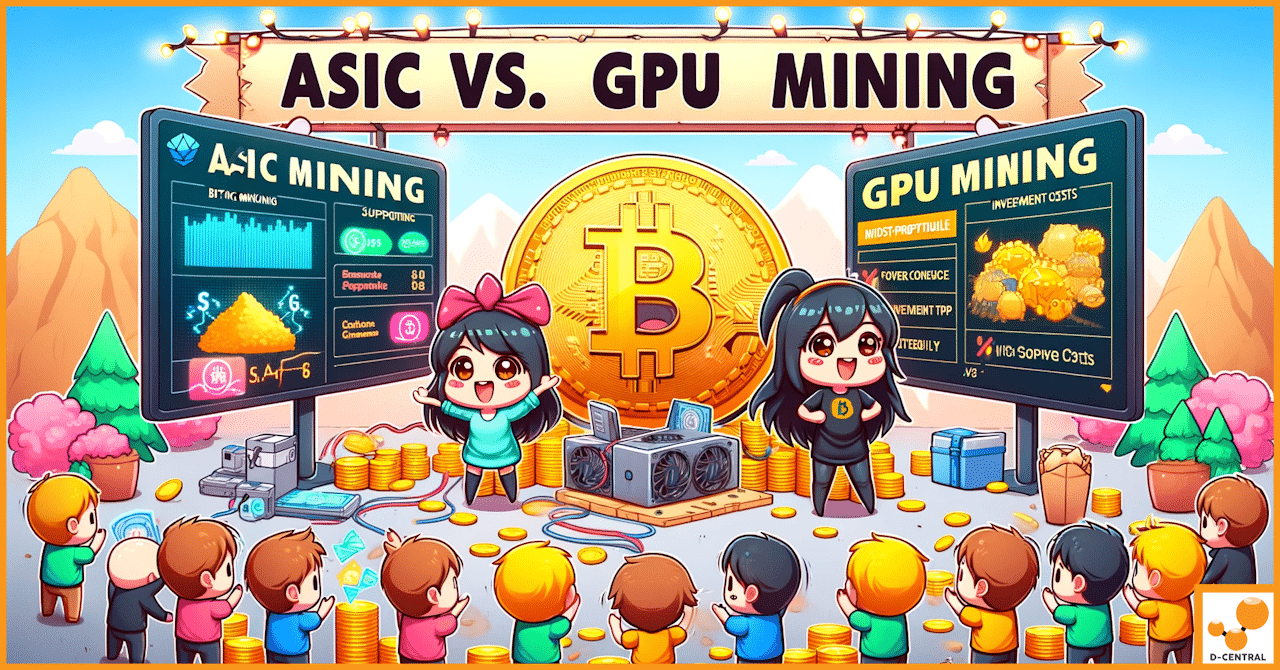
Here is the uncomfortable truth that the “multi-coin mining” crowd does not want you to hear: if you are serious about Bitcoin mining in 2026, there is exactly one category of hardware that matters. Application-Specific Integrated Circuits — ASICs — dominate the Bitcoin network for a reason. GPUs had their moment. That moment ended years ago. Understanding why is not just academic knowledge; it is the difference between running a real mining operation and burning electricity for nostalgia.
At D-Central Technologies, we have been deep in the trenches of Bitcoin mining since 2016. We have repaired thousands of ASIC miners, built custom configurations, and helped home miners across Canada and beyond set up operations that actually produce results. This is not a theoretical comparison. This is field-tested reality from the workshop floor.
The Hardware Evolution: How Bitcoin Mining Left GPUs Behind
Bitcoin mining hardware has gone through four distinct generations, and each transition was driven by a single relentless force: the SHA-256 algorithm does not care about versatility. It rewards raw, specialized efficiency.
The CPU Era (2009-2010)
Satoshi Nakamoto mined the genesis block with a CPU. In those early days, anyone with a desktop computer could mine Bitcoin. The network hashrate was measured in megahashes per second. The difficulty was trivial. This era lasted roughly a year before miners discovered something better.
The GPU Era (2010-2013)
Graphics cards — originally designed to render polygons in video games — turned out to be far better at parallel computation than CPUs. A single GPU could deliver hash rates 50 to 100 times faster than a CPU. Mining pools formed. The hashrate climbed into the gigahash range. For a brief window, GPU mining was genuinely profitable for Bitcoin.
But that window closed permanently when the next generation arrived.
The FPGA Bridge (2011-2013)
Field-Programmable Gate Arrays served as a short-lived bridge technology. More efficient than GPUs but less specialized than what came next, FPGAs proved the principle: purpose-built silicon wins.
The ASIC Revolution (2013-Present)
The first Bitcoin ASICs shipped in 2013 and immediately rendered every GPU mining rig obsolete for Bitcoin. These chips do one thing — compute SHA-256 hashes — and they do it with an efficiency that general-purpose hardware cannot touch. The gap has only widened since. Modern ASICs like the Antminer S21 series deliver hash rates measured in hundreds of terahashes per second at efficiencies under 20 joules per terahash. No GPU on Earth comes close.
ASIC vs GPU: The Numbers Do Not Lie
Let us put concrete numbers on this comparison, because vague claims help nobody.
Hash Rate
A top-tier GPU like the NVIDIA RTX 4090 delivers roughly 120-130 MH/s on Ethash-type algorithms. On SHA-256 — the algorithm that secures Bitcoin — a GPU is essentially useless. We are talking about megahashes per second against an ASIC producing hundreds of terahashes per second. That is a difference of roughly six orders of magnitude. A single modern ASIC outperforms hundreds of thousands of GPUs for Bitcoin mining.
Energy Efficiency
This is where the gap becomes absurd. Modern ASICs achieve 15-20 J/TH (joules per terahash). A GPU attempting SHA-256 hashing would consume orders of magnitude more energy per hash. In a world where electricity cost is the single largest variable in mining profitability, this efficiency gap is the entire ballgame.
Network Reality
The Bitcoin network hashrate currently exceeds 800 EH/s (exahashes per second) with a difficulty above 110 trillion. This hashrate is produced almost entirely by ASIC miners operating in facilities worldwide. Plugging a GPU into this network is like bringing a garden hose to fight a forest fire. The probability of finding a block with GPU hardware on the Bitcoin network is effectively zero.
The Economics
After the April 2024 halving, the block reward stands at 3.125 BTC. Combined with transaction fees, miners compete for roughly 450 BTC per day across the entire network. Every joule of efficiency matters. Every terahash of performance matters. ASICs win on both counts by margins that make the comparison almost absurd.
Why GPUs Cannot Compete on the Bitcoin Network
Some people still ask: “But what if I already have a GPU? Can I mine Bitcoin with it?” Technically, you can point a GPU at a SHA-256 pool. Practically, you will spend more on electricity in a single day than you will earn in a lifetime. Here is why:
The Difficulty Adjustment
Bitcoin’s difficulty adjustment algorithm is elegant and merciless. Every 2,016 blocks (roughly two weeks), the network recalibrates difficulty to maintain approximately 10-minute block intervals. As more ASIC hashrate comes online, difficulty increases. This self-regulating mechanism means that inefficient hardware gets squeezed out continuously. GPUs were squeezed out of Bitcoin mining over a decade ago, and the difficulty has increased by orders of magnitude since.
Specialization Always Wins
A GPU is designed to be good at many things: gaming, rendering, machine learning, video encoding. An ASIC is designed to be perfect at one thing. In any competitive environment where everyone is optimizing for the same objective, the specialist always defeats the generalist. This is not a flaw in GPU design — it is a fundamental principle of engineering. You do not use a Swiss Army knife when a scalpel is required.
The Altcoin Trap
The usual counterargument is: “Fine, I will use my GPU to mine altcoins instead.” From a Bitcoin maximalist perspective — and this is the perspective we hold at D-Central — this misses the point entirely. Altcoins are not Bitcoin. They do not share Bitcoin’s security model, its decentralization properties, its monetary policy, or its network effects. Mining altcoins to swap for Bitcoin adds layers of counterparty risk, tax complexity, and exposure to tokens with questionable long-term viability. If your goal is to accumulate Bitcoin, buy an ASIC and mine Bitcoin directly.
ASIC Mining for the Home Miner: It Has Never Been More Accessible
There is a persistent myth that ASIC mining is only for industrial operations running megawatt facilities. That was never entirely true, and in 2026, it is flat-out wrong. The home mining revolution is here, and D-Central has been building the tools for it since the beginning.
Open-Source Solo Miners
The Bitaxe family of open-source miners represents a paradigm shift. These compact, low-power ASIC miners are purpose-built for home solo mining. D-Central is a pioneer in the Bitaxe ecosystem — we created the original Bitaxe Mesh Stand, developed leading heatsink solutions, and stock every variant: Supra, Ultra, Hex, Gamma, and GT. These devices plug into a standard wall outlet, connect to your WiFi, and start hashing SHA-256 immediately. No GPU rig, no noise complaints, no rewiring your electrical panel.
Bitcoin Space Heaters
Here is an idea that makes GPUs look even more absurd for home mining: Bitcoin Space Heaters. Every watt consumed by a miner is converted to heat. D-Central’s Space Heater editions take full-power ASIC miners and enclose them in configurations designed to heat your home. You are not “wasting” electricity on mining — you are heating your house and getting paid in Bitcoin for it. Try doing that with a GPU mining rig drawing 300W to produce effectively zero Bitcoin.
Full-Scale Home Operations
For home miners ready to go bigger, modern ASICs from the Antminer S21 and Whatsminer M60 series deliver serious hashrate in increasingly manageable form factors. D-Central’s custom configurations — our Slim Edition, Pivotal Edition, and Loki Edition builds — are specifically engineered for home environments, addressing noise, airflow, and power requirements that off-the-shelf units ignore.
The D-Central Advantage: Full-Lifecycle Support
Buying an ASIC is step one. Running it effectively for years is where the real value compounds. This is where D-Central separates from every other hardware vendor in the space.
Expert ASIC Repair
ASICs are industrial machines. Components fail. Hashboards degrade. Control boards malfunction. D-Central operates one of North America’s most comprehensive ASIC repair services, with dedicated repair pages for 38+ models across Bitmain, MicroBT, Innosilicon, and Canaan hardware. We have repaired thousands of miners since 2016 — and when we say repair, we mean component-level diagnostics, not “swap the board and hope.” This repair expertise is something no GPU vendor offers because GPUs are consumer electronics designed to be replaced, not repaired.
Canadian Hosting
Not every home can accommodate a full-scale mining operation. D-Central offers Bitcoin mining hosting in Quebec, where cold climate and competitive hydroelectric rates create ideal conditions for ASIC mining. Our facility in Laval, QC handles the noise, cooling, and maintenance while you collect the Bitcoin. This is a turnkey solution that does not exist in the GPU mining world.
Hardware Sourcing and Consulting
Navigating the ASIC market requires knowing which models deliver real value versus which are overpriced or nearing end-of-life. D-Central’s hardware catalog is curated based on actual performance data from our repair bench and hosting facility. We sell what works because we run and repair this hardware every single day.
Solo Mining: Every Hash Counts
Solo mining — pointing your ASIC directly at the Bitcoin network without pooling — is the purest form of mining. You find a block, you get the full 3.125 BTC reward plus all transaction fees. No pool fees. No custodial risk. No trusting a third party with your hashrate.
Is solo mining a long shot with a single Bitaxe? Absolutely. The probability is low. But Bitaxe miners have found solo blocks — it has happened, and it will happen again. The lottery analogy is apt: you cannot win if you do not play. And unlike an actual lottery, every hash you produce strengthens the Bitcoin network’s decentralization. Your Bitaxe running in your living room is a vote for a distributed, censorship-resistant monetary network. No GPU pointing at an altcoin pool achieves anything remotely comparable.
The Decentralization Argument: Why Home ASIC Mining Matters
Beyond profitability, beyond efficiency numbers, there is a deeper reason why ASIC mining — especially home ASIC mining — matters more than ever in 2026.
The Bitcoin network’s security depends on hashrate being distributed across many independent miners and geographies. When mining concentrates in a few large facilities or a single country, the network becomes vulnerable to regulatory capture, physical attacks, and political pressure. Every home miner running an ASIC — whether it is a Bitaxe on a desk or an Antminer in a garage — adds a node of resistance to that centralization pressure.
GPU mining does not contribute to this mission. GPUs pointed at Bitcoin produce negligible hashrate. GPUs pointed at altcoins contribute to networks that do not share Bitcoin’s security properties or decentralization goals. If you believe in Bitcoin’s mission — sound money, censorship resistance, individual sovereignty — then the tool for the job is an ASIC, not a GPU.
D-Central’s entire mission is the decentralization of every layer of Bitcoin mining. We exist to put ASIC hardware into the hands of individuals, to repair and maintain that hardware, and to provide the knowledge needed to run it effectively. This is what being a Bitcoin Mining Hacker means: taking institutional-grade technology and making it work for the pleb miner at home.
Making the Right Hardware Decision in 2026
If you are evaluating mining hardware in 2026, here is the decision framework:
If Your Goal Is Bitcoin
Buy an ASIC. Period. Whether that is a Bitaxe for solo mining education and lottery-style block hunting, a Space Heater edition for dual-purpose home heating, or a full-power S21 for maximum hashrate — ASIC is the only rational choice for Bitcoin mining. Browse our complete selection at the D-Central shop.
If You Already Own GPUs
Do not waste them on mining. GPUs are excellent at tasks they were designed for: gaming, rendering, compute workloads. Use them for their intended purpose. If you want Bitcoin, take the money you would have spent on electricity for a GPU mining rig and either buy Bitcoin directly or invest in an ASIC.
If You Are Budget-Constrained
A Bitaxe Supra or Ultra costs a fraction of a high-end GPU and actually produces SHA-256 hashes efficiently. It draws 15-25 watts from a 5V barrel jack. It sits silently on your desk. It mines Bitcoin 24/7. And it connects you to the most important open-source hardware movement in Bitcoin mining. Visit our Bitaxe Hub to explore every model and accessory.
Key Factors to Evaluate
- Joules per terahash (J/TH) — The single most important efficiency metric. Lower is better. Modern ASICs: 15-20 J/TH. GPUs on SHA-256: not even worth calculating.
- Your electricity rate — Canadian home miners benefit from rates as low as $0.04-0.07/kWh in some provinces. ASIC mining in Canada is structurally advantaged.
- Noise and heat management — Full-power ASICs are loud. D-Central’s custom editions and Space Heaters are engineered specifically for home environments.
- Repairability — ASICs can be repaired and maintained for years. D-Central’s repair service extends the operational life of your hardware far beyond warranty.
- Resale value — ASICs hold value based on their hash rate and efficiency. Even older models find buyers. GPU mining rigs depreciate as gaming cards.
Frequently Asked Questions
Can I mine Bitcoin with a GPU in 2026?
Technically, yes. Practically, no. The Bitcoin network hashrate exceeds 800 EH/s, produced almost entirely by ASIC miners. A GPU produces negligible SHA-256 hashrate and would consume far more in electricity than it could ever earn in Bitcoin. ASICs outperform GPUs for Bitcoin mining by roughly six orders of magnitude.
What is the most efficient Bitcoin mining hardware available today?
The latest generation ASICs from Bitmain (Antminer S21 series) and MicroBT (Whatsminer M60 series) lead in efficiency at 15-20 J/TH. For home solo mining, the Bitaxe family of open-source ASIC miners offers accessible entry points with genuine SHA-256 hashing capability. D-Central stocks all major ASIC models and every Bitaxe variant.
Is solo mining with a Bitaxe realistic?
Solo mining with a Bitaxe is a low-probability, high-reward proposition. The odds of finding a block with a single unit are small, but Bitaxe miners have hit solo blocks. More importantly, every hash contributes to Bitcoin network decentralization. Many home miners run a Bitaxe for the principle and the lottery chance while operating larger ASICs in a pool for consistent returns.
Why does D-Central recommend ASICs over GPUs for Bitcoin?
Three reasons: efficiency, effectiveness, and mission alignment. ASICs are purpose-built for SHA-256, delivering hash rates and energy efficiency that GPUs cannot approach. Every watt spent on ASIC mining produces meaningful Bitcoin hashrate, strengthening the network. GPU mining on Bitcoin produces essentially nothing. We are Bitcoin maximalists — we build tools that serve Bitcoin, not general-purpose hardware that serves everything poorly.
Can I use an ASIC miner to heat my home?
Absolutely. Every watt an ASIC consumes is converted to heat. D-Central’s Bitcoin Space Heater editions are specifically designed for home heating. You replace a traditional electric heater with a mining unit that produces the same heat output while earning Bitcoin. It is one of the most compelling use cases for home mining in cold climates like Canada.
What happens when an ASIC miner breaks?
Unlike GPUs that are typically discarded when they fail, ASICs can be repaired at the component level. D-Central operates one of North America’s most comprehensive ASIC repair services, handling hashboard repairs, control board diagnostics, fan replacements, and chip-level work across 38+ models. Repair extends the productive life of your mining hardware by years.
What is the current Bitcoin block reward?
Following the April 2024 halving, the block reward is 3.125 BTC per block. Blocks are found approximately every 10 minutes on average. The next halving is expected around 2028, when the reward will drop to 1.5625 BTC. This decreasing supply schedule is a fundamental feature of Bitcoin’s monetary policy and makes efficient mining hardware increasingly important over time.
How does D-Central support home miners?
D-Central provides end-to-end support: hardware sales (ASICs, Bitaxe, accessories, parts), custom miner configurations for home environments, ASIC repair services, mining hosting in Quebec for those who cannot run hardware at home, and technical consulting. We have been in the Bitcoin mining space since 2016 and focus exclusively on making mining accessible to individuals — not institutions.