In 2026, the Bitcoin network hashrate has surged past 800 EH/s, difficulty has climbed above 110 trillion, and the block reward sits at 3.125 BTC after the April 2024 halving. Running an ASIC miner profitably has never demanded more from your hardware. When a hashboard goes down or a power supply fails, every hour of downtime is lost revenue and lost hash power that should be securing the network.
Yet despite the stakes, a surprising number of miners still believe myths about ASIC repair that lead them to trash perfectly fixable machines, waste money on unnecessary replacements, or attempt risky DIY jobs that turn a minor fault into a paperweight. D-Central Technologies has been repairing ASIC miners since 2016 — thousands of units across every major manufacturer. We have seen every failure mode, every misconception, and every bad decision that follows from believing repair myths.
This article tears apart the seven most persistent ASIC repair myths, explains the reality behind each one, and shows you why professional repair is not just viable — it is the smartest move a home miner can make in 2026.
Myth 1: ASIC Miners Cannot Be Repaired Once They Break
This is the foundational myth, and it is dead wrong.
An ASIC miner is an electronic device — a collection of PCBs, ASIC chips, power delivery circuits, connectors, fans, and firmware. Like any electronic device, individual components fail while the rest of the system remains perfectly functional. A blown MOSFET on a hashboard does not mean the other 200+ ASIC chips on that board are dead. A failed control board does not mean the hashboards are compromised.
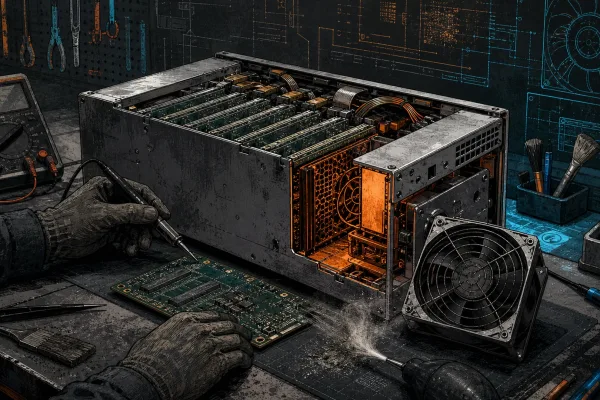
At our repair facility in Montreal, Quebec, D-Central’s technicians perform component-level diagnostics on every unit that comes through the door. We use thermal imaging to identify hot spots, oscilloscopes to trace signal paths, and multimeters to isolate faults down to specific components. The result: the vast majority of “dead” ASIC miners that arrive at our bench leave fully operational.
What Can Actually Be Repaired
- Hashboard failures — dead ASIC chips, blown voltage regulators, cracked solder joints, corroded connectors
- Control board issues — firmware corruption, failed Ethernet controllers, damaged SD card slots, bricked firmware
- Power supply failures — capacitor degradation, fan failures, voltage regulation faults
- Fan and cooling failures — seized bearings, broken blades, thermal paste degradation
- Connector and cable damage — corroded pins, melted connectors from poor power delivery, broken ribbon cables
The machines that genuinely cannot be repaired are rare edge cases — catastrophic liquid damage that corroded entire boards, or physical impacts that cracked the PCB substrate itself. Even then, individual hashboards or components can often be salvaged as donor parts.
Myth 2: Replacing a Broken Miner Is Cheaper Than Repairing It
This myth persists because people compare the wrong numbers. They look at the repair quote and compare it to the sticker price of a new unit, ignoring everything else.
Here is the real math:
| Cost Factor | Replace (New Unit) | Professional Repair |
|---|---|---|
| Hardware cost | Full price of new ASIC ($2,000–$15,000+) | Repair fee (typically 15–40% of new unit cost) |
| Shipping | International freight from manufacturer (often weeks) | Domestic shipping within Canada |
| Downtime | 2–8 weeks waiting for delivery | Typically 1–2 weeks turnaround |
| Import duties/taxes | Customs, brokerage fees, GST/HST on full value | None (domestic service) |
| Lost mining revenue | Higher (longer downtime) | Lower (faster turnaround) |
| Environmental cost | Full unit becomes e-waste | Only failed components replaced |
When you factor in the full cost of replacement — purchase price, international shipping, customs duties, weeks of lost hash power — repair wins by a massive margin in the vast majority of cases. A hashboard repair that costs a few hundred dollars versus buying a $5,000+ new unit is not even a close comparison.
The only scenario where replacement genuinely makes sense is when the miner is so far behind current-generation efficiency that the electricity cost exceeds its earning potential. Even then, repurposing older miners as Bitcoin space heaters often makes more sense than scrapping them entirely. An Antminer S9 that is unprofitable as a pure miner can still offset your heating bill while stacking sats.
Myth 3: Only the Manufacturer Can Do Quality ASIC Repairs
Manufacturers build ASICs. They are not necessarily the best at fixing them — and they certainly are not the most accessible or affordable option for most miners.
Consider the reality of manufacturer repair in 2026:
- Geographic barriers — Most ASIC manufacturers are based in China. Shipping a miner overseas for repair means international freight costs, customs paperwork, and turnaround times measured in months, not weeks.
- Warranty limitations — Manufacturers typically only repair units under warranty. If your warranty has expired — or if you have modified the firmware, replaced fans, or made any customization — you are on your own.
- Communication challenges — Language barriers, time zones, and limited customer service resources make the process frustrating for North American miners.
- End-of-life models — Manufacturers have zero incentive to repair older models. They want you buying the next generation. Good luck getting Bitmain to prioritize your S17 repair when they are pushing the latest S-series.
Third-party repair specialists like D-Central exist precisely because the manufacturer model does not serve individual miners well. Our technicians have torn down, diagnosed, and rebuilt thousands of units across Bitmain Antminer, MicroBT Whatsminer, Canaan Avalon, and Innosilicon models. That cross-manufacturer experience gives us diagnostic insight that a single manufacturer’s support team simply cannot match.
We see the same failure patterns across different brands. We know which components are prone to failure in Canadian conditions — the thermal cycling from basement installations, the humidity variations across seasons, the power quality issues common in residential circuits. This is hard-won, hands-on knowledge that no manufacturer’s support ticket system can replicate.
Myth 4: Repaired ASIC Miners Are Less Reliable Than New Ones
This myth treats “repaired” as if it means “patched together.” In reality, a professionally repaired ASIC miner often comes back stronger than it left the factory.
Here is why:
Root Cause Analysis
When a new miner fails, nobody investigates why. It just broke. When a miner comes to D-Central for repair, our technicians do not just replace the failed component — they identify the root cause. Was the failure caused by a power surge? Thermal stress from inadequate ventilation? A manufacturing defect in a specific batch of components? Understanding the “why” means we can address the underlying issue, not just the symptom.
Upgraded Components
In many cases, we replace failed components with higher-quality alternatives. A blown capacitor gets replaced with one rated for higher temperatures. A failed fan gets swapped for one with better bearings and airflow. The repaired machine is not identical to what left the factory — it is improved.
Full System Inspection
A repair visit is also a health check. While we have the machine open, we inspect everything: thermal paste condition, connector integrity, fan bearing health, firmware version, hashboard alignment. Issues that would have caused a failure in three months get caught and fixed now. A miner that went through professional repair often has fewer latent issues than a brand-new unit that was assembled on a Friday afternoon at the end of a production run.
Real-World Track Record
D-Central has been performing ASIC repairs since 2016 — over eight years of operational data. Our repaired units run reliably in home mining setups, hosting facilities in Quebec, and basement operations across Canada. The data speaks for itself: professionally repaired miners perform.
Myth 5: DIY ASIC Repair Is Easy and Saves Money
We get it. You are a home miner. You hack firmware, build Bitaxe units, and run your own full node. The DIY instinct is strong, and we respect it. But ASIC repair is a different beast from ASIC setup, and confusing the two can be expensive.
Why DIY ASIC Repair Is Risky
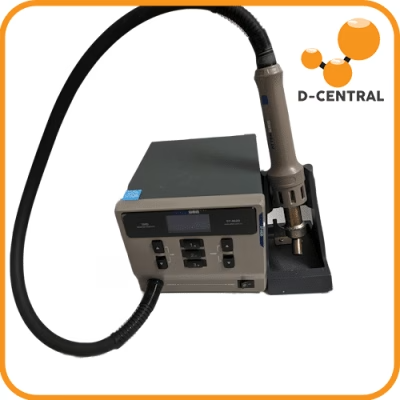
- BGA rework requires specialized equipment — The ASIC chips on a hashboard are ball grid array (BGA) components. Replacing them requires a rework station with precise temperature profiling, proper flux, and alignment tools. A hot air gun from Amazon is not going to cut it. Poor BGA rework can bridge solder balls, lift pads, or damage adjacent components.
- Diagnostic complexity — A hashboard that reports “ASIC chip 47 not responding” might have a problem on chip 47, or it might have a broken signal trace three chips upstream, or a failed voltage domain that feeds chips 40 through 55. Without proper diagnostic equipment and experience, you are guessing.
- Electrostatic discharge (ESD) — ASIC chips are sensitive to static electricity. Professional repair facilities use ESD-safe workstations, wrist straps, and grounding mats. Working on a hashboard on your kitchen table in winter with low humidity is a recipe for invisible damage that shows up as intermittent failures weeks later.
- Firmware risks — Flashing incorrect firmware or corrupting the NAND during a recovery attempt can brick the control board. Recovery from a bad flash requires UART access and sometimes chip-level reprogramming.
- Escalating costs — The most expensive repairs we see at D-Central are units that someone tried to fix at home first. A $200 repair becomes a $600 repair when you have also damaged the PCB traces, lifted pads, or shorted components during your DIY attempt.
Where DIY Makes Sense
To be clear, not every maintenance task requires a professional. These are reasonable DIY tasks:
- Replacing fans (straightforward connector swap)
- Cleaning dust buildup with compressed air
- Replacing thermal paste on heatsinks
- Updating firmware through the web interface
- Replacing a power supply with an identical model
- Swapping a known-good control board
The line is drawn at component-level board work. If it involves a soldering iron and a magnifying glass, send it to a professional.
Myth 6: All ASIC Repair Services Are the Same
This is the myth that can hurt you the most, because choosing the wrong repair shop can be worse than no repair at all.
The ASIC repair market in 2026 has exploded. With the network hashrate above 800 EH/s and hundreds of thousands of miners deployed worldwide, repair demand is massive. Unfortunately, that demand has attracted operators who are long on marketing and short on competence.
What to Look For in a Repair Service
| Quality Indicator | Red Flag | Green Flag |
|---|---|---|
| Track record | New operation with no verifiable history | Years of operation with documented repairs |
| Diagnostic process | “Send it and we will see” | Structured intake, diagnostic report before repair |
| Transparency | No photos, no explanation of what failed | Photos/documentation of the fault and repair |
| Component sourcing | Unknown or counterfeit parts | Genuine or OEM-equivalent components with traceability |
| Post-repair testing | Ships back untested | Burn-in testing under load before return |
| Warranty | No warranty or vague promises | Written warranty on repairs performed |
| Model coverage | Only works on one brand | Cross-manufacturer expertise |
D-Central Technologies checks every green flag on that list. We have been repairing ASIC miners since 2016, we provide diagnostic reports, we document our work, we source quality components, we burn-in test every repair, and we stand behind our work with a warranty. Our repair pages cover 38+ specific ASIC models across Bitmain, MicroBT, Canaan, and Innosilicon — because real expertise means knowing the quirks of each platform.
Myth 7: ASIC Repair Is Only Worth It for Expensive Miners
The logic seems sound on the surface: “My S9 is only worth $50, why would I spend $150 to repair it?” But this thinking misses the bigger picture.
The Second-Life Value of Older Miners
Older-generation miners like the Antminer S9 or L3+ may not compete with current-gen units on pure mining efficiency, but they have found new life in applications that the original manufacturers never envisioned:
- Bitcoin space heaters — An S9 produces roughly 1,300 watts of heat. In a Canadian winter, that is real, useful thermal energy. D-Central’s Bitcoin Space Heater editions take older miners and convert them into whisper-quiet home heating units that mine Bitcoin as a byproduct. Repairing a broken S9 for its second life as a space heater makes perfect economic sense.
- Mining education and training — Older miners are ideal for learning the fundamentals of ASIC operation, firmware management, and pool configuration without risking expensive current-gen hardware.
- Parts donors — A repaired hashboard from an S9 can serve as a donor for other repairs, keeping an entire fleet of units running.
- Off-grid and solar mining — Lower-power older units are a better match for small solar installations than current-gen units that draw 3,000+ watts.
The real question is not “what is this miner worth on the market?” but “what is this miner worth in my specific setup?” A $50 miner that heats your garage workshop all winter while stacking sats is worth far more than its resale value suggests.
The D-Central Approach to ASIC Repair
D-Central Technologies has been operating since 2016, making us one of the longest-running Bitcoin mining service providers in Canada. Our repair operation is built on principles that reflect who we are: Bitcoin Mining Hackers who believe in extending the life of hardware, reducing waste, and keeping hash power in the hands of individual miners rather than centralized industrial operations.
Our Repair Process
- Intake and documentation — Every unit is photographed, cataloged, and its symptoms recorded at intake.
- Comprehensive diagnostics — We run full diagnostics including thermal imaging, voltage testing, and chip-level scanning to identify all faults — not just the obvious one.
- Repair quote — You get a detailed quote explaining what failed, what needs to be replaced, and what it will cost. No surprises.
- Component-level repair — Our technicians perform the repair using proper ESD-safe procedures, quality components, and professional rework equipment.
- Burn-in testing — Every repaired unit runs under full load to verify stability, hash rate performance, and thermal behavior before it ships back.
- Documentation and return — You receive your repaired miner with documentation of what was done and warranty coverage on the repair.
We also offer mining consulting for miners who want advice on fleet maintenance schedules, optimal operating conditions, and when it genuinely makes sense to upgrade versus repair.
Sustainability and Decentralization: Why Repair Matters Beyond Cost
Every ASIC miner that gets repaired instead of replaced is a win for Bitcoin’s decentralization.
Here is why: when a home miner’s machine breaks and they cannot get it fixed, they drop off the network. That hash power disappears from the decentralized pool of individual miners and gets replaced by industrial farms buying new units by the container load. The network becomes more centralized, more concentrated, more vulnerable.
Repair keeps individual miners hashing. It keeps the network decentralized. It keeps hash power distributed across basements, garages, and home offices instead of concentrated in a handful of industrial facilities.
From an environmental perspective, the numbers are equally compelling. Manufacturing a single ASIC miner requires rare earth minerals, energy-intensive fabrication processes, and international shipping. Repairing a failed component on an existing board uses a fraction of those resources. In an industry that faces constant scrutiny over its energy use, extending hardware lifespans through repair is one of the most tangible sustainability improvements any miner can make.
Frequently Asked Questions
Can all ASIC miner failures be repaired?
The vast majority of failures can be repaired, including hashboard faults, control board issues, power supply failures, and fan problems. The rare exceptions are catastrophic physical damage (cracked PCB substrate) or extensive liquid damage that has corroded entire circuits. Even in these cases, individual components can often be salvaged.
How much does ASIC repair typically cost compared to buying a new miner?
Professional ASIC repair typically costs 15 to 40 percent of the price of a new equivalent unit, depending on the fault. When you factor in shipping, customs duties, and lost mining revenue from longer downtime, repair is almost always the more cost-effective option.
How long does a typical ASIC repair take at D-Central?
Most repairs are completed within one to two weeks, including diagnostics, repair, and burn-in testing. Complex hashboard repairs involving multiple chip replacements may take slightly longer. We provide estimated timelines with every repair quote.
Does D-Central repair all brands of ASIC miners?
Yes. We repair miners from all major manufacturers including Bitmain (Antminer series), MicroBT (Whatsminer series), Canaan (Avalon series), and Innosilicon. Our repair pages cover 38+ specific models with detailed information on common faults and repair procedures.
Will a repaired ASIC miner perform as well as a new one?
A professionally repaired ASIC miner should perform at or near its original specifications. In some cases, repairs include component upgrades and firmware optimizations that can improve performance beyond the original factory configuration. Every repaired unit undergoes burn-in testing to verify full hash rate performance before it ships back.
Is it worth repairing older ASIC miners like the Antminer S9?
Often yes, especially for secondary uses. Older miners are excellent candidates for conversion into Bitcoin space heaters, mining education and training, off-grid solar mining, or as parts donors for fleet maintenance. The value of an older miner depends on your specific use case, not just its resale price.
What DIY maintenance can I safely do on my ASIC miner?
Safe DIY tasks include replacing fans, cleaning dust with compressed air, replacing thermal paste, updating firmware through the web interface, and swapping power supplies or control boards. Component-level board work — anything involving soldering or chip replacement — should be left to professionals with proper equipment.
Does D-Central offer remote diagnostic support?
Yes. For miners who want to troubleshoot before sending hardware in, D-Central offers remote support through our ticket system and Discord channel. We can help identify whether the issue requires professional repair or can be resolved with basic maintenance.