Bitcoin was never designed to be a storage network. It was designed to be something far more dangerous to the status quo: an immutable, permissionless ledger that no government, corporation, or centralized entity can censor, alter, or shut down. And yet, in the relentless race to build “decentralized storage,” it is Bitcoin’s architecture — not Filecoin’s — that has quietly proven to be the more durable foundation for a sovereign data future.
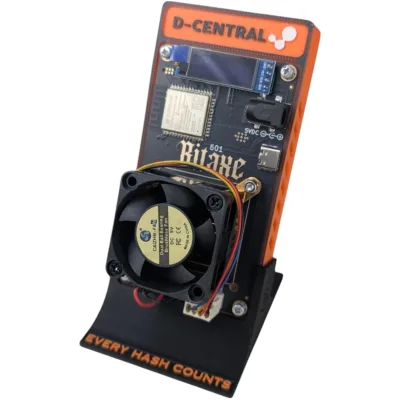
At D-Central Technologies, we have spent years as Bitcoin Mining Hackers, taking institutional-grade technology and putting it in the hands of home miners, plebs, and sovereign individuals. We understand Bitcoin’s infrastructure at the hardware level — from the ASIC chips we repair in our ASIC repair lab to the open-source miners we pioneer like the Bitaxe. And from that vantage point, we see what many in the broader crypto space miss: Bitcoin’s layered architecture is quietly enabling decentralized storage capabilities that make purpose-built altcoin solutions look fragile by comparison.
What Decentralized Storage Actually Means
Strip away the marketing jargon and decentralized storage comes down to one simple promise: your data lives on a distributed network where no single entity controls access, availability, or censorship. Traditional cloud providers — Amazon S3, Google Cloud, Microsoft Azure — are centralized honeypots. One subpoena, one policy change, one Terms of Service update, and your data disappears.
Decentralized storage attempts to solve this by distributing data across a peer-to-peer network, encrypting it, and using cryptographic proofs to verify that storage providers are actually holding the data they claim to hold.
The question is not whether decentralized storage is needed. It is. The question is: which foundation do you build it on?
Filecoin: The Purpose-Built Approach and Its Fractures
Filecoin launched with a clear thesis: build a blockchain specifically designed to incentivize decentralized storage. Storage providers lock up FIL tokens as collateral, offer disk space to the network, and earn rewards for storing and serving data. The system uses Proof-of-Replication (PoRep) and Proof-of-Spacetime (PoSt) to verify that data is being stored correctly over time.
On paper, it sounds elegant. In practice, the cracks are significant:
| Concern | Details |
|---|---|
| Token Dependency | The entire incentive model depends on FIL token value. If FIL price drops, storage providers leave the network. Your data availability is tethered to speculative token markets. |
| Complexity Overhead | Running a Filecoin storage node requires specialized hardware (GPU for proof generation), significant capital lockup, and deep technical knowledge. This creates centralization pressure — only well-funded operators can participate meaningfully. |
| Retrieval Problems | Storing data on Filecoin is one thing. Retrieving it quickly and reliably is another. Retrieval markets remain underdeveloped, and real-world retrieval speeds often lag behind centralized alternatives. |
| Single Ecosystem Risk | Filecoin is built on its own blockchain with its own consensus mechanism. If the Filecoin ecosystem faces a critical vulnerability or governance failure, the entire storage layer is compromised. |
| Centralization Creep | A small number of large storage providers dominate Filecoin’s available capacity. The decentralization promise is undermined by economic realities that favor scale. |
The fundamental problem with purpose-built storage blockchains is that they sacrifice the one thing that matters most in decentralized systems: battle-tested resilience. Filecoin has existed since 2020. Bitcoin has been running continuously since January 3, 2009 — surviving nation-state attacks, exchange collapses, regulatory crackdowns, and every form of adversity the world has thrown at it.
Bitcoin’s Layered Architecture: The Unseen Storage Foundation
Bitcoin was never designed for large-scale data storage — and that is precisely its advantage. Bitcoin’s base layer does one thing exceptionally well: it provides the most secure, immutable, and censorship-resistant timestamping and settlement layer ever created. Everything else gets built on top.
This layered approach mirrors how the internet itself was designed. TCP/IP does not try to be a web browser, a streaming service, and a database all at once. It provides a reliable transport layer, and higher-level protocols handle specialized tasks. Bitcoin works the same way.
Here is how the Bitcoin stack enables decentralized storage:
The Base Layer: Immutable Anchoring
Every Bitcoin block header contains a Merkle root — a cryptographic fingerprint that can anchor virtually unlimited amounts of off-chain data. By embedding a hash of an external dataset into a Bitcoin transaction, you create an immutable, timestamped proof that the data existed at a specific point in time. No one can alter that proof without rewriting the entire Bitcoin blockchain — a computational impossibility given the network’s 800+ EH/s of hashrate.
This is not theoretical. It is already being used for document notarization, supply chain verification, and data integrity proofs.
Second-Layer Solutions: Capacity Without Compromise
The Lightning Network, Bitcoin’s layer-2 payment channel system, has demonstrated that you can scale Bitcoin’s capabilities without sacrificing base-layer security. The same architectural pattern applies to storage: keep the heavy data off-chain, use Bitcoin’s base layer for anchoring and verification, and leverage purpose-built layers for retrieval and serving.
Projects exploring this space use Bitcoin’s scripting capabilities and time-locked contracts to create trustless storage agreements — without requiring a separate token or consensus mechanism.
Sidechains and Federated Solutions
Bitcoin sidechains enable experimental functionality while remaining pegged to Bitcoin’s security model. Storage-focused sidechains can implement specialized data structures and incentive mechanisms while settling proofs back to the Bitcoin mainchain.
| Feature | Bitcoin-Based Storage | Filecoin |
|---|---|---|
| Network Security | 800+ EH/s PoW, 16+ years of uptime | PoSt/PoRep, 5 years of operation |
| Token Risk | BTC is the most liquid, most adopted cryptocurrency | FIL value directly impacts storage availability |
| Developer Ecosystem | Largest open-source developer community in crypto | Smaller, Protocol Labs-dependent |
| Decentralization | Tens of thousands of full nodes worldwide | Storage provider concentration in large operators |
| Architecture | Layered (base + L2 + sidechains) | Monolithic single-chain |
| Hardware Accessibility | Run a node on consumer hardware | Requires GPU + significant capital lockup |
Why This Matters for Home Miners and Sovereign Individuals
If you are running a Bitcoin miner at home — whether it is a Bitaxe solo miner hashing away on your desk or an Antminer converted into a Bitcoin space heater warming your living room — you are already participating in the most decentralized infrastructure ever built. Every hash you contribute strengthens the network that can anchor the next generation of decentralized applications, including storage.
This is the part that the Filecoin crowd never talks about: the security foundation. You can build the most sophisticated storage incentive mechanism in the world, but if the underlying network can be attacked, censored, or manipulated, none of it matters. Bitcoin miners — from industrial operations to pleb miners running open-source hardware — provide the security that makes trustless data anchoring possible.
At D-Central, our mission is the decentralization of every layer of Bitcoin mining. That mission extends beyond just hash rate distribution. When home miners strengthen Bitcoin’s security, they are strengthening the foundation for every application built on top of it — including decentralized storage, identity, timestamping, and notarization.
The Open-Source Advantage: Bitcoin’s Development Culture
Filecoin is primarily developed by Protocol Labs, a single company. Bitcoin is developed by hundreds of independent contributors, reviewed by thousands, and run by tens of thousands of node operators. This is not a cosmetic difference — it is a fundamental architectural advantage.
When you build storage solutions on top of Bitcoin, you inherit:
- Peer-reviewed protocol changes — Every Bitcoin protocol change undergoes years of scrutiny before activation. No single entity can push through changes unilaterally.
- Implementation diversity — Multiple independent implementations (Bitcoin Core, btcd, libbitcoin) reduce single-point-of-failure risk.
- Incentive alignment — Bitcoin miners, node operators, developers, and users all have aligned incentives to maintain the network’s integrity. There is no VC-funded foundation that can pivot the project’s direction.
- Hardware sovereignty — You can run a Bitcoin full node on a Raspberry Pi. You can mine with an open-source Bitaxe. You can verify everything yourself. This is the cypherpunk ideal in action.
This culture of radical openness and verification is why Bitcoin-based solutions will outlast purpose-built altcoin projects. The entire ethos of “don’t trust, verify” applies to storage just as much as it applies to money.
Practical Applications Already in Motion
Bitcoin-based data anchoring is not a theoretical future — it is happening now:
- OpenTimestamps — An open-source timestamping protocol that uses Bitcoin to create tamper-proof proofs of data existence. Used for document notarization, academic credential verification, and legal evidence preservation.
- RGB Protocol — A smart contract system built on top of Bitcoin and the Lightning Network that enables complex programmable assets and contracts while keeping data off-chain and anchored to Bitcoin.
- Nostr — A decentralized social protocol that uses cryptographic key pairs (compatible with Bitcoin’s key infrastructure) for identity and data distribution, with Bitcoin/Lightning for payments.
- Ordinals and Inscriptions — While controversial in the Bitcoin community, ordinals demonstrated that the Bitcoin blockchain can store and reference data directly, sparking broader conversations about Bitcoin’s data layer capabilities.
Each of these projects builds on Bitcoin’s immutability rather than trying to recreate it from scratch with a new token and a new consensus mechanism.
The Canadian Angle: Infrastructure for a Sovereign Future
Canada has unique advantages in the decentralized infrastructure conversation. Our cold climate provides natural cooling for mining operations. Our energy grid — particularly in Quebec, where D-Central operates a Bitcoin mining hosting facility — offers access to clean, affordable hydroelectric power. And our regulatory environment, while not perfect, has historically been more accommodating to Bitcoin businesses than many other jurisdictions.
When Canadian miners contribute hash rate to the Bitcoin network, they are not just earning sats. They are building the physical infrastructure layer that supports every application built on Bitcoin — from payments to storage to identity. This is what decentralization looks like at the hardware level, and it is why D-Central’s mission of putting mining hardware into the hands of individuals matters far beyond just mining profitability.
If you are interested in getting started with home mining — whether for heat, for sovereignty, or for the chance at a 3.125 BTC solo block reward — our team of mining consultants can help you find the right setup for your needs.
Conclusion: Build on Bedrock, Not on Sand
The decentralized storage race is not going to be won by the project with the fanciest proof mechanism or the biggest ICO war chest. It will be won by the project built on the most secure, most decentralized, most battle-tested foundation available. That foundation is Bitcoin.
Filecoin offers a dedicated storage solution, but it comes with token risk, centralization pressure, and the fragility of a young, single-purpose blockchain. Bitcoin offers something different: an unbreakable anchor layer that storage solutions can build on top of, inheriting 16+ years of security and the largest decentralized network in human history.
As Bitcoin Mining Hackers, we believe in building on bedrock. Whether you are mining at home with a Bitaxe, heating your house with a space heater miner, or running a full node to verify your own transactions, you are contributing to the infrastructure that makes true decentralization possible — not just for money, but for data, identity, communication, and storage.
Every hash counts. Every node matters. Every layer of decentralization we build brings us closer to a sovereign future.
Frequently Asked Questions
Can Bitcoin actually be used for decentralized storage?
Bitcoin’s base layer is not designed for large-scale data storage — and that is by design. Instead, Bitcoin serves as an immutable anchoring layer. Data is stored off-chain (on dedicated storage networks, IPFS, or other systems), and a cryptographic hash of that data is embedded in a Bitcoin transaction. This creates a tamper-proof, timestamped record that the data existed at a specific point in time, anchored by Bitcoin’s 800+ EH/s of proof-of-work security.
What is wrong with Filecoin’s approach to storage?
Filecoin’s approach ties storage availability directly to its FIL token value. If FIL drops significantly, storage providers have less incentive to maintain their operations, potentially putting stored data at risk. Additionally, the hardware requirements for Filecoin storage mining (GPUs for proof generation, significant collateral lockup) create centralization pressure where only well-funded operators can participate meaningfully, undermining the decentralization promise.
How does home Bitcoin mining relate to decentralized storage?
Every Bitcoin miner — from a small Bitaxe solo miner to a full-size Antminer — contributes hash rate that secures the Bitcoin network. That security is what makes Bitcoin’s immutable timestamping and data anchoring trustworthy. When you mine at home, you are strengthening the foundation layer that enables not just peer-to-peer payments but also decentralized storage, identity systems, and other applications built on Bitcoin’s infrastructure.
What is OpenTimestamps and how does it use Bitcoin for data integrity?
OpenTimestamps is an open-source protocol that creates cryptographic timestamps anchored to the Bitcoin blockchain. By hashing a document or dataset and embedding that hash in a Bitcoin transaction, OpenTimestamps creates an immutable proof that the data existed at a specific block height. This is used for document notarization, academic credential verification, legal evidence preservation, and supply chain integrity.
Why is a layered architecture better than a monolithic storage blockchain?
A layered architecture separates concerns: the base layer handles security and immutability, while specialized upper layers handle capacity, speed, and application-specific logic. This means the base layer stays simple, secure, and resistant to attack, while innovation happens at higher layers without risking the foundation. Monolithic blockchains like Filecoin try to do everything in one layer, which creates complexity, increases attack surface, and makes the entire system dependent on a single consensus mechanism.
Is D-Central involved in any decentralized storage projects?
D-Central’s core focus is Bitcoin mining hardware, repair, and education. We are not directly involved in building decentralized storage protocols. However, by decentralizing Bitcoin mining — putting hardware like the Bitaxe, NerdAxe, and Bitcoin space heaters into the hands of home miners across Canada and worldwide — we strengthen the security foundation that all Bitcoin-based applications, including storage, depend on. Our mission is the decentralization of every layer of Bitcoin mining.