Every Bitcoin miner is a heater. This is not a bug — it is a thermodynamic feature. An Antminer S21 converts roughly 3,500 watts of electricity into SHA-256 hashes and heat, with nearly 100% of that electrical energy ultimately becoming thermal output. For most home miners, this waste heat is either vented outdoors or managed with ducting. But for printing facilities — operations that already consume enormous amounts of thermal energy for ink curing, substrate drying, screen printing, and climate control — this heat is not waste at all. It is a resource waiting to be captured.
At D-Central Technologies, we have spent nearly a decade helping businesses integrate Bitcoin mining into their operations. We have seen this story play out across greenhouses, workshops, warehouses, and yes — printing facilities. The math is straightforward: if your facility already needs heat, and Bitcoin mining produces heat as a byproduct of generating revenue, combining the two is not creative thinking. It is engineering common sense.
Why Printing Facilities Are Ideal Candidates for Bitcoin Mining Heat Recovery
Printing operations are thermally intensive. Whether you run a commercial offset press, a large-format digital printing shop, a screen printing facility, or an industrial 3D printing operation, your processes demand consistent environmental temperatures and often require supplemental heat for curing, drying, and material handling. Here is what makes printing facilities particularly well-suited for mining heat integration:
- Consistent heating demand: Most printing processes require ambient temperatures between 20-25°C (68-77°F). In Canadian winters — and much of North America — maintaining these temperatures costs thousands per month in natural gas or electric heating.
- Large floor area: Printing facilities typically occupy warehouses or industrial units with 2,000-20,000+ square feet. This provides ample space for mining hardware alongside existing equipment.
- Three-phase power infrastructure: Commercial printing operations already have robust electrical panels, often with three-phase 208V or 240V service. This is exactly what ASIC miners need.
- Existing ventilation: Print shops already manage air quality (VOC extraction, dust management, temperature control). Adding mining heat to the airflow loop is an incremental engineering task, not a ground-up build.
- Operational hours: While presses may not run 24/7, the facility itself needs climate control around the clock to protect substrates, inks, and finished products. Bitcoin miners can provide baseline heating during off-hours when presses are idle.
The Thermodynamics: How Much Heat Are We Talking About?
Let us get specific. In 2026, the current generation of Bitcoin miners operates at these approximate power levels:
| Miner Model | Hashrate | Power Draw | Heat Output (BTU/hr) |
|---|---|---|---|
| Antminer S21 | 200 TH/s | 3,500W | ~11,942 |
| Antminer S19k Pro | 120 TH/s | 2,760W | ~9,418 |
| Whatsminer M60S | 186 TH/s | 3,348W | ~11,424 |
| D-Central Space Heater (S19 Edition) | ~90 TH/s | ~2,800W | ~9,554 |
The conversion is simple: 1 watt = 3.412 BTU/hr. A single Antminer S21 produces roughly the same heat as a large portable space heater. Ten of them produce approximately 119,000 BTU/hr — equivalent to a small furnace. For a 5,000 square foot printing facility in Montreal or Toronto, you might need 100,000-150,000 BTU/hr of heating capacity during peak winter. A rack of 10-15 miners could provide a substantial portion of that baseline heat, all while earning Bitcoin at the same time.
The current block reward is 3.125 BTC (post-April 2024 halving). With the network hashrate now exceeding 800 EH/s and difficulty above 110T, mining margins are tighter than they were in previous cycles. But when your mining heat directly offsets a fuel bill you were going to pay regardless, the effective cost of mining drops dramatically. Your miners are not just miners — they are heaters that happen to produce Bitcoin.
Heat Recovery Architecture for Print Shops
The engineering challenge is not whether mining heat can warm a printing facility — it absolutely can. The challenge is capturing and distributing that heat efficiently. Here are the primary approaches we recommend:
Direct Air Heating (Simplest)
ASIC miners are air-cooled machines. They pull air in through one side and exhaust hot air (typically 50-65°C / 120-150°F) out the other. In the simplest configuration, you place miners in a designated area and duct the hot exhaust air directly into the facility’s HVAC distribution system. This works well when:
- The printing area is on the same floor as the mining equipment
- You have existing ductwork that can accept a supplemental heat source
- Noise is manageable (ASIC miners produce 70-80 dB — think vacuum cleaner to leaf blower levels)
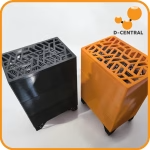
D-Central’s Bitcoin Space Heaters are purpose-built for exactly this use case. We take proven ASIC platforms (S9, S19, and others) and re-engineer them into enclosed, sound-dampened heating units with controlled airflow. For a printing facility, these units can be deployed as supplemental heaters throughout the workspace — each one mining Bitcoin while keeping your production floor warm.
Isolated Mining Room with Heat Transfer
For larger deployments (20+ miners), the best practice is to build a dedicated mining room — essentially a hot aisle/cold aisle setup — with insulated walls, intake fans, and exhaust ducting that routes into the facility’s main air handler. This approach gives you:
- Noise isolation: A properly insulated mining room brings noise levels in the main production area down to negligible levels.
- Temperature control: You can regulate how much mining heat enters the printing area using motorized dampers and thermostatic controls. In summer, excess heat vents outdoors; in winter, it feeds the building.
- Clean separation: Printing processes (especially screen printing and offset) can be sensitive to particulate matter. Keeping miners in a separate filtered environment protects both the miners and your print quality.
Hydronic Heat Recovery (Advanced)
For facilities with hot water or radiant floor heating systems, immersion-cooled miners offer an elegant solution. Miners are submerged in dielectric fluid, which is pumped through a heat exchanger to transfer thermal energy into the building’s hydronic loop. This is more complex and expensive to set up, but offers the highest efficiency and zero noise in the production area. This approach is particularly relevant for large-format printing operations that use heated platens or require precise temperature zones.
The Financial Case: Dual Revenue Streams
Here is where this gets interesting for printing facility owners. Let us model a modest deployment of 10 Antminer S21 units in a Canadian printing facility:
| Parameter | Value |
|---|---|
| Number of miners | 10 x Antminer S21 |
| Total hashrate | 2,000 TH/s (2 PH/s) |
| Total power consumption | 35 kW |
| Monthly electricity cost (@ $0.08/kWh CAD) | ~$2,016 CAD |
| Heat output | ~119,420 BTU/hr |
| Natural gas offset (heating season, ~6 months) | $600-$1,200 CAD/month |
| Bitcoin earned (variable, depends on BTC price and difficulty) | Variable — sats accumulate daily |
The critical insight is the heating offset. During Canadian heating season (roughly October through April), those 10 miners are not just consuming electricity to mine Bitcoin — they are replacing natural gas or electric heating that you would have paid for anyway. This effectively subsidizes your mining operation’s electricity cost by $600-$1,200/month, depending on your facility’s heat demand and local gas prices.
When you factor in the heating offset, your net electricity cost for mining drops significantly. This is the same principle behind D-Central’s Bitcoin Space Heaters for home miners, scaled up for commercial operations. The heat is not waste — it is revenue from your heating budget redirected into Bitcoin.
Practical Considerations for Implementation
Electrical Infrastructure
Ten S21 miners draw approximately 35 kW at 240V. This requires a dedicated 200A circuit (or equivalent) from your electrical panel. Most commercial printing facilities with three-phase service can accommodate this, but you will need a licensed electrician to install dedicated circuits with appropriate breakers, outlets (typically NEMA 6-20R or hardwired), and potentially a sub-panel for the mining room. Budget $3,000-$8,000 CAD for electrical work depending on complexity.
Noise Management
This is non-negotiable. ASIC miners are loud. An Antminer S21 runs at approximately 75 dB — comparable to a busy restaurant or a vacuum cleaner. Ten of them in an open room approach 85 dB, which exceeds OSHA/WorkSafeBC exposure limits for prolonged periods. Solutions include:
- Dedicated mining room with sound insulation (mineral wool, mass-loaded vinyl, double drywall)
- D-Central’s Space Heater enclosures which reduce noise by 20-30 dB per unit
- Custom shrouds and duct silencers on exhaust paths
- Locating the mining room away from production areas and offices
Network and Monitoring
Each miner needs a wired Ethernet connection (Wi-Fi is unreliable for mining). You will need a managed network switch, and we strongly recommend a mining management dashboard (such as Foreman or Awesome Miner) to monitor hashrate, temperatures, and alerts. D-Central’s mining consulting service can help you design and configure the entire network and monitoring stack.
Seasonal Heat Management
Canadian printing facilities benefit from mining heat for roughly 6-7 months of the year. During summer, that heat becomes a liability. You need a plan for warm months:
- Exhaust venting: Motorized dampers that redirect hot air outdoors when indoor temperatures are sufficient
- Reduced operation: Underclocking or shutting down some miners during peak summer (though this reduces Bitcoin earnings)
- Dedicated cooling: Industrial exhaust fans and fresh air intake for the mining room, sized for full heat load
In Quebec and much of Canada, cooling season is relatively short — typically late June through early September. For the majority of the year, mining heat is an asset.
Getting Started: A Phased Approach
We recommend printing facility owners take a phased approach rather than going all-in on day one:
Phase 1: Proof of Concept (1-3 Miners)
Start with one to three miners or D-Central Space Heater units. Place them in a designated area, duct the exhaust into your workspace, and monitor the thermal impact over 30-60 days. This gives you real data on heat contribution, noise levels, electricity costs, and Bitcoin earnings without major infrastructure investment. Total investment: $5,000-$15,000 CAD including hardware.
Phase 2: Scaling Up (5-15 Miners)
Once you have validated the concept, invest in a proper mining room with sound insulation, dedicated electrical circuits, and ducted heat distribution. This is where the heating offset becomes meaningful and the Bitcoin earnings start to compound. Budget $15,000-$50,000 CAD for hardware, electrical, and buildout.
Phase 3: Optimization
Fine-tune your setup with automated damper controls, monitoring dashboards, and potentially immersion cooling if you want to push efficiency further. Explore underclocking for better J/TH efficiency during shoulder seasons when full heat output is not needed. Consider connecting your mining heat to specific curing or drying processes for direct thermal application.
Why D-Central Is the Right Partner for This
D-Central Technologies has been in the Bitcoin mining business since 2016. We are not a generic hardware reseller — we are Bitcoin Mining Hackers. We take institutional-grade mining technology and engineer it into solutions that work for real businesses and home miners. Here is what we bring to printing facility operators:
- Purpose-built hardware: Our Bitcoin Space Heater line is designed specifically for heat recovery applications. Sound-dampened, controlled airflow, plug-and-mine simplicity.
- Full ASIC inventory: We stock all major mining platforms in our online shop — from entry-level open-source miners like the Bitaxe to full-scale Antminer S21 units.
- Repair and maintenance: When a hashboard goes down, you do not want to ship it overseas. Our ASIC repair service handles board-level diagnostics and repair in-house, right here in Canada. Over thousands of miners repaired and counting.
- Consulting: Our mining consulting team can assess your facility, design the integration, and support deployment from start to finish.
- Hosting options: If you want to mine Bitcoin but do not want hardware on-site, our Quebec hosting facility offers competitive rates with Canadian hydro power.
The Bigger Picture: Decentralizing Bitcoin Mining, One Facility at a Time
There is a reason D-Central’s mission is the decentralization of every layer of Bitcoin mining. When a printing facility in Montreal, a machine shop in Calgary, or a warehouse in Winnipeg starts mining Bitcoin with their waste heat, that is hashrate that does not belong to a mega-corp data center in Texas or a state-owned operation overseas. Every commercial facility that adds even a few miners to their heating infrastructure contributes to a more distributed, more resilient, more censorship-resistant Bitcoin network.
The technology-first case is clear: Bitcoin mining is energy conversion. Printing facilities need heat. The synergy is real, the economics are favorable (especially in Canada with our cold climate and relatively affordable electricity), and the mission aligns with building a more decentralized financial infrastructure for everyone.
If you run a printing facility and you are still paying full price for natural gas heating while leaving your electrical capacity underutilized, it is time to think like a Mining Hacker. Your heaters should be earning Bitcoin.
Frequently Asked Questions
How much can a printing facility save on heating by using Bitcoin miners?
Savings depend on facility size, local energy rates, and the number of miners deployed. A modest setup of 10 Antminer S21 units produces approximately 119,000 BTU/hr of heat — enough to significantly offset heating costs for a 5,000 sq ft facility. In Canadian markets, this can translate to $600-$1,200 CAD per month in natural gas savings during the October-April heating season, while simultaneously earning Bitcoin.
What equipment do I need to start mining Bitcoin in my printing facility?
At minimum, you need ASIC mining hardware (such as the Antminer S21 or a D-Central Bitcoin Space Heater), a dedicated 240V electrical circuit, wired Ethernet connectivity, and a plan for routing the hot exhaust air into your workspace. For a proof-of-concept, one to three miners is sufficient. For larger deployments, you will need a dedicated mining room with sound insulation and ducted heat distribution. D-Central’s consulting team can design the full setup for your specific facility.
How loud are Bitcoin miners, and will they disrupt printing operations?
Individual ASIC miners typically produce 70-80 dB of noise, comparable to a vacuum cleaner. Multiple units in an open space can exceed safe workplace exposure levels. The solution is either a sound-insulated mining room (separate from the production floor) or D-Central’s Bitcoin Space Heater enclosures, which reduce noise by 20-30 dB per unit. With proper planning, mining noise should be imperceptible in the production area.
What happens to the mining heat during summer when I do not need heating?
During warm months, mining heat must be vented outdoors using exhaust fans and motorized dampers. Many Canadian facilities only experience true cooling season for 2-3 months (late June through early September). Some operators choose to underclock miners for better efficiency during shoulder seasons or shut down a portion of their fleet during peak summer. Automated damper systems can switch between indoor heating and outdoor venting based on thermostat readings.
Is Bitcoin mining still profitable in 2026 with the current difficulty and halving?
Mining profitability depends on your electricity rate, hardware efficiency, and the Bitcoin price. With the block reward at 3.125 BTC and network hashrate above 800 EH/s, margins are tighter than previous cycles. However, for printing facilities, the critical advantage is the heating offset — the heat your miners produce replaces heating fuel you would have purchased regardless. This effectively subsidizes your electricity cost and makes mining profitable at electricity rates that would otherwise be marginal.
Can D-Central help with the full setup, from planning to deployment?
Yes. D-Central offers end-to-end support through our mining consulting service. We assess your facility’s electrical capacity, heating requirements, and available space, then design an integration plan that includes hardware selection, room layout, ducting, electrical specifications, and monitoring. We also supply the mining hardware through our shop and provide ongoing ASIC repair support to keep your miners running.