The Physics Are Simple: Every Watt Becomes Heat
Here is an uncomfortable truth that the legacy heating industry does not want you to think about: every electric heater on the market — baseboard, ceramic, oil-filled, infrared — converts electricity to heat at essentially the same ratio. One watt in, one watt of heat out. That is the first law of thermodynamics. There is no magic.
So if you are going to convert electricity into heat anyway, why not run those watts through an SHA-256 ASIC chip first and stack sats while you stay warm?
That is the premise behind Bitcoin mining heaters — and it is not theoretical. D-Central Technologies has been building, tuning, and shipping these dual-purpose machines since 2016. We take institutional-grade ASIC mining hardware, hack it for residential use, and put it in your living room. The heat is identical to any electric heater. The difference is that a Bitcoin mining heater also secures the most decentralized monetary network in human history while it warms your house.
No other heater on the market does useful computational work. Yours can.
Why Bitcoin Mining Heaters Make Sense in 2026
The Bitcoin network hashrate has blown past 800 EH/s. Difficulty sits above 110 trillion. The block reward is 3.125 BTC after the 2024 halving. At these levels, large-scale mining operations squeeze margins relentlessly — but home miners playing the heating game operate on completely different economics.
Here is why:
- You were going to heat your home anyway. In Canada, heating season runs 6 to 8 months. That electricity cost is already in your budget. A mining heater displaces your existing electric heater at zero marginal cost for the heat — the Bitcoin earned is pure upside.
- Thermodynamics does not care about difficulty. Whether your miner earns 1,000 sats/day or 100 sats/day, it still outputs the same BTUs per watt. The heat value is constant. The Bitcoin is a bonus.
- You strengthen decentralization. Every home miner running a space heater adds hashrate outside of institutional data centers. That is the mission: decentralization of every layer of Bitcoin mining.
If you are running a 1,500W electric baseboard heater in your basement right now, you are literally burning money into dumb heat. Swap it for a Bitcoin space heater and that same 1,500W produces identical warmth plus contributes to Bitcoin’s security. The decision is obvious.
D-Central’s Bitcoin Space Heater Lineup
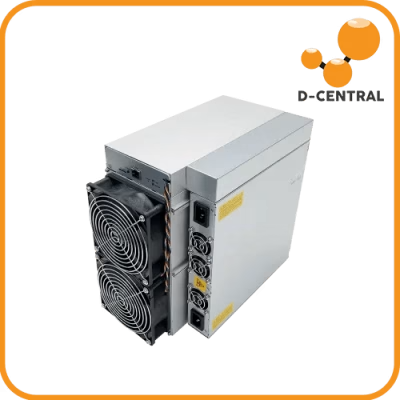
D-Central Technologies builds multiple space heater configurations, each based on proven ASIC hardware that has been custom-tuned for residential noise levels, airflow, and thermal management. Here is the current lineup:
| Model | Hashrate | Power Draw | Heat Output (BTU/h) | Noise Level | Best For |
|---|---|---|---|---|---|
| S9 Space Heater Edition | 4–13.5 TH/s | 300–1,150W | 1,023–3,925 | ~40–50 dB | Bedrooms, offices, small rooms |
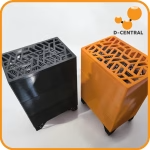
| BitChimney (Normal) | 31 TH/s | 750W | ~2,559 | 49 dB | Living rooms, dens |
| BitChimney (High Power) | 38 TH/s | 950W | ~3,241 | 56 dB | Open-plan spaces |
| Antminer Slim Edition | Up to 50 TH/s | 1,000–1,500W | 3,412–5,118 | ~45–55 dB | Garages, workshops, basements |
| Antminer Loki Edition | Up to 56 TH/s | 1,000–1,200W | 3,412–4,095 | ~45–55 dB | Dedicated mining rooms, basements |
| Antminer Pivotal Edition | Varies by config | 1,200–1,800W | 4,095–6,143 | ~50–60 dB | Large rooms, heated garages |
Every model listed above is available at d-central.tech/bitcoin-space-heaters.
BTU Output: The Math That Makes It Work
Every electrical device converts watts to heat at the same rate: 1 watt = 3.412 BTU/h. This is physics, not marketing. Here is what that means for Bitcoin mining heaters:
| Power Draw | Heat Output | Equivalent To |
|---|---|---|
| 300W | 1,024 BTU/h | Small personal space heater |
| 750W | 2,559 BTU/h | Medium ceramic heater |
| 1,150W | 3,924 BTU/h | Standard portable heater |
| 1,500W | 5,118 BTU/h | Typical baseboard section |
| 1,800W | 6,142 BTU/h | Large room heater |
A standard Canadian bedroom needs roughly 3,000–5,000 BTU/h depending on insulation, window area, and exterior temperature. A single S9 Space Heater Edition running at full power (1,150W / ~3,925 BTU/h) comfortably heats a well-insulated 150 sq ft room in a Montreal winter. Need more coverage? Run two units, or step up to a Slim or Loki Edition for a larger space.
Noise Levels: Residential-Ready, Not Data-Center Loud
The number one concern home miners raise is noise. Fair enough — a stock Antminer S19 at full tilt screams at 75+ dB, like a vacuum cleaner that never stops. That is unacceptable in a home.
D-Central’s space heater editions solve this in multiple ways:
- Custom fan profiles: We flash modified firmware that reduces fan RPM while maintaining safe operating temperatures at lower hashrates.
- Aftermarket fans: Quieter, higher-quality fans replace the stock industrial blowers.
- Shroud + duct systems: Our Universal ASIC Shrouds channel airflow into ductwork, letting you direct heat where you want it and exhaust noise into another room or outside.
- Underclocking: Running an S19-class chip at 50-70% power dramatically cuts noise while still producing meaningful heat and hashrate.
Real-world noise levels by model:
| Model | Noise (dB) | Comparable To |
|---|---|---|
| S9 Space Heater (low power) | ~40 dB | Quiet library, light rainfall |
| S9 Space Heater (full power) | ~50 dB | Quiet conversation, refrigerator hum |
| BitChimney (normal mode) | 49 dB | Quiet office environment |
| BitChimney (high power) | 56 dB | Normal conversation |
| Slim/Loki Edition (tuned) | ~45–55 dB | Dishwasher, moderate fan |
For comparison, a typical portable electric space heater runs at 35–45 dB. Bitcoin mining heaters are louder — but not dramatically so, especially the S9 and BitChimney models. Most people adjust within a day or two. It becomes white noise.
Electrical Requirements: What Your Home Needs
Before you order, check your electrical panel. Here is what each tier of mining heater requires:
| Power Tier | Circuit Required | Models | Notes |
|---|---|---|---|
| 300–1,150W | Standard 15A / 120V | S9 Space Heater Edition | Plugs into any household outlet |
| 750–950W | Standard 15A / 120V | BitChimney | Plugs into any household outlet |
| 1,000–1,500W | Dedicated 15A / 120V | Slim Edition, Loki Edition | Should not share circuit with other large loads |
| 1,500–1,800W | Dedicated 20A / 120V or 240V | Pivotal Edition | Electrician may be needed for 240V install |
Most Canadian homes have 100A or 200A electrical service. A single Bitcoin space heater at 1,000W draws about 8.3A on a 120V circuit — well within a standard 15A breaker’s capacity (which is rated for 12A continuous). You likely have spare capacity already.
The Canadian Advantage: Why We Are Built for This
Canada is arguably the best country on Earth for Bitcoin mining heaters, and it is not even close. Here is why:
Long heating season. From October through April — six to seven months — Canadians run electric heaters, furnaces, and heat pumps. In northern regions and Quebec, that extends to eight months. Every month of heating season is a month where your mining heater’s electricity cost is effectively offset by displaced heating costs.
Cheap hydroelectric power. Quebec residential rates sit around $0.06–0.09 CAD/kWh. Ontario’s off-peak rates are competitive too. Compared to the US average of $0.12–0.16 USD/kWh, Canadian miners enjoy a structural advantage.
Cold ambient air. ASIC chips run cooler and more efficiently when intake air is cold. A miner pulling in -20C garage air in January runs significantly cooler than the same unit in a Texas data center at 35C. Cooler chips last longer and can be pushed harder.
Decentralization. Canada’s hashrate contribution strengthens the geographic distribution of Bitcoin’s security. Every Canadian home miner running a space heater is a node of resistance against mining centralization. We are the North, and we mine.
If you are in Quebec, Manitoba, or British Columbia — where hydro rates are lowest — the economics of mining heaters are exceptionally strong. And if your home already runs electric baseboard heating, the swap is literally plug-and-play.
Setting Up Your Bitcoin Mining Heater: Practical Guide
Getting a D-Central space heater running in your home takes about 30 minutes. Here is the process:
1. Choose your location. Pick a room where you want supplemental heat. Basements, home offices, garages, and living rooms are the most popular placements. Ensure there is adequate airflow — the miner needs to pull in cool air and exhaust warm air.
2. Check your circuit. Verify you have a circuit with enough capacity (see the electrical requirements table above). Avoid daisy-chaining with other high-draw appliances.
3. Connect to your network. All D-Central space heater editions connect via Ethernet or WiFi. You will need network access to configure your mining pool, monitor hashrate, and adjust settings.
4. Configure your pool. Point your miner to a mining pool of your choice. For maximum sovereignty, consider solo mining — every hash counts. For more consistent (but smaller) payouts, a pool like Ocean or Braiins is a solid choice.
5. Manage airflow. For directed heating, pair your miner with a Universal ASIC Shroud and flexible ductwork to channel warm air exactly where you need it — into an adjacent room, through a wall, or into your home’s existing duct system.
6. Monitor and tune. Check your miner’s dashboard periodically. Adjust hashrate up or down based on your heating needs. In milder weather, reduce power. When it hits -30C outside, crank it.
If anything goes wrong — a hashboard fails, a fan dies, or you get an error code — D-Central offers full ASIC repair services with fast turnaround. We built these machines. We know how to fix them.
Summer Strategy: What To Do When Heating Season Ends
The obvious question: what happens in July?
You have options:
- Duct the heat outside. Use a shroud and inline fan (like a Cloudline T6) to exhaust hot air out a window or through a wall vent. The miner keeps hashing, and the heat goes outside.
- Move it to the garage or basement. Cooler, less-occupied spaces can absorb the heat without making your living area uncomfortable.
- Reduce hashrate. Drop to 30-50% power for lower heat output while still stacking sats.
- Shut it down for 2-3 months. In the hottest months, some miners simply power off. You still got 6-8 months of free heating and Bitcoin. That math still works.
- Send it for maintenance. Summer downtime is the perfect window for a professional cleaning, thermal paste refresh, and diagnostic check at D-Central’s repair shop.
The beauty of the heating model is that even if you only run your miner during heating season, the economics are favorable. You are not paying extra for electricity — you are redirecting money you were already spending on heat.
Mining Heaters vs. Traditional Electric Heaters
Let us compare directly:
| Feature | Traditional Electric Heater | Bitcoin Mining Heater |
|---|---|---|
| Heat per watt | 3.412 BTU/W | 3.412 BTU/W (identical) |
| Useful work performed | None | SHA-256 hashing / Bitcoin mining |
| Bitcoin earned | 0 sats | Varies by hashrate and difficulty |
| Supports Bitcoin network | No | Yes — contributes hashrate |
| Noise level | ~35–45 dB | ~40–56 dB (model dependent) |
| Repairable | Usually disposable | Fully repairable (hashboards, fans, PSUs) |
| Resale value | Near zero | Retains value as mining hardware |
| Decentralizes Bitcoin | No | Yes |
Same heat. Same electricity cost. But one of them stacks sats and strengthens the most important network in the world.
Who Should Run a Bitcoin Mining Heater?
Bitcoin mining heaters are not for everyone, and we will not pretend otherwise. They are ideal for:
- Home miners who want to offset heating costs with Bitcoin earnings
- Bitcoin maximalists who want to contribute hashrate to the network from home
- Canadians (and anyone in cold climates) with 6+ months of heating season
- Homeowners with electric heating — the swap from baseboard to mining heater is direct
- DIY enthusiasts and tinkerers who enjoy configuring and optimizing hardware
- Anyone who believes in decentralization and wants to put their money where their conviction is
If you have never touched mining hardware before, the S9 Space Heater Edition is the perfect entry point — low cost, low power, easy to configure, and quiet enough for a bedroom. If you want more hashrate and heat, the BitChimney or Slim Edition step you up. For dedicated setups, the Loki and Pivotal Editions deliver serious output.
Not sure which model is right for your space? Talk to our consulting team — we will help you size the right setup for your home, your electrical capacity, and your goals.
Beyond Solo Units: The Bitaxe for Micro-Heating
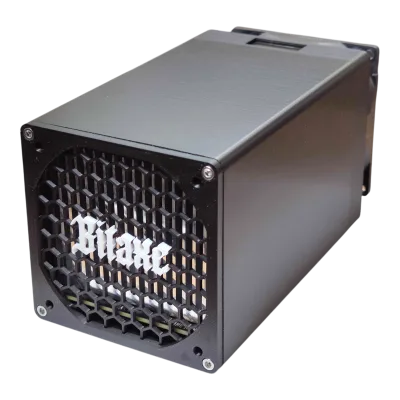
For the smallest rooms — or for those who just want to dip a toe into mining — the Bitaxe family of open-source solo miners is worth considering. At 5-15W per unit, a single Bitaxe will not heat a room, but a cluster of them on a shelf generates a few watts of gentle warmth, solo-mines Bitcoin, and looks cool doing it.
D-Central is a pioneer in the Bitaxe ecosystem — we created the original Bitaxe Mesh Stand and developed leading accessories including custom heatsinks and cases. We stock every Bitaxe variant: Supra, Ultra, Hex, Gamma, and GT.
The Bitaxe is not a space heater replacement. It is a sovereignty statement that happens to produce a small amount of heat. Every hash counts.
Frequently Asked Questions
How many BTUs does a Bitcoin mining heater produce?
Every watt consumed by an ASIC miner converts to approximately 3.41 BTU/h of heat. A 750W Bitcoin space heater produces roughly 2,559 BTU/h, a 1,200W unit outputs about 4,095 BTU/h, and a full-power 3,250W setup delivers around 11,093 BTU/h. This is comparable to or exceeds most portable electric space heaters on the market.
Are Bitcoin mining heaters loud? Can I use one in a bedroom?
D-Central’s space heater editions are custom-tuned for residential noise levels. The S9 Space Heater Edition runs at approximately 40-50 dB depending on fan speed, comparable to a quiet conversation. The BitChimney operates at 49 dB in normal mode. For bedrooms, the lower-wattage S9 edition is the best fit.
What electrical circuit do I need for a Bitcoin space heater?
Most D-Central space heater editions run on a standard 15A/120V household circuit. The S9 Space Heater Edition at 300-1,150W fits easily on any outlet. Higher-wattage units should ideally have a dedicated 15A circuit. For units exceeding 1,800W, a dedicated 20A circuit or 240V outlet is recommended.
Do Bitcoin mining heaters work in summer?
Yes, but you need a plan for the heat. You can duct the hot air outside using D-Central’s Universal ASIC Shrouds and Cloudline inline fans, reduce hashrate, move the miner to a cooler space, or simply shut down for 2-3 months. In Canada, where heating season runs 6-8 months, the economics are heavily favorable even with summer downtime.
How much Bitcoin can I earn with a mining heater?
Earnings depend on hashrate, electricity cost, and network difficulty. At current difficulty levels above 110 trillion (as of 2026), a mining heater earns a modest amount of satoshis daily. The real value proposition is that the heat is free — you were going to spend money heating your home anyway. The Bitcoin earned is a bonus on top of heat you already needed.
Is Bitcoin mining with a space heater profitable in Canada?
Canada is one of the best places on Earth for mining heater economics. Long winters (6-8 months of heating season) mean months of effectively free mining. Quebec hydro rates average $0.06-0.09 CAD/kWh, among the lowest in North America. When your heater displaces electric baseboard costs and you earn Bitcoin on top, the math works strongly in your favor.
Can I connect a Bitcoin mining heater to my home’s ductwork?
Yes. With D-Central’s Universal ASIC Shrouds and flexible ducting, you can channel the heated exhaust air into your existing duct system, through a wall, or into an adjacent room. This is one of the most popular configurations for whole-home supplemental heating.
What happens if my mining heater breaks?
D-Central offers comprehensive ASIC repair services with fast turnaround. We built these machines and we know how to fix them — hashboard replacements, fan swaps, PSU diagnostics, firmware reflashing. We have repaired thousands of miners since 2016.
Start Heating With Bitcoin
Your electric heater converts watts to heat and nothing else. A Bitcoin mining heater converts those same watts to the same heat — plus satoshis, plus hashrate for the network, plus a step toward true decentralization of Bitcoin mining.
D-Central Technologies has been building these machines since 2016. We are Canada’s Bitcoin Mining Hackers — taking institutional-grade ASIC hardware and hacking it for your living room. Every unit we ship is tested, tuned, and ready to heat your home while stacking sats.
Browse the full lineup at d-central.tech/bitcoin-space-heaters, or visit our shop for the complete catalog of miners, parts, and accessories.
Every watt heats. Every hash counts.