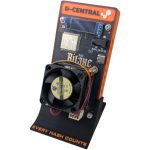
The open-source Bitcoin mining movement has produced two standout platforms: the Bitaxe and the NerdAxe. Both are designed for solo mining — the act of pointing your hashrate directly at the Bitcoin network, rolling the dice for a full block reward without intermediaries. But they take fundamentally different approaches to hardware design, performance, and user experience.
D-Central Technologies has been a pioneer in the Bitaxe ecosystem since the beginning — creating the original Bitaxe Mesh Stand, developing leading heatsink solutions, and stocking every variant alongside the full Nerd lineup. This gives us a unique vantage point to compare these platforms honestly.
This guide breaks down every meaningful difference so you can choose the right solo miner for your setup.
The Philosophy Behind Each Platform
Both the Bitaxe and NerdAxe are fully open-source hardware. Schematics, PCB layouts, and firmware are publicly available. Anyone can manufacture them. This is the cypherpunk way — trustless, verifiable, sovereign hardware.
The Bitaxe family (created by Skot) focuses on extracting maximum hashrate from individual ASIC chips. Starting with the original Bitaxe based on the BM1387, the lineup has evolved through the Supra (BM1366), Ultra (BM1368), Gamma (BM1370), and the flagship Bitaxe Hex — a six-chip board pushing serious hashrate for an open-source device.
The NerdAxe (from the BitMaker community) takes a different path. Built around the BM1368 chip, it emphasizes a compact, integrated form factor with an onboard display and a focus on educational value and simplicity.
Hardware Specifications Compared
| Specification | Bitaxe Supra (BM1366) | Bitaxe Ultra (BM1368) | NerdAxe (BM1368) |
|---|---|---|---|
| ASIC Chip | Bitmain BM1366 | Bitmain BM1368 | Bitmain BM1368 |
| Chip Count | 1 | 1 | 1 |
| Typical Hashrate | 500-600 GH/s | 500-700 GH/s | 500-600 GH/s |
| Power Draw | ~12-15W | ~12-15W | ~12-15W |
| Power Connector | 5V DC barrel jack (5.5×2.1mm) | 5V DC barrel jack (5.5×2.1mm) | 5V DC barrel jack (5.5×2.1mm) |
| PSU Required | 5V / 6A | 5V / 6A | 5V / 6A |
| WiFi | ESP32-S3 (2.4GHz) | ESP32-S3 (2.4GHz) | ESP32-S3 (2.4GHz) |
| Display | Optional (external) | Optional (external) | Built-in OLED |
| USB-C Port | Firmware flashing / serial only | Firmware flashing / serial only | Firmware flashing / serial only |
| Cooling | 40mm fan + heatsink | 40mm fan + heatsink | 40mm fan + heatsink |
| Firmware | AxeOS (ESP-Miner) | AxeOS (ESP-Miner) | NerdMiner-derived |
Critical note: Both the Bitaxe and NerdAxe are powered via a 5V DC barrel jack (5.5×2.1mm) — NOT USB-C. The USB-C port on these devices is exclusively for firmware flashing and serial communication. Using USB-C for power will not provide sufficient current and may damage components. Always use the included or recommended 5V/6A power supply.
Multi-Chip Variants: Scaling Up
Both ecosystems offer multi-chip options for miners who want more hashrate from the open-source platform:
| Device | Chips | Hashrate | Power Connector |
|---|---|---|---|
| Bitaxe Hex | 6x BM1366 | ~3+ TH/s | 12V DC XT30 |
| NerdQAxe++ | 4x BM1368 | ~2+ TH/s | 12V DC XT30 |
| NerdOctaxe Gamma | 8x BM1370 | ~6+ TH/s | 12V DC XT60 |
Notice how the multi-chip variants step up to 12V DC connectors (XT30 or XT60) to handle the increased power demand. The NerdOctaxe Gamma requires an 18-20A PSU, while the NerdQAxe++ needs a 10A supply.
Setup and Configuration
Bitaxe Setup Process
- Power on using the 5V/6A barrel jack PSU
- Connect to the Bitaxe WiFi access point from your phone or computer
- Navigate to the web interface (typically 192.168.4.1)
- Enter your WiFi credentials, mining pool URL, and Bitcoin address
- Save and reboot — the device connects and begins hashing
The Bitaxe runs AxeOS, a clean web-based interface that shows hashrate, temperature, fan speed, and share statistics in real time. Configuration is entirely browser-based — no apps, no accounts, no third-party dependencies. Pure sovereignty.
NerdAxe Setup Process
- Power on using the 5V/6A barrel jack PSU
- The built-in OLED display shows device status immediately
- Connect to the NerdAxe WiFi AP
- Configure via the web interface with pool details and wallet address
- Monitor directly on the OLED or through the web UI
The NerdAxe firmware is derived from the NerdMiner project and offers a slightly different interface. The built-in OLED display is a standout feature — you can see your hashrate and mining status at a glance without opening a browser.
Performance and Efficiency
In terms of raw hashrate per chip, both platforms deliver similar performance since they use the same ASIC chips. A BM1368-based Bitaxe Ultra and a BM1368-based NerdAxe will produce comparable hashrates under similar conditions.
The real performance differences emerge in:
- Thermal management: The Bitaxe ecosystem has a wider range of aftermarket heatsink options (including D-Central purpose-built heatsinks), which can enable more aggressive overclocking
- Firmware tuning: AxeOS has a mature autotuning system that dynamically adjusts voltage and frequency for optimal efficiency
- Overclocking headroom: Both platforms support overclocking through their respective firmware interfaces, but community-reported results vary by individual chip quality
Build Quality and Form Factor
The Bitaxe follows a standardized PCB layout that has become the de facto open-source mining form factor. This standardization means a rich ecosystem of cases, stands, and accessories — including the D-Central original Mesh Stand design, which provides optimal airflow for passive and active cooling.
The NerdAxe has a more compact, integrated design with the OLED screen built directly onto the PCB. It is a visually appealing device that works well as a desk piece or educational display.
Ecosystem and Accessories
| Category | Bitaxe Ecosystem | NerdAxe Ecosystem |
|---|---|---|
| Cases | Multiple third-party and D-Central options | Growing selection |
| Heatsinks | D-Central custom heatsinks, aftermarket options | Standard included heatsink |
| Stands | D-Central Mesh Stand (original), 3D printed options | 3D printed community designs |
| Firmware | AxeOS (active development, large community) | NerdMiner-based (active development) |
| Community Size | Largest open-source mining community | Growing, dedicated community |
| Multi-chip Options | Bitaxe Hex (6-chip) | NerdQAxe++ (4-chip), NerdOctaxe (8-chip) |
D-Central stocks the complete lineup of both ecosystems. Browse our full selection of open-source miners to see every available variant.
Solo Mining: The Shared Mission
Both the Bitaxe and NerdAxe exist for one primary purpose: solo mining Bitcoin. This means pointing your device at the Bitcoin network (typically through a solo mining pool like Solo CKPool) and attempting to find a valid block on your own.
The math is straightforward — and humbling. At 500 GH/s against a network difficulty measured in hundreds of trillions, your odds of finding a block in any given day are astronomically low. But every hash has the same chance. Solo miners have hit blocks with sub-terahash devices. It happens.
The point is not the expected value calculation. The point is sovereignty. Your hardware, your electricity, your node, your keys. No pool operator taking a cut. No KYC. No counterparty risk. This is Bitcoin mining as Satoshi envisioned it.
For a deeper dive into solo mining probability and strategy, visit our Bitaxe Hub — the most comprehensive Bitaxe resource on the web.
Which Should You Choose?
Choose the Bitaxe if:
- You want the largest accessory and upgrade ecosystem
- You plan to overclock and optimize aggressively
- You want the most widely supported firmware (AxeOS)
- You are scaling to multi-chip setups (Bitaxe Hex)
- You want the widest community for support and knowledge sharing
Choose the NerdAxe if:
- You want a built-in OLED display for at-a-glance monitoring
- You value the compact, all-in-one form factor
- You are interested in the broader Nerd ecosystem (NerdQAxe++, NerdOctaxe)
- You want a visually striking desk piece that doubles as a miner
- You plan to scale into multi-chip NerdAxe variants
The Best Answer: Both
Many serious open-source mining enthusiasts run both platforms. They are complementary, not competing. Each device you add to your solo mining fleet increases your total hashrate and your chance at a block — while simultaneously strengthening Bitcoin decentralization by adding another independent node to the network.
Use our miner comparison tool to see detailed side-by-side specifications of every open-source miner we carry.
Where to Buy
D-Central Technologies stocks every Bitaxe variant (Supra, Ultra, Gamma, Hex, GT), every NerdAxe variant (NerdAxe, NerdQAxe++, NerdOctaxe), and the full range of accessories for both platforms. As a pioneer in the Bitaxe ecosystem — the company that created the original Bitaxe Mesh Stand and developed purpose-built heatsinks for these devices — we ensure quality control on every unit we ship.
All products ship from Canada with worldwide delivery available. Browse our complete open-source miner collection.
Frequently Asked Questions
Can I power a Bitaxe or NerdAxe with USB-C?
No. The USB-C port on both devices is for firmware flashing and serial communication only. Power must be supplied through the 5V DC barrel jack (5.5×2.1mm) using a 5V/6A power supply. Using USB-C for power will not provide sufficient current.
What are my realistic chances of solo mining a block?
With a single device running at ~500 GH/s, the expected time to find a block is measured in thousands of years. However, probability is memoryless — every hash has the same infinitesimal chance. Solo miners have found blocks with small devices. The appeal is sovereignty and the lottery aspect, not expected value.
Can I mine to a pool instead of solo mining?
Yes. Both the Bitaxe (AxeOS) and NerdAxe support Stratum protocol and can connect to any compatible mining pool. However, most open-source miner operators choose solo mining — it aligns with the decentralization ethos of these devices.
Which device is louder?
Both use small 40mm fans and produce minimal noise — typically under 40 dB. Neither will be noticeable in a normal room environment. The exact noise level depends on fan speed settings and cooling configuration.
Do I need to run a Bitcoin node to solo mine?
Not necessarily. Most solo miners point their devices at Solo CKPool or a similar solo mining proxy. However, running your own node with a solo mining setup is the ultimate sovereignty configuration and is recommended if you have the technical capability.
Can I use both Bitaxe and NerdAxe devices together?
Absolutely. Each device operates independently and can point to the same pool or wallet address. Running multiple devices from different platforms increases your total hashrate and fleet redundancy.