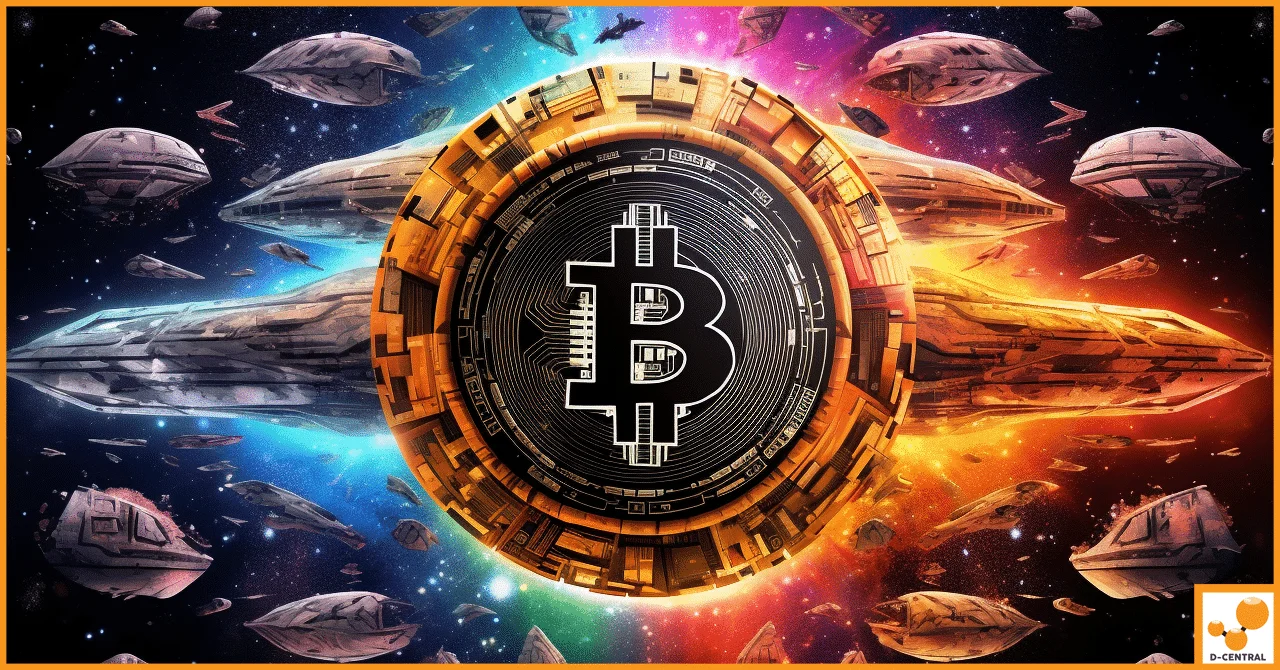
The second Death Star is dust. The Emperor is a smoldering crater at the bottom of a reactor shaft. Across the galaxy, fireworks erupt over Coruscant, Naboo, Tatooine, and Bespin. The Ewoks are drumming on stormtrooper helmets. The Empire — that bloated, centralized monstrosity that controlled every credit, every trade route, every chain code — is finished.
Return of the Jedi is not just the end of a trilogy. It is a blueprint for what happens when decentralized rebels refuse to quit, when a small band of idealists destroys a system that seemed invincible. And if you have been paying attention to Bitcoin since 2009, this story should feel very, very familiar.
This is Episode VI of our Star Wars, A Bitcoin Story series. If you have followed along from Episode I through Episode V, you know the parallels run deep. Now it is time for the finale — where both rebellions claim victory, and a new era begins.
The Fall of the Empire: How Centralized Power Always Collapses
The Galactic Empire’s fatal flaw was never military. It was architectural. A single point of failure — the Emperor — controlled everything. The Death Star was a monument to centralized hubris: concentrate all your power into one massive weapon, and pray nobody finds the exhaust port.
Spoiler: they always find the exhaust port.
The fiat monetary system has the same structural weakness. Central banks are the Emperor. Galactic Credits are the tool of enforcement. And the exhaust port? It is the money printer itself — the moment people realize that “unlimited quantitative easing” means “your savings are being vaporized,” the rebellion begins.
| Imperial System | Fiat Equivalent | Why It Falls |
|---|---|---|
| Emperor Palpatine | Central bank governors | Single point of failure, corrupted by unlimited power |
| Death Star | Quantitative easing / money printer | Destroys everything it touches, including allies |
| Galactic Credits | Fiat currency (USD, EUR, CAD) | Value controlled by decree, debased at will |
| Imperial chain codes | CBDCs / financial surveillance | Total surveillance breeds total resistance |
| Stormtroopers | Banking regulations and enforcement | Numerous but ultimately unable to stop guerrilla innovation |
The Empire did not collapse because the Rebellion had a bigger army. It collapsed because centralized systems are inherently fragile. One thermal exhaust port. One kid from Tatooine. One torpedo. Game over.
Bitcoin works the same way — except it is designed so there is no exhaust port to find. No central server. No CEO. No kill switch. Over 800 EH/s of hashrate distributed across thousands of miners worldwide. You cannot destroy what you cannot target.
The Rebel Alliance: A Decentralized Network of Misfits
The Rebel Alliance was never a centralized military power. It was a loose coalition of pilots, smugglers, Wookiees, Ewoks, former senators, and farmboys. They operated from hidden bases, communicated through encrypted channels, and struck where the Empire least expected. They were, in every meaningful sense, a peer-to-peer network.
Bitcoin’s network is identical in structure. There is no Rebel Command issuing orders from the top. Every node validates independently. Every miner competes honestly through proof-of-work. The protocol is the constitution, and no one — not miners, not developers, not exchanges — can unilaterally change the rules. The 21 million supply cap is as immutable as the laws of physics.
This is why home mining matters so much. Every Bitaxe humming on a desk, every repurposed Antminer heating a Canadian basement, every solo miner rolling the dice for a 3.125 BTC block reward — they are all Rebel X-wings. Small, fast, distributed, and collectively unstoppable.
Ewoks: The Home Miners of Endor
Let us talk about the Ewoks. The galaxy laughed at them. Teddy bears with sticks and rocks against the Empire’s finest legion of stormtroopers. And yet, the Ewoks turned the Battle of Endor. They used home-field advantage, improvised technology, and sheer determination to neutralize a technologically superior force.
Home miners are the Ewoks of Bitcoin. The institutions laugh — “You cannot mine profitably at home. You need megawatt facilities. You need cheap industrial power.” And yet, home miners keep hashing. They use excess solar, monetize waste heat, repurpose old ASICs as space heaters, and contribute to the most important metric in Bitcoin: decentralization of hashrate.
A Bitaxe pulling 500 GH/s on a 5V barrel jack is an Ewok catapult. An S19 Space Heater Edition warming a Quebec basement while stacking sats is a log trap taking out an AT-ST. Neither will win the battle alone. Together, they win the war.
The Throne Room: Bitcoin vs. CBDCs
The climax of Return of the Jedi happens in the Emperor’s throne room. Palpatine is confident. He has planned everything. Luke is trapped, the fleet is walking into an ambush, and the shield generator on Endor is (supposedly) protected. The Emperor believes his control is total.
This is exactly where central banks are right now with CBDCs — Central Bank Digital Currencies. They see Bitcoin succeeding and think: “We can do that, but with total surveillance built in.” Chain codes for every citizen. Programmable money that expires, that restricts what you can buy, that can be frozen with a keystroke.
But Palpatine’s confidence was his weakness. He did not account for Vader’s redemption — for the possibility that someone inside the system would reject it. And CBDCs face the same existential problem: the more aggressively governments push surveillance money, the more people opt out entirely into Bitcoin.
| Feature | CBDCs (The Empire) | Bitcoin (The Rebellion) |
|---|---|---|
| Supply control | Unlimited, adjusted by central authority | Hard cap: 21 million. Enforced by math |
| Privacy | Full surveillance — every transaction tracked | Pseudonymous, with privacy-enhancing tools |
| Censorship | Accounts can be frozen, funds seized | Censorship-resistant by design |
| Programmability | Expiry dates, purchase restrictions, social scoring | Neutral protocol — money is money |
| Network type | Centralized — single point of failure | Decentralized — 20,000+ nodes worldwide |
| Star Wars parallel | Imperial chain codes | The Force — cannot be controlled or destroyed |
The Emperor’s throne room is a reminder: total control is an illusion. The tighter you grip, the more systems slip through your fingers. Senator Organa said it first. Bitcoin proves it every ten minutes with a new block.
The Shield Generator: Proof-of-Work Is the Endor Mission
Before the Rebel fleet could attack the second Death Star, the shield generator on Endor had to fall. That ground mission — Han, Leia, Chewie, the droids, and a legion of Ewoks — was the unglamorous, boots-on-the-ground work that made everything else possible.
Proof-of-work mining is Bitcoin’s shield generator mission. It is not flashy. It is not cheap. Critics call it “wasteful” the same way Imperial officers dismissed the Endor garrison as unnecessary. But without proof-of-work, Bitcoin’s security falls apart. Without the shield generator down, the Death Star is invincible.
Every miner contributing hashrate — from a warehouse full of S21s to a single Bitaxe on a windowsill — is a Rebel commando on Endor. The work is real, the energy expenditure is real, and that reality is what makes Bitcoin’s ledger trustworthy. No amount of clever marketing or “energy-efficient consensus mechanisms” can replicate the thermodynamic security that proof-of-work provides.
This is why we build what we build at D-Central. ASIC repair, open-source miners, space heaters that mine while they warm your home — it is all ground-game work. Keeping hashrate distributed. Keeping the shield generator offline so the Empire cannot regroup.
Vader’s Redemption: When the System’s Own Enforcers Defect
Darth Vader was the Empire’s most feared enforcer for two decades. And in the end, he turned. He looked at his son being tortured by the Emperor and chose family over empire, freedom over power, love over control.
We are witnessing the same phenomenon in fiat finance. Former central bankers are buying Bitcoin. Traditional financial institutions are building Bitcoin infrastructure. Even some politicians who once dismissed it as “money for criminals” are now advocating for Bitcoin-friendly legislation. The enforcers are defecting.
Every time a legacy finance executive quietly adds Bitcoin to their personal portfolio, that is a Vader moment. Every time a traditional bank offers Bitcoin custody, that is an Imperial Star Destroyer turning its guns on the Death Star. The system is consuming itself.
But here is the critical lesson: Vader’s redemption did not make the Empire good. It destroyed the Empire. The defectors do not reform the fiat system — they accelerate its collapse by validating the alternative.
After the Victory: Building the New Republic (and Why It Is Hard)
Return of the Jedi ends with celebration, but the Expanded Universe shows that building the New Republic was messy, contentious, and imperfect. The Rebellion was great at destroying the Death Star but struggled with governance. Old Imperial factions lingered. New power struggles emerged.
Bitcoin faces similar growing pains. The block size wars. The mining centralization debates. The fee market evolution. The tension between privacy and transparency. Building a new monetary system on the rubble of the old one is hard, and the work is far from finished.
But here is what separates Bitcoin from the New Republic: Bitcoin has an incorruptible constitution. The protocol’s rules are enforced by mathematics, not politicians. There is no Chancellor to be corrupted, no Senate to be dissolved. The 21 million supply cap does not care about your political opinions, your nationality, or your net worth. It applies equally to everyone.
That incorruptibility is what gives Bitcoiners the conviction to keep building, keep mining, keep running nodes. The foundation is sound. The rest is just construction.
The Mining Hacker’s Role in the Post-Empire Galaxy
At D-Central, we have been in this fight since 2016 — back when mining was considered fringe even within the Bitcoin community. We are the Rebel mechanics, the engineers keeping X-wings flying, the hackers who take institutional-grade mining technology and make it accessible for the home miner.
We repair ASICs that the manufacturers consider disposable. We build custom space heaters that turn waste heat into household utility. We pioneered the Bitaxe Mesh Stand, developed heatsink solutions for every Bitaxe variant, and stock every open-source miner from the original Nerdminer to the latest NerdQAxe. We do this from Canada — from the frozen North — because decentralization means hashrate should exist everywhere, not just in jurisdictions with the cheapest electricity.
The Rebellion did not win because one person had the best weapon. It won because thousands of individuals made a choice to resist, each in their own way, with whatever tools they had. That is home mining. That is what we enable. That is the post-Empire galaxy we are building.
Lessons from Episode VI for Every Bitcoiner
| Return of the Jedi Moment | Bitcoin Parallel | Lesson for Miners |
|---|---|---|
| Ewoks defeat stormtroopers | Home miners decentralize hashrate | You do not need a megawatt facility to matter. Every hash counts |
| Shield generator destroyed | Proof-of-work secures the network | The unsexy ground work is what makes the whole system possible |
| Vader turns on the Emperor | Legacy finance adopts Bitcoin | Institutional adoption validates Bitcoin but does not reform fiat |
| Death Star II destroyed | 21M supply cap vs. infinite printing | Centralized power always has an exhaust port. Math does not |
| New Republic built imperfectly | Bitcoin governance and scaling debates | Building the future is messy, but the protocol is incorruptible |
| Celebration across the galaxy | Growing global adoption of Bitcoin | We are still early. The fireworks are just beginning |
Read the Full Series
This is Episode VI — the finale of our Star Wars, A Bitcoin Story saga. If you missed the earlier episodes, here is the full chronological order:
- Episode I: The Birth of Bitcoin and the Rise of Skywalker
- Episode II: Galactic Credits, Aurodium, and the Bitcoin Standard
- Episode III: Imperial Chain-Codes vs. Central Bank Digital Currencies
- Episode IV: From Satoshi’s White Paper to the Jedi Code
- Episode V: Andor’s Resistance and Bitcoin’s Fight Against the Fiat Empire
- Episode VI: Return of the Bitcoin — You are here
Frequently Asked Questions
How does Return of the Jedi parallel Bitcoin’s victory over fiat?
The Rebellion’s victory over the Empire mirrors Bitcoin’s challenge to centralized fiat money. Both represent decentralized, grassroots movements toppling systems built on centralized control. The Empire’s Galactic Credits, controlled by decree and backed by force, function identically to fiat currencies. Bitcoin — like the Rebellion — wins through distributed participation, not centralized firepower. No single entity controls Bitcoin, just as no single leader won the Battle of Endor.
Why are Ewoks the perfect metaphor for home miners?
Ewoks were underestimated by the Empire, used improvised technology, leveraged home-field advantage, and collectively defeated a vastly superior military force. Home miners face the same dismissal from industrial mining operations — yet they contribute meaningfully to hashrate decentralization, use creative solutions like mining-as-heating, and collectively form a distributed network that no centralized force can shut down. A Bitaxe on your desk is your Ewok catapult.
What is the Bitcoin parallel to the Death Star’s exhaust port?
The Death Star’s exhaust port represents the single point of failure inherent in all centralized systems. Central banks have this same vulnerability — a small group of people controlling monetary policy for billions. Bitcoin was designed without an exhaust port. There is no CEO, no central server, no kill switch. With 800+ EH/s of distributed hashrate and 20,000+ nodes worldwide, there is no single target that can bring the network down.
How do CBDCs compare to Imperial chain codes?
Imperial chain codes tracked every citizen’s movements and transactions, serving as tools of surveillance and control. CBDCs — Central Bank Digital Currencies — are the real-world equivalent: government-issued digital money with full transaction visibility, programmable spending restrictions, and the ability to freeze accounts instantly. Bitcoin offers the opposite — pseudonymous, censorship-resistant money where no authority can surveil or restrict your transactions.
Can I actually mine Bitcoin at home like a Rebel on Endor?
Absolutely. Home mining is more accessible than ever. Open-source miners like the Bitaxe run on a standard 5V barrel jack power supply — plug it in, point it at a solo mining pool, and you are contributing to network decentralization. For larger setups, ASIC miners like the Antminer series can double as space heaters, turning “wasted” electricity into home heating. D-Central has been equipping home miners since 2016 with hardware, repairs, and expertise.
What is the current Bitcoin block reward?
As of the most recent halving in April 2024, the Bitcoin block reward is 3.125 BTC per block. Blocks are produced approximately every 10 minutes. The reward halves roughly every four years, enforcing Bitcoin’s hard supply cap of 21 million coins — a monetary policy enforced by code, not by committee.