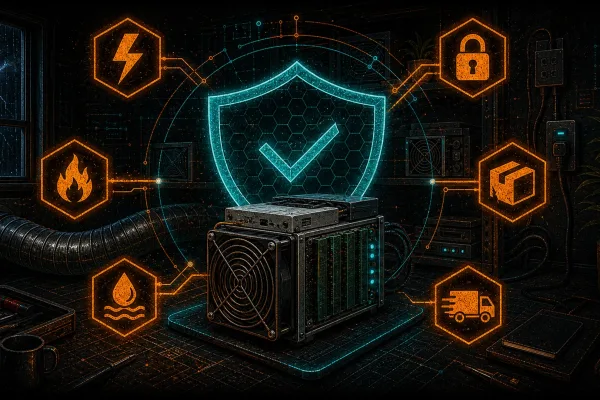
Short answer: A defensible ASIC purchase is an evidence trail, not a market forecast. Define the requirement, verify the seller and payee, bind the quote to an exact unit and condition, allocate shipping and import risk in writing, confirm electrical and site acceptance, and reserve a documented right to inspect, test, reject and recover. No current price, efficiency claim, popularity ranking or financial projection can replace those gates.
1. Define the requirement before requesting quotes
Record the operational need without choosing a seller or relying on a product page. Include the target electrical service, permitted continuous load, voltage and phase, connector and cord requirements, physical dimensions, mass, airflow direction, heat rejection, noise limit, network restrictions, environmental range, maintenance access and spares strategy. The authority having jurisdiction, utility, insurer, landlord and site operator may impose separate conditions.
Define acceptance measures and tolerances before price negotiation: exact hardware revision and power mode; a stated test duration and ambient condition; accepted hashrate rather than a dashboard headline; wall power measured with appropriate equipment; rejected work; temperature, fan and error behaviour; and required logs. Do not infer expected performance from another revision or from an unstated firmware configuration.
Keep acquisition and operating decisions separate. This guide does not estimate future coin price, network conditions, electricity charges, uptime, revenue or resale value. If a business case depends on any of them, record the source, observation date, sensitivity and person accountable for updating it.
2. Use evidence grades, not reputation or rankings
Grade each material claim by how closely the evidence controls the actual transaction. A familiar name, large following, market-share graphic or enthusiastic review is not item-specific evidence.
| Grade | Evidence type | Examples | Permitted use |
|---|---|---|---|
| A — controlling or item-specific | Authoritative record or executed evidence tied to the transaction | Government or accredited listing, binding ruling, executed contract, carrier and insurance record, serialized inspection, exact model-and-revision approval | Use for a gate after verifying scope, validity and identity match. |
| B — corroborated technical | Revision-specific documentation supported by independent evidence | Exact-revision manual plus a serialized test under stated conditions | Use to support requirements and acceptance; identify remaining assumptions. |
| C — seller-controlled | Evidence created or selected by the seller | Quote, listing, dashboard, stock photo, chat message or seller-run test | Use as a lead only; corroborate safety, compliance, identity and performance. |
| D — unsupported aggregate | Estimate, ranking, trend, forecast or review without auditable methodology | Market size, share, growth projection, popularity list or anonymous testimonial | Discard for procurement approval. |
For every Grade A or B record, preserve the complete document, issuer, URL or file reference, version, date obtained, scope, expiry if any, exact identifiers and reviewer. Screenshots should preserve context, but a screenshot must not be promoted to a stronger grade than its source.
3. Verify the seller, payee and supply chain
- Confirm the legal entity name, registration, physical address, tax identifiers where applicable and the signer’s authority. Independently obtain contact details; do not rely only on those inside an unexpected invoice.
- Reconcile the invoice seller, contract party, bank or payment beneficiary and refund destination. A last-minute account change, unrelated beneficiary, secrecy or pressure is a stop signal.
- Ask whether the seller owns the equipment, acts as agent, drop-ships, or relies on another supplier. Record where title and risk pass and whether any lien, financing interest or third-party claim may follow the goods.
- Require written provenance sufficient to assess authenticity, sanctions, forced-labour and stolen-property risks. Absence of a record is a risk fact, not proof of a clean chain.
- Confirm who provides the warranty and who has authority and parts to perform it. A seller warranty and an original equipment warranty are different promises.
The federal Office of Consumer Affairs recommends checking the seller and transaction before shopping online. The Competition Bureau warns that purchase scams often use attractive offers and non-delivery. Consumer remedies can vary by province, transaction and whether the buyer acts personally or for business, so do not assume a commercial purchase has consumer protections.
4. Bind every claim to the exact unit and condition
The purchase schedule should identify quantity, exact model, hardware revision, serial or serial-allocation process, manufacture date if material, power supply, cables and accessories, packaging standard, firmware version or allowed baseline, new/used/refurbished status, cosmetic grade, prior service, excluded damage and photographs of the actual serialized units where feasible.
Define each condition term. “New,” “unused,” “refurbished,” “tested,” “working” and “as is” do not share a universal technical meaning. State the permitted powered hours or evidence, board and chip repair history, replaced components, corrosion or liquid exposure, modification, overclocking or immersion history, cleaning method, remaining warranty and which defects permit rejection.
Performance evidence should identify who ran the test, when, on which serial, for how long, at what input voltage and ambient condition, with which firmware and settings, and which instruments or logs were used. Preserve raw logs where possible. A test shows what happened during that window; it does not guarantee future output or site compatibility.
5. Allocate quote, payment, shipping and delivery risk
Put the complete commercial agreement in one controlled record: currency, taxes, payment milestones, inspection rights, cancellation, substitutions, delivery window, late or short shipment, title, risk of loss, warranty, limitation of liability, dispute forum and return logistics. Order precedence should resolve conflicts among the purchase order, quote, invoice, specifications and messages.
Use the full Incoterms 2020 rule and a precise named place or port, then add the obligations the rule does not settle. An Incoterms rule allocates defined delivery, cost and risk tasks; it does not by itself determine title, payment, product compliance, warranty, tax ownership or every insurance term. Confirm carrier, packaging, declared value, coverage limits, exclusions, deductibles, evidence deadlines and who files a claim.
Use a payment method and milestone proportionate to counterparty and recovery risk. Independently verify beneficiary changes. Split payments should follow objective evidence such as serialized allocation, inspection and carrier acceptance, while retaining enough leverage for arrival testing. Digital-asset or wire payment can be difficult to reverse; never treat urgency or a payment screenshot as settlement evidence.
6. Complete one landed-cost and decision record
Do not compare only unit prices. Complete each line, attach the evidence, mark unresolved items and name the person who can close the gate. The total is a scenario, not a promise.
| Gate or cost field | Evidence required | Amount, result or assumption | Owner and review date | Decision |
|---|---|---|---|---|
| Seller, payee and authority | Registry, independently verified contact, contract and beneficiary match | Record legal identities and exceptions | _____ | Pass / stop |
| Exact unit and condition | Revision, serial process, provenance, photos, history and serialized test | Record quantity and condition exceptions | _____ | Pass / stop |
| Unit price and payment | Executed quote, currency, milestone and recovery terms | Unit price + payment and foreign-exchange costs | _____ | Pass / stop |
| Freight and cargo risk | Incoterms rule and place, carrier, insurance, packing and claims process | Freight + insurance + expected unrecovered risk | _____ | Pass / stop |
| Import and tax | Importer, classification, origin, value, ruling or adviser record | Brokerage + duty if any + GST/HST + applicable provincial tax | _____ | Pass / stop |
| Approval and site readiness | Exact-unit approval or accepted field evaluation and site sign-off | Inspection + field evaluation + electrical/site work | _____ | Pass / stop |
| Acceptance and security | Inspection plan, instruments, firmware source, quarantine and test record | Labour + test tools + remediation allowance | _____ | Pass / stop |
| Warranty and lifecycle | Issuer, exclusions, RMA route, parts plan and end-of-life route | Spares + downtime exposure + RMA freight + disposal | _____ | Pass / stop |
| Decision total | All evidence attached; unresolved assumptions stated | Sum every applicable line without netting speculative revenue | Approver: _____ | Approve / reject / defer |
The decision record should also state alternatives considered, rejected assumptions, residual risks, acceptance deadline, responsible approver and next review trigger. Preserve the version actually approved; do not silently replace source files later.
7. Canadian import, tax, sanctions and approval boundaries
Classification, value and tax
The importer is responsible for a supportable tariff classification. Product marketing names do not decide the tariff item. The Canada Border Services Agency publishes classification guidance and an advance-ruling process; a ruling request needs detailed product information. Origin and tariff treatment are separate from classification. Value for duty also follows customs rules rather than an arbitrary invoice label.
The Canada Revenue Agency explains GST/HST treatment for imports. The correct treatment depends on who imports, the transaction and registration facts; QST, PST, RST or another provincial sales or use tax may also apply according to the province and transaction. Record the importer of record, business number and account where required, classification rationale, origin, valuation method, broker instructions, tax recovery position and records retained. This is not a declaration that any particular shipment is duty-free.
Sanctions and forced-labour controls
Global Affairs Canada expects businesses to understand ownership and control, indirect dealings and changing sanctions rules. Screen relevant sellers, payees, intermediaries, banks, carriers, origins and beneficial owners using a documented, current process. A payment route or transshipment does not remove sanctions risk.
Canada prohibits importing goods mined, manufactured or produced wholly or in part by forced labour. CBSA guidance explains the prohibition, while the federal Supply Chains Act can impose annual reporting duties on entities within its scope. A supplier statement alone may not establish provenance; map the chain, identify evidence gaps and obtain qualified advice when risk is material.
Electrical and radio approval
The Standards Council of Canada publishes recognized Canadian electrical product and equipment approval marks. Match a recognized mark and certification file or listing to the exact equipment, revision and nameplate, and confirm acceptance with the authority having jurisdiction. Where an accepted field evaluation is required, complete it before energization. A seller’s logo photograph, overseas mark or approval for a component does not necessarily approve the complete machine.
If equipment contains wireless radio functions, Innovation, Science and Economic Development Canada certification and labelling rules may apply. Confirm the exact radio module, host integration and listing rather than assuming a module image resolves the finished-product requirement.
8. Used and refurbished evidence package
- Legal owner and seller authority; original purchase or other provenance; serial photographs; any theft or lien checks appropriate to the facts.
- Exact board, controller and power-supply revisions; modification, repair, component-replacement and firmware history; prior environment, including immersion, smoke, dust, corrosion, condensation or liquid events.
- High-resolution condition evidence before shipment, including connectors, boards, cooling path, fans, housings, fasteners, seals where relevant and nameplates.
- Serialized functional test with stated duration, voltage, ambient condition, power mode, accepted hashrate, wall power, rejected work, temperatures, fan behaviour and complete error logs.
- Definition of refurbishment steps and parts used, technician or facility identity, quality-control result, warranty scope and exclusions. “Tested” is not a refurbishment specification.
- Written right to inspect, quarantine, test and reject; who pays freight, brokerage, repair, disposal or return charges when the goods fail.
Do not open or energize visibly wet, damaged or electrically suspect equipment merely to meet a test deadline. Preserve evidence, isolate the unit and use qualified personnel. Contract deadlines should expressly accommodate safe inspection.
9. Firmware and network-security gate
Treat every device, controller, update file and management credential as untrusted until verified. The Canadian Centre for Cyber Security recommends supply-chain risk management across acquisition and operation. Record the approved firmware source, release and integrity check where provided; configuration baseline; update and rollback authority; password rotation; network segmentation; allowed destinations; DNS and time sources; remote support; logging; and decommissioning procedure.
- Obtain firmware only through a verified channel and preserve version provenance. Do not install an unknown image just because it promises higher output.
- Change default credentials before production use and restrict administration to a management network.
- Observe outbound connections in quarantine, reconcile endpoints and pool configuration, and investigate unexpected accounts, proxies, certificates, jobs or traffic.
- Document whether warranty terms restrict firmware or configuration changes and how security fixes will be supplied.
- Before resale or disposal, remove credentials, pool addresses, certificates, network configuration and operational logs using a verified procedure.
10. Arrival, quarantine and acceptance protocol
- Before opening: record delivery time, carrier, seal, pallet and carton condition. Photograph every side and any impact, puncture, water indicator or tampering. Notify the carrier and insurer within their deadlines without waiving seller remedies.
- Reconcile identity: compare quantity, serials, exact revision, nameplates, approval records, power supplies, cords and accessories to the contract. Segregate substitutions and undocumented units.
- Inspect safely: look for impact, loose parts, contamination, corrosion, moisture, damaged connectors, altered boards or unsafe repairs. Keep suspect equipment de-energized.
- Quarantine: isolate management interfaces from production, preserve existing configuration where lawful and necessary as evidence, then control credentials, firmware, network paths and time sources.
- Test: use the agreed supply and a safe site. Record instruments, voltage, ambient, duration, mode, firmware, accepted hashrate, wall power, rejected work, temperatures, fans, logs and interruptions.
- Decide: compare results to written tolerances. Accept, conditionally accept, reject or request cure in writing before the deadline; identify each serial and preserve raw evidence.
Acceptance should be affirmative. Silence, power-on or partial use should not become deemed acceptance unless the buyer deliberately agreed to that result. Preserve packaging until the inspection and claim windows close.
11. Warranty, repair, security support and end-of-life
Identify the warranty issuer, start date, covered serials, transferability, exclusions, operating limits, permitted firmware, claim evidence, turnaround target, repair location, advance replacement, data handling, return authorization, inbound and outbound freight, brokerage and duties on replacement or re-entry. The Competition Bureau explains that advertised warranties must be available as represented, but the contract still needs operational detail.
Plan spare parts and authorized substitutions, board-level repair evidence, post-repair testing, firmware-support duration and vulnerability reporting. Record who may authorize a paid repair and the not-to-exceed amount. No warranty promise eliminates downtime, shipping, insolvency or parts-obsolescence risk.
Plan resale, reuse, secure decommissioning and lawful recycling before purchase. Cross-border movements of electronic waste can trigger federal controls; do not label unusable equipment as reusable merely to avoid waste requirements. Preserve serial disposition and recycler or shipment records.
Decision rule
Approve only when each stop gate has an accountable owner, acceptable Grade A or B evidence, a contract remedy and a dated decision record. Reject or defer when identity, authority, electrical approval, import responsibility, provenance, firmware integrity, arrival testing or recovery rights remain unresolved. A lower price does not compensate for a safety or legality gate.
Primary sources reviewed
Reviewed 29 August 2026. Laws, tariff measures, sanctions, certifications and administrative guidance can change. Recheck the current official record for the actual transaction and jurisdiction.
- CBSA: tariff classification resources and advance rulings for tariff classification.
- CBSA: customs valuation.
- Canada Revenue Agency: GST/HST and imports/exports.
- Global Affairs Canada: sanctions compliance.
- CBSA Memorandum D9-1-6: goods produced or manufactured by forced labour and Supply Chains Act, section 11.
- Standards Council of Canada: recognized Canadian electrical approval marks.
- ISED: wireless equipment certification.
- Canadian Centre for Cyber Security: supply-chain risk management.
- International Chamber of Commerce: Incoterms 2020.
- Office of Consumer Affairs: online shopping, Competition Bureau: purchase merchandise scams, and provincial and territorial consumer affairs offices.
- Competition Bureau: warranties and guarantees.
- Environment and Climate Change Canada: cross-border movement of hazardous waste and hazardous recyclable material.
Frequently asked questions
Is there reliable public data for ASIC market size or market share?
There is no single regulator-maintained or consistently audited public dataset that establishes global ASIC market size or manufacturer share. Estimates can use different definitions, dates, channels and methods. Do not use an uncited estimate, forecast or ranking as procurement evidence; request item-specific evidence instead.
What proves that a unit is genuine and in the stated condition?
No single photograph, seal or dashboard proves identity and condition. Verify the legal seller and payee, invoice, exact model and hardware revision, serials, provenance, prior use and repair history, included components, current test evidence, warranty issuer and return rights. Reconcile those records to the received unit before acceptance.
How should performance be verified?
Define a test window for the exact revision, firmware and power mode. Record wall power at the agreed supply voltage, accepted hashrate, rejected work, temperatures, fan behaviour and hardware or event logs under a stated ambient condition. A seller-controlled dashboard screenshot is not enough, and performance acceptance does not replace electrical approval.
Are ASIC miners automatically duty-free when imported into Canada?
No assumption is safe. Tariff classification, origin, value for duty, tariff treatment and importer responsibilities depend on the facts and current rules. GST or HST and provincial tax treatment may also apply. An importer can seek a CBSA advance ruling on classification and should document the broker or adviser position used.
Does a photograph of a certification logo prove electrical approval?
No. Verify that the exact equipment and revision are covered by a Canadian-recognized certification or by a field evaluation accepted by the authority having jurisdiction. Match the mark, file or listing and nameplate to the unit. Do not energize equipment while approval, supply, overcurrent protection, connectors, ventilation or site acceptance remains unresolved.
What should happen when equipment arrives?
Preserve carrier and packaging evidence, document damage or moisture before moving the shipment, reconcile quantity, serials, revision and approval records, and keep devices off the production network. Verify firmware provenance and credentials, inspect safely, then run the documented acceptance test before the contractual rejection deadline. Record exceptions and notify the correct parties in writing.