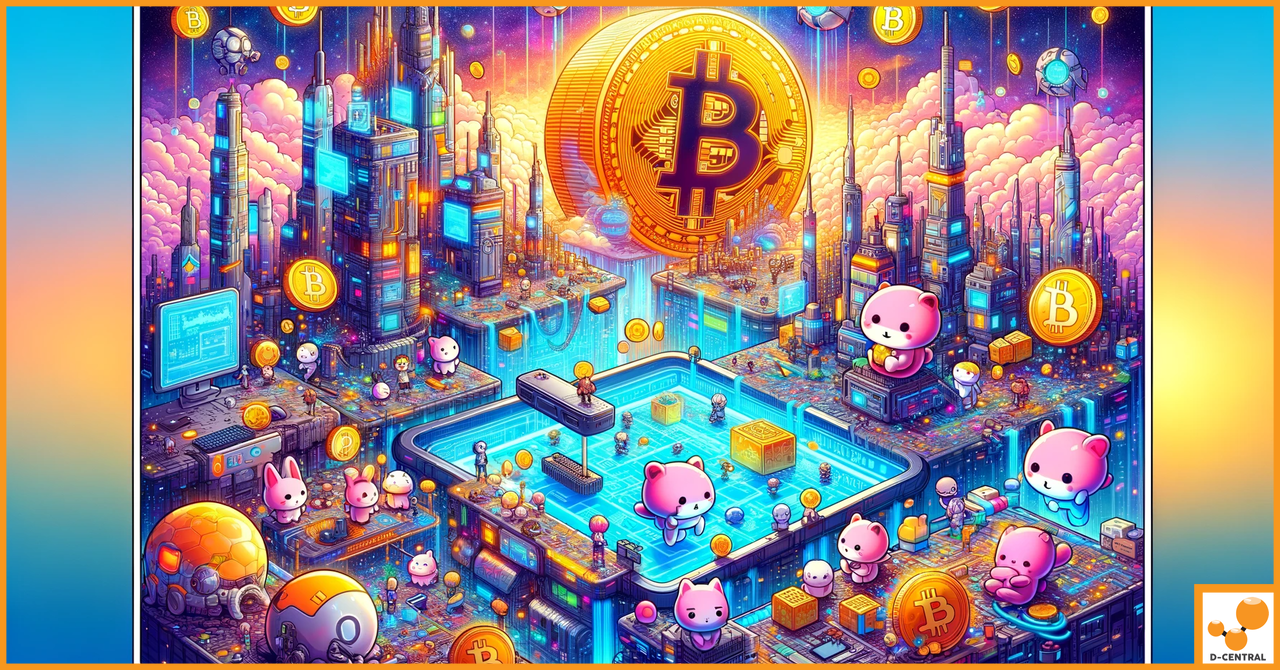
Cyberspace is not a metaphor. It is a place — a sovereign, borderless territory where millions of people live significant portions of their economic, creative, and political lives. And like every sovereign territory, it needs a native currency. Not one borrowed from a government treasury. Not one controlled by a central bank committee meeting behind closed doors. It needs money that was born in the same fire of cryptography and decentralization that forged cyberspace itself.
That currency is Bitcoin.
Since 2016, D-Central Technologies has operated at the intersection where cyberspace meets physical reality — where cryptographic protocols translate into heat, hashrate, and hard-earned sats. As Canada’s leading Bitcoin mining hardware provider and pioneer in the open-source mining movement, we have watched the cypherpunk vision mature from manifesto to infrastructure. This is not speculation. This is the world we build every day.
This article traces the arc from the cypherpunk roots of cyberspace to Bitcoin’s role as its native monetary system, and explains why mining — especially decentralized, home-based mining — is the physical backbone that keeps this sovereign digital nation alive.
The Cypherpunk Blueprint: Where Cyberspace Began
Before cyberspace was a trillion-dollar economy, it was a radical idea debated on mailing lists by a handful of cryptographers, mathematicians, and self-described troublemakers. The cypherpunk movement, emerging in the late 1980s and crystallizing in the early 1990s, held a core conviction that most of the world considered paranoid: privacy is a fundamental right, and cryptography is the only tool that guarantees it without requiring trust in institutions.
The cypherpunks were not armchair philosophers. They wrote code. Eric Hughes published “A Cypherpunk’s Manifesto” in 1993, declaring that “privacy is necessary for an open society in the electronic age.” Phil Zimmermann released PGP encryption and promptly faced a federal investigation for it. Tim May circulated the “Crypto Anarchist Manifesto,” predicting that cryptographic technology would “alter completely the nature of government regulation, the ability to tax and control economic interactions, the ability to keep information secret.”
Every one of those predictions has come true.
John Perry Barlow’s Declaration
In 1996, John Perry Barlow published “A Declaration of the Independence of Cyberspace,” directly addressing the governments of the industrial world: “You are not welcome among us. You have no sovereignty where we gather.” The document was dismissed by many as utopian. Three decades later, it reads like a blueprint.
Cyberspace did become its own territory. It developed its own culture, its own governance experiments, its own economy. The only thing it was missing was its own money — money that could not be seized, inflated, censored, or debased by the very institutions the cypherpunks had spent decades trying to route around.
The Missing Piece: Digital Cash
The cypherpunks knew this. They tried to solve it. David Chaum built DigiCash in the 1990s. Adam Back invented Hashcash in 1997 — a proof-of-work system that would later become a cornerstone of Bitcoin’s consensus mechanism. Wei Dai proposed b-money. Nick Szabo designed Bit Gold. Hal Finney built Reusable Proofs of Work.
Each attempt moved the needle forward. Each one failed to achieve the critical combination: decentralized issuance, censorship resistance, trustless verification, and a fixed supply schedule that no committee could override.
Then, on October 31, 2008, Satoshi Nakamoto published the Bitcoin whitepaper. On January 3, 2009, the genesis block was mined, with a message embedded in the coinbase transaction: “The Times 03/Jan/2009 Chancellor on brink of second bailout for banks.”
The cypherpunks finally had their money. Cyberspace finally had its currency.
Bitcoin as the Native Currency of a Sovereign Digital Nation
Bitcoin is not “digital gold” in the way financial commentators use the term — as a hedge, an asset class, a line item in a portfolio. Bitcoin is the monetary system of cyberspace. Understanding the distinction matters.
A monetary system requires specific properties: it must be natively digital, permissionless, censorship-resistant, scarce, verifiable, and capable of final settlement without relying on any trusted third party. No government-issued currency satisfies these requirements in cyberspace. They all depend on banks, payment processors, and legal jurisdictions — exactly the intermediaries that cyberspace was designed to route around.
Scarcity Enforced by Mathematics
There will only ever be 21 million bitcoin. This is not a policy decision that can be reversed in a committee meeting. It is enforced by consensus rules running on tens of thousands of nodes worldwide. The current block reward, post-2024 halving, stands at 3.125 BTC per block — half of what it was before April 2024, and destined to halve again roughly every four years until the final satoshi is mined around 2140.
This mathematically enforced scarcity is not merely an economic feature. It is a political statement. It says: no individual, no institution, no government can create more of this money. In a world where central banks have printed trillions in the last decade, Bitcoin’s fixed supply is an act of defiance encoded in software.
Censorship Resistance and Permissionless Access
Anyone with an internet connection can receive, hold, and send bitcoin. No KYC form. No credit check. No bank account required. No government approval needed. This is not a bug or an oversight — it is the core design principle. Bitcoin transactions, once confirmed by the network’s proof-of-work consensus, are final and irreversible.
This matters enormously for people living under authoritarian regimes, for dissidents, for journalists, for anyone the existing financial system has decided to exclude. But it also matters for the fundamental architecture of cyberspace: a sovereign digital territory requires sovereign digital money, and sovereignty means no single point of failure and no permission required.
Settlement Without Trust
Traditional financial systems are built on layers of trust: you trust your bank, your bank trusts the central bank, the central bank trusts the government. Remove any layer and the system collapses. Bitcoin replaces trust with verification. Every full node independently validates every transaction against the consensus rules. No trust required. No counterparty risk.
This is what makes Bitcoin the only currency that can truly function as the native money of cyberspace — a territory that, by its very nature, cannot rely on the trust frameworks of the physical world.
Mining: The Physical Backbone of a Digital Nation
Here is where the abstract becomes tangible. Bitcoin exists as a protocol — a set of rules enforced by software. But that protocol requires energy to secure it. Mining is the process by which new blocks are added to the blockchain, transactions are confirmed, and the network’s security is maintained. Without miners, Bitcoin is just a whitepaper.
As of early 2026, the Bitcoin network hashrate exceeds 800 EH/s (exahashes per second) — an almost incomprehensible amount of computational power dedicated to securing the network. Every hash represents real energy consumed, real hardware running, real economic commitment by miners around the world.
This is why D-Central exists. This is what we do.
Decentralized Mining: The Cypherpunk Imperative
The cypherpunk vision was never about replacing one centralized system with another. If Bitcoin mining concentrates in a handful of industrial facilities controlled by a few corporations, the decentralization promise is hollow. The network becomes vulnerable to the same political pressures, regulatory capture, and single points of failure that Bitcoin was designed to eliminate.
Decentralized mining — mining at home, mining in small operations, mining with open-source hardware — is not a hobby. It is an act of sovereignty. Every independent miner running their own hardware, pointing at their own node, contributes to the geographic and political distribution of hashrate that keeps Bitcoin censorship-resistant.
This is the mission D-Central’s founder built the company around in 2016, and it remains our north star: decentralization of every layer of Bitcoin mining.
Home Mining and the Bitaxe Revolution
The open-source mining movement has made decentralized mining more accessible than ever. The Bitaxe — a family of open-source ASIC miners — represents a breakthrough in making Bitcoin mining available to individuals. D-Central has been a pioneer in the Bitaxe ecosystem from the beginning, creating the original Bitaxe Mesh Stand and developing leading accessories including heatsinks for both the standard Bitaxe and the Bitaxe Hex.
These are not toy miners. They are fully functional SHA-256 ASIC devices running real proof-of-work, capable of solo mining on the Bitcoin mainnet. A Bitaxe Supra or Ultra draws minimal power through its 5V barrel jack (5.5×2.1mm DC connector — not USB-C, which is for firmware flashing only), runs silently, and gives its operator a genuine chance at mining a full block reward of 3.125 BTC.
Every hash counts. That is not marketing language — it is a mathematical fact about probability and proof-of-work.
Dual-Purpose Mining: Heating Your Home with Hashrate
One of the most practical innovations in home mining is the realization that ASIC miners are, thermodynamically, 100% efficient space heaters. Every watt of electricity consumed by a miner is converted to heat. The only question is whether that heat is wasted or useful.
D-Central’s Bitcoin Space Heaters answer that question definitively. Built from repurposed Antminer hardware (S9, S17, S19 editions), these units mine bitcoin while heating your home. In a Canadian winter — and we know Canadian winters — this is not a gimmick. It is practical thermodynamics meeting sound money.
You were going to heat your house anyway. You might as well earn sats while doing it.
Why Bitcoin Maximalism Is Not Extremism — It Is Engineering
The term “Bitcoin maximalist” is often used dismissively, as though conviction about the superiority of one protocol is somehow unreasonable. But in the context of cyberspace as a sovereign territory, Bitcoin maximalism is an engineering position, not an ideological one.
Network Effects and Security
A sovereign monetary system requires maximal security. Security in proof-of-work comes from hashrate. Hashrate follows economic incentives. Bitcoin’s network effect — its liquidity, its brand recognition, its hash rate exceeding 800 EH/s — creates a security moat that no other cryptocurrency approaches. Fragmenting mining effort across multiple chains does not improve security for any of them. It degrades it for all of them.
The Fixed Supply Matters
Cyberspace’s native currency must be credibly scarce. Bitcoin’s 21 million cap has never been changed in over 17 years of operation, despite enormous economic incentives to do so. This track record of monetary policy immutability is not matched by any other digital asset, many of which have altered their issuance schedules, consensus mechanisms, or supply caps.
Censorship Resistance Requires Decentralization
Bitcoin’s node count (estimated at over 60,000 reachable nodes), its mining distribution across dozens of countries, and its protocol governance model (which requires overwhelming consensus for any change) make it the most censorship-resistant monetary network ever created. A currency for cyberspace must be resistant to the political pressures of the physical world. Only Bitcoin has demonstrated this property at scale.
The Infrastructure of Sovereignty: What D-Central Builds
We are not observers of this transformation. We are builders.
Open-Source Mining Hardware
D-Central stocks the full range of Bitaxe variants (Supra, Ultra, Hex, Gamma, GT), NerdAxe, NerdNOS, Nerdminer, NerdQAxe, and more. We develop custom accessories, provide setup support, and maintain the most comprehensive Bitaxe resource hub in the industry. When you buy a Bitaxe from D-Central, you are not just buying hardware — you are joining an ecosystem backed by pioneers who have been in this space since the beginning.
ASIC Repair: Keeping Hashrate Online
Every ASIC that sits broken in a closet is hashrate removed from the network. D-Central’s ASIC repair service has fixed thousands of miners since 2016 — hashboard repairs, control board diagnostics, chip-level work across Bitmain, MicroBT, Innosilicon, Canaan, and more. We are one of the few Western repair facilities with the expertise and parts inventory to handle the full range of mining hardware.
Repairing miners is not just a business. It is infrastructure maintenance for the Bitcoin network.
Mining Hosting in Quebec
For operators who need more power than a home circuit provides, D-Central offers mining hosting in Quebec — where clean hydroelectric energy and cold climate create ideal mining conditions. Quebec’s energy grid is over 95% hydroelectric, making it one of the greenest mining jurisdictions on the planet.
Cyberspace in 2026: The Stakes Have Never Been Higher
We are living through a period where the cypherpunk vision is being tested in real time. Governments worldwide are deploying CBDCs (Central Bank Digital Currencies) — the exact opposite of what the cypherpunks built. CBDCs offer programmable money under full state surveillance: every transaction tracked, spending rules enforced at the protocol level, accounts freezable at will.
This is not a conspiracy theory. It is published policy from the Bank of Canada, the European Central Bank, the People’s Bank of China, and dozens of other central banks. CBDCs are the financial surveillance infrastructure that the cypherpunks warned about in the 1990s, now being built with modern technology.
Bitcoin is the countermeasure.
Every miner running, every node validating, every transaction settling on the Bitcoin blockchain strengthens the alternative. The sovereign currency of cyberspace does not need permission to exist. It does not need approval from regulators. It needs hashrate, nodes, and people who refuse to accept that money must be controlled by the state.
The Role of Home Miners
If you are running a Bitaxe on your desk, you are not just mining sats. You are contributing to the decentralization of the most important monetary network in human history. If you are heating your home with a Bitcoin Space Heater, you are simultaneously reducing your heating bill and strengthening Bitcoin’s security. If you are repairing an old Antminer instead of throwing it away, you are keeping hashrate distributed rather than concentrated.
These are not small acts. They are the building blocks of a sovereign digital nation.
Conclusion: Building the Currency of a Free Internet
The cypherpunks understood something fundamental: freedom in cyberspace requires tools that cannot be controlled by any single entity. They built encryption. They built anonymous remailers. They built Tor. And ultimately, through Satoshi Nakamoto’s synthesis of decades of cryptographic research, they built Bitcoin.
Cyberspace is a sovereign nation. Bitcoin is its currency. Mining is its defense budget. And every individual who participates — by running a node, by mining at home, by choosing to transact in bitcoin rather than surveillance-friendly alternatives — is a citizen of this digital nation exercising their sovereignty.
At D-Central Technologies, we have spent nearly a decade making this participation accessible. From open-source Bitaxe miners to dual-purpose space heaters to professional ASIC repair, everything we build serves one purpose: decentralization of every layer of Bitcoin mining.
The cypherpunks wrote the manifesto. Satoshi wrote the code. Now it is up to us to run the hardware.
Every hash counts.
Frequently Asked Questions
What does it mean that cyberspace is a “sovereign nation” with Bitcoin as its currency?
Cyberspace has developed its own culture, governance experiments, economy, and social structures — independent of any single government’s jurisdiction. Bitcoin serves as its native monetary system because it shares the same core properties: it is decentralized, borderless, permissionless, and censorship-resistant. Unlike government-issued currencies that depend on banks and regulators, Bitcoin operates natively within the digital realm without requiring trust in any institution.
How does the cypherpunk movement connect to Bitcoin and mining?
The cypherpunk movement, active since the late 1980s, advocated for privacy and freedom through cryptographic tools. Key cypherpunk innovations — including Adam Back’s Hashcash (proof-of-work), David Chaum’s digital cash concepts, and public-key cryptography — became foundational building blocks of Bitcoin. Mining is the physical manifestation of the cypherpunk ethos: it secures the network through computation rather than institutional trust, ensuring that no central authority controls the monetary system.
Why does Bitcoin need miners to function?
Bitcoin miners perform proof-of-work computation to validate transactions, create new blocks, and secure the network against attacks. Without miners, transactions could not be confirmed and the blockchain would stop advancing. The current network hashrate exceeds 800 EH/s, representing an enormous collective investment in Bitcoin’s security. Every miner — from industrial operations to a single Bitaxe on a desk — contributes to this security.
What is the current Bitcoin block reward?
Following the April 2024 halving, the block reward is 3.125 BTC per block. This reward halves approximately every four years (every 210,000 blocks) as part of Bitcoin’s fixed supply schedule. The total supply is capped at 21 million BTC, with the final satoshi expected to be mined around the year 2140.
Can I mine Bitcoin at home with a Bitaxe?
Yes. Bitaxe devices are open-source ASIC miners designed specifically for home and solo mining. They connect to your home WiFi, draw minimal power through a 5V barrel jack (5.5×2.1mm DC connector — note: the USB-C port is for firmware flashing only, not power), and run silently. While solo mining is probabilistic and block discovery is not guaranteed, every hash you produce is a genuine attempt at finding a valid block worth 3.125 BTC. D-Central is a pioneer in the Bitaxe ecosystem and stocks all variants with full setup support.
What is a Bitcoin Space Heater and how does it work?
A Bitcoin Space Heater is a repurposed ASIC miner enclosed in a housing designed for residential use. Since miners convert 100% of consumed electricity into heat, they function as space heaters that also mine bitcoin. D-Central offers Space Heater editions built from Antminer S9, S17, and S19 hardware. They heat your home during winter while earning sats — making your heating bill productive rather than purely consumptive.
Why is decentralized mining important for Bitcoin’s security?
If mining concentrates in a few large facilities, Bitcoin becomes vulnerable to the same political pressures, regulatory capture, and single points of failure it was designed to eliminate. Decentralized mining — spread across thousands of home miners, small operations, and different jurisdictions — ensures that no government or corporation can shut down or censor the network. This is why home mining with open-source hardware is not just a hobby but an act of sovereignty.
What are CBDCs and why are they relevant to this discussion?
CBDCs (Central Bank Digital Currencies) are government-issued digital currencies with full state surveillance built in: every transaction tracked, spending rules programmable at the protocol level, and accounts freezable at will. Multiple central banks worldwide are actively developing CBDCs. They represent the exact opposite of the cypherpunk vision — centralized, surveilled, permissioned money. Bitcoin exists as the censorship-resistant alternative, and every miner strengthens that alternative.