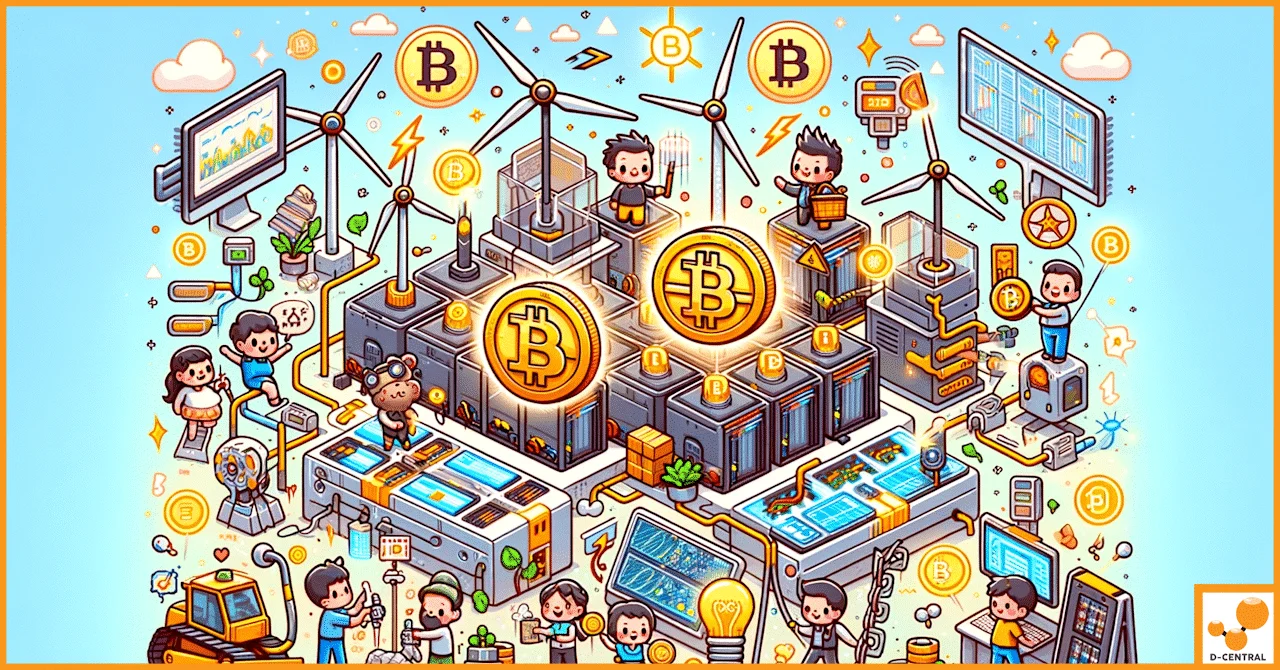
Bitcoin mining does not waste energy. It monetizes it. That single distinction separates people who understand proof-of-work from people who parrot mainstream talking points about “environmental harm.” The truth is that Bitcoin mining sits at the most productive intersection of energy markets and cryptographic security ever engineered — and in 2026, that intersection is only getting more powerful.
At D-Central Technologies, we have operated at this crossroads since 2016. From our Quebec hydroelectric hosting facility to the Bitcoin Space Heaters we build for home miners across Canada, our entire business model proves one thing: energy-aware mining is not some future aspiration. It is how we operate today.
This article breaks down exactly how Bitcoin mining interacts with energy markets, why that interaction benefits both systems, and how you — whether you are running a single Bitaxe on your desk or heating your basement with an Antminer — can position yourself at this intersection.
Bitcoin Mining Is a Buyer of Last Resort
Every electrical grid on the planet has the same fundamental problem: supply and demand rarely match perfectly. Generators produce electricity whether someone needs it or not. Wind blows at 3 AM when nobody is awake. Hydroelectric dams overflow in spring when snowmelt peaks. Natural gas plants fire up for peak demand and sit idle the rest of the day.
Bitcoin miners solve this. They are the only industrial load that can:
- Start and stop in seconds — no warm-up cycles, no production losses
- Operate anywhere with an internet connection — location-agnostic by design
- Consume any amount of power — scale from 15 watts (Bitaxe) to 15 megawatts (industrial facility)
- Run 24/7 or respond to price signals — curtail instantly when grid prices spike
No other industry offers this flexibility. Aluminum smelters cannot shut down mid-pour. Data centers cannot drop load without losing customer data. But a Bitcoin miner? You turn it off, it stops hashing, you turn it back on, it resumes. Zero waste, zero damage, zero penalty.
This makes Bitcoin mining the most efficient demand-response asset ever created. Grid operators in Texas (ERCOT), Quebec (Hydro-Quebec), and Scandinavia already recognize this. Miners absorb surplus energy that would otherwise be curtailed — meaning wasted — and convert it into the hardest money ever created.
The Quebec Advantage: Hydroelectric Power and Bitcoin
Canada produces more hydroelectric power per capita than almost any nation on Earth. Quebec alone generates over 200 TWh annually from hydro, with consistent surplus capacity during off-peak periods. This is not intermittent solar that disappears at sunset or wind that dies on calm days. Quebec hydro is baseload-capable, renewable, and cheap.
D-Central operates our hosting facility in Laval, Quebec specifically because of this energy profile. Our miners run on some of the cleanest, most affordable electricity available anywhere in the world. When critics claim Bitcoin mining is “dirty,” they are ignoring operations like ours that run on near-zero-emission hydroelectric power.
| Energy Source | CO2 per kWh | Availability | Mining Suitability |
|---|---|---|---|
| Quebec Hydro | ~1.3 g | 24/7 baseload | Excellent — stable, cheap, clean |
| Solar | ~40 g | Daytime only | Good with storage, intermittent |
| Wind | ~11 g | Variable | Good — miners absorb overproduction |
| Natural Gas | ~450 g | On-demand | Common, higher emissions |
| Stranded / Flare Gas | Net negative* | Site-specific | Ideal — converts waste to value |
*Flare gas mining captures methane that would otherwise be vented or flared, resulting in lower net emissions than doing nothing.
For Canadian miners, the calculus is straightforward. Quebec hydro rates for industrial consumers hover around CAD $0.05–0.06/kWh. Compare that to the US average industrial rate of roughly USD $0.08/kWh or European rates that can exceed EUR $0.15/kWh. When your electricity is both cheap and clean, the “Bitcoin is bad for the environment” argument collapses entirely.
Home Mining as Energy Monetization
You do not need a warehouse in Quebec to participate in energy-market-aware mining. Every home miner is already an energy market participant — you are buying electricity and converting it into bitcoin and heat. The question is whether you are doing it intelligently.
Heat Recovery: The Dual-Purpose Mining Thesis
In cold climates — and Canada has no shortage of those — the waste heat from Bitcoin miners is not waste at all. It is a heating system. A single Antminer S19 produces approximately 3,400 watts of thermal output. That is equivalent to a large space heater, except this one pays you back in bitcoin.
D-Central builds purpose-designed Bitcoin Space Heaters that take ASIC miners and integrate them into home heating systems. The economics are compelling:
| Scenario | Heating Cost | Bitcoin Earned | Net Heating Cost |
|---|---|---|---|
| Electric baseboard (1,500 W) | ~$0.10/hr | $0.00 | $0.10/hr |
| Natural gas furnace | ~$0.06/hr | $0.00 | $0.06/hr |
| Bitcoin Space Heater (3,400 W) | ~$0.23/hr | ~$0.15–0.20/hr* | ~$0.03–0.08/hr |
*Bitcoin earnings vary with network difficulty, hashrate, and BTC exchange rate. Based on typical 2026 S19-class performance at CAD $0.07/kWh.
When you factor in that heating is a sunk cost in Canadian winters — you are spending that money anyway on natural gas or electric baseboards — the bitcoin earned effectively subsidizes your heating bill. In some configurations, mining can reduce your net heating cost to near zero.
Small-Scale Solo Mining: Every Hash Counts
Not everyone wants to run a 3,400-watt ASIC in their living room. Open-source solo miners like the Bitaxe let you participate in Bitcoin’s energy-to-security conversion at 15–25 watts. That is less than a light bulb.
Solo mining at this scale is not about daily profitability calculations. It is about participating in the network, contributing to decentralization, and taking a shot at a full 3.125 BTC block reward. With the Bitcoin network hashrate exceeding 800 EH/s and difficulty above 110 trillion, the odds for a single Bitaxe are long — but they are never zero. Every hash counts.
From an energy market perspective, these small miners are interesting because they represent perfectly distributed, always-on demand. Thousands of Bitaxe units running in homes across North America create a decentralized mining network that mirrors the decentralized energy future: small, distributed, resilient.
How Energy Prices Shape Mining Strategy
Sophisticated miners — from home operators to industrial facilities — treat electricity as their primary input cost and manage it accordingly. Here is how energy market dynamics directly affect mining decisions:
Time-of-Use Optimization
Many Canadian provinces and US states offer time-of-use (TOU) electricity rates. Miners who can schedule operations around off-peak hours gain a significant cost advantage. An ASIC running at $0.04/kWh during overnight off-peak versus $0.12/kWh during afternoon peak is effectively tripling its margins.
Smart miners use automated controls to curtail during peak pricing and resume during off-peak windows. This is not theoretical — it is standard practice for any operation treating mining as a serious energy play.
Seasonal Strategy
In Canada, the mining-as-heating thesis creates a natural seasonal strategy:
- October through April (heating season): Run miners at full capacity. 100% of waste heat displaces conventional heating costs. Net electricity cost drops dramatically.
- May through September (cooling season): Scale back or relocate hash power. Some miners shut down home units and shift to hosted facilities with industrial cooling. Others reduce clock speeds to lower heat output.
This seasonal approach aligns perfectly with energy market fundamentals. Winter electricity demand in Canada is high (everyone heating their homes), but hydro supply is also robust. Summer demand can spike with air conditioning in southern regions, driving up prices — exactly when you want to reduce consumption.
The Difficulty Adjustment as Market Signal
Bitcoin’s difficulty adjustment — recalculated every 2,016 blocks, roughly every two weeks — is the protocol’s built-in energy market regulator. When energy gets expensive and miners drop off, difficulty decreases, making remaining miners more profitable. When cheap energy attracts new hashrate, difficulty increases, maintaining equilibrium.
This self-correcting mechanism means Bitcoin mining constantly seeks the cheapest energy on the planet. It is a global, permissionless arbitrage engine for electricity prices. That is not a bug. That is the most elegant energy market mechanism ever designed.
Grid Stabilization: Miners as Shock Absorbers
The most powerful argument for Bitcoin mining in energy markets is demand response. When the Texas grid nearly collapsed during Winter Storm Uri in 2021, Bitcoin miners were among the first loads to curtail. Riot Platforms alone returned over 1 GW of capacity to ERCOT during the 2023 summer heat wave. No other industrial consumer responded that quickly.
This pattern is now being formalized. Grid operators are signing demand-response contracts with miners specifically because of their unique load characteristics:
| Grid Need | Mining Response | Grid Benefit |
|---|---|---|
| Excess renewable generation | Increase hashrate, absorb surplus | Prevents curtailment, stabilizes pricing |
| Peak demand emergency | Curtail instantly, release capacity | Prevents blackouts, reduces stress |
| Baseload undersupply | Reduce operations during shortfall | Frees capacity for essential loads |
| Frequency regulation | Modulate load in real time | Maintains grid frequency at 60 Hz |
| New generation financing | Anchor tenant for new plants | Enables infrastructure investment |
Bitcoin miners are not parasites on the grid. They are shock absorbers. They soak up energy nobody else wants and release capacity the moment it is needed elsewhere. No other technology does this as effectively.
The Canadian Home Miner’s Energy Playbook
If you are mining at home in Canada — or considering it — here is a practical framework for thinking about energy:
1. Know your rate structure. Check whether your province offers TOU or tiered pricing. In Ontario, off-peak rates (currently around $0.076/kWh) versus on-peak ($0.158/kWh) represent a 2x cost difference. In Quebec, rates are more flat but generally lower.
2. Calculate your heating offset. Use our Mining Profitability Calculator to model your specific scenario. Factor in the heating value — every watt your miner produces displaces a watt of conventional heating during winter months.
3. Right-size your operation. You do not need to run an S21 if a Bitcoin Space Heater or even a Bitaxe suits your setup better. Match your mining hardware to your energy budget and heat tolerance.
4. Monitor difficulty and hashprice. The mining landscape shifts every two weeks with the difficulty adjustment. Stay informed and adjust your strategy accordingly.
5. Think long-term. Bitcoin mining is not a get-rich-quick scheme. It is a long-term energy conversion strategy. The miners who survive and thrive are the ones who think in four-year halving cycles, not daily price charts.
Frequently Asked Questions
Does Bitcoin mining actually waste energy?
No. Bitcoin mining converts electricity into cryptographic security for the most decentralized monetary network on Earth. Much of the energy consumed would otherwise be curtailed (wasted) because it exceeds grid demand. Miners monetize surplus and stranded energy that has no other buyer. In Canada, many mining operations — including D-Central’s Quebec facility — run on near-zero-emission hydroelectric power.
How does Bitcoin mining help stabilize power grids?
Miners are uniquely flexible loads. They can increase consumption when the grid has surplus energy (preventing curtailment and negative pricing) and curtail instantly during peak demand (freeing capacity for essential services). This demand-response capability makes miners valuable grid assets, which is why operators like ERCOT in Texas now actively contract with mining facilities for grid stabilization services.
Can I really heat my home with a Bitcoin miner?
Yes. All electricity consumed by a miner is converted to heat — thermodynamics guarantees it. A 3,400-watt Antminer S19 produces the same thermal output as a 3,400-watt space heater, except it also earns bitcoin. D-Central builds purpose-designed Bitcoin Space Heaters that integrate ASIC miners into home heating systems, making this practical for Canadian homes.
What is the best energy source for Bitcoin mining?
Hydroelectric power is ideal — cheap, clean, reliable, and baseload-capable. Quebec hydro is among the best mining energy sources globally at approximately CAD $0.05–0.06/kWh for industrial consumers. Stranded natural gas (flare gas) is another strong option as it monetizes energy that would otherwise be wasted. Solar and wind work well in combination with storage or in hybrid setups where miners absorb intermittent overproduction.
Why does D-Central host miners in Quebec specifically?
Quebec offers the trifecta: abundant hydroelectric power (200+ TWh/year), cold climate for natural cooling, and competitive industrial electricity rates. D-Central’s hosting facility in Laval, QC operates on some of the cleanest and most affordable power in North America. Cold Canadian winters also reduce cooling costs significantly compared to operations in warmer climates.
How does Bitcoin’s difficulty adjustment relate to energy markets?
The difficulty adjustment is Bitcoin’s built-in energy market regulator. Every 2,016 blocks (~2 weeks), the protocol recalculates mining difficulty based on total network hashrate. When energy prices rise and miners shut down, difficulty drops, making remaining miners more profitable. When cheap energy attracts new hashrate, difficulty increases. This creates a global, permissionless arbitrage mechanism that constantly directs mining toward the cheapest available energy.
Mining at the Energy Frontier
The intersection of Bitcoin mining and energy markets is not a niche academic topic. It is the operational reality for every miner on the planet, from a Bitaxe running on a desk in Toronto to a 100-megawatt facility powered by Icelandic geothermal. Understanding energy markets is not optional — it is the difference between mining profitably and mining at a loss.
At D-Central Technologies, we have built our entire business around this intersection. Our Quebec hosting runs on clean hydro. Our Space Heaters turn waste heat into home comfort. Our ASIC repair services keep aging hardware running efficiently, extending the useful life of machines that might otherwise be e-waste. And our open-source mining products like the Bitaxe democratize access to Bitcoin’s energy-to-security conversion at the lowest possible power draw.
Energy and hashrate are two sides of the same coin. The miners who understand this — who treat electricity not as a cost to be minimized but as an input to be optimized — are the ones who will be mining for decades. The rest will learn the hard way.
We are the Bitcoin Mining Hackers. We are the North. And we have been at this intersection since 2016.