Every year, millions of tonnes of electronic waste pile up in landfills across the globe. Circuit boards loaded with copper, gold, and rare earth elements rot alongside the plastic housings that once held them. In the Bitcoin mining industry, where hardware generations turn over every 2-3 years and efficiency gains make older ASICs unprofitable at industrial scale, e-waste is a real problem — and one that the mainstream media loves to weaponize against Bitcoin.
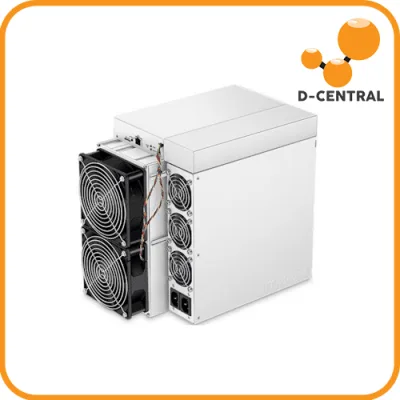
But here is the thing they never mention: ASIC miners are among the most repairable, repurposable, and recyclable electronic devices ever manufactured. Unlike a smartphone glued shut with proprietary screws and software locks, an Antminer is a modular machine built from standardized components — hashboards, control boards, fans, power supplies — every one of them replaceable, repairable, and upgradeable. The mining hacker community has known this for years. It is time the rest of the world caught up.
At D-Central Technologies, we have been repairing and refurbishing ASIC miners since 2016. We have seen firsthand how a “dead” Antminer S9 can be brought back to life with a $40 hashboard repair, run for another five years as a Bitcoin space heater, and ultimately have its components harvested for the next generation of builds. That is not waste — that is engineering.
The E-Waste Problem in Bitcoin Mining: Separating Fact from FUD
The narrative that Bitcoin mining is an environmental catastrophe conveniently ignores several critical facts. Yes, ASIC miners have a finite profitable lifespan at industrial scale. When network difficulty rises and newer chips offer better joules-per-terahash, large operations retire older machines. But “retired from industrial mining” is not the same as “destined for a landfill.”
| Hardware Generation | Original Release | Efficiency (J/TH) | Second-Life Use Case |
|---|---|---|---|
| Antminer S9 (14 TH/s) | 2016 | ~98 J/TH | Space heater, garage/workshop heating |
| Antminer S17 (56 TH/s) | 2019 | ~40 J/TH | Home mining, heat recovery |
| Antminer S19 (95 TH/s) | 2020 | ~34 J/TH | Home mining, dual-purpose heating |
| Antminer S19j Pro (104 TH/s) | 2021 | ~30 J/TH | Profitable home mining + heating |
| Antminer S21 (200 TH/s) | 2024 | ~17.5 J/TH | Current-gen industrial + home mining |
Every single machine in that table has a useful second life. The S9 that a large farm decommissions in 2024 becomes a pleb miner’s space heater in 2025 — still hashing, still securing the network, still converting electricity into both heat and sats. The only “waste” happens when nobody bothers to repair and redeploy these machines.
Why ASIC Miners Are the Most Repairable Electronics on Earth
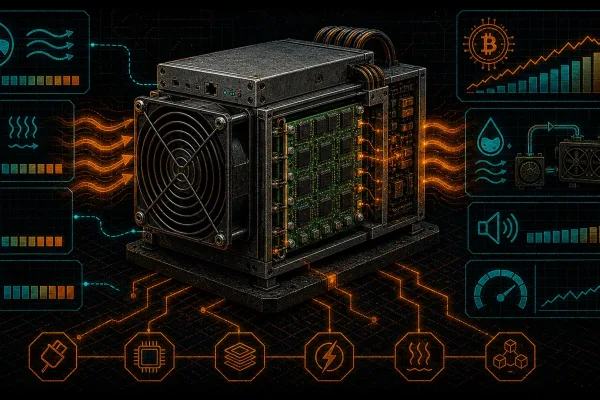
Compare an Antminer to a modern laptop. The laptop has its RAM soldered to the motherboard, its SSD glued in place, its battery trapped behind proprietary adhesive, and its software locked to a single vendor’s ecosystem. Now look at an Antminer:
- Hashboards slide in and out on rail connectors. A dead ASIC chip can be reflowed or replaced individually.
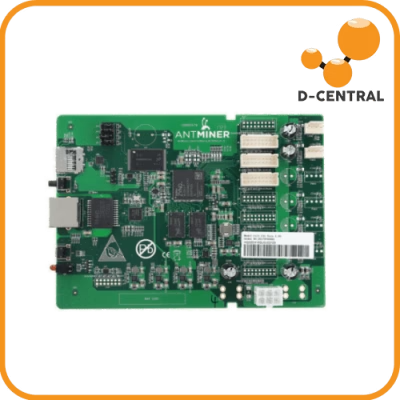
- Control boards are standardized per generation. Swap one in five minutes.
- Fans are standard 120mm or 140mm units with simple 4-pin connectors.
- Power supplies (APW series) are standalone units with standard PCIe connectors.
- Firmware is flashable, forkable, and hackable — no vendor lock-in.
This modularity is not accidental. It is a consequence of Bitcoin mining’s ruthless selection pressure for efficiency and uptime. Bitmain, MicroBT, and other manufacturers designed these machines to be serviced in the field by operators who cannot afford to ship hardware back to China every time a fan dies.
For the home miner and the repair technician, this modularity is a gift. At D-Central, our ASIC repair service covers 38+ specific models across Bitmain, MicroBT, Innosilicon, Canaan, and Halong Mining hardware. We repair at the component level — individual ASIC chip replacement, thermal compound reapplication, hashboard trace repair, power domain diagnostics. A machine that would be “e-waste” at a large farm walks out of our shop in Montreal, Quebec running at full hashrate.
The Circular Economy of Bitcoin Mining Hardware
The lifecycle of a Bitcoin miner does not have to be linear (manufacture -> use -> landfill). In practice, it looks more like this:
Stage 1: Industrial Deployment — A new-generation ASIC runs at an industrial facility where electricity is cheapest and uptime is everything. It mines profitably for 2-4 years until newer, more efficient hardware takes its rack slot.
Stage 2: Resale and Refurbishment — The retired miner is sold on the secondary market. Companies like D-Central acquire, test, repair, and refurbish these machines. Failed components are replaced. Firmware is updated. Thermal compound is refreshed. The machine is certified and resold.
Stage 3: Second-Life Deployment — The refurbished miner goes to a home miner, a small-scale operator, or gets built into a Bitcoin space heater. In Canada, where winter lasts six months, a 1,400W Antminer S9 space heater offsets your electric baseboard heating while stacking sats. The “waste heat” narrative flips entirely — ALL the electricity becomes useful heat, and the Bitcoin is a bonus.
Stage 4: Component Harvesting — When a machine truly cannot be economically repaired as a whole unit, its components live on. Working hashboards go into other units. Fans, cables, heat sinks, and enclosures get reused. Even dead hashboards contain recoverable copper, gold, tin, and silicon.
This is the circular economy in action. No other consumer electronics category comes close to this level of repairability and reuse.
Canada’s Natural Advantage: Cold Climate + Clean Energy
Canada is uniquely positioned for sustainable Bitcoin mining, and this is something we take pride in at D-Central. Here is why:
| Factor | Canada’s Advantage |
|---|---|
| Electricity Mix | 82% non-emitting sources (hydro, nuclear, wind, solar). Quebec alone is 99% hydro. |
| Climate | 6+ months of cold weather = free cooling for ASICs + useful heat output for homes/buildings |
| Energy Costs | Quebec residential: ~$0.07-0.09 CAD/kWh, among the lowest in the world |
| Regulatory Environment | No Bitcoin mining bans. Legal, regulated, and increasingly recognized |
| Excess Energy | Hydro-Quebec regularly exports surplus power. Mining monetizes what would otherwise be curtailed |
When you combine clean hydroelectric power, sub-zero ambient temperatures that eliminate cooling costs, and a home heating season that makes every watt of mining heat useful, Bitcoin mining in Canada is not just sustainable — it is one of the most environmentally sound ways to use electricity, period.
This is why we operate our hosting facility in Montreal, Quebec — powered by some of the cleanest, cheapest electricity on the planet.
Home Mining: Where Sustainability and Sovereignty Meet
The real environmental argument for Bitcoin mining is not about industrial-scale operations. It is about the millions of homes that already use electric resistance heating and could replace some or all of that with Bitcoin miners that produce the exact same heat — plus Bitcoin.
A 1,400W electric baseboard heater converts electricity to heat at 100% efficiency. A 1,400W Antminer S9 also converts electricity to heat at 100% efficiency — thermodynamics does not care what the electrons pass through on their way to becoming heat. The difference is that the Antminer also produces Bitcoin while it heats your home.
This is the dual-purpose mining thesis, and it completely dismantles the “Bitcoin wastes energy” narrative. When your miner IS your heater, the energy cost of mining is effectively zero — you were going to spend that electricity on heat anyway.
D-Central’s Bitcoin Space Heater lineup — available in S9, S17, and S19 configurations — is built specifically for this use case. Quiet enough for a living space, powerful enough to heat a room, and stacking sats 24/7 during the heating season.
Open-Source Hardware: The Ultimate Anti-Waste Movement
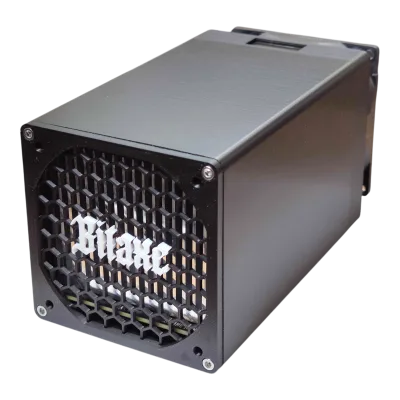
Beyond refurbishing industrial ASICs, the open-source mining movement represents a fundamentally different approach to hardware sustainability. Devices like the Bitaxe — which D-Central has been involved with since its earliest days as a pioneer manufacturer — are designed from the ground up to be repairable, modifiable, and long-lived.
Open-source mining hardware means:
- Full schematics available — anyone can diagnose and repair the board
- No proprietary firmware locks — community firmware keeps devices updated indefinitely
- Modular design philosophy — upgrade the ASIC chip without replacing the whole board
- Community-driven development — thousands of contributors improving the platform
- Local manufacturing — produced by companies like D-Central, not shipped from halfway around the world
A Bitaxe Supra or Ultra running on a 5V barrel jack (5.5×2.1mm DC — not USB-C, that port is for firmware flashing only) draws just 12-15W. It will solo mine for years, it is trivially repairable, and when a new ASIC chip generation arrives, the community designs an upgrade path rather than a replacement.
This is what the right to repair looks like in practice. No planned obsolescence. No glued-in batteries. No software kill switches. Just open hardware, built to last.
What D-Central Does Differently
We are not a faceless retailer dropshipping mining hardware from Shenzhen. We are a Canadian company with a physical repair shop in Montreal, Quebec, staffed by technicians who diagnose hashboard failures down to individual BM1397 and BM1366 chips. Here is what sets our approach apart:
- Component-level ASIC repair: We do not just swap boards — we repair them. Chip-level rework, trace repair, thermal optimization. This keeps hardware out of landfills and in the hands of miners.
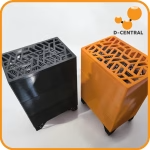
- Custom builds for home miners: Our Slim Edition, Pivotal Edition, and Loki Edition Antminers are modified specifically for residential deployment — quieter, more compact, optimized for the home environment.
- Full ecosystem support: From mining consulting to repair to hosting to parts and accessories — we support the entire lifecycle of mining hardware, which means nothing gets thrown away prematurely.
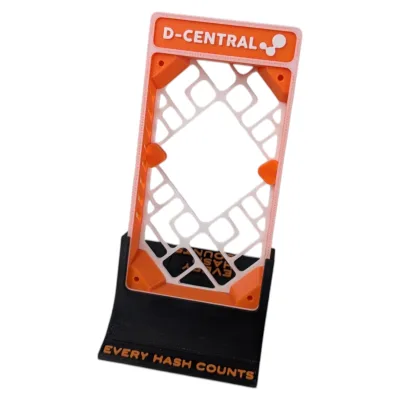
- Open-source advocacy: As a Bitaxe pioneer manufacturer and the creator of the original Bitaxe Mesh Stand, we actively push for repairable, open hardware that anyone can service.
The Decentralization-Sustainability Connection
Here is the part that most “eco-friendly mining” articles miss entirely: decentralization itself is a sustainability strategy.
When mining is concentrated in a handful of industrial megafarms, those operations have zero incentive to repair older hardware. They run the newest, most efficient machines and dump everything else. The economics of scale push toward disposability.
But when mining is distributed across thousands of homes — each one using miners as heaters, running on local renewable energy, repairing their own hardware — the entire incentive structure flips. Home miners keep machines running longer because every hash counts, every sat matters, and the heat is always useful. The pleb miner is the most sustainable miner.
This is why D-Central’s mission — the decentralization of every layer of Bitcoin mining — is not just a philosophical stance. It is an environmental one. More miners in more homes means less hardware in landfills, more network security, and greater resistance to centralization.
Practical Steps: How to Mine Bitcoin Sustainably
If you are ready to mine Bitcoin in the most environmentally responsible way possible, here is the playbook:
- Buy refurbished first. A refurbished Antminer from a reputable source like D-Central performs identically to new at a fraction of the cost and environmental footprint. Check our shop for current inventory.
- Use your miner as a heater. If you live anywhere with a heating season — and in Canada, that is basically everywhere — position your miner where you need heat. Offset your heating bill while stacking sats.
- Repair before you replace. A single dead fan or a failing hashboard does not make the whole machine garbage. D-Central’s repair service can bring most machines back to full operation.
- Run on clean energy. If your grid mix is clean (and in most of Canada, it is), your mining operation is already greener than the global average by a wide margin.
- Consider open-source hardware. A Bitaxe running solo on your desk uses less power than a light bulb, teaches you about mining at the silicon level, and will never become planned-obsolete e-waste.
- Join the community. The home mining community shares repair knowledge, firmware hacks, and heat recovery designs that keep hardware running longer and more efficiently.
FAQ
How long can a refurbished Antminer last?
With proper maintenance — thermal compound replacement, fan cleaning, firmware updates — a refurbished Antminer can run for 5-10+ years. The Antminer S9, released in 2016, is still widely used in 2026 as a space heater and solo miner. ASIC chips themselves rarely fail; it is typically fans, connectors, and thermal interfaces that degrade over time, all of which are easily replaced.
Is Bitcoin mining really bad for the environment?
The “Bitcoin wastes energy” narrative ignores critical context. Bitcoin mining converts electricity to heat at 100% efficiency — the same as any electric heater. When used for dual-purpose heating, the energy is not wasted at all. Additionally, Bitcoin mining is increasingly powered by renewable sources. In Canada, where over 82% of electricity comes from non-emitting sources, mining is among the cleanest industrial activities possible. Mining also monetizes stranded and curtailed energy that would otherwise be wasted entirely.
What happens to ASIC miners when they become “obsolete”?
Obsolescence at industrial scale does not mean uselessness. Older-generation miners get resold, refurbished, and redeployed by home miners and small operators. They serve as space heaters, solo miners, and educational tools. When a unit truly cannot be repaired economically, its components — hashboards, fans, cables, heat sinks, enclosures — are harvested for other machines. The precious metals and materials in the circuit boards can be recovered through proper e-waste recycling.
How does ASIC repair reduce e-waste?
Component-level ASIC repair — which D-Central has specialized in since 2016 — fixes individual chips, traces, and connectors on hashboards rather than scrapping the entire board. A hashboard repair that costs $40-150 saves a piece of hardware worth $200-2,000+ from becoming landfill waste. Across the thousands of repairs we perform, this represents tonnes of electronic waste diverted from disposal every year.
Can I really heat my home with a Bitcoin miner?
Absolutely. Every watt consumed by a Bitcoin miner is converted to heat — this is basic thermodynamics. A 1,400W Antminer S9 in a space heater enclosure produces the same heat as a 1,400W electric baseboard heater, plus it mines Bitcoin. D-Central’s Bitcoin Space Heater lineup is designed specifically for residential use with noise reduction and proper airflow management. During Canadian winters, your miner pays for part or all of its electricity through Bitcoin earnings while heating your home.
What is the environmental benefit of open-source mining hardware like Bitaxe?
Open-source mining hardware is designed for maximum repairability and longevity. Full schematics are publicly available, meaning anyone can diagnose and repair the device. There are no proprietary firmware locks or planned obsolescence mechanisms. The modular design allows upgrading individual components (like the ASIC chip) without replacing the entire device. This philosophy stands in stark contrast to mainstream consumer electronics, where repairability is actively discouraged. A Bitaxe is built to be maintained indefinitely.
Does D-Central recycle mining hardware that cannot be repaired?
When a machine is truly beyond economic repair, we harvest every reusable component — working hashboards, fans, cables, heat sinks, and enclosures — for use in other repairs and builds. The remaining materials are directed to certified e-waste recycling facilities that recover precious metals and properly handle hazardous materials. Our goal is zero hardware reaching a landfill.