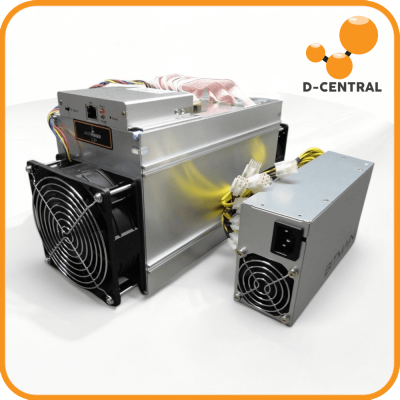
Every four years, the Bitcoin network slashes its block reward in half. After the April 2024 halving, miners now compete for 3.125 BTC per block. Meanwhile, the network hashrate has surged past 800 EH/s — a number that would have seemed absurd even three years ago. In this environment, ASIC efficiency is not a nice-to-have metric. It is the single variable that separates miners who stack sats from miners who bleed money on their electricity bill.
This is the reality of Bitcoin mining in 2026: the margin between profitable and unprofitable sits on a razor’s edge, measured in joules per terahash. If your hardware is inefficient, the network will punish you. If your hardware is efficient, you can mine through bear markets, difficulty spikes, and halvings while others shut down.
At D-Central Technologies, we have been repairing, building, and deploying ASIC miners since 2016. We are Bitcoin Mining Hackers — we take institutional-grade technology and make it accessible for home miners, pleb miners, and anyone who believes that decentralizing hashrate is a matter of sovereignty, not just profit. This guide breaks down ASIC efficiency from first principles to modern practice, so you can make hardware decisions grounded in engineering reality, not marketing hype.
What ASIC Efficiency Actually Means
ASIC efficiency is measured in joules per terahash (J/TH). This metric tells you how many joules of electrical energy are consumed for every trillion SHA-256 hashes computed. A lower J/TH number means less electricity consumed per unit of computational work — which translates directly to lower operating costs and higher margins.
The Core Formula
The calculation is straightforward: divide the miner’s wall power consumption (in watts) by its hashrate (in TH/s). A miner drawing 3,400W at 190 TH/s operates at approximately 17.9 J/TH. A miner pulling 5,000W at 300 TH/s hits roughly 16.7 J/TH. Despite consuming far more raw power, the second machine is more efficient — it extracts more hashes per joule.
This distinction matters enormously. Two miners generating identical revenue will have dramatically different profit margins if one burns 30% more electricity per hash. Over a year of 24/7 operation, that efficiency gap compounds into thousands of dollars.
Why J/TH Matters More Than Raw Hashrate
Marketing teams love headline hashrate numbers. They are easy to understand and sound impressive. But raw hashrate without context is meaningless. A hypothetical 500 TH/s machine that consumes 25 J/TH is a worse investment than a 300 TH/s machine at 15 J/TH in most electricity markets. The lower-hashrate machine will actually generate more profit because its operating costs are drastically reduced relative to its output.
The only scenario where raw hashrate trumps efficiency is when electricity is essentially free — and truly free electricity is far rarer than miners like to believe. For most operators, especially home miners running on residential power rates, efficiency is king.
The Hardware Evolution: From CPUs to Sub-15 J/TH ASICs
Understanding where we are requires understanding how we got here. The trajectory of Bitcoin mining hardware is one of the most relentless efficiency curves in computing history.
The Early Eras: CPU, GPU, FPGA
Satoshi Nakamoto mined the genesis block on a standard CPU. Those early days were beautiful in their simplicity — anyone with a laptop could participate. As Bitcoin gained traction, miners discovered that GPUs, originally built for rendering video game graphics, could crunch SHA-256 hashes orders of magnitude faster than CPUs. The GPU era gave way to FPGAs (Field-Programmable Gate Arrays), which offered better efficiency by allowing hardware to be configured specifically for the hashing algorithm.
Each transition followed the same pattern: specialized hardware replaced general-purpose hardware, extracting more hashes per watt at each step.
The ASIC Revolution
The introduction of Application-Specific Integrated Circuits in 2013 was the decisive moment. ASICs do exactly one thing — compute SHA-256 hashes — and they do it with ruthless efficiency. Unlike GPUs or FPGAs, an ASIC chip cannot be reprogrammed for another task. This extreme specialization is precisely what makes ASICs so efficient.
Early ASICs like the Avalon1 and Bitmain’s first Antminer models operated at efficiency levels that seem comically bad by today’s standards — hundreds of J/TH. But they obliterated everything that came before them. The ASIC era permanently raised the floor for mining participation and kicked off an arms race between manufacturers that continues to this day.
The Nanometer Race
ASIC efficiency improvements have been driven primarily by semiconductor fabrication advances. Each reduction in chip node size — from 28nm to 16nm to 7nm to 5nm and now 3nm — allows more transistors to be packed into less silicon, doing more work with less energy. The progression looks something like this:
- 28nm era (2014-2016): ~100+ J/TH — Antminer S5, S7
- 16nm era (2016-2019): ~80-100 J/TH — Antminer S9, the legendary workhorse
- 7nm era (2019-2022): ~29-34 J/TH — Antminer S19 series, Whatsminer M30S series
- 5nm era (2022-2024): ~15-22 J/TH — Antminer S21, Whatsminer M60S, Avalon A1566
- 3nm era (2024-present): ~11-15 J/TH — Antminer S21 XP, next-gen flagships
Each generation delivers roughly a 30-50% efficiency improvement over its predecessor. The S9, which dominated mining for years at ~80 J/TH, is now six to seven times less efficient than current-generation hardware. It can still mine — and many operators repurpose S9s as Bitcoin space heaters, capturing the waste heat for home heating — but its days as a pure profit-generating miner are over for anyone paying standard electricity rates.
The 2026 ASIC Landscape
The current generation of Bitcoin mining ASICs represents the most efficient hardware in the history of the network. Three manufacturers dominate the market, each pushing the efficiency envelope.
Bitmain: The Antminer Lineup
Bitmain’s Antminer series remains the industry benchmark. The S21 line operates in the 15-17.5 J/TH range, while the S21 XP pushes below 14 J/TH. Their hydro-cooled variants squeeze out additional efficiency by running chips at optimal temperatures with liquid cooling. Bitmain’s dominance is built on aggressive R&D spending, exclusive access to TSMC and Samsung fabrication, and the sheer volume of units they produce.
The Antminer T21 serves as a more accessible entry point, trading some efficiency for a lower purchase price — a legitimate trade-off for miners with cheap electricity or shorter payback horizons.
MicroBT: The Whatsminer Lineup
MicroBT has established itself as the strongest competitor to Bitmain. The Whatsminer M60S and M63S series deliver efficiency figures that are competitive with or occasionally superior to their Antminer counterparts. MicroBT’s build quality has earned them a loyal following, and their machines tend to be slightly quieter than comparable Antminers — a non-trivial consideration for home mining setups.
Canaan: The AvalonMiner Lineup
Canaan, the original pioneer of ASIC mining (the Avalon1 was the first commercially available Bitcoin ASIC), continues to compete with its AvalonMiner series. While they have historically trailed Bitmain and MicroBT on peak efficiency, their latest models have closed the gap considerably. Canaan’s advantage lies in their publicly traded status and commitment to transparency.
The Open-Source Revolution
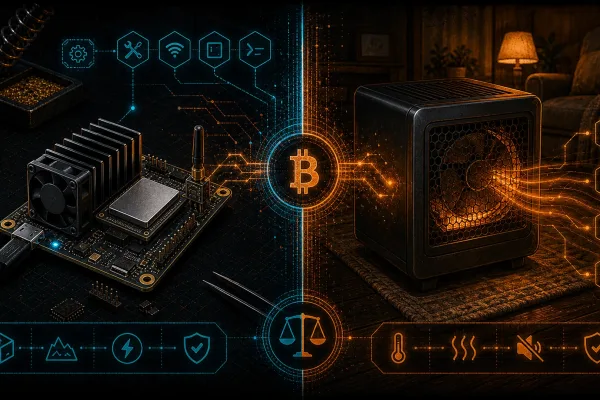
Beyond the industrial ASIC manufacturers, a parallel revolution is happening in open-source mining hardware. Devices like the Bitaxe — which D-Central has been involved with since its inception as a pioneer manufacturer — are putting hashrate in the hands of individuals at a scale that was previously impossible. While a Bitaxe running a BM1366 or BM1368 chip cannot compete with a full ASIC rack on raw output, that is not the point. The point is sovereignty: your hash, your keys, your node, your rules.
The Bitaxe family, including the Supra, Ultra, Hex, Gamma, and GT variants, allows anyone to participate in solo mining for a few hundred dollars and a handful of watts. Every hash counts — and when a solo miner finds a block, it is a direct contribution to the decentralization of Bitcoin’s security model.
Efficiency as a Survival Strategy
After the April 2024 halving cut the block reward from 6.25 BTC to 3.125 BTC, miners immediately felt the squeeze. Revenue per hash was cut in half overnight, but electricity costs stayed exactly the same. The miners who survived — and thrived — were the ones running efficient hardware.
The Electricity Cost Equation
Consider a concrete example. A miner operating at 20 J/TH with an electricity cost of $0.08/kWh spends roughly $0.014 per TH/s per day on power. A miner at 30 J/TH pays $0.021 per TH/s per day — 50% more. At scale, this gap is devastating. A 100 TH/s operation at 30 J/TH would spend approximately $766 per year more than the same hashrate at 20 J/TH. Scale that to a petahash, and you are looking at tens of thousands of dollars in wasted electricity annually.
For home miners, the math is even more unforgiving because residential electricity rates are typically higher than industrial rates. This is precisely why efficient hardware matters disproportionately for the pleb miner.
Mining Through Bear Markets
Efficiency is what allows you to keep mining when the Bitcoin price drops. If your breakeven electricity cost — the maximum price per kWh you can pay and still mine profitably — is higher, you stay online longer during downturns. Miners with older, inefficient hardware are the first to capitulate. Miners with efficient hardware simply ride it out, accumulating sats at a discount while the weak hands disconnect.
This is the mining hacker philosophy: you do not shut down when it gets hard. You optimize, you hack, you upgrade, and you keep hashing. Use our mining profitability calculator to model your specific electricity cost against current-generation hardware and see exactly where your breakeven sits.
Dual-Purpose Mining: Recapturing Waste Heat
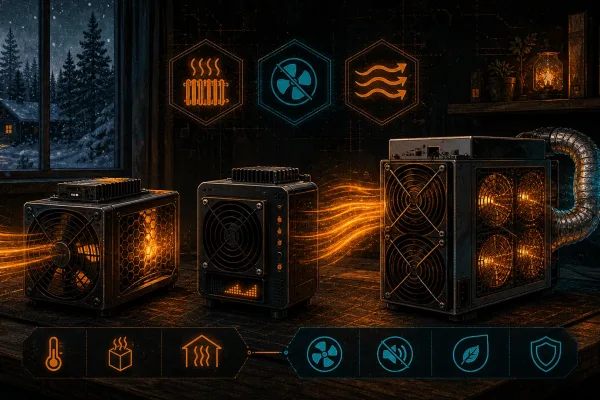
One of the most powerful efficiency strategies for home miners is heat recovery. Every watt consumed by an ASIC miner is converted to heat — 100% of it. That heat does not have to be wasted. By integrating a miner into your home heating system, you effectively subsidize your mining operation with heating savings, or conversely, you get free heating as a byproduct of mining.
D-Central’s Bitcoin Space Heater line was built on exactly this principle. An Antminer S9 running as a space heater produces roughly 1,400W of heat — equivalent to a portable electric heater — while simultaneously mining Bitcoin. The mining revenue may not be substantial with an S9-class miner in 2026, but when you factor in the displaced heating cost, the economics shift dramatically. You were going to pay for heating anyway. Now your heater pays you back.
The Decentralization Imperative
Efficiency conversations in mainstream mining circles are dominated by profitability. At D-Central, we believe there is an equally important dimension: decentralization.
When only the most efficient, industrial-scale operations can mine profitably, hashrate concentrates in fewer hands. This is antithetical to Bitcoin’s design. The entire security model of proof-of-work assumes a distributed set of miners — no single entity or cartel should control a majority of the network’s hashrate.
Home mining and pleb mining are not just hobbies. They are acts of sovereignty. Every home miner running a Bitaxe, a NerdAxe, or even an Antminer in a closet is contributing to the geographic and political distribution of Bitcoin’s hashrate. Efficient hardware makes this participation economically viable, not just ideologically motivated.
This is what decentralization of every layer of Bitcoin mining looks like in practice: accessible hardware, open-source firmware, sovereign operation, and the conviction that hash rate distribution matters as much as hash rate magnitude.
Maintaining Efficiency: Repair and Maintenance
Even the most efficient ASIC miner degrades over time. Dust accumulation reduces cooling efficiency, forcing fans to spin harder and chips to throttle. Thermal paste dries out. Hashboards develop faults. A miner that shipped at 17 J/TH can drift to 22+ J/TH after a year of neglected maintenance — a 30% efficiency loss that drains profit every hour of every day.
Preventive Maintenance
Regular maintenance is the most cost-effective efficiency optimization available. Compressed air cleaning every 3-6 months, thermal paste replacement annually, and periodic firmware updates can keep your miner running at or near its rated efficiency for years.
When to Repair vs. Replace
The repair-or-replace decision comes down to efficiency economics. If a repair can restore a miner to its rated efficiency at a fraction of the replacement cost, repair wins. If the miner is two or more generations behind and even a perfect repair leaves it at 30+ J/TH, replacement with current-generation hardware may make more sense.
D-Central has been performing ASIC repairs across all major manufacturers since 2016 — Bitmain, MicroBT, Canaan, Innosilicon, and more. With 50+ model-specific repair pages and thousands of miners serviced, we can diagnose whether your machine is worth restoring or whether it is time to upgrade. Either way, the goal is the same: maximum joules-per-terahash efficiency from every piece of hardware you own.
The Future of ASIC Efficiency
The efficiency curve is not flattening. Several trends point toward continued improvements:
Advanced Fabrication Nodes
As chip fabrication moves to 3nm and eventually 2nm processes, the theoretical efficiency floor for SHA-256 computation keeps dropping. Samsung and TSMC are both investing billions in next-generation fabs, and ASIC manufacturers are first in line for allocation.
Liquid Cooling and Immersion
Immersion cooling — submerging miners in dielectric fluid — allows chips to run at lower temperatures, which improves both efficiency and lifespan. Several manufacturers now offer hydro-cooled variants, and aftermarket immersion solutions are gaining traction. This technology is particularly interesting for home miners, as it also virtually eliminates noise.
Custom Firmware Optimization
Third-party firmware like Braiins OS+, Vnish, and LuxOS allows miners to fine-tune their machines for optimal efficiency. Autotuning features dynamically adjust voltage and frequency per chip, squeezing out efficiency gains that stock firmware leaves on the table. For the mining hacker, custom firmware is a mandatory upgrade.
The Thermodynamic Floor
There is a physical limit to how efficient a SHA-256 ASIC can be, dictated by the Landauer limit and practical semiconductor physics. We are still well above that theoretical floor, which means significant efficiency gains remain possible. But each incremental improvement gets harder and more expensive — the low-hanging fruit has been picked.
Frequently Asked Questions
What is ASIC efficiency and how is it measured?
ASIC efficiency is measured in joules per terahash (J/TH). It represents how much electrical energy is consumed for every trillion SHA-256 hashes computed. Lower J/TH values indicate higher efficiency — the miner produces more hashes per unit of electricity. To calculate it, divide the miner’s wall power draw (in watts) by its hashrate (in TH/s).
What is a good J/TH rating for a Bitcoin miner in 2026?
In 2026, current-generation miners operate between 11-18 J/TH. Anything below 18 J/TH is considered competitive for most electricity rates. Miners in the 14-16 J/TH range (like the Antminer S21 or Whatsminer M60S) hit a strong balance of efficiency and acquisition cost. Sub-14 J/TH models (S21 XP class) are premium efficiency but carry higher upfront prices. For home miners paying $0.08-0.12/kWh, targeting 18 J/TH or better is advisable.
How does the 2024 halving affect ASIC efficiency requirements?
The April 2024 halving cut the block reward from 6.25 BTC to 3.125 BTC, meaning miners earn half as much Bitcoin per block. This immediately doubled the efficiency threshold required for profitability. Miners that were marginal before the halving became unprofitable overnight. In a post-halving environment with 800+ EH/s of network hashrate, only efficient hardware survives at standard electricity rates.
Can older ASIC miners still be profitable?
It depends entirely on your electricity cost and whether you are capturing waste heat. An Antminer S9 at ~80 J/TH is not profitable as a pure miner for anyone paying more than a few cents per kWh. However, repurposed as a Bitcoin space heater, the S9 becomes economically viable because the heat output displaces conventional heating costs. The mining revenue becomes a bonus rather than the primary value proposition.
Why does hashrate keep increasing even after halvings?
Network hashrate is driven by the total revenue available to miners (block reward multiplied by Bitcoin’s price) relative to the cost of mining. Even though the block reward halves, if Bitcoin’s price appreciates sufficiently, total mining revenue can still increase. Additionally, newer, more efficient hardware allows miners to be profitable at lower revenue-per-hash levels, so efficient miners keep deploying even when less efficient operators shut down.
How does D-Central help home miners optimize efficiency?
D-Central Technologies serves the home mining community through multiple channels: we sell current-generation ASIC miners and open-source mining hardware like the Bitaxe, perform professional ASIC repairs to restore degraded miners to rated efficiency, build Bitcoin space heaters for dual-purpose mining and heating, and provide technical education through our guides and blog. We have been doing this since 2016 — longer than most companies in this space have existed.
What is the most energy-efficient way to mine Bitcoin at home?
The most efficient home mining strategy combines three elements: (1) current-generation hardware with the lowest J/TH you can afford, (2) custom firmware like Braiins OS+ or Vnish for autotuning optimization, and (3) heat recovery to offset home heating costs. If you are in a cold climate — Canada, northern US, northern Europe — the dual-purpose mining and heating approach can make home mining economically compelling even at higher residential electricity rates.
Is solo mining with a Bitaxe worth it from an efficiency standpoint?
Solo mining with a Bitaxe is not an efficiency play in the traditional sense — a single Bitaxe running at 500 GH/s to 1.2 TH/s has a very low probability of finding a block. But efficiency is not the only metric that matters. Solo mining with a Bitaxe is a sovereignty play. You are running your own miner, pointed at your own node, with zero dependence on pools or third parties. The electricity cost is minimal (5-15W), and the educational and ideological value is immense. And when a solo Bitaxe does find a block — which has happened — the reward is the full 3.125 BTC plus fees.