Bitcoin Mining Noise Levels: Why Every Home Miner Needs to Care About Decibels
There is a moment every home miner remembers. You unbox your first ASIC, plug it in, and the fans spin up. What follows is a wall of sound that sends pets running, wakes up the household, and makes you question every decision that led to this point. Bitcoin mining noise is the single biggest barrier between you and a successful home mining operation, and if you do not plan for it, your mining journey ends before it starts.
At D-Central, we have been hacking institutional mining hardware into home-friendly solutions since 2016. We have heard every complaint, tested every workaround, and built products specifically to solve the noise problem. This guide breaks down exactly how loud different miners are, what your options look like, and how to build a mining setup that your household can actually live with.
Understanding Mining Noise: What the Decibels Actually Mean
Before we compare hardware, you need to understand what decibel ratings actually tell you. The decibel scale is logarithmic, not linear. That means 80 dB is not “a little louder” than 70 dB. It is ten times more intense. A jump from 60 dB to 80 dB represents a hundred-fold increase in sound intensity. This is why an Antminer S19 at 75-80 dB is not just “slightly worse” than a StealthMiner at 40-45 dB. It is a fundamentally different experience.
For home mining context, here is what matters:
- Below 30 dB — You will not notice it. This is the territory of whispers and quiet rooms. Perfectly livable in any room of your house.
- 30-45 dB — Noticeable if you listen for it, but easily masked by normal household activity. Comparable to a quiet office or library.
- 45-60 dB — Clearly audible. You would not want this in a bedroom, but a basement or garage handles it fine.
- 60-75 dB — Disruptive. Conversation becomes difficult nearby. Requires a dedicated room with some sound treatment.
- 75+ dB — Hostile. Extended exposure causes hearing fatigue. This is where most stock ASICs live, and it is why people think home mining is impractical.
Bitcoin Miner Noise Comparison: From Silent to Jet Engine
We have tested and deployed every miner on this list. These are real-world numbers from our workshop, not manufacturer specs written in an anechoic chamber.
| Miner | Noise Level (dB) | Everyday Comparison | Home Friendly? |
|---|---|---|---|
| Bitaxe (Supra/Ultra/Gamma) | ~0 dB (silent) | No moving parts on basic models | Anywhere, any room |
| Nerdminer | ~0 dB (silent) | Fanless microcontroller | Anywhere, any room |
| NerdAxe | ~25-30 dB | Whisper / rustling leaves | Anywhere, any room |
| NerdQAxe | ~30-35 dB | Quiet library | Living spaces, office |
| StealthMiner | ~40-45 dB | Quiet conversation / refrigerator | Office, basement, garage |
| Bitcoin Space Heater (S9 Edition) | ~45-55 dB | Moderate rainfall / dishwasher | Basement, dedicated room |
| Antminer S21 (Low Power Mode) | ~50-55 dB | Normal conversation | Basement, garage |
| Antminer S21 (Full Power) | ~60-65 dB | Loud conversation / busy restaurant | Dedicated room only |
| Antminer S9 (Stock) | ~75 dB | Vacuum cleaner | Isolated room / external structure |
| Antminer S19 (Stock) | ~75-80 dB | Lawn mower / loud traffic | Isolated room / external structure |
The pattern is clear. Stock industrial ASICs were designed for data centers where nobody sleeps. Open-source miners like the Bitaxe and NerdAxe were designed from the ground up for the environments real people actually live in. The gap between these two worlds is enormous, but it is also bridgeable with the right approach.
Silent Mining: The Zero-Noise Option
If noise is a dealbreaker, you have real options that produce zero or near-zero sound. These are not compromises. They are purpose-built machines for home miners who refuse to sacrifice their living environment.
Bitaxe: Truly Silent Solo Mining
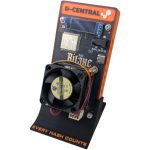
The Bitaxe is a single-chip open-source Bitcoin miner that operates with passive cooling on basic configurations. No fans means no noise. Period. You can run a Bitaxe on your desk, on a bookshelf, or on your nightstand while you sleep. It draws about 15 watts, produces no audible sound, and mines Bitcoin 24/7.
D-Central has been a pioneer in the Bitaxe ecosystem since the beginning. We created the original Bitaxe Mesh Stand, developed custom heatsinks, and stock every variant: Supra, Ultra, Gamma, Hex, and GT. Every hash from a Bitaxe contributes to Bitcoin’s decentralization, and you do not need ear protection to run one.
Nerdminer: Education Meets Silence
The Nerdminer is a fanless microcontroller-based miner. It produces zero noise because there are no moving parts whatsoever. The hashrate is minimal, but that is not the point. The Nerdminer is an entry point into solo mining, a conversation piece, and a statement that you believe in decentralization enough to run your own hardware.
NerdAxe: Whisper-Quiet and Capable
The NerdAxe steps up the hashrate while keeping noise in the 25-30 dB range. That is quieter than most rooms in your house at night. The tiny fan is barely perceptible from a metre away. It is the sweet spot for miners who want more power than a Nerdminer but are not ready to deal with ASIC-level acoustics.
Browse our full range of open-source miners in the D-Central shop.
Taming the Beast: Noise Reduction for Full-Size ASICs
Not everyone wants to mine with open-source hardware. If you are running a full-size ASIC for serious hashrate, the noise problem is solvable. It just takes engineering. Here are the proven approaches, ranked by effectiveness.
Acoustic Enclosures
A purpose-built acoustic enclosure is the most effective single modification you can make. The StealthMiner, which D-Central assembles and tunes, drops a full-size ASIC from 75+ dB down to 40-45 dB. That is a reduction from lawn-mower territory to quiet-refrigerator territory. The enclosure uses sound-dampening materials and engineered airflow to contain noise while maintaining proper cooling.
Key considerations for any acoustic enclosure:
- Airflow is non-negotiable. An enclosure that reduces noise by restricting airflow will overheat your miner and kill hashboards. Sound dampening must work with the cooling path, not against it.
- Exhaust routing matters. An enclosure is only as quiet as its weakest point. If your exhaust dumps directly into the room, you have not solved the problem. Duct the exhaust outside or into your HVAC system.
- Material thickness counts. Mass loaded vinyl, acoustic foam, and multi-layer construction all contribute. Thin plastic shells barely dent the noise floor.
Fan Replacements and Speed Control
Stock ASIC fans are selected for data center reliability and maximum cooling capacity, not for acoustics. Swapping to quieter aftermarket fans or adding variable speed controllers can cut noise by 10-20 dB. The trade-off is straightforward: slower fans mean less cooling capacity, which means your miner runs hotter or needs to be underclocked.
This is where firmware hacking shines. Custom firmware like Braiins OS+ allows you to dial in fan curves that balance noise against thermal headroom. You are essentially telling the miner exactly when and how hard to push the fans, instead of letting the stock firmware blast them at maximum speed all the time.
Shrouds and Duct Adapters
An ASIC shroud with duct adapter does not reduce noise at the source. What it does is give you control over where the noise goes. By attaching ductwork to the exhaust, you can route hot (and loud) air outside, into an attic, or into a dedicated exhaust path. The miner is still loud at the outlet, but the outlet is no longer in your living space.
Shrouds also improve cooling efficiency by preventing hot exhaust air from recirculating back into the intake. Better airflow means the fans do not need to work as hard, which provides a secondary noise reduction.
Immersion Cooling
The nuclear option. Submerging your ASIC in dielectric fluid eliminates all fan noise because there are no fans. The pump that circulates the fluid is far quieter than any ASIC fan. Immersion systems can bring a 75+ dB miner down below 40 dB.
The downsides are real: high upfront cost, specialized maintenance, and complexity that most home miners do not need. But if you are running multiple machines and noise is the constraint that limits your operation, immersion cooling removes that constraint entirely.
Bitcoin Space Heaters: Mining Noise, Solved by Design
D-Central’s Bitcoin Space Heaters represent a fundamentally different approach to the noise problem. Instead of trying to silence an ASIC sitting in your office, a space heater reframes the miner as a heating appliance. The miner is enclosed, acoustically dampened, and integrated with proper airflow management from the factory.
Available in S9, L3, S17, and S19 editions, these units take miners that would be unbearable in a living space and package them into something that belongs in a room. The enclosed design captures and directs the noise, while the heat output replaces your conventional electric heater during cold months.
This is the Bitcoin Mining Hacker approach at its core: institutional mining hardware, re-engineered for the home. You are not just reducing noise. You are monetizing the heat output that every other miner wastes. In a Canadian winter, that heat is not a byproduct. It is the point.
Room Placement and Acoustic Planning
Hardware selection and modifications are only half the equation. Where you put your miner and how you prepare the room makes a significant difference.
- Basement placement — Concrete walls and distance from living spaces provide natural sound isolation. A miner in the basement is barely audible on the main floor.
- Closet or utility room — Enclosed spaces contain noise, but you must solve ventilation. A miner in an unventilated closet will overheat within minutes.
- Garage or shed — Ideal for noise isolation, but watch ambient temperature extremes. ASICs have operating temperature ranges, and a Canadian garage in January or July can push those limits.
- Vibration isolation — Rubber pads, foam mats, or vibration-dampening mounts prevent the miner from transmitting low-frequency hum through floors and walls. This is the noise that travels through structure, not air, and it is often the most annoying component.
- Soft surfaces absorb, hard surfaces reflect — A miner on a bare concrete floor in a tiled room sounds louder than the same miner on a rubber mat surrounded by acoustic panels. The decibel rating at the source is identical; the room acoustics change how it reaches your ears.
Choosing the Right Noise Strategy for Your Setup
Your ideal approach depends on three factors: how much hashrate you need, what space you have available, and how noise-sensitive your household is.
- Zero tolerance for noise: Bitaxe, Nerdminer, or NerdAxe. Fanless or near-fanless, desk-friendly, and silent. You sacrifice hashrate for absolute peace.
- Some tolerance, limited space: StealthMiner or a space heater edition. Acoustic enclosure handles the dampening so you do not need a dedicated room.
- Dedicated room available: Full-size ASICs with fan replacements, custom firmware, and shrouds ducted outside. Maximum hashrate with manageable noise.
- No compromise on anything: Immersion cooling. Silent, maximum hashrate, maximum cost.
Frequently Asked Questions
Can I mine Bitcoin silently?
Yes. The Bitaxe and Nerdminer are completely silent miners with no moving parts. The NerdAxe is near-silent at 25-30 dB. These are real Bitcoin miners connected to the Bitcoin network, producing valid hashes, and contributing to decentralization. The hashrate is modest compared to industrial ASICs, but the noise output is zero or near-zero. Visit our Bitaxe Hub to explore the full lineup.
How loud is an Antminer compared to household appliances?
A stock Antminer S19 at 75-80 dB is comparable to a lawn mower or standing next to a busy highway. An S9 at 75 dB is similar to a vacuum cleaner running continuously. The newer S21 is somewhat better at 50-65 dB depending on power mode, which is closer to a loud conversation or a running dishwasher. None of these are acceptable in a living space without noise mitigation.
Do acoustic enclosures affect mining performance?
A well-designed acoustic enclosure should not reduce hashrate. The key word is “well-designed.” Cheap enclosures that restrict airflow will cause thermal throttling, which reduces hashrate and shortens hardware lifespan. Purpose-built solutions like the StealthMiner engineer the airflow path so cooling performance is maintained while noise is contained. Always verify that intake and exhaust paths are unobstructed.
What is the quietest way to mine Bitcoin with serious hashrate?
Immersion cooling is the quietest method for running full-power ASICs, bringing noise below 40 dB. For a more accessible option, D-Central’s Bitcoin Space Heaters enclose a full ASIC in a dampened housing at 45-55 dB while recovering heat for your home. Pairing a modern ASIC like the S21 in low-power mode with a shroud and duct exhaust is another practical approach that keeps noise in the 50-55 dB range within the room.
The Mining Hacker Approach to Noise
Bitcoin mining noise is an engineering problem, and engineering problems have solutions. The industry designed these machines for warehouse floors where decibel levels do not matter. Home miners operate under different constraints, and meeting those constraints requires either choosing hardware built for the home or modifying industrial hardware to fit.
D-Central exists to bridge that gap. From silent Bitaxe solo miners to acoustically engineered space heaters, from shrouds and cooling solutions to fully assembled StealthMiners, we build and stock the tools that make home mining actually livable. Every solution we offer has been tested in real homes by real miners, because that is who we are: Bitcoin Mining Hackers solving real problems for the pleb mining community.
Decentralization does not happen in data centers. It happens in basements, garages, spare bedrooms, and home offices. The noise problem is solvable. Now you know how.
Ready to build a quiet mining setup? Browse our full catalog or visit the Bitaxe Hub to start with silent solo mining.