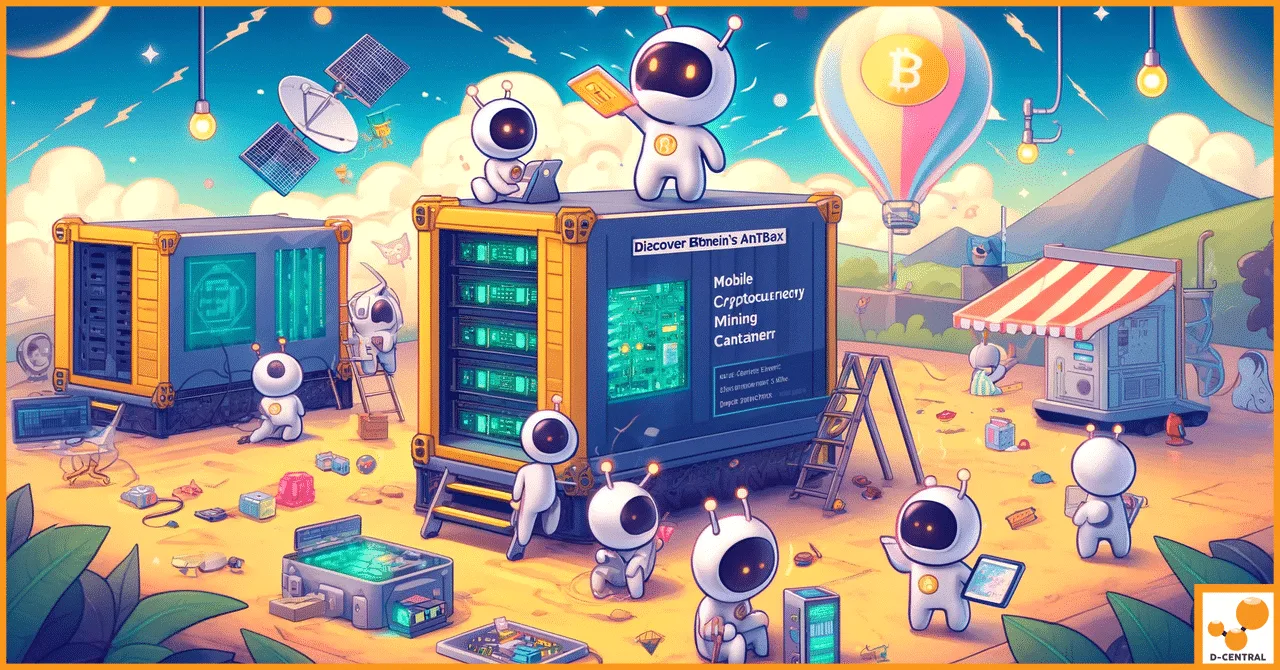
Mobile mining containers have fundamentally changed how serious Bitcoin miners deploy hashrate. Instead of building out permanent facilities with all the permitting headaches, cooling infrastructure, and capital expenditure that entails, containerized solutions let you drop a fully operational mining farm on a concrete pad, hook up power, and start hashing within days.
The Bitmain Antbox is one of the most recognized names in this space. But is it the right solution for your operation? In this guide, we break down everything you need to know about the Antbox and mobile mining containers in general — the engineering, the economics, the deployment strategy, and the alternatives — so you can make an informed decision before committing serious capital.
Why Mobile Mining Containers Exist
Bitcoin mining has always been a game of optimization. You are converting electricity into SHA-256 hashes, and every variable — power cost, cooling efficiency, uptime, hardware lifecycle — determines whether you are profitable or burning money.
Traditional mining facilities solve these problems with permanent buildings, industrial HVAC systems, and long-term power purchase agreements. That works if you have the capital, the permits, and the certainty that your location will remain economically viable for 5+ years. But Bitcoin mining economics shift fast. Difficulty adjustments happen every 2,016 blocks. The current block reward is 3.125 BTC. Halving cycles compress margins. Energy markets fluctuate.
Mobile mining containers solve a specific problem: they decouple your mining operation from any single location. If your power contract expires, energy costs spike, or regulations change, you load the container onto a flatbed and redeploy. That flexibility has real economic value.
Core Advantages Over Fixed Facilities
| Factor | Fixed Facility | Mobile Container |
|---|---|---|
| Deployment Time | 6–18 months (permits, construction) | Days to weeks |
| Capital Required | High (building, electrical, HVAC) | Lower (turnkey unit) |
| Relocatability | None — sunk cost | Full — load and ship |
| Scalability | Requires expansion planning | Add another container |
| Energy Flexibility | Tied to grid/contract | Can chase cheapest power |
| Permitting | Complex zoning requirements | Often simpler (temporary structure) |
For operations in the 100 kW to 2 MW range, containers often make more economic sense than building. Above that scale, purpose-built facilities start winning on per-unit economics — but even large operators use containers for overflow capacity or stranded energy sites.
Inside a Mining Container: What Actually Matters
Strip away the marketing and a mining container is an engineered enclosure solving three problems simultaneously: power distribution, thermal management, and physical security. How well it solves each of these determines whether your ASICs run at peak efficiency or cook themselves.
Power Distribution
A container hosting 180+ ASIC miners draws serious amperage. The power distribution unit (PDU) needs to handle the full load with proper circuit protection, balanced phase distribution, and emergency shutoff capability. Cheap containers cut corners here — undersized breakers, poor grounding, no redundancy. That is how you get electrical fires or cascading failures that take your entire operation offline.
Look for containers with:
- Properly rated bus bars and breakers for the full load
- Three-phase power distribution with balanced loading
- Emergency power disconnect (EPO) accessible from outside
- Surge protection on the main feed
- Monitoring on each circuit for load balancing
Thermal Management
Every watt your ASICs consume becomes heat. A container running 180 Antminer S19-series units at ~3,000W each generates roughly 540 kW of thermal energy inside a steel box. If your cooling system cannot remove that heat faster than it is generated, ambient temps climb, hashboards throttle, and chips degrade.
The most common approach is negative-pressure ventilation — exhaust fans pull hot air out one end while intake filters on the opposite end draw in fresh ambient air. This works well in cooler climates (hello, Canada) but struggles in hot regions where intake air is already 35°C+. More advanced containers use evaporative cooling, liquid cooling, or hybrid systems.
Canada’s cold climate is genuinely one of the best natural advantages for containerized mining. When your ambient temperature is -10°C for five months of the year, your “cooling system” is essentially free airflow. That is a significant operating cost advantage. D-Central operates hosting facilities in Quebec specifically because of this climate advantage combined with low-cost hydroelectric power.
Physical Security
A container full of ASIC miners represents hundreds of thousands of dollars in hardware. At minimum, you need:
- Steel construction rated for the hardware weight
- Lockable access points with tamper detection
- Surveillance camera integration points
- Environmental monitoring (temperature, humidity, smoke detection)
- Remote monitoring and alerting capability
Bitmain Antbox: Technical Breakdown
Bitmain launched the Antbox as their in-house containerized mining solution, designed specifically around their own Antminer hardware. This tight integration between container and miners is both its strength and its limitation.
Antbox Specifications
| Specification | Details |
|---|---|
| Form Factor | Standard shipping container (20ft / 40ft models) |
| Capacity (S9 era) | Up to 324 Antminer S9 units |
| Capacity (S19 era) | Up to 180 Antminer S19 series units |
| Cooling | Negative-pressure ventilation with custom air inlet system |
| Power Distribution | Integrated PDU with circuit protection |
| Transport | Standard flatbed truck compatible |
| Deployment | Crane placement, utility hookup, network connection |
Where Antbox Excels
The Antbox benefits from Bitmain’s deep understanding of their own hardware. The rack spacing, airflow paths, and power distribution are all optimized for Antminer form factors. If you are running a fleet of Antminers — which, realistically, most Bitcoin mining operations are — that integration means fewer compatibility headaches.
The modular design also means you can start with one container and scale by adding more as your operation grows. Each container is a self-contained unit with its own power and cooling, so scaling does not require redesigning your infrastructure.
Where Antbox Falls Short
The Antbox is fundamentally an institutional product at an institutional price point. For miners operating at the 1-10 ASIC scale — the home miners and small operators that make up a huge and growing segment of the Bitcoin mining community — it is massively overkill.
This is where the Bitcoin mining landscape has shifted dramatically. The decentralization of mining is no longer just an ideal — it is happening. Home miners running a handful of ASICs, solo mining enthusiasts running Bitaxe devices, and small operators heating their homes with Bitcoin space heaters are collectively adding meaningful hashrate to the network without needing shipping containers.
The Container Alternatives: Comparing Solutions
Bitmain is not the only player in containerized mining. Several competitors offer differentiated solutions worth evaluating.
| Solution | Strength | Best For | Consideration |
|---|---|---|---|
| Bitmain Antbox | Antminer-optimized integration | All-Bitmain fleets | Vendor lock-in to Bitmain ecosystem |
| EZ Smartbox | High electrical capacity, road-legal | Large mobile operations | Premium pricing (~$100/kW) |
| Powermining | Hot/cold air separation, plug-and-play | Quick deployment in varied climates | Less customizable cooling |
| Custom Build | Full control over every component | Operators with engineering capacity | Longer lead time, higher complexity |
The real question is not which container is “best” — it is whether a container is even the right form factor for your operation. For many miners in 2026, the answer increasingly involves smaller-scale, distributed approaches.
Strategic Deployment: Location Selection
If you do go the container route, location selection is arguably more important than the container itself. The three variables that dominate your economics are power cost, climate, and regulatory environment.
Power Cost — The Dominant Variable
Electricity typically represents 70-80% of ongoing operational costs for a Bitcoin mining operation. A difference of even $0.01/kWh across a fleet of 180 S19-series miners running 24/7 translates to roughly $47,000 per year. At scale, power cost is destiny.
The most compelling containerized mining deployments target stranded energy — natural gas flaring sites, curtailed wind/solar, or remote hydroelectric facilities with excess capacity. These sources can offer power at $0.02-0.04/kWh, dramatically below grid rates.
Climate — Free Cooling Is Real Money
In Canada, we have a natural advantage that cannot be overstated. When ambient temperatures drop below the optimal ASIC operating range (~25°C), your cooling system transitions from “expensive necessity” to “open the vents.” Five to seven months of near-free cooling in northern locations represents a massive operating cost reduction.
This is one reason D-Central’s hosting operations are based in Quebec — combining hydroelectric power rates with a cold climate creates a genuinely competitive cost structure.
Regulatory Environment
Mining-friendly jurisdictions matter. Some municipalities have imposed moratoriums on mining operations, while others actively court miners for economic development and grid balancing services. Do your due diligence on local regulations, noise ordinances, and utility interconnection requirements before committing to a site.
The Bigger Picture: Decentralizing Bitcoin Mining
Here is where we step back from container specs and talk about what actually matters for Bitcoin’s future.
The entire point of Bitcoin mining is to secure a decentralized network. When mining concentrates in large facilities — whether containers or warehouses — it creates geographic and operational concentration risks. A single regulatory action, natural disaster, or grid failure can take a significant chunk of hashrate offline.
The most resilient Bitcoin network is one where hashrate is maximally distributed — thousands of small miners in homes, garages, and small businesses across every jurisdiction. This is the vision D-Central has been building toward since 2016.
You do not need a shipping container to contribute meaningful hashrate to Bitcoin.
A single Antminer S19 running in your basement, properly cooled and connected to a mining pool, contributes to network decentralization just as effectively as one unit inside a container. A Bitaxe solo miner on your desk contributes to decentralization while giving you a shot at a full 3.125 BTC block reward. A Bitcoin space heater in your living room heats your home while securing the network.
The technology exists at every scale. The question is whether you need industrial-scale infrastructure or whether a more distributed approach better serves both your economics and Bitcoin’s security model.
If you are evaluating your options — whether that means a container deployment, a hosted solution, or setting up a home mining operation — D-Central’s mining consulting team can help you map out the right approach for your specific situation.
ASIC Maintenance in Containerized Operations
Running ASICs inside containers creates specific maintenance challenges that fixed facilities handle differently. The enclosed environment concentrates dust, humidity, and heat cycling stress on components. Hashboards fail, fans degrade, and PSUs develop issues — often faster than in climate-controlled buildings.
If your container operation experiences hardware failures — and it will — having a reliable ASIC repair service in your supply chain is not optional. D-Central has been repairing Antminers and other ASIC hardware since 2016, with model-specific expertise across the entire Bitmain, MicroBT, and Canaan lineup. Getting a hashboard back online in days rather than weeks directly impacts your revenue.
Preventive maintenance is equally critical: regular filter cleaning, firmware updates, thermal paste reapplication on aging units, and fan replacements before they fail completely. Container environments demand more aggressive maintenance schedules than climate-controlled facilities.
Frequently Asked Questions
What is the Bitmain Antbox and who is it designed for?
The Bitmain Antbox is a prefabricated mobile mining container designed to house ASIC mining hardware — specifically Bitmain’s Antminer lineup. It comes in 20ft and 40ft configurations, housing up to 324 S9-era miners or 180 S19-series units. It is designed for medium to large-scale mining operators who need rapid deployment without building permanent facilities.
How much does a mobile mining container cost?
Costs vary significantly by manufacturer, capacity, and features. Expect anywhere from $30,000 to $150,000+ for a fully equipped container. The EZ Smartbox runs approximately $100 per kW of capacity. Beyond the container itself, budget for site preparation, electrical infrastructure, network connectivity, and transportation costs to your deployment location.
Can I mine Bitcoin profitably without a container?
Absolutely. Most Bitcoin miners worldwide operate without containers. Home mining with one to several ASICs, solo mining with open-source devices like the Bitaxe, or using Bitcoin space heaters that dual-purpose as home heating are all viable approaches. Containers make sense for specific operational scales and deployment scenarios, but they are not a prerequisite for profitable or meaningful Bitcoin mining.
What climate is best for containerized Bitcoin mining?
Cold climates offer the biggest operational advantage because ambient cooling dramatically reduces energy costs. Canada, northern United States, Scandinavia, and similar regions provide months of near-free cooling. In hot climates, you need significantly more energy for active cooling, which directly impacts profitability.
How long does it take to deploy a mining container?
Once the container arrives on-site, deployment typically takes days rather than months — assuming your site preparation (concrete pad, electrical infrastructure, network connectivity) is already complete. Site preparation itself can take two to six weeks depending on complexity. Compare this to six to eighteen months for a purpose-built facility.
What maintenance do mining containers require?
Regular maintenance includes air filter cleaning or replacement (monthly in dusty environments), ASIC firmware updates, fan inspection and replacement, electrical connection checks, and monitoring for hashboard failures. Container environments concentrate dust and heat cycling stress, so maintenance schedules should be more aggressive than in climate-controlled buildings. Having access to professional ASIC repair services is essential for keeping hashrate online.
Is a mining container better than hosted mining?
It depends on your situation. Containers give you full physical control over your hardware and flexibility to relocate, but require significant upfront capital and operational expertise. Hosted mining eliminates the infrastructure burden but means trusting a third party with your hardware. Many operators use a hybrid approach — some self-managed capacity plus hosted overflow. Evaluate based on your capital, technical capacity, and risk tolerance.