The high-performance computing arms race is reshaping global infrastructure at a pace that would make Satoshi raise an eyebrow. Nvidia’s data center revenue has exploded past $100 billion annually, AI megacorporations are building power-hungry “AI factories” that consume entire grid allocations, and governments are scrambling to secure compute capacity the way they once hoarded oil reserves.
But here is the part the mainstream narrative conveniently ignores: Bitcoin miners were building high-performance computing infrastructure before “AI factory” was even a buzzword.
The Bitcoin network currently operates at over 800 EH/s — the single largest distributed computing network ever constructed by humanity. Every ASIC miner running in a basement in Quebec, every Bitcoin space heater warming a Canadian home, every Bitaxe humming on a desk — they are all nodes in this global hashing infrastructure. And unlike centralized AI compute centers controlled by a handful of corporations, this network belongs to no one. That is the point.
At D-Central Technologies, we have spent since 2016 building, repairing, and deploying the hardware that powers this decentralized computing revolution. While the tech press fawns over AI factories, we are focused on something far more consequential: putting hashing power into the hands of individuals.
AI Factories vs. Hashing Centers: Same Hardware, Opposite Philosophy
The technical overlap between AI compute centers and Bitcoin mining facilities is real, and it is significant. Both require massive computational throughput, both consume substantial energy, and both depend on specialized silicon — GPUs for AI training, ASICs for SHA-256 hashing.
But the philosophical difference could not be more stark.
| Dimension | AI Factories | Bitcoin Hashing Centers |
|---|---|---|
| Ownership | Controlled by 3-5 megacorps (Nvidia, Microsoft, Google, Meta, Amazon) | Distributed across hundreds of thousands of operators worldwide |
| Access | Pay-per-use, subject to terms of service, can be revoked | Permissionless — anyone can mine, anywhere, anytime |
| Purpose | Train models that extract value from user data | Secure the hardest monetary network ever created |
| Energy Narrative | “Necessary evil” — massive consumption rarely questioned | Actively incentivizes renewable deployment and waste energy capture |
| Censorship Risk | High — models can be filtered, access gated, outputs controlled | Minimal — the protocol enforces rules, not corporations |
| Minimum Entry | Billions of dollars in capital | A single Bitaxe and a power outlet |
The AI industry is centralizing compute into the hands of fewer and fewer entities. Bitcoin mining — especially home mining and solo mining — does the exact opposite. It distributes computational power across the globe, making the network more resilient, more censorship-resistant, and more aligned with the cypherpunk vision that started this entire revolution.
The Energy Hypocrisy: Why AI Gets a Pass and Bitcoin Does Not
Let us talk about the elephant in the server room.
A single large AI training run can consume as much electricity as a small country over several months. Microsoft, Google, and Meta are signing deals for nuclear power plants — literal nuclear reactors — to feed their AI ambitions. Nvidia’s latest GPU clusters for AI training pull megawatts of power that dwarf most Bitcoin mining operations.
Yet somehow, Bitcoin mining remains the media’s favourite punching bag when it comes to energy consumption.
The reality is more nuanced than the headlines suggest:
Bitcoin mining is a buyer of last resort for energy. Miners seek out the cheapest electricity, which overwhelmingly means stranded, surplus, or renewable energy that would otherwise be wasted. In Quebec, where D-Central operates our hosting facility, hydroelectric power is abundant and often curtailed during low-demand periods. Mining captures that surplus energy and converts it into economic value.
Bitcoin miners can shut off instantly. Unlike AI workloads that require uninterruptible compute for model training, Bitcoin miners can power down in milliseconds. This makes them ideal demand-response participants — stabilizing the grid when demand spikes and consuming power when there is excess. No AI factory can make that claim.
Dual-purpose mining turns “waste” into heat. Every watt consumed by a Bitcoin miner is converted to heat. Our Bitcoin space heater line takes this to its logical conclusion: mine Bitcoin and heat your home simultaneously. The energy is not wasted — it is used twice. Try doing that with an Nvidia H100 cluster.
Why Home Mining Matters More Than Ever
As AI infrastructure centralizes into massive data centers owned by a handful of corporations, the decentralization of Bitcoin’s hash rate becomes even more critical. Every home miner running a machine contributes to the geographic and political distribution of hash power. This is not just a nice-to-have — it is a security feature of the Bitcoin network.
Consider what happens when hash rate concentrates:
- Single jurisdiction risk: A government hostile to Bitcoin can pressure or seize mining operations concentrated in their territory
- Corporate capture: A few large mining companies could theoretically collude or be coerced into censoring transactions
- Infrastructure dependency: Centralized operations depend on centralized power grids, internet providers, and supply chains
Home mining breaks all three of these attack vectors. A Bitaxe running on your desk, an Antminer heating your garage, a space heater warming your living room — these are all acts of sovereignty. They distribute hash power across thousands of jurisdictions, hundreds of ISPs, and millions of individual power connections. No government can knock on every door.
This is why D-Central has invested heavily in making home mining accessible. From our Bitaxe Hub — the most comprehensive Bitaxe resource on the internet — to our custom Antminer Slim and Loki editions, to our complete line of Bitcoin space heaters, everything we build is designed to put hash power where it belongs: in your hands.
The Hardware Convergence: ASICs, GPUs, and the Specialization of Silicon
One of the most fascinating technical parallels between AI and Bitcoin mining is the evolution of specialized hardware.
In AI’s early days, researchers used general-purpose CPUs. Then they discovered GPUs were dramatically better at parallel computation. Now, companies are designing custom AI accelerators — Google’s TPUs, Amazon’s Trainium, Intel’s Gaudi — purpose-built silicon for specific workloads.
Bitcoin mining followed the exact same trajectory, just earlier. CPU mining gave way to GPU mining, which gave way to FPGAs, which gave way to ASICs. Today’s Bitcoin ASICs are among the most efficient computing devices ever manufactured, converting electricity into SHA-256 hashes with extraordinary precision.
| Evolution Stage | AI Computing | Bitcoin Mining |
|---|---|---|
| General Purpose | CPUs (Intel Xeon, AMD EPYC) | CPUs (Bitcoin Core mining, 2009-2010) |
| Parallel Processing | GPUs (Nvidia A100, H100) | GPUs (2010-2013) |
| Semi-Custom | Google TPUs, Amazon Trainium | FPGAs (2011-2013) |
| Fully Specialized | Custom AI accelerators (emerging) | ASICs — Antminer, Whatsminer, Bitaxe (2013-present) |
| Efficiency Gains | ~10-100x over CPUs | ~10,000,000x over CPUs |
Here is the kicker: Bitcoin mining’s hardware evolution is roughly a decade ahead of AI’s. The lessons learned from designing, manufacturing, and deploying millions of ASICs worldwide — power delivery, thermal management, silicon optimization, facility design — are directly applicable to the AI hardware challenge. Bitcoin miners have been solving these problems since before “deep learning” entered the mainstream vocabulary.
The Open-Source Hardware Revolution
While Nvidia guards its chip designs behind layers of intellectual property, the Bitcoin mining community has taken a radically different approach. Projects like the Bitaxe represent a fundamentally different vision of how computing hardware should work: open-source, auditable, and accessible.
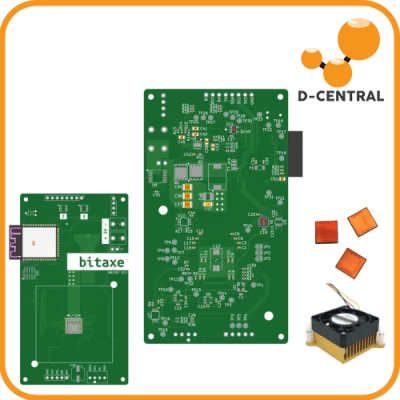
The Bitaxe is an open-source Bitcoin solo miner powered by a single ASIC chip. It connects to your WiFi, draws power through a 5V barrel jack (5.5×2.1mm DC — not USB-C, that port is for firmware flashing only), and lets anyone participate in solo mining with a device that fits in the palm of your hand. No permission required. No corporate gatekeeper. No terms of service.
D-Central has been a pioneer in the Bitaxe ecosystem since its inception. We created the original Bitaxe Mesh Stand — the first company to manufacture it. We developed leading heatsink solutions for both the standard Bitaxe and the Bitaxe Hex. We stock every variant: Supra, Ultra, Hex, Gamma, GT, plus the full Nerd/open-source lineup including NerdAxe, NerdQAxe, and NerdOctaxe.
This open-source approach stands in direct contrast to the AI hardware world, where a single company (Nvidia) controls roughly 80-90% of the training GPU market. In Bitcoin mining, anyone can design, manufacture, and deploy mining hardware. The Bitaxe proves that you do not need a billion-dollar fab to participate in securing the network.
From AI-as-a-Service to Mining-as-a-Lifestyle
The tech industry loves the “as-a-Service” model. Nvidia sells DGX Cloud — pay by the hour for AI compute. Microsoft offers Azure AI. Google has Vertex AI. The premise is the same: rent someone else’s infrastructure, on their terms, at their prices.
Bitcoin mining offers something different: sovereignty.
When you own your mining hardware, you own your hash rate. Nobody can de-platform you. Nobody can change the terms of service. Nobody can decide your workload is “inappropriate” and shut down your instance. Your miner runs the Bitcoin protocol — the same rules for everyone, enforced by mathematics, not moderators.
This is why the “mining as a lifestyle” concept resonates so deeply with the cypherpunk community. It is not just about the sats. It is about participating in a system that operates outside the control of any single entity. Every hash your miner computes is a vote for decentralization, a contribution to the most robust computing network on the planet.
For Canadians especially, this hits home. Our cold climate is a natural advantage for mining — free cooling for most of the year. Our abundant hydroelectric power in Quebec provides clean, affordable electricity. And the heat output from miners is not waste — it is a feature. A Bitcoin space heater in a Canadian winter is not an indulgence; it is engineering common sense.
What D-Central Is Building
While tech giants race to build centralized AI megastructures, D-Central Technologies is focused on the opposite vector: decentralizing hash power, one miner at a time.
Here is what that looks like in practice:
Home mining hardware: From entry-level Bitaxe solo miners to full Antminer setups, we provide the hardware for every scale of home mining operation. Our custom editions — Slim, Pivotal, Loki — are specifically engineered for residential deployment, optimizing noise, heat, and power consumption for living spaces.
Bitcoin space heaters: Our space heater line transforms ASIC miners into functional home heating appliances. Available in S9, S17, and S19 configurations, these units heat your home while mining Bitcoin. Dual-purpose computing at its finest.
ASIC repair: With over 38 model-specific repair service pages and years of hands-on experience, D-Central is Canada’s premier ASIC repair centre. We keep miners running longer, reducing e-waste and keeping hash rate online. Hashboard diagnostics, chip-level repair, firmware troubleshooting — this is what we do.
Hosting: For those who need industrial-scale deployment, our Quebec hosting facility offers competitive power rates backed by hydroelectric infrastructure. Located at 1325 Rue Bergar, Laval, QC — real infrastructure, real address, real accountability.
Education and consulting: Through our mining consulting services, blog, and comprehensive guides, we help new miners navigate everything from hardware selection to power infrastructure to thermal management.
The Real Computing Revolution
The mainstream tech narrative wants you to believe that the future of computing is AI — centralized, corporate-controlled, and permission-gated. And AI will certainly play a significant role in the decades ahead.
But there is another computing revolution happening in parallel, one that does not get billion-dollar press conferences or fawning magazine covers. It is happening in basements and garages, in spare bedrooms and workshops. It is the decentralization of hash power — the quiet, relentless distribution of computational sovereignty to individuals around the world.
Every Bitaxe plugged into a home network. Every space heater warming a Canadian living room. Every repaired Antminer brought back to life in our workshop. These are not just products — they are instruments of decentralization.
The era of high-performance computing is here. The question is: who controls it?
At D-Central Technologies, our answer has been the same since 2016: you do.
Every hash counts.
FAQ
How does Bitcoin mining compare to AI computing in terms of energy consumption?
Both are energy-intensive, but with critical differences. A single large AI model training run can consume tens of gigawatt-hours over weeks or months, and that energy is gone when training ends. Bitcoin mining converts electricity into network security continuously, and every watt becomes heat — which can be repurposed for space heating. Bitcoin miners can also shut down instantly to participate in demand-response programs, while AI training runs cannot be interrupted without losing progress. The energy narrative around Bitcoin mining is often unfairly skewed compared to the pass given to AI compute centers.
What is the difference between an AI factory and a Bitcoin hashing center?
An AI factory is a large-scale data center built to train and run AI models, typically owned by megacorporations like Nvidia, Microsoft, or Google. A Bitcoin hashing center is a facility dedicated to SHA-256 mining that secures the Bitcoin network. The key difference is architecture: AI factories are centralized by design, controlled by a single entity. Bitcoin hashing can be distributed across millions of locations worldwide — from industrial facilities to individual homes running a single Bitaxe. This distribution is a security feature, not a limitation.
Can I mine Bitcoin at home in Canada?
Absolutely. Canada is one of the best countries in the world for home mining. Cold winters provide free cooling for your miners, reducing energy costs. Abundant hydroelectric power in provinces like Quebec offers clean, affordable electricity. And the heat output from miners directly offsets your heating bill during 6-8 months of the year. D-Central offers everything you need to get started — from a single Bitaxe (5V barrel jack, draws minimal power) to full Bitcoin space heater setups that replace traditional electric heaters. Visit our shop or check the Bitaxe Hub for detailed setup guides.
What is the Bitaxe and why does it matter for decentralization?
The Bitaxe is an open-source, single-chip Bitcoin solo miner. It is significant because it represents the most accessible entry point to Bitcoin mining ever created. Unlike industrial ASICs that cost thousands and require specialized infrastructure, a Bitaxe fits on your desk, connects via WiFi, and runs on a standard 5V/6A power supply through a 5.5×2.1mm DC barrel jack. Each Bitaxe running globally adds to the geographic distribution of hash power, making the Bitcoin network more resilient against censorship and state-level attacks. D-Central has been a pioneer in the Bitaxe ecosystem, creating the original Mesh Stand and developing heatsink solutions for multiple Bitaxe models.
Is solo mining with a Bitaxe realistic?
Solo mining with a Bitaxe is a probabilistic endeavour — think of it as a Bitcoin lottery. With the network hashrate above 800 EH/s and a single Bitaxe producing around 500 GH/s to 1.2 TH/s depending on the model, the odds of finding a block (currently worth 3.125 BTC) are low for any individual unit. But every hash has a non-zero probability, and Bitaxe users have found blocks. The real value extends beyond block rewards: you participate in decentralizing the network, learn hands-on about mining technology, and contribute to Bitcoin’s censorship resistance. Every hash counts.
How does D-Central support the home mining community?
D-Central Technologies has been supporting home miners since 2016. We provide hardware across every scale — from open-source Bitaxe solo miners to full ASIC setups. Our Bitcoin space heater line converts mining hardware into dual-purpose home heating appliances. We operate Canada’s premier ASIC repair centre with 60+ model-specific service capabilities. We offer mining consulting for those planning their first or expanding an existing operation. And through our Bitaxe Hub, blog, and educational content, we provide the knowledge base that every home miner needs. We also offer hosting in our Quebec facility for miners who need industrial-scale deployment.
What makes Bitcoin mining hardware different from AI hardware?
Bitcoin mining ASICs are purpose-built to perform a single computation — SHA-256 hashing — with maximum efficiency. They cannot run AI workloads. Conversely, AI GPUs like Nvidia’s H100 are designed for parallel floating-point operations used in neural network training and inference. While both represent specialized silicon, Bitcoin ASICs are far more energy-efficient at their specific task, achieving efficiency gains of roughly 10 million times over general-purpose CPUs. The other critical difference is access: Nvidia controls 80-90% of the AI GPU market, while Bitcoin ASIC manufacturing is distributed across multiple companies (Bitmain, MicroBT, Canaan) and open-source projects like the Bitaxe.