Every Watt Does Double Duty: Why Bitcoin Miners Are the Smartest Heaters You Can Own
Here is a fact that most people never think about: every electric heater on the planet converts electricity to heat at nearly 100% efficiency. Your baseboard heater, your space heater, your heat pump’s resistance backup — they all turn watts into BTUs at essentially the same rate. The laws of thermodynamics do not care about brand names.
So if you are going to burn 1,000 watts to heat a room anyway, why not burn those watts doing something useful — like securing the Bitcoin network and stacking sats while you stay warm?
That is the core insight behind dual-purpose Bitcoin mining heaters, and it is why D-Central Technologies has made them a cornerstone of our product lineup since 2016. We are not selling you a gimmick. We are selling you thermodynamics plus sovereignty.
The Physics: Why Bitcoin Miners Are Literally Space Heaters
Let us kill the myth that mining “wastes” energy. An ASIC miner is an electric device that converts 100% of its input power into heat. Period. There is no chemical exhaust, no combustion byproduct, no energy escaping as light (unless you count a couple of LEDs). Every single watt consumed by the ASIC chips, control board, and fans becomes thermal energy released into your space.
A 1,200-watt Antminer running in your basement produces exactly the same heat output as a 1,200-watt ceramic space heater from the hardware store. The difference? The ceramic heater gives you warm air and nothing else. The Bitcoin miner gives you warm air plus hashrate contributing to the most robust computational network in human history.
The BTU Math
The conversion is straightforward: 1 watt = 3.412 BTU/h. Here is what that means for D-Central’s lineup:
| Product | Power Range | BTU/h Output | Equivalent Room Size |
|---|---|---|---|
| Antminer S9 Space Heater Edition | 300 – 1,150 W | 1,024 – 3,924 BTU/h | Small bedroom to large office |
| Antminer L3+ Space Heater Edition | 400 – 800 W | 1,365 – 2,730 BTU/h | Home office / small room |
| BitChimney | 750 – 950 W | 2,559 – 3,241 BTU/h | Medium room |
| Antminer Loki Edition | 1,000 – 1,200 W | 3,412 – 4,094 BTU/h | Large room / open concept area |
| Antminer S19 Space Heater Edition | 1,000 – 1,500 W | 3,412 – 5,118 BTU/h | Large living area / basement |
| Antminer Slim Edition | 1,000 – 1,400 W | 3,412 – 4,777 BTU/h | Large room / workshop |
| Antminer Pivotal Edition | 1,000 – 1,500 W | 3,412 – 5,118 BTU/h | Large living area / garage |
A typical Canadian home needs roughly 20–30 BTU/h per square foot in winter. A single Antminer Loki Edition at 1,200 watts produces about 4,094 BTU/h — enough to heat a 130–200 square foot room as the sole heat source, or supplement heating in a larger space. Stack two or three units across your home and you have replaced a meaningful chunk of your heating bill with machines that also mine Bitcoin.
The Canadian Advantage: Cold Climate Is a Feature, Not a Bug
Canada is uniquely positioned for dual-purpose Bitcoin mining. Our long winters — 5 to 7 months of serious heating season depending on your province — mean that the “free heat” argument is not some edge case. It is the majority of the year.
Consider the economics for a homeowner in Quebec, Ontario, or Alberta:
| Factor | Traditional Heater | Bitcoin Space Heater |
|---|---|---|
| Heat output per watt | 3.412 BTU/h | 3.412 BTU/h (identical) |
| Bitcoin earned | 0 sats | Sats every day |
| Network contribution | None | Hashrate securing Bitcoin |
| Resale value after 5 years | ~$0 | Hardware + accumulated sats |
| Decentralization impact | None | One more node on the network |
During heating season, the effective cost of mining is zero — because you would have spent that electricity on heat anyway. Every sat you mine from October to April is pure upside. In the shoulder months, you dial the wattage down or point the exhaust outside. In peak summer, you might shut down entirely or route heat through your HVAC ducting out of the house. D-Central’s ASIC shrouds and duct adapters make this routing straightforward.
Quebec’s hydroelectric rates — among the cheapest in North America — make the equation even more compelling. And for miners who want to scale beyond what their home can handle, D-Central’s hosting facility in Laval, Quebec provides the infrastructure for larger operations.
D-Central’s Dual-Purpose Product Lineup
We do not just sell generic miners and tell you to figure it out. Every product in our Space Heater lineup has been specifically modified, tested, and tuned for residential deployment. That means noise management, thermal optimization, voltage compatibility (110V where possible), and plug-and-play simplicity.
Antminer S9 Space Heater Edition
The entry point. The S9 is the workhorse that refuses to die — millions of units produced, battle-tested firmware ecosystem, dirt-cheap hashboards if you ever need a replacement. Our Space Heater Edition encloses it in a purpose-built case with quiet 140mm fans, turning a 75 dB industrial machine into something you can live with. Running BraiinsOS+, you can throttle between 300W and 1,150W depending on how much heat you need. At full tilt, it pushes 13.5 TH/s of SHA-256 hashrate while dumping nearly 4,000 BTU/h into your room.
Antminer Loki Edition
The Loki is our custom-built home mining solution using next-generation Antminer platforms — the S19, S19j Pro, and S19k Pro. D-Central designed the Loki configuration to run at 1,000–1,200W on 110V residential power, underclocked and tuned for quiet operation. You get up to 56 TH/s of hashrate in a machine that behaves like a well-mannered space heater. The Loki is the sweet spot for home miners who want real hashrate without rewiring their panel.
Antminer Slim Edition
The Slim takes the 19-series and 21-series Antminer platforms and repackages them into a compact, streamlined form factor. Compatible with residential power and tuned for efficiency, the Slim is designed for miners who want a modern ASIC miner that fits cleanly into a home environment without dominating the room.
Antminer Pivotal Edition
For those who want more power in a configurable package, the Pivotal Edition offers flexibility across multiple Antminer platforms. The dual-voltage capability and adjustable performance profiles make it adaptable to different rooms, seasons, and heating needs.
BitChimney
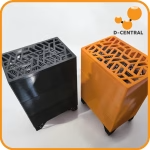
The BitChimney takes a different approach — an elegant chimney-style enclosure that channels ASIC heat upward through a vertical design. Running at 750W in normal mode (31 TH/s, 49 dB) or 950W in high-power mode (38 TH/s, 56 dB), the BitChimney delivers serious hashrate in a form factor that looks like it belongs in your living space. D-Central assembles, tunes, and ships every BitChimney unit — we stand behind its performance and provide full support.
Antminer S19 Space Heater Edition
The full-power option for larger spaces. The S19 Space Heater Edition brings next-generation efficiency (J/TH ratios significantly better than the S9) in a residential-friendly configuration. Running at 1,000–1,500W, it delivers over 5,000 BTU/h — enough to be the primary heat source for a large basement or open-plan living area.
DIY Options
For the true Mining Hackers among us, D-Central offers DIY kits and cases: the S9/L3 Space Heater DIY Box, the S17/T17 Conversion Kit, the Slim DIY Case, and the Loki DIY Kit. Build your own dual-purpose miner exactly the way you want it. We provide the enclosure, fans, and hardware — you bring the ASIC and the ambition.
Browse the full lineup at D-Central Bitcoin Space Heaters.
Heat Recovery Integration: Beyond Just a Room Heater
The most sophisticated home miners do not just let heat radiate from a box. They integrate their miners into their home’s HVAC system for whole-house heat recovery.
Here is how it works:
Step 1: Enclose the miner in a shroud or duct-compatible case (D-Central sells purpose-built shrouds for most Antminer models).
Step 2: Duct the hot exhaust into your existing HVAC return or directly into the rooms you want heated. Standard 6-inch or 8-inch duct with a Cloudline inline fan works perfectly.
Step 3: Control the airflow with a speed controller or thermostat. When the room hits your target temperature, reduce fan speed or divert exhaust.
Step 4: In summer, reverse the ducting to exhaust outside, or route through a heat exchanger to preheat your domestic hot water (advanced setup).
This approach turns a single 1,200W miner into a distributed heating element that can contribute heat to multiple rooms through your existing ductwork. Some of our customers have completely eliminated their traditional heating system in favor of a cluster of Loki and Slim Edition miners strategically placed throughout their home.
Noise Management: Living With Your Miner
The number one concern for home miners is noise. Stock ASIC miners are industrial machines designed for data centers — they are loud. D-Central’s Space Heater editions solve this through a combination of approaches:
- Underclocking via BraiinsOS+ — reducing clock speed drops noise dramatically. An S9 at 600W is a fraction of the volume at full power.
- Fan replacement — swapping stock 120mm screamers for quiet 140mm Noctua or Gelid Gale fans.
- Enclosure design — our Space Heater cases and the BitChimney use larger chambers and directed airflow to reduce turbulence noise.
- Vibration dampening — rubber mounts and foam gaskets eliminate the mechanical buzz that transmits through shelves and floors.
The result: a machine that you can sleep in the same room with (at lower wattages) or comfortably run in an adjacent room at full power. Noise levels on our tuned units typically range from 40–55 dB depending on the model and power setting — comparable to a refrigerator or a quiet conversation.
Firmware: The Software That Makes It All Possible
Every D-Central Space Heater edition ships with or is compatible with BraiinsOS+ (for S9 and S17-era models) or stock firmware with custom tuning profiles (for S19/S21-era units). BraiinsOS+ is critical because it enables:
- Autotuning — the firmware automatically finds the most efficient operating point for each individual ASIC chip.
- Wattage control — set your target power consumption and let the firmware handle the rest. Need 500W of heat? Set it to 500W. Need 1,100W? Crank it up.
- Remote monitoring — check hashrate, temperatures, and fan speeds from your phone or laptop.
- Pool switching — easily move between pools or switch to solo mining when you are feeling lucky.
For those running newer hardware like the Loki Edition or Pivotal Edition, D-Central provides pre-configured tuning profiles optimized for residential wattage and noise levels. Need help dialing in your setup? Our mining consulting team can walk you through the configuration.
Mining Pool Strategy for Home Heaters
When you mine with a Space Heater edition, you have two strategic choices:
Pool mining: Join a mining pool and earn a steady stream of sats proportional to your hashrate. Even at 13 TH/s (a single S9), you will see daily payouts on most pools. With a Loki Edition pushing 40–56 TH/s, the daily sat flow becomes meaningful. This is the reliable, “paycheck” approach.
Solo mining: Point your miner at a solo pool and take your shot at finding a full block — currently worth 3.125 BTC (the reward after the April 2024 halving). The odds are long, but real blocks have been found by solo miners running far less hashrate than you might expect. It is Bitcoin’s version of the lottery, except your ticket also heats your house. Every hash counts.
Many of our customers split their hashrate — running one miner on a pool for consistent returns and another on solo for the thrill. With D-Central’s Bitaxe open-source miners, you can add a dedicated solo mining device alongside your Space Heater for pure lottery mining.
Maintenance and Repair: D-Central Has Your Back
ASIC miners are robust machines, but they are not maintenance-free. Dust accumulates on heatsinks, thermal paste degrades over years, and hashboards occasionally need attention. This is where D-Central’s position as Canada’s leading ASIC repair center becomes a massive advantage for Space Heater owners.
We have repaired thousands of miners since 2016. Our technicians diagnose and fix issues at the chip level — not just board-level swaps. If your Space Heater edition ever needs service, our repair team knows these machines inside and out because we built and tuned them in the first place.
For preventive care, we recommend:
- Quarterly compressed air blowout — remove dust from heatsinks and fans.
- Annual thermal paste refresh — on heavily used units running at higher wattages.
- Firmware updates — keep BraiinsOS+ current for efficiency improvements and bug fixes.
- Fan inspection — check bearings and replace fans showing signs of wear (grinding, clicking, or reduced airflow).
The Bigger Picture: Decentralization Starts at Home
Every Bitcoin Space Heater running in a Canadian home is a node in the most decentralized financial network ever built. When you mine at home, you are not just heating your space or stacking sats — you are contributing hashrate from a location that no government, corporation, or data center operator controls.
The Bitcoin network’s security comes from its distribution. The more geographically dispersed the hashrate, the more resilient the network becomes against censorship, regulation, and single points of failure. Every home miner is a statement: this network belongs to everyone.
D-Central’s mission is the decentralization of every layer of Bitcoin mining. Our Space Heater editions are the most tangible expression of that mission — putting real mining hardware into real homes, producing real heat and real hashrate. No institutional middlemen. No permission required.
Frequently Asked Questions
How much does it cost to run a Bitcoin Space Heater?
The electricity cost is identical to running any electric heater at the same wattage. A 1,200W unit running 24/7 consumes about 28.8 kWh per day. At a typical Canadian residential rate of $0.08–0.12/kWh, that is $2.30–$3.46 per day. During heating season, this cost replaces your existing heating bill — you are not paying extra, you are redirecting the same energy spend through a machine that also mines Bitcoin.
How much Bitcoin can I mine with a Space Heater edition?
Mining revenue depends on your hashrate, current network difficulty (~110T+ in 2026), the Bitcoin price, and your pool fees. At current difficulty, an S9 Space Heater at 13 TH/s will earn a modest amount of sats daily — enough to offset a portion of electricity over time. A Loki Edition at 40–56 TH/s earns significantly more. The key insight is that during heating season, the electricity is money you would have spent on heat anyway, so every sat mined is pure upside.
Can I run a Bitcoin Space Heater on standard 110V household power?
Yes. The S9 Space Heater Edition runs on 110V with the APW3++ power supply. The Loki Edition is specifically designed for 110V residential power. The BitChimney also supports standard power. Some higher-wattage configurations may require a dedicated 15A or 20A circuit — the same kind you would use for a large space heater or window AC unit. No electrician or panel upgrades needed for most setups.
How loud are D-Central’s Space Heater editions?
Our tuned units typically range from 40–55 dB depending on model and wattage setting. For reference, 40 dB is comparable to a quiet library, 50 dB is a normal conversation. The S9 Space Heater Edition with aftermarket 140mm fans at lower wattage is remarkably quiet. Higher-performance units like the Loki or S19 editions are louder at full power but can be placed in a basement, closet, or adjacent room with ducting to keep living areas quiet.
What happens in summer when I do not need the heat?
You have several options: (1) Shut down the miner entirely during peak summer — this is perfectly fine and what many Canadian home miners do. (2) Exhaust the heat outside through a window or dryer vent using a duct and inline fan. (3) Move the miner to a garage or basement with ventilation. (4) Reduce wattage to lower heat output while maintaining some hashrate. (5) For the advanced setup: use the exhaust to preheat domestic hot water via a heat exchanger.
Do Bitcoin Space Heaters work as well as a regular space heater?
Identically. Thermodynamics is thermodynamics. A 1,200W Bitcoin miner produces exactly the same heat as a 1,200W ceramic heater — 4,094 BTU/h. The only difference is the form factor and the fact that the miner also produces hashrate. Some customers actually prefer the miner’s heat distribution because the fan-driven airflow circulates warm air more effectively than a radiant heater.
Can I use a Bitcoin Space Heater as my only heat source?
For a single room, absolutely — a Loki Edition or S19 Space Heater Edition can be the sole heat source for a medium to large room. For whole-house heating, you would need multiple units or a ducted integration with your HVAC system. Many of our customers use Space Heater editions as supplemental heat in key rooms (office, living room, bedroom) while their central heating handles the rest of the house.
Does D-Central offer repair support for Space Heater editions?
Absolutely. We built these machines and we stand behind them. D-Central has been Canada’s leading ASIC repair center since 2016, with thousands of successful repairs completed. If your Space Heater edition ever needs service — hashboard issues, fan replacements, firmware troubleshooting — our team has you covered. Visit d-central.tech/asic-repair to submit a repair request.