The Bitcoin mining industry just got a loud wake-up call. HIVE Digital Technologies — formerly Hive Blockchain — has completed its pivot away from proof-of-work mining and into the AI data centre business. Their GPU farms, once pointed at blockchain computations, now serve large language models and high-performance computing clients. The company did not just rebrand. It abandoned its original mission.
This is not an isolated event. Across the publicly traded mining sector, companies are chasing AI revenue because Wall Street rewards it. The narrative is simple: GPU compute for AI pays more per watt than mining. Therefore, repurpose the hardware. It sounds rational on a spreadsheet. But from where we stand — in the workshop, soldering iron in hand, ASICs humming in the background — this trend reveals something far more important about who actually secures the Bitcoin network and why decentralization matters more than ever.
What Happened: HIVE’s Pivot from Mining to AI
HIVE Blockchain rebranded to HIVE Digital Technologies and systematically shifted its GPU computing capacity from mining operations to AI and high-performance computing (HPC) workloads. The company had built massive GPU farms — primarily NVIDIA hardware — for mining Ethereum and other GPU-mineable chains. When Ethereum moved to proof-of-stake in September 2022, those GPUs lost their most profitable mining target overnight.
Rather than pivot to Bitcoin-specific ASIC hardware, HIVE chose to reposition its GPU fleet for the booming AI inference and training market. The company now markets itself as a “green AI infrastructure” provider, leasing compute to enterprise AI customers.
The timeline tells the story:
| Date | Event | Significance |
|---|---|---|
| 2017 | Hive Blockchain founded | One of the first publicly listed mining companies |
| 2017-2022 | GPU mining operations in Canada, Sweden, Iceland | Mixed mining: Ethereum, altcoins, some Bitcoin |
| Sep 2022 | Ethereum Merge (proof-of-stake) | GPU mining of ETH ends permanently |
| 2023 | Rebrand to HIVE Digital Technologies | Company identity shifts away from blockchain mining |
| 2024-2025 | AI revenue becomes primary focus | Mining revenue increasingly secondary in quarterly reports |
HIVE is not alone. Several publicly traded mining companies have followed a similar playbook — Hut 8, Core Scientific, and others have all explored or committed to AI/HPC diversification. The institutional mining sector is fragmenting, with a growing portion of its compute capacity being redirected away from securing the Bitcoin network.
On the surface, this is rational capital allocation. But beneath the press releases is a deeper pattern: companies that never had conviction in Bitcoin as a technology are the first to abandon it when a shinier narrative appears.
Why GPU Mining Was Always a Dead End for Bitcoin
Here is what the mainstream coverage misses entirely: GPUs stopped being relevant to Bitcoin mining over a decade ago.
Bitcoin’s SHA-256 proof-of-work algorithm was GPU-mineable in the early years (2009-2012), but Application-Specific Integrated Circuits (ASICs) made GPUs completely obsolete for Bitcoin by 2013. The efficiency gap is not marginal — it is orders of magnitude.
| Hardware | SHA-256 Hashrate | Power Draw | Efficiency (J/TH) |
|---|---|---|---|
| Nvidia RTX 4090 (GPU) | ~1.5 GH/s | 450W | ~300,000 J/TH |
| Antminer S21 (ASIC) | 200 TH/s | 3,500W | 17.5 J/TH |
| Bitaxe Supra (Open-Source ASIC) | ~0.5 TH/s | ~15W | ~30 J/TH |
A single Antminer S21 produces the SHA-256 equivalent of roughly 133,000 RTX 4090 GPUs. That is not a typo. ASICs are purpose-built silicon that does one thing — hash SHA-256 — and does it with ruthless efficiency.
Companies like Hive that built their mining operations on GPUs were always running on borrowed time. The GPUs were primarily used for altcoin mining (Ethereum, Ravencoin, etc.), with Bitcoin as a side narrative for investor relations. When the altcoin mining rug got pulled by Ethereum’s move to proof-of-stake, the GPU infrastructure had nowhere profitable to go within proof-of-work mining.
The lesson: if your mining hardware can be repurposed for AI, it was never serious Bitcoin mining hardware in the first place.
The Decentralization Problem With Corporate Mining Pivots
Here is the part that most analysts miss, because they are staring at revenue-per-megawatt charts instead of thinking about what Bitcoin actually needs to survive.
Every GPU or ASIC that pivots away from mining is hash rate that leaves the network. When publicly traded companies — the ones operating at industrial scale with hundreds of megawatts of capacity — redirect their hardware to AI workloads, the Bitcoin network’s hash rate distribution shifts. The hash rate that remains becomes more concentrated among fewer large operators.
This is a centralization vector. And it is the exact problem that Satoshi’s design was built to resist.
Corporate miners — the Hives, Riots, and Marathons of the world — concentrate hash rate in enormous facilities controlled by boards of directors, subject to shareholder pressure, and vulnerable to regulatory capture. Their commitment to Bitcoin lasts exactly as long as the stock price rewards it.
This is the fundamental fragility of institutional mining: the incentive is share price, not network security.
When Hive pivots to AI, it proves that corporate mining operations are mercenary infrastructure. They follow capital, not conviction. And a network secured by mercenary hash rate is a network that can be weakened by the next narrative cycle.
Consider the current state of Bitcoin mining:
| Metric | Current State |
|---|---|
| Network Hash Rate | ~800+ EH/s (exahashes per second) |
| Block Reward | 3.125 BTC per block |
| Mining Hardware | SHA-256 ASICs dominate (GPUs irrelevant for BTC) |
| Public Company Trend | Diversifying into AI/HPC, reducing mining focus |
| Home Mining Trend | Growing rapidly — open-source hardware, solo mining pools |
Bitcoin’s security model depends on hash rate being distributed across many independent operators. When large players leave or reallocate, the remaining hash rate must be picked up by others — or the network becomes more vulnerable to coordination attacks. This is not theoretical. It is the fundamental game theory that underpins Bitcoin’s consensus mechanism.
Why Dedicated ASIC Hardware Is the Answer
The Hive pivot exposes a critical distinction that most commentary ignores: the difference between general-purpose computing hardware and purpose-built mining hardware.
GPUs are general-purpose parallel processors. They can mine, render graphics, train AI models, and run HPC simulations. This flexibility is their strength in computing — and their weakness in Bitcoin mining commitment. If a GPU can do something more profitable than mining, it will.
ASICs are the opposite. A BM1366 chip inside a Bitaxe Supra or a BM1397 inside an Antminer S19 does exactly one thing: compute SHA-256 hashes. It cannot run AI workloads. It cannot render video. It cannot be repurposed. Its only economic purpose is securing the Bitcoin network.
This is not a limitation. It is the feature. When you deploy an ASIC, you are making an irreversible commitment to Bitcoin’s security. That commitment cannot be redirected when venture capital decides AI is the new narrative. The hash rate stays.
| Factor | GPU Mining | ASIC Mining |
|---|---|---|
| Bitcoin SHA-256 efficiency | Catastrophically inefficient | Purpose-optimized silicon |
| Can be repurposed for AI | Yes — and it will be | No — committed to Bitcoin |
| Operator commitment | Follows highest ROI | Locked to proof-of-work |
| Hash rate persistence | Leaves when profits leave | Stays on network |
| Decentralization impact | Concentrated in data centres | Can be distributed to homes |
| Dual-use potential | None for home miners | Space heating + mining |
Home Mining: The Real Decentralization Play
Every time a corporate miner abandons Bitcoin hash rate, it is a reminder that decentralization cannot be outsourced to publicly traded companies. The network needs hash rate that is distributed, resilient, and operated by people who care about Bitcoin as a technology — not as a line item on a quarterly earnings report.
The antidote is distributed, conviction-driven mining — thousands of individuals running dedicated ASIC hardware in their homes, garages, and small facilities. Hardware that cannot be repurposed. Operators who are not answering to a board. Hash rate that stays on the network because the operators believe in what Bitcoin represents.
This is what D-Central has been building toward since 2016: the decentralization of every layer of Bitcoin mining. We are the Bitcoin Mining Hackers.
Home mining in 2025 and beyond is more viable than most people realize. The hardware has matured, the efficiency has improved, and the ecosystem of open-source tools has exploded:
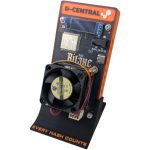
Open-source solo miners like the Bitaxe let anyone contribute hash rate to the network with a device that draws about 15 watts — less than a light bulb. The Bitaxe runs on a 5V barrel jack (5.5×2.1mm DC connector — not USB-C, which is for firmware flashing only), costs a fraction of an industrial ASIC, and connects directly to solo mining pools where every hash is a lottery ticket for the full 3.125 BTC block reward. D-Central is a pioneer in the Bitaxe ecosystem, having created the original Bitaxe Mesh Stand and developed leading accessories including heatsinks for the Bitaxe and Bitaxe Hex.
Full ASIC miners like the Antminer S19 or S21 series deliver industrial-grade hash rate that can be deployed in home environments — especially in Canada, where cold winters make Bitcoin space heaters a genuinely practical dual-purpose application. Your miner heats your home and secures the network simultaneously. The energy is not wasted — it is used twice.
ASIC repair and maintenance extend hardware lifecycles, keeping hash rate on the network longer and reducing the wasteful cycle of hardware disposal. When institutional miners dump their fleets to chase AI revenue, used hardware floods the secondary market at reduced prices. Smart miners acquire, refurbish, and deploy it. D-Central’s ASIC repair service covers 38+ models across Bitmain, MicroBT, Innosilicon, and Canaan — everything from hashboard diagnostics to chip-level replacement.
For miners who want scale without home noise and heat constraints, D-Central operates a hosting facility in Quebec — leveraging the province’s hydroelectric power for competitive energy rates.
What Bitcoiners Should Take Away From the Hive Pivot
The Hive story is not really about AI. It is about commitment. When a company builds its Bitcoin mining operation on hardware that can be repurposed, and then repurposes it the moment something more profitable comes along, it tells you everything about where their conviction lies.
Here is what matters for the long-term health of the Bitcoin network:
1. Hash rate distribution matters more than hash rate quantity. The network is at roughly 800+ EH/s today. The question is not whether that number goes up — it is whether that hash rate is concentrated in a handful of corporate facilities or distributed across thousands of independent operators.
2. Purpose-built hardware creates irreversible commitment. ASICs cannot pivot to AI. That is the point. Every ASIC deployed is hash rate that stays on the network as long as it is profitable to mine — and for home miners using waste heat, the profitability threshold is much lower than for data centre operators paying rack space and cooling costs.
3. Open-source hardware democratizes participation. The Bitaxe ecosystem — Supra, Ultra, Hex, Gamma, GT, and all their accessories — puts ASIC manufacturing specifications in the public domain. Anyone can build, modify, and deploy these devices. No corporate gatekeeper. No shareholder vote required.
4. Canadian home miners have a structural advantage. Cold climate, relatively affordable electricity in several provinces, and a regulatory environment that has not banned proof-of-work mining. For Canadians, mining from home or from a hosted facility in Quebec is a practical path to contributing hash rate while offsetting heating costs.
5. The AI narrative is not your narrative. For Bitcoin miners, the relevant question is never “should I pivot to AI?” The relevant question is “how do I secure more hash rate, more efficiently, more independently?” Stay focused on the mission.
The D-Central Approach: Mining Hackers, Not Mining Corporations
D-Central Technologies has been in this industry since 2016. We have watched companies come and go — pivoting from mining to AI, from Bitcoin to whatever the market rewards this quarter.
Our approach has always been different. We are Bitcoin Mining Hackers. We take institutional-grade mining technology and make it accessible to individuals. We repair hardware that corporations would throw away. We build and stock the full ecosystem of open-source mining devices — every Bitaxe variant, every NerdAxe, NerdQAxe, Nerdminer, every accessory, every replacement part.
We are not going to pivot to AI. We are not going to rebrand as a “digital infrastructure” company. We mine Bitcoin. We help others mine Bitcoin. We believe that a decentralized network of home miners running dedicated hardware is more important to Bitcoin’s long-term security than any amount of corporate hash rate that can be redirected at the next board meeting.
Every hash counts. Especially the ones that cannot be repurposed.
FAQ
Why did Hive Blockchain pivot from Bitcoin mining to AI?
Hive built its mining operations primarily on GPU hardware, which became unprofitable for proof-of-work mining after the Ethereum merge in September 2022. Rather than invest in purpose-built ASIC hardware for Bitcoin mining, the company chose to repurpose its existing GPU infrastructure for AI inference and high-performance computing workloads, chasing more favourable public market valuations.
Can GPUs still be used to mine Bitcoin?
Technically yes, but it is economically absurd. A top-end Nvidia RTX 4090 GPU produces roughly 1.5 GH/s on SHA-256, while a single Antminer S21 ASIC produces 200 TH/s — roughly 133,000 times more hash rate. GPU mining for Bitcoin has been obsolete since 2013 when ASICs took over. Any company that was “Bitcoin mining” with GPUs was primarily mining altcoins.
What makes ASIC miners better for Bitcoin’s decentralization than GPUs?
ASICs are purpose-built silicon that can only compute SHA-256 hashes. They cannot be repurposed for AI, gaming, or any other workload. This means ASIC-based hash rate represents an irreversible commitment to Bitcoin network security. GPU hash rate, by contrast, follows the highest available ROI and will leave the network the moment something more profitable appears.
How does the GPU-to-AI pivot affect Bitcoin’s security?
When publicly traded mining companies redirect hardware from Bitcoin mining to AI workloads, the network loses hash rate. While HIVE’s GPU infrastructure was primarily mining altcoins (not Bitcoin directly), the broader trend of institutional miners diversifying into AI reduces the total hash rate committed to Bitcoin by companies that also operated ASIC-based Bitcoin mining alongside their GPU operations. This concentrates remaining hash rate among fewer operators, creating a centralization risk.
How can individuals contribute to Bitcoin’s hash rate from home?
Home miners can deploy open-source devices like the Bitaxe (which runs on a 5V barrel jack — not USB-C — and draws about 15W) for solo mining, or run full ASIC miners like the Antminer S19/S21 series for higher hash rate. In cold climates like Canada, ASIC miners double as Bitcoin space heaters, making the energy expenditure serve two purposes. D-Central stocks the full range of home mining hardware and provides ASIC repair services to keep hardware running.
Is solo mining with a Bitaxe realistic?
Solo mining with a Bitaxe at ~0.5 TH/s against a network running 800+ EH/s is statistically unlikely to find a block in any given timeframe. But it is not zero. Every hash is a lottery ticket for the full 3.125 BTC block reward, and Bitaxe miners have found solo blocks. More importantly, every Bitaxe running is hash rate that is not controlled by a corporation — it contributes to decentralization regardless of whether it finds a block.
What services does D-Central Technologies offer for Bitcoin miners?
D-Central provides the full lifecycle: hardware sales (Bitaxe, NerdAxe, NerdQAxe, Nerdminer, Antminer, space heaters, accessories), ASIC repair across all major manufacturers (38+ models), mining consulting, hosted mining in Quebec, and technical support. Operating since 2016, we specialize in making institutional-grade mining technology accessible to individual miners.