Every Bitcoin miner on the planet converts electricity into two outputs: SHA-256 hashes and heat. That heat is not a bug — it is a feature. For the hospitality industry, where heating represents one of the largest operational expenses, capturing mining exhaust heat is a straightforward thermodynamic arbitrage: you secure the Bitcoin network AND heat your property, collapsing two cost centers into one revenue-generating system.
In 2026, with the Bitcoin network surpassing 800 EH/s of total hashrate and block rewards at 3.125 BTC, the economics of dual-purpose mining have never been more compelling. Hotels and resorts that deploy ASIC miners as heating infrastructure do not just cut energy bills — they stack sats while keeping guests comfortable. This is the Mining Hacker approach to hospitality: take institutional-grade technology and hack it into a solution that serves multiple purposes simultaneously.
The Thermodynamics: Why Bitcoin Miners Are the Most Efficient Electric Heaters
Here is a fact that surprises most people: a Bitcoin ASIC miner converts electricity to heat at exactly the same efficiency as a standard electric space heater — virtually 100%. Every watt consumed by an Antminer S19 or S21 becomes thermal energy. The difference? A space heater gives you nothing but warmth. An ASIC miner gives you warmth AND Bitcoin.
A single Antminer S19k Pro running at 2,760 watts produces approximately 9,418 BTU/hr of heat. Scale that to a hotel with 10 units and you are generating 94,180 BTU/hr — enough to supplement heating for a mid-sized property — while simultaneously mining Bitcoin. The heat is not “waste.” It is the primary product with a secondary Bitcoin revenue stream, or vice versa depending on your perspective.
| ASIC Model | Power Draw | Heat Output (BTU/hr) | Hashrate | Use Case |
|---|---|---|---|---|
| Antminer S9 (Space Heater Edition) | 1,350 W | ~4,607 BTU/hr | 13.5 TH/s | Individual rooms, small offices |
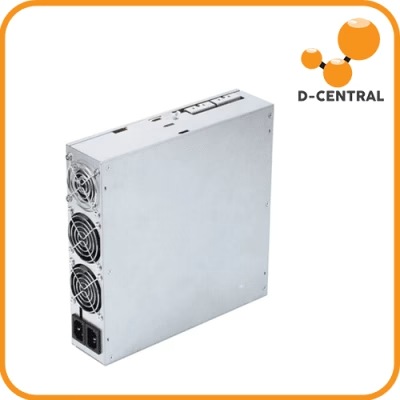
| Antminer S19k Pro | 2,760 W | ~9,418 BTU/hr | 120 TH/s | Lobbies, conference rooms |
| Antminer S21 | 3,500 W | ~11,942 BTU/hr | 200 TH/s | Central plant, pool heating |
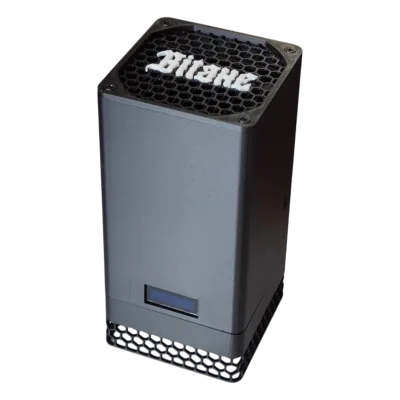
| Bitaxe Hex | ~90 W | ~307 BTU/hr | ~3 TH/s | Lobby display, conversation piece |
Why Hotels Are the Ideal Deployment for Mining Heaters
Hotels and resorts have characteristics that make them nearly perfect for dual-purpose mining deployments:
Consistent heating demand. Unlike residential properties where heating needs fluctuate with occupancy, hotels maintain climate control 24/7/365 across hundreds of rooms, lobbies, pools, and conference facilities. That constant thermal load maps perfectly onto the 24/7 runtime that ASIC miners require for optimal profitability.
Existing infrastructure. Hotels already have the electrical capacity, HVAC ducting, and maintenance teams to support mining equipment. Integrating ASIC exhaust heat into existing forced-air or hydronic systems is an engineering problem, not a fundamental redesign.
Commercial electricity rates. Large hospitality properties often negotiate industrial electricity rates that are lower than residential. In Canada, commercial rates in Quebec can run as low as $0.05-0.07 CAD/kWh — a rate that makes mining profitable even before accounting for the displaced heating costs.
Off-peak revenue generation. During shoulder seasons when occupancy drops, miners continue running. The Bitcoin revenue helps offset the reduced room income, smoothing out the seasonal revenue curve that plagues the hospitality industry.
Integration Architecture: How It Actually Works
Deploying Bitcoin miners as hotel heating infrastructure is not as simple as stacking Antminers in a closet. It requires thoughtful engineering. Here are the two primary integration approaches:
Direct Air Integration
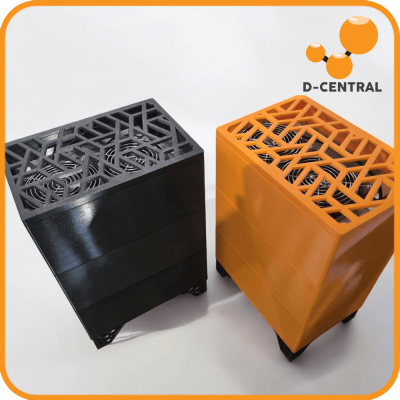
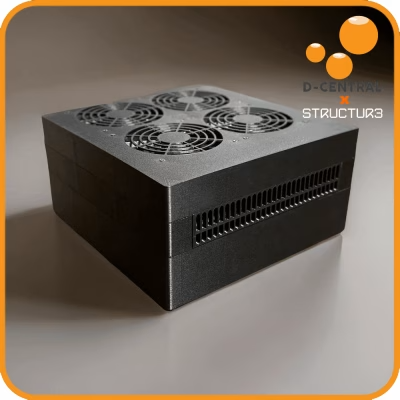
The simplest approach: ASIC miners are housed in a dedicated mechanical room, and the hot exhaust air (typically 50-65 degrees C / 122-149 degrees F) is ducted directly into the building HVAC supply. This works best with forced-air heating systems. The key engineering challenge is managing airflow — ASIC miners require significant CFM (cubic feet per minute) of intake air, and the exhaust must be properly channeled to avoid hotspots. D-Central’s Bitcoin Space Heater editions are purpose-built for exactly this kind of deployment, with custom shrouds that integrate directly into standard ductwork.
Hydronic Heat Exchange
For hotels with radiator or in-floor heating systems, a liquid-cooled or heat-exchanger approach captures ASIC exhaust heat and transfers it to a glycol or water loop. Immersion-cooled mining setups are particularly effective here — the dielectric fluid absorbs heat directly from the ASIC chips and circulates through a heat exchanger connected to the building hydronic system. This approach is quieter, more efficient at heat capture, and integrates seamlessly with existing boiler infrastructure.
| Integration Method | Best For | Complexity | Heat Capture Rate | Noise Impact |
|---|---|---|---|---|
| Direct air ducting | Forced-air HVAC systems | Low-Medium | 85-90% | Requires soundproofing |
| Hydronic heat exchange | Radiator / in-floor heating | Medium-High | 90-95% | Minimal (isolated plant room) |
| Immersion cooling + heat exchange | Pool heating, spa facilities | High | 95-99% | Near silent |
| Space heater units (per-room) | Individual rooms, suites | Low | ~100% | Requires quiet-tuned units |
The Economics: Running the Numbers
Let us model a real scenario for a 100-room hotel in Canada deploying 20 Antminer S19k Pro units as supplemental heating:
| Parameter | Value |
|---|---|
| Number of miners | 20x Antminer S19k Pro |
| Total power draw | 55.2 kW |
| Total hashrate | 2,400 TH/s |
| Heat output | ~188,360 BTU/hr |
| Electricity cost (QC commercial) | $0.06 CAD/kWh |
| Monthly electricity cost | ~$2,385 CAD |
| Displaced heating cost (natural gas equivalent) | ~$1,200-1,800 CAD/month |
| Bitcoin revenue (varies with price/difficulty) | Variable — offsets or exceeds electricity cost |
| Net effective heating cost | Near-zero or negative (profit) |
The critical insight: when you account for the Bitcoin earned, the effective cost of heating drops to near zero or even goes negative. You are being paid to heat your hotel. No traditional heating system — not gas boilers, not heat pumps, not geothermal — can make that claim.
Addressing the Challenges
Noise Management
ASIC miners are loud. A stock Antminer S19 runs at approximately 75 dB — unsuitable for guest-facing areas. The solution is isolation: dedicate a mechanical room (ideally in a basement or service area), install acoustic dampening, and duct the heat silently into the HVAC system. For per-room deployments, D-Central’s Space Heater editions use custom fan profiles and shrouds to reduce noise to acceptable levels for living spaces.
Electrical Requirements
Twenty S19k Pros drawing 55.2 kW requires proper electrical infrastructure — 240V circuits, appropriately rated breakers, and potentially an electrical panel upgrade. Most commercial hotels already have the capacity. Consult with a licensed electrician and your utility provider before deployment. D-Central’s mining consulting service can help you scope the electrical requirements for your specific property.
Maintenance and Uptime
ASIC miners need periodic maintenance: fan cleaning, thermal paste replacement, firmware updates, and occasional hashboard repairs. For a hotel operation, this means either training in-house maintenance staff or partnering with a service provider. D-Central’s ASIC repair service handles everything from preventive maintenance to full hashboard diagnostics — critical for keeping your heating system (and Bitcoin revenue) running reliably.
Regulatory Considerations
In Canada, deploying mining equipment in a commercial building falls under standard electrical and building codes. There are no Bitcoin-specific regulations that prevent this kind of deployment. That said, you should verify with local authorities regarding noise bylaws (for the mechanical room), electrical permits, and any zoning considerations. The regulatory environment in Canada is generally favorable for Bitcoin mining operations, especially in provinces like Quebec and Alberta.
The Canadian Advantage
Canada is uniquely positioned for mining-heated hospitality:
Cold climate = maximum value. Canadian hotels and resorts face 6-8 months of heating season. That is 6-8 months where every joule of mining heat directly displaces purchased heating energy. In tropical climates, mining heat is genuinely wasted; in Canada, it is genuinely valuable.
Low electricity costs. Quebec hydroelectric rates are among the cheapest in the world. Even Ontario and British Columbia offer competitive commercial rates. Cheap, clean electricity is the foundation of profitable mining.
Clean energy grid. Canada electricity is predominantly hydroelectric, nuclear, and renewable. Mining with Canadian electricity produces a fraction of the carbon footprint compared to coal-powered grids. For hotels marketing sustainability, this is a legitimate green credential — you are heating with verified clean energy while securing the Bitcoin network.
Tourism industry alignment. Canada resort and lodge market — ski resorts, wilderness lodges, northern retreats — operates in precisely the cold climates where mining heat has maximum value. A ski resort in Tremblant or Whistler running ASIC miners to heat its lodge is the perfect marriage of technology and hospitality. D-Central operates mining hosting facilities in Quebec, and the same infrastructure principles that power our hashcenters apply directly to hospitality deployments.
Beyond Hotels: The Broader Hospitality Opportunity
The mining-as-heating model extends across the entire hospitality sector:
Ski resorts and mountain lodges — massive heating demand in cold climates, often with access to cheap hydroelectric power. The shoulder season (summer) can run miners at reduced capacity or vent heat outdoors.
Hot springs and spa facilities — immersion-cooled miners can pre-heat pool and spa water, directly offsetting one of the largest energy costs for these properties.
Conference centers — large open spaces with significant heating requirements and the electrical infrastructure to support a mining deployment.
Campgrounds and RV parks — heated washroom and common facilities can be powered by smaller mining setups, with the Bitcoin revenue offsetting operating costs during off-season.
Getting Started: A Practical Roadmap
If you operate a hotel, resort, or hospitality property and want to explore mining-as-heating, here is the practical path forward:
1. Audit your heating load. Calculate your property BTU requirements by zone and season. This determines how many miners you need and which integration method makes sense.
2. Assess your electrical capacity. Determine available amperage, voltage, and panel capacity. Most commercial properties have significant headroom.
3. Choose your hardware. Select miners based on your heating requirements, noise tolerance, and budget. D-Central’s shop carries the full range from quiet Space Heater editions for guest-adjacent areas to high-performance S21s for central plant deployments.
4. Design the integration. Work with an HVAC engineer to design the ductwork or heat exchange system. For Canadian deployments, D-Central’s consulting team can assist with system design and hardware selection.
5. Deploy and monitor. Install miners, connect to a mining pool (or solo mine for the chance at a full 3.125 BTC block reward), and monitor both hashrate and thermal performance.
6. Maintain and optimize. Schedule regular maintenance, adjust mining intensity seasonally, and reinvest Bitcoin earnings or use them to fund further property improvements.
The Bottom Line: Heating That Pays You Back
The hospitality industry spends billions annually on heating. Every dollar spent on natural gas, propane, or electric resistance heating is a dollar that exits the business permanently. Bitcoin mining heat is fundamentally different: the energy expenditure produces both thermal comfort AND a scarce digital asset.
This is not theoretical. Properties around the world are already deploying this model. In Canada, with our cold climate, cheap hydroelectric power, and favorable regulatory environment, the opportunity is particularly compelling. The question for hotel and resort operators is not whether this technology works — it does — but how quickly they can deploy it before their competitors do.
D-Central Technologies has been building dual-purpose mining solutions since 2016. From our Bitcoin Space Heater product line to our consulting services and repair infrastructure, we provide everything a hospitality operator needs to turn their heating system into a Bitcoin mining operation. We are the Bitcoin Mining Hackers — and we are here to help you hack your heating costs down to zero.
Frequently Asked Questions
How much heat does a Bitcoin ASIC miner actually produce?
ASIC miners convert virtually 100% of their electrical input into heat. An Antminer S19k Pro drawing 2,760 watts produces approximately 9,418 BTU/hr — comparable to a medium-sized electric space heater. The difference is that the ASIC miner also earns Bitcoin while producing that heat, making it the only heater in existence that pays you back.
Will the noise from Bitcoin miners disturb hotel guests?
Stock ASIC miners run at 70-80 dB and are not suitable for guest-facing areas. However, with proper deployment — isolated mechanical rooms, acoustic dampening, and ducted heat distribution — guests will never hear the miners. D-Central Space Heater editions are specifically designed with noise-reduced fan profiles for deployment in occupied spaces.
What is the return on investment for a hotel mining-heating system?
ROI depends on electricity cost, Bitcoin price, mining difficulty, and the displaced heating cost. In Canadian provinces with low hydroelectric rates ($0.05-0.07/kWh), the displaced heating costs alone can offset 50-75% of the electricity cost, with Bitcoin revenue covering the remainder and often producing net profit. Most deployments achieve full ROI within 12-24 months.
Do I need any special permits to install Bitcoin miners in my hotel?
In Canada, Bitcoin mining equipment falls under standard electrical installation codes. You will need an electrical permit for the circuit installation, and your mechanical room must meet local building code requirements for ventilation and fire safety. There are no Bitcoin-specific regulations in Canada that restrict commercial mining deployments.
What happens to the mining equipment in summer when heating is not needed?
During warm months, you have several options: reduce mining intensity to match any remaining heating needs (hot water, pool heating), vent excess heat outdoors, or shut down miners entirely and rely on the Bitcoin accumulated during heating season. Many Canadian properties find that even summer nights in northern locations benefit from supplemental heating, extending the useful mining season.
Can Bitcoin mining heat really replace a hotel entire heating system?
For most properties, mining heat works best as a supplemental system rather than a complete replacement — especially for peak heating demand on the coldest days. However, for smaller lodges, resorts, and properties with moderate heating needs, a properly sized mining deployment can handle 80-100% of the heating load during typical winter conditions.
How does D-Central help hotels implement mining-as-heating solutions?
D-Central provides end-to-end support: hardware supply from our online shop (including purpose-built Space Heater editions), system design through our consulting service, ongoing ASIC repair and maintenance, and operational guidance from over eight years of experience in the Bitcoin mining industry. We also offer hosting solutions for properties that want to start with hosted mining before deploying on-premises.