
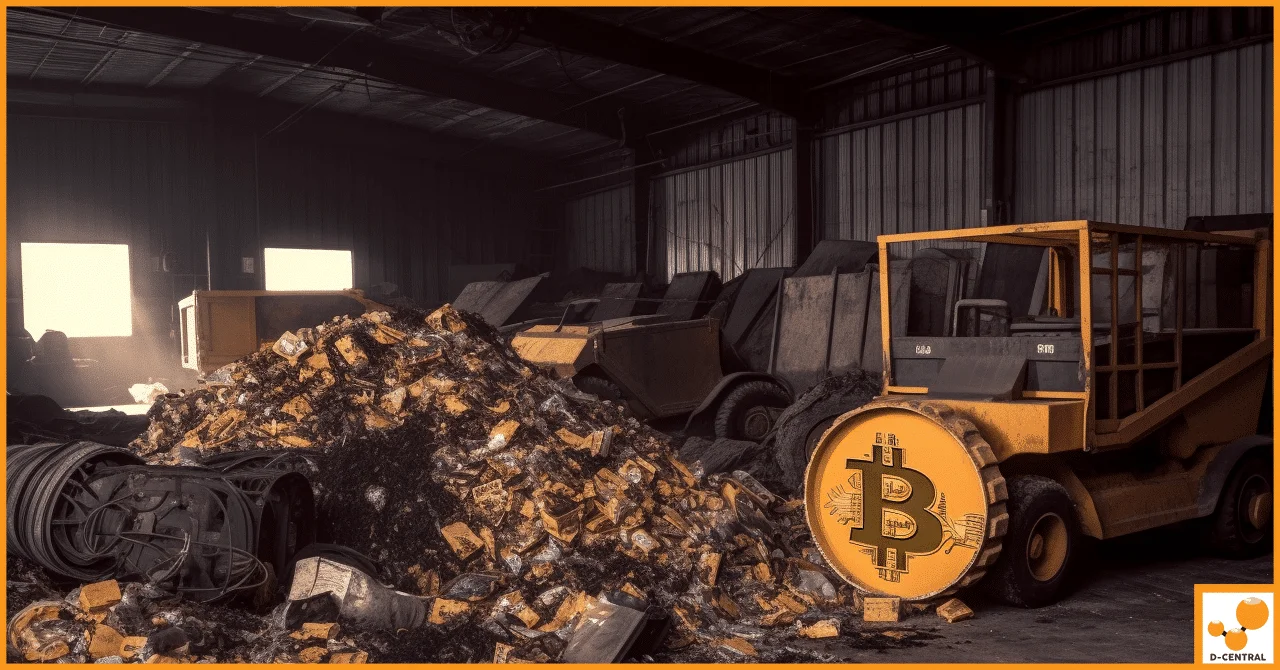
Every ASIC miner on the planet converts electrical energy into two outputs: SHA-256 hashes and heat. The hashes secure the Bitcoin network — now surpassing 800 EH/s globally — while the heat typically gets vented into the atmosphere. That is a staggering amount of thermal energy going to waste. But here is the thing: recycling facilities are massive consumers of process heat, and most of them are burning natural gas or running electric heaters to get it. The synergy is almost too obvious.
At D-Central Technologies, we have spent years engineering solutions that turn Bitcoin mining heat into a productive asset. From our Bitcoin Space Heaters that warm homes to industrial-scale heat recovery systems, we have seen firsthand how mining heat transforms from a “problem” into a revenue multiplier. Recycling facilities represent one of the most compelling use cases — and in this article, we break down exactly how it works, what it costs, and why it matters for both industries.
Why Bitcoin Mining Heat Is Perfect for Recycling Operations
Modern ASIC miners like the Antminer S21 series operate at junction temperatures between 75-105°C. The exhaust air from a properly configured mining room sits at 45-65°C — a temperature range that aligns remarkably well with many recycling processes. Paper pulping, plastic granulation pre-heating, metal slag drying, glass batch preheating, and material sterilization all require sustained heat in this exact range.
The key advantage? This heat is constant. Unlike solar thermal or waste-heat recovery from intermittent industrial processes, Bitcoin miners run 24/7/365. Every block the network mines — currently yielding 3.125 BTC per block — means miners are producing a continuous, predictable thermal output. For a recycling facility that needs consistent process heat, this reliability is worth its weight in gold (or rather, in Bitcoin).
| Recycling Process | Required Temp Range | ASIC Heat Compatibility | Heat Transfer Method |
|---|---|---|---|
| Paper pulp drying | 40-70°C | Excellent | Air-to-air / ducting |
| Plastic granulation pre-heat | 50-80°C | Excellent | Air-to-water heat exchanger |
| E-waste component separation | 40-60°C | Excellent | Direct hot air ducting |
| Glass batch preheating | 200-400°C | Supplemental only | Multi-stage heat pump |
| Metal slag drying | 60-120°C | Good (with concentration) | Liquid loop heat exchanger |
| Material sterilization | 60-80°C | Excellent | Closed-loop hydronic |
| Compost acceleration | 55-65°C | Excellent | Underfloor radiant / ducting |
The Economics: Running the Numbers
Let us talk about what actually matters to a facility operator: the bottom line. Consider a mid-size recycling facility currently spending $15,000-$25,000 per month on natural gas for process heating. Now consider a fleet of 100 Antminer S19-series units, each pulling roughly 3,250W and producing approximately 11,000 BTU/hr of heat. That is 1.1 million BTU/hr — or roughly 26.4 million BTU per day — of free thermal energy as a byproduct of Bitcoin mining.
At current natural gas prices in Canada (averaging $4-6/GJ depending on province), that thermal output displaces $8,000-$14,000 per month in heating costs alone. Add the Bitcoin mining revenue on top — even at conservative difficulty projections — and the recycling facility is not just saving on heating, it is running an entirely new profit center.
| Cost Category | Traditional Heating | Bitcoin Mining Heat Recovery |
|---|---|---|
| Monthly heating fuel | $15,000-$25,000 | $0 (byproduct) |
| Bitcoin mining revenue | N/A | Variable (depends on hashrate, BTC price) |
| Electricity for miners (100 units) | N/A | $18,000-$28,000/mo (at $0.07-$0.12/kWh) |
| Heat distribution infrastructure | Existing boiler system | One-time: $30,000-$80,000 (ducting, exchangers) |
| Maintenance | Boiler servicing | Miner maintenance + duct cleaning |
| Net monthly cost/revenue | -$15,000 to -$25,000 | Revenue-positive in most scenarios |
The critical insight: the electricity cost to run the miners is not wasted — it produces Bitcoin AND heat simultaneously. You are not paying for heating fuel on top of mining electricity. The heat is a free byproduct of an already profitable operation. This dual-output model is exactly what makes Bitcoin mining heat recovery fundamentally different from any other heating technology.
Technical Implementation: From Mining Room to Recycling Floor
The engineering is straightforward but demands precision. There are three primary architectures for integrating mining heat into a recycling facility:
1. Direct Hot Air Ducting
The simplest approach. ASIC miners exhaust hot air at 45-65°C. Insulated ductwork channels this directly to drying chambers, curing rooms, or preheating stages. Works best for paper pulp drying, compost acceleration, and material sterilization where the temperature range matches natively. Infrastructure cost: $15,000-$30,000 for a 100-unit installation. D-Central’s universal ASIC shrouds and duct adapters make the physical connection between miner exhaust and facility ductwork clean and efficient.
2. Air-to-Water Heat Exchangers
For facilities that need to transport heat over longer distances or integrate with existing hydronic systems, air-to-water exchangers capture the thermal energy from mining exhaust and transfer it to a glycol or water loop. This heated liquid then circulates to wherever the process heat is needed — radiant floor systems, tank heating, or pre-heating stages for melting operations. Infrastructure cost: $40,000-$80,000. Efficiency: 70-85% heat capture rate.
3. Immersion Cooling with Heat Recovery
The most advanced option. Miners are submerged in dielectric fluid, which absorbs heat directly from the ASIC chips at much higher efficiency than air cooling. The heated fluid (typically reaching 50-60°C) is pumped through heat exchangers connected to the facility’s process systems. This approach maximizes heat capture (90%+ efficiency) and dramatically reduces miner noise. Infrastructure cost: $80,000-$150,000, but the superior heat recovery and quieter operation often justify the premium.
The Canadian Advantage
Canada is uniquely positioned for this kind of integration. Our cold climate means recycling facilities need heat for 7-9 months of the year. Our electricity rates — particularly in Quebec and Manitoba — are among the lowest in North America, making Bitcoin mining highly competitive. And our progressive environmental policies mean that facilities demonstrating genuine heat recovery can access green infrastructure grants and carbon credit programs.
D-Central operates out of Canada and has deep expertise in both Bitcoin mining hosting and custom heat recovery solutions. We have helped facilities across the country design and implement dual-purpose mining installations. If you are a recycling operator in Canada considering this approach, you are already in the right geography — and we are the right partner to make it happen.
Real-World Applications Already in Operation
This is not theoretical. Facilities across North America and Scandinavia are already running hybrid mining-recycling operations:
- Paper recycling: A facility in Sweden integrated mining heat into their paper pulp drying lines, cutting natural gas consumption by over 40%. The consistent 50-55°C exhaust from their mining containers replaced multiple gas-fired dryers.
- Aluminum scrap processing: A Canadian operation uses mining heat to pre-heat aluminum scrap before it enters the melting furnace. Pre-heating from ambient to 60°C reduces the energy required for final melting by approximately 8-12%, translating to significant cost savings on high-energy-cost smelting.
- Plastic recycling: Pre-heating plastic flake before granulation improves melt consistency and reduces energy consumption in the extruder. Mining heat at 55-65°C is ideal for this stage.
- Composting facilities: Maintaining thermophilic composting temperatures (55-65°C) accelerates decomposition and pathogen kill. Mining heat ducted under compost beds keeps temperatures optimal year-round, even in harsh winter climates.
Environmental Impact: The Numbers That Matter
Bitcoin’s critics love to point at energy consumption without examining the full picture. Heat recovery flips the narrative entirely. When 100% of the electrical energy input to a miner is converted to useful work — hashing AND heating — the effective efficiency approaches near-unity. No energy is “wasted” because every joule of electricity becomes either a hash or useful thermal energy.
For a recycling facility displacing natural gas with mining heat, the environmental math is compelling:
- CO2 reduction: Displacing 26.4 million BTU/day of natural gas eliminates roughly 1,400 kg of CO2 emissions daily — over 500 tonnes per year.
- Grid impact: If the mining operation runs on renewable electricity (hydro in Quebec, for example), the entire chain — from electrons to hashes to heat — is zero-carbon.
- Circular economy alignment: Recycling facilities already exist to reduce waste. Adding Bitcoin mining heat recovery deepens their sustainability credentials and strengthens their environmental reporting metrics.
Getting Started: What a Recycling Facility Needs to Know
If you operate a recycling facility and this article has your attention, here is the practical path forward:
- Audit your thermal needs: Map every process that consumes heat, the temperature ranges required, and your current fuel costs. This is your baseline.
- Assess your electrical capacity: 100 Antminer S19-series units need approximately 325 kW of power. Larger installations scale linearly. Your facility likely already has significant electrical infrastructure — the question is available capacity.
- Choose your architecture: Direct ducting, hydronic, or immersion — based on your specific process requirements and facility layout.
- Consult with experts: This is where D-Central’s mining consulting services come in. We help facilities design the right mining configuration, select the appropriate hardware, engineer the heat recovery system, and optimize for both mining profitability and thermal output.
- Start with a pilot: Begin with 10-20 miners serving a single process line. Measure thermal output, validate the economics, and scale from there.
Why This Matters for Bitcoin’s Future
Every recycling facility that integrates Bitcoin mining heat recovery becomes a node in the decentralization of Bitcoin’s hash rate. Instead of concentrated mega-farms in a handful of jurisdictions, we get mining distributed across thousands of industrial facilities worldwide — each one contributing to network security while solving their own heating challenges.
This is the vision D-Central has championed since 2016: the decentralization of every layer of Bitcoin mining. From Bitaxe solo miners on your desk to industrial heat recovery in recycling plants, every hash counts. The network does not care whether your miner is in a purpose-built data center or bolted into the HVAC system of a recycling facility — it only cares that you are contributing honest hash power to the most secure monetary network ever created.
D-Central: Your Partner in Dual-Purpose Mining
We are not just theorists — we are Bitcoin Mining Hackers. D-Central has been building, repairing, and deploying mining hardware since 2016. Our ASIC repair services keep your miners running at peak efficiency, our consulting team designs optimal heat recovery configurations, and our shop stocks everything from enterprise-grade ASICs to the custom shrouds and adapters that make heat ducting work.
Whether you are a recycling facility looking to eliminate your gas bill, a Bitcoin miner searching for productive uses for your exhaust heat, or an entrepreneur seeing the opportunity in the intersection of these two industries — we have the expertise, the hardware, and the Canadian grit to make it happen.
Frequently Asked Questions
How much heat does a single ASIC miner produce?
A modern ASIC like the Antminer S19 series produces approximately 11,000 BTU/hr (about 3.2 kW thermal). This is equivalent to a small electric space heater running at full power. Scale this to 100 units and you are generating over 1.1 million BTU/hr — enough to meaningfully offset process heating in a mid-size recycling facility.
What temperature does ASIC mining exhaust reach?
Air-cooled ASIC miners typically produce exhaust air at 45-65°C (113-149°F), depending on the miner model, ambient intake temperature, and fan speed. This range is directly compatible with many recycling processes including paper drying, plastic pre-heating, material sterilization, and composting.
Is it profitable to mine Bitcoin just for the heat?
You never mine Bitcoin “just for the heat” — that is the beauty of the dual-output model. The electricity you pay for produces both Bitcoin revenue and heat simultaneously. In facilities that would otherwise pay for heating fuel, the displaced fuel cost effectively subsidizes the mining operation (or vice versa). In most scenarios with electricity under $0.10/kWh, the combined economics are positive.
What are the noise implications of running miners in a recycling facility?
Standard air-cooled ASICs produce 70-80 dB each. In a recycling facility that already has industrial equipment running, this is often within acceptable limits. For noise-sensitive areas, immersion cooling reduces miner noise to near-zero, and proper enclosure design with acoustic insulation can bring air-cooled installations below 55 dB at facility boundaries.
How does D-Central help recycling facilities implement this?
D-Central provides end-to-end support: thermal audits, mining hardware selection and sourcing, heat recovery system design, installation guidance, ongoing ASIC maintenance and repair, and optimization consulting. We have been building dual-purpose mining solutions since 2016 and our team understands both the mining and industrial heating sides of the equation. Contact our consulting team to start the conversation.
Does this work in warm climates or only in cold regions like Canada?
Heat recovery works everywhere, but the economics are strongest where heating fuel costs are significant — which means cold climates like Canada are ideal. In warmer climates, the thermal output can still serve industrial processes that need heat year-round (sterilization, drying, melting), but the ambient heat disposal challenge in summer months requires careful system design. Canada’s climate makes it a natural fit.
What is the upfront investment for a pilot installation?
A 10-20 unit pilot with direct hot air ducting typically costs $20,000-$50,000 for the heat recovery infrastructure (ducting, dampers, controls) on top of the mining hardware itself. The mining hardware is a capital asset generating Bitcoin revenue from day one. Most facilities see full ROI on the heat recovery infrastructure within 6-18 months from displaced fuel savings alone.
{
“@context”: “https://schema.org”,
“@type”: “FAQPage”,
“mainEntity”: [
{
“@type”: “Question”,
“name”: “How much heat does a single ASIC miner produce?”,
“acceptedAnswer”: {
“@type”: “Answer”,
“text”: “A modern ASIC like the Antminer S19 series produces approximately 11,000 BTU/hr (about 3.2 kW thermal). This is equivalent to a small electric space heater running at full power. Scale this to 100 units and you are generating over 1.1 million BTU/hr — enough to meaningfully offset process heating in a mid-size recycling facility.”
}
},
{
“@type”: “Question”,
“name”: “What temperature does ASIC mining exhaust reach?”,
“acceptedAnswer”: {
“@type”: “Answer”,
“text”: “Air-cooled ASIC miners typically produce exhaust air at 45-65 degrees Celsius (113-149 degrees Fahrenheit), depending on the miner model, ambient intake temperature, and fan speed. This range is directly compatible with many recycling processes including paper drying, plastic pre-heating, material sterilization, and composting.”
}
},
{
“@type”: “Question”,
“name”: “Is it profitable to mine Bitcoin just for the heat?”,
“acceptedAnswer”: {
“@type”: “Answer”,
“text”: “You never mine Bitcoin just for the heat — that is the beauty of the dual-output model. The electricity you pay for produces both Bitcoin revenue and heat simultaneously. In facilities that would otherwise pay for heating fuel, the displaced fuel cost effectively subsidizes the mining operation. In most scenarios with electricity under $0.10/kWh, the combined economics are positive.”
}
},
{
“@type”: “Question”,
“name”: “What are the noise implications of running miners in a recycling facility?”,
“acceptedAnswer”: {
“@type”: “Answer”,
“text”: “Standard air-cooled ASICs produce 70-80 dB each. In a recycling facility that already has industrial equipment running, this is often within acceptable limits. For noise-sensitive areas, immersion cooling reduces miner noise to near-zero, and proper enclosure design with acoustic insulation can bring air-cooled installations below 55 dB at facility boundaries.”
}
},
{
“@type”: “Question”,
“name”: “How does D-Central help recycling facilities implement this?”,
“acceptedAnswer”: {
“@type”: “Answer”,
“text”: “D-Central provides end-to-end support: thermal audits, mining hardware selection and sourcing, heat recovery system design, installation guidance, ongoing ASIC maintenance and repair, and optimization consulting. We have been building dual-purpose mining solutions since 2016 and our team understands both the mining and industrial heating sides of the equation.”
}
},
{
“@type”: “Question”,
“name”: “Does this work in warm climates or only in cold regions like Canada?”,
“acceptedAnswer”: {
“@type”: “Answer”,
“text”: “Heat recovery works everywhere, but the economics are strongest where heating fuel costs are significant — which means cold climates like Canada are ideal. In warmer climates, the thermal output can still serve industrial processes that need heat year-round, but the ambient heat disposal challenge in summer months requires careful system design.”
}
},
{
“@type”: “Question”,
“name”: “What is the upfront investment for a pilot installation?”,
“acceptedAnswer”: {
“@type”: “Answer”,
“text”: “A 10-20 unit pilot with direct hot air ducting typically costs $20,000-$50,000 for the heat recovery infrastructure on top of the mining hardware itself. The mining hardware is a capital asset generating Bitcoin revenue from day one. Most facilities see full ROI on the heat recovery infrastructure within 6-18 months from displaced fuel savings alone.”
}
}
]
}
 Bitaxe Heatsink — High-Performance Aluminum Cooler for Bitaxe & Nerdaxe Gamma / Supra / Ultra — Silent Operation & Stable Overclocking" width="80" height="80" loading="lazy" style="width:80px;height:80px;object-fit:contain;border-radius:6px;background:#1A1A1A;flex-shrink:0;">
Shop Heatsinks
Bitaxe Heatsink — High-Performance Aluminum Cooler for Bitaxe & Nerdaxe Gamma / Supra / Ultra — Silent Operation & Stable Overclocking" width="80" height="80" loading="lazy" style="width:80px;height:80px;object-fit:contain;border-radius:6px;background:#1A1A1A;flex-shrink:0;">
Shop Heatsinks
