The narrative around Bitcoin mining has been hijacked. Massive warehouse operations, institutional capital, publicly traded mining companies — the industry has drifted dangerously far from Satoshi’s original vision of “one CPU, one vote.” But here is what the mainstream narrative misses entirely: a counter-movement has been building for years, and it is winning.
Small-scale mining is not a nostalgia trip. It is an act of technological sovereignty. And the hardware powering this revolution — from the Bitaxe to the NerdAxe, from Nerdminers to full-blown Bitcoin Space Heaters — is more capable, more accessible, and more important than ever.
At D-Central Technologies, we have been in the trenches of this movement since 2016. We are not observers — we are Bitcoin Mining Hackers who take institutional-grade technology and make it work for the individual. This is the story of how compact mining hardware is reshaping Bitcoin, and why it matters more than ever.
From USB Sticks to ASIC Chips: A Brief History
Bitcoin mining started exactly where it should have: on laptops, desktops, and the GPUs of early adopters. Anyone could mine. The barrier to entry was essentially zero. That was the whole point.
Then the arms race began. FPGAs gave way to ASICs. Hashrate consolidated into fewer, larger hands. By 2018, the dream of decentralized mining looked dead to most people.
But “most people” underestimate the cypherpunk spirit.
USB miners were the first attempt to bring mining back to the individual. Devices like the GekkoScience Compac and R606 plugged into any computer and started hashing. They were not going to compete with a warehouse full of Antminers, and nobody pretended they would. That was never the point. The point was participation — running your own hashrate, on your own terms, contributing to the network’s decentralization.
These early USB miners laid the philosophical groundwork for everything that followed. They proved there was a market — and a mission — for compact, accessible mining hardware.
The Open-Source Mining Revolution
The real breakthrough came when the open-source hardware movement collided with Bitcoin mining. Instead of relying on closed-source manufacturers who optimized purely for industrial scale, a community of builders started designing mining hardware from the ground up — with schematics published for anyone to review, modify, and manufacture.
This is where the Bitaxe project changed everything.
Bitaxe is a fully open-source, standalone ASIC solo miner built around Bitmain’s SHA-256 chips. It is not a toy, not a novelty, and not a simulation. It is a real miner performing real SHA-256 computation against the actual Bitcoin network. And it fits on your desk.
The project has evolved through multiple generations, each one pushing compact mining further:
| Model | ASIC Chip | Hashrate | Power Input | Key Feature |
|---|---|---|---|---|
| Bitaxe Ultra | BM1366 | ~500 GH/s | 5V barrel jack (5.5×2.1mm) | Proven workhorse, massive community |
| Bitaxe Supra | BM1368 | ~600 GH/s | 5V barrel jack (5.5×2.1mm) | Next-gen efficiency |
| Bitaxe Gamma | BM1370 | ~1.2 TH/s | 5V barrel jack (5.5×2.1mm) | Latest-gen chip, highest single-chip output |
| Bitaxe GT | BM1370 (x2) | ~2.4 TH/s | 12V DC XT30 | Dual-chip, serious hashrate in compact form |
| Bitaxe Hex | BM1366 (x6) | ~3 TH/s | 12V DC XT30 | Six-chip powerhouse, D-Central heatsink available |
Critical hardware fact: The USB-C port on Bitaxe units is for firmware flashing and serial communication only. It does not supply power for mining. Single-chip models (Supra, Ultra, Gamma) require a 5V/6A power supply with a 5.5×2.1mm barrel jack. The GT and Hex use 12V DC via XT30 connectors.
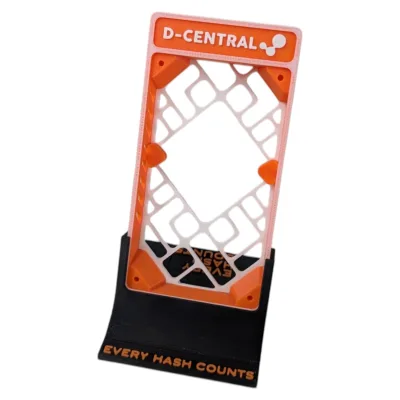
D-Central Technologies was a pioneer in the Bitaxe ecosystem from the beginning. We created the original Bitaxe Mesh Stand — the first company to manufacture it. We developed leading heatsink solutions for both the standard Bitaxe and the Bitaxe Hex. Today, we stock every Bitaxe variant, every accessory, every compatible PSU. When it comes to Bitaxe, we are the one-stop shop.
Beyond Bitaxe: The Full Open-Source Mining Lineup
The Bitaxe is the flagship, but the open-source mining ecosystem extends much further. Here is what the compact mining landscape looks like today:
| Device | Type | Target User | Mining Mode |
|---|---|---|---|
| Bitaxe (all variants) | Standalone ASIC solo miner | Home miners, enthusiasts | Solo (lottery mining) |
| NerdAxe | Multi-chip open-source miner | Builders, tinkerers | Solo / Pool |
| NerdQAxe | Quad-chip open-source miner | Serious home miners | Solo / Pool |
| Nerdminer | ESP32-based lottery miner | Beginners, display piece | Solo (educational) |
| NerdNOS | Mining firmware / device | Custom builders | Solo / Pool |
| Bitcoin Space Heaters | Full ASIC in heater enclosure | Home heaters / dual-purpose miners | Pool |
Every single one of these devices serves the same mission: putting hashrate in the hands of individuals. Each hash generated by a home miner is a vote for decentralization, a tiny act of rebellion against the consolidation of mining power.
Why Small-Scale Mining Matters More Than Ever
The Bitcoin network’s total hashrate has surpassed 800 EH/s. At that scale, a single Bitaxe producing 500 GH/s looks infinitesimal. Critics call it pointless. They are wrong — and here is why.
Decentralization Is Not Optional
Bitcoin’s security model depends on distributed hashrate. When mining consolidates into a handful of publicly traded companies operating under the regulatory authority of a single nation, Bitcoin’s censorship resistance degrades. Every independent miner — whether running a Bitaxe on a bookshelf or an Antminer in a garage — adds a sovereign unit of hashrate that answers to no one but its operator.
This is not idealism. This is Bitcoin’s threat model. Small-scale mining is the immune system of the network.
The Lottery Is Real
Solo mining with compact hardware is often called “lottery mining,” and the analogy is apt — but incomplete. Unlike a state lottery, Bitcoin mining is a fair lottery with transparent rules, no middleman, and a 3.125 BTC prize. Multiple Bitaxe units have already found blocks. The probability on any given day is low, but it is never zero, and every hash counts.
Dual-Purpose Mining: The Thermodynamic Hack
Here is a fact that changes the entire mining economics equation: 100% of the electricity consumed by a miner is converted to heat. Every single watt. This means that any Bitcoin miner, from a Bitaxe to an Antminer S21, is also a space heater with a hashrate.
Bitcoin Space Heaters take this concept to its logical conclusion. Instead of paying for electricity to heat your home and paying for electricity to mine Bitcoin, you combine both into a single expense. During Canadian winters — and we know Canadian winters — this is not a novelty. It is a rational energy strategy.
At D-Central, we build Space Heater editions using battle-tested ASIC platforms (S9, S17, S19) in custom enclosures designed for residential use. Heat your home. Stack sats. One electrical bill.
Education and Sovereignty
Running your own miner teaches you more about Bitcoin than a hundred YouTube videos ever could. You learn about difficulty adjustments, nonce ranges, block templates, pool protocols, and the raw physics of SHA-256 computation. You gain hands-on understanding of why proof-of-work matters and what it actually costs to produce a block.
That knowledge translates to sovereignty. When you understand mining at the hardware level, you cannot be fooled by narratives about “wasted energy” or “better alternatives.” You know the truth because you run the machines.
The D-Central Approach: Hacking Mining for the Individual
D-Central Technologies exists because we believe mining should not be gatekept by institutions. Since 2016, we have been taking industrial-grade mining technology and hacking it for home miners — the people who actually care about Bitcoin’s decentralized future.
Here is what that looks like in practice:
Bitaxe Pioneer. We have been in the Bitaxe ecosystem since the beginning, developing accessories, heatsinks, and solutions that make these devices perform at their best. We carry every variant, every accessory, and the expertise to support it all.
ASIC Repair. We operate one of the most comprehensive ASIC repair services in North America, with 60+ model-specific repair pages and the technical depth to back them up. Repair is the ultimate hack — extending hardware life, reducing e-waste, and keeping hashrate online that would otherwise be scrapped.
Custom Builds. Our Antminer Slim Edition, Pivotal Edition, and Loki Edition take standard ASIC platforms and reshape them for specific use cases. Different form factors, optimized configurations, and solutions that no factory offers.
Full Ecosystem. Hardware, repair, hosting in Quebec, consulting, training — we cover the entire lifecycle of a miner’s journey. No other company in the space offers this depth.
Getting Started with Small-Scale Mining
If you are reading this and have never mined Bitcoin, here is the honest truth: the best time to start was years ago. The second best time is now. And the barrier to entry has never been lower.
A Bitaxe Supra, a 5V power supply, and a WiFi connection. That is all you need to start solo mining Bitcoin from your desk. Setup takes minutes. The device draws about 15 watts — less than a light bulb. It runs silently. And every hash it produces is a genuine attempt at solving the next Bitcoin block.
For those ready to scale up, the NerdQAxe and NerdAxe offer more hashrate while maintaining the open-source ethos. And for home miners who want serious hashrate combined with home heating, our Space Heater editions turn the economics of mining on their head.
The Bitaxe Hub on our site is the most comprehensive resource for getting started with open-source solo mining — setup guides, overclocking tips, troubleshooting, and every accessory you could need.
The Road Ahead
The future of small-scale mining is not about catching up to industrial operations. It never was. It is about building a parallel infrastructure — a distributed network of sovereign miners who collectively ensure that Bitcoin remains uncapturable.
Chip technology continues to improve. The BM1370 in the Bitaxe Gamma delivers hashrate that would have required an entire USB miner farm just a few years ago. Open-source firmware is getting more sophisticated, with features like automatic difficulty adjustment, real-time monitoring, and over-the-air updates. The community is growing, sharing designs, and iterating faster than any corporate R&D department.
At D-Central, we are committed to staying at the cutting edge of this movement. We are not just selling hardware — we are building the infrastructure for decentralized mining. Every Bitaxe we ship, every ASIC we repair, every Space Heater we build is a small act of resistance against the centralization of Bitcoin’s hash power.
This is what it means to be Bitcoin Mining Hackers. The machines are getting smaller. The mission is getting bigger. And every hash counts.
Frequently Asked Questions
What is small-scale Bitcoin mining?
Small-scale Bitcoin mining refers to mining operations run by individuals or small groups using compact hardware like Bitaxe solo miners, NerdAxe, or Nerdminers. Unlike industrial operations with thousands of ASICs, small-scale mining prioritizes decentralization, sovereignty, and accessibility — often running from a home desk or shelf.
Can you actually mine Bitcoin with a Bitaxe?
Yes. The Bitaxe is a fully functional SHA-256 ASIC miner running open-source firmware. It performs solo mining against the Bitcoin network, meaning every hash has a chance — however small — of solving a block and earning the full 3.125 BTC block reward. Multiple Bitaxe units have already found blocks.
What power supply does a Bitaxe need?
Most Bitaxe models (Supra, Ultra, Gamma) use a 5V barrel jack (5.5×2.1mm DC) with a 5V/6A power supply. The Bitaxe GT and Bitaxe Hex use a 12V DC XT30 connector. Important: the USB-C port on Bitaxe units is for firmware flashing and serial communication only — it does NOT supply power for mining.
Is small-scale mining profitable?
Profitability depends on your definition. If you measure by daily electricity-versus-hashrate economics alone, large ASICs will always win on raw efficiency. But small-scale mining offers non-monetary value: sovereignty over your own hashrate, contributing to network decentralization, education, and the lottery chance at a full 3.125 BTC block reward. Many home miners also use their hardware as space heaters, effectively mining with energy they would spend on heating anyway.
How does small-scale mining help Bitcoin’s decentralization?
Every independent miner running their own hardware — whether a Bitaxe on a desk or an Antminer in a garage — adds a sovereign node of hashrate to the network. This distributes mining power geographically and organizationally, making Bitcoin more resistant to censorship, state-level attacks, and mining pool centralization. Small-scale mining is the immune system of the Bitcoin network.
What is the difference between solo mining and pool mining?
Pool mining combines hashrate from many miners and distributes rewards proportionally based on contributed work. Solo mining means your hardware works independently — you earn nothing unless you solve a block, but if you do, you receive the entire 3.125 BTC block reward. Devices like the Bitaxe are purpose-built for solo mining, turning every hash into a lottery ticket.