Quick answer
Umbrel turned running your own Bitcoin node from a weekend sysadmin project into a plug-and-play setup: umbrelOS on the Umbrel Home server deploys in minutes. For home miners running a Bitaxe or an ASIC space heater, pairing your hardware with your own full node validates your mining rewards against the real chain, keeps your addresses private, and enforces your rules.
Why Every Bitcoin Miner Should Run a Full Node
Before diving into hardware, let’s establish why this matters. A Bitcoin full node independently validates every transaction and every block against the consensus rules. It does not trust miners, exchanges, or any third party. When you run a full node, you are enforcing the rules of Bitcoin — your rules. No one can feed you invalid blocks or censor your transactions. For home miners, the benefits are concrete:- Transaction verification — You validate your own mining rewards against the actual blockchain, not a filtered version of it.
- Privacy — Broadcasting transactions through your own node means no third-party service logs your wallet addresses, balances, or spending patterns.
- Network contribution — Every full node strengthens Bitcoin’s decentralization. More nodes mean more independent verification of the consensus rules.
- Solo mining validation — If you are solo mining with a Bitaxe, your node can be the one that validates and broadcasts your winning block to the network.
- Lightning Network — Running your own Lightning node on top of your Bitcoin node lets you send and receive payments with minimal fees and maximum privacy.
What Is UmbrelOS?
UmbrelOS is a Linux-based operating system purpose-built for self-hosting. Originally designed to simplify running a Bitcoin full node, it has expanded into a full self-hosting platform with a one-click app store. The key advantage of umbrelOS is that it eliminates the command-line barrier. You do not need to SSH into a server, edit configuration files, or compile software from source. The entire experience runs through a clean web dashboard accessible from any device on your local network.Core Capabilities
| Feature | Details |
|---|---|
| Bitcoin Core | Full node with automatic IBD (Initial Block Download), pruning options, and Tor support |
| Lightning (LND / CLN) | Run your own Lightning node for private, low-fee payments |
| Electrum Server | Electrs or Fulcrum — connect your hardware wallet without leaking addresses to third parties |
| Block Explorer | Mempool.space instance running locally on your own data |
| Tor Integration | Built-in Tor support for anonymous node operation and remote access |
| App Store | One-click install for 200+ self-hosted applications |
| Zero Configuration | Plug in, power on, navigate to umbrel.local — done |
Umbrel Home Hardware: Purpose-Built for Sovereignty
While umbrelOS runs on any x86 machine or Raspberry Pi, the Umbrel Home is a purpose-built server that eliminates the friction of DIY assembly. At $699 USD, it sits at a compelling price point for a device designed to run 24/7 as the backbone of your sovereign Bitcoin infrastructure.Hardware Specifications
| Component | Specification |
|---|---|
| CPU | 2.9 GHz Quad-Core Intel N97 (Alder Lake-N) |
| RAM | 16 GB DDR5 dual-channel |
| Storage | 2 TB NVMe SSD (PCIe Gen 3) |
| Networking | Gigabit Ethernet, Wi-Fi 5, Bluetooth 5.0 |
| Ports | 3x USB 3.0, 1x USB-C, HDMI |
| Power Draw | ~10 W idle, ~25 W under load |
| Cooling | Active fan cooling, virtually silent |
| Form Factor | Compact cube (~13 cm per side) |
Umbrel Home vs. Raspberry Pi: Honest Comparison
The Raspberry Pi was the original gateway to running a Bitcoin node at home. It deserves respect for that. But hardware has moved on, and the Pi’s limitations become obvious when you try to run a full sovereign stack.| Metric | Raspberry Pi 4 (8 GB) | Umbrel Home |
|---|---|---|
| CPU | 1.8 GHz ARM Cortex-A72 | 2.9 GHz Intel N97 (x86) |
| RAM | 8 GB LPDDR4 | 16 GB DDR5 |
| Storage | microSD + external USB SSD | 2 TB internal NVMe |
| IBD Time | 3–7 days | ~24 hours |
| Multi-App Performance | Sluggish with 3+ apps | Smooth with 10+ apps |
| Storage Reliability | microSD corruption risk | Enterprise-grade NVMe |
| Power Draw | ~7 W (Pi only, add SSD) | ~10 W (all-in-one) |
| DIY Assembly | Required (case, SSD, PSU, cables) | None — plug and play |
| Total Cost | ~$200–$350 (Pi + SSD + case + PSU) | $699 |
The Sovereign Mining Stack: Node + Miner
Here is where things get interesting for home miners. When you pair your own full node with your own mining hardware, you close the sovereignty loop entirely. Consider the complete stack:- Umbrel Home running Bitcoin Core — validates every block, enforces consensus rules, stores the full blockchain
- Electrum Server (Electrs/Fulcrum) — connects your hardware wallet to your own node, so no third party sees your balances
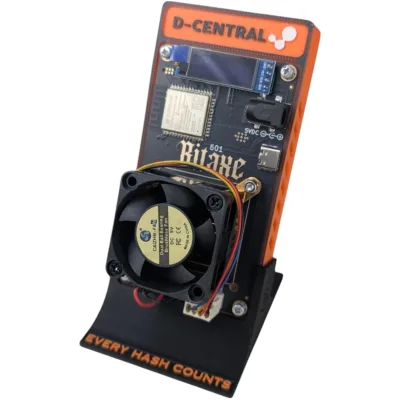
- Bitaxe solo miner — hashes SHA-256 against the network, pointed at a solo mining pool or your own node via Stratum
- Lightning node (LND/CLN) — send and receive payments privately, route payments for the network
- Local block explorer (Mempool) — monitor the mempool, fees, and your own transactions without touching a web browser
Setting Up Umbrel Home: Five Minutes to Sovereignty
The setup process is deliberately simple. No terminal commands. No Linux experience required.- Unbox — Umbrel Home, power adapter, Ethernet cable, quick-start guide.
- Connect — Plug Ethernet into your router and power into the wall. Press the power button.
- Access — Open any browser on your network and navigate to
umbrel.local. - Create account — Set your local admin password. This is stored only on the device.
- Install Bitcoin Core — One click from the App Store. Initial Block Download begins automatically.
Essential Apps for Bitcoin Miners
The Umbrel App Store has over 200 applications. Most are irrelevant to miners. Here are the ones that matter:| App | Purpose | Why Miners Need It |
|---|---|---|
| Bitcoin Core | Full node | Validates your mining rewards, enforces consensus |
| Electrs / Fulcrum | Electrum server | Private wallet connections — no address leakage to Electrum servers |
| LND / Core Lightning | Lightning node | Instant, private payments; earn routing fees |
| Mempool | Block explorer | Monitor fees, blocks, and your own transactions locally |
| ThunderHub | Lightning management | Channel management, liquidity, forwarding history |
| Ride The Lightning | Lightning management | Alternative LN dashboard with detailed analytics |
| Tailscale / WireGuard | VPN | Secure remote access to your node from anywhere |
| Pi-hole | DNS ad blocker | Network-wide ad/tracker blocking for all devices |
Umbrel vs. Start9: Choosing Your Node OS
Umbrel is not the only game in town. Start9’s StartOS is a strong alternative, and honest comparison is warranted. Umbrel’s strengths: Larger app library, polished UI, faster onboarding, Umbrel Home hardware option, larger community. Start9’s strengths: More privacy-focused defaults, better dependency management between services, fully open-source from day one, health-check system that monitors service status. Both run Bitcoin Core, Lightning, Electrum Server, and the essential sovereignty stack. Both support Tor. Both eliminate the command line for most users. Our take: if you prioritize ease of use and the widest app selection, go with Umbrel. If you prioritize privacy defaults and service health monitoring, look at Start9. Either way, you are running your own node — and that is what matters. For a deeper comparison, including how both platforms integrate with mining hardware, read our Bitcoin Home Server and Node Guide.Power Consumption and Running Costs
One of the most common objections to running a home server is the electricity cost. Let’s kill that myth with actual numbers. The Umbrel Home draws approximately 10 watts at idle, spiking to 25 watts under heavy load (IBD, indexing). For sustained operation after initial sync, expect roughly 12–15 watts average. At Canadian residential electricity rates (~$0.07–0.12/kWh depending on province):| Scenario | Power | Annual Cost (CAD) |
|---|---|---|
| Umbrel Home (idle) | 10 W | $6–$10 |
| Umbrel Home (average) | 13 W | $8–$14 |
| Raspberry Pi 4 + SSD | 8 W | $5–$8 |
Security Considerations
Running your own server introduces responsibilities. Umbrel handles the heavy lifting, but you should understand the basics:- Physical security — Your node stores your Lightning channel state and potentially wallet keys. Keep it in a secure location.
- Network security — Keep your Umbrel behind your router’s firewall. Do not expose ports to the open internet unless you know what you are doing. Use Tor or Tailscale for remote access.
- Backups — Umbrel provides backup functionality for Lightning channel state. Use it. Lightning channel loss without backup means lost funds.
- Updates — Keep umbrelOS and apps updated. Security patches matter.
- Seed phrase — Your on-chain Bitcoin wallet seed phrase should be stored offline on metal or paper, never on the Umbrel itself. See our guide on offline Bitcoin key storage.
Who Should Buy an Umbrel Home?
Not everyone needs the prebuilt hardware. Here is the honest breakdown: Buy the Umbrel Home if:- You want a plug-and-play node with zero assembly
- You value reliability and do not want to troubleshoot microSD corruption or USB-SSD disconnects
- You plan to run 5+ apps simultaneously (Bitcoin Core + Lightning + Electrs + Mempool + more)
- You want the fastest possible Initial Block Download (~24 hours vs. 3–7 days on Pi)
- You are building a complete sovereign stack alongside your mining hardware
- You already have the hardware sitting unused
- You enjoy the DIY process and want to learn Linux fundamentals
- You only need Bitcoin Core and maybe one or two additional apps
- Budget is your primary constraint
Frequently Asked Questions
Can I connect my Bitaxe to my Umbrel node for solo mining?
Not directly through Bitcoin Core’s built-in Stratum. Solo mining requires a Stratum server or mining pool software (like ckpool or public-pool) running between your miner and Bitcoin Core. You can install solo mining pool software on your Umbrel or point your Bitaxe at a public solo pool like solo.ckpool.org or public-pool.io while still using your Umbrel node for wallet verification and block monitoring.
How long does Initial Block Download take on Umbrel Home?
Approximately 24 hours on the Umbrel Home hardware with a stable internet connection. On a Raspberry Pi 4, expect 3–7 days. The NVMe SSD and faster CPU in the Umbrel Home dramatically reduce IBD time compared to ARM-based solutions.
Does running a Bitcoin node use a lot of bandwidth?
After the initial sync (~600+ GB download), ongoing bandwidth is modest — roughly 10–50 GB per month depending on how many peers you serve. If you have a data cap, you can limit inbound connections in Bitcoin Core settings.
Can I access my Umbrel remotely?
Yes. Umbrel supports Tor for remote access (built-in), and you can install Tailscale or WireGuard from the app store for faster VPN-based remote access. Never expose your Umbrel directly to the internet without a VPN or Tor.
Is 2 TB enough storage for the Bitcoin blockchain?
Yes, for now. The Bitcoin blockchain is currently over 600 GB. At the current growth rate, 2 TB provides years of headroom. If you need more in the future, you can enable pruning to limit disk usage or upgrade the NVMe drive.
Can I run Umbrel alongside my Bitcoin Space Heater?
Absolutely. The Umbrel Home draws only 10 W — negligible compared to a mining space heater. Run both on the same network: the space heater mines and heats your home, the Umbrel node validates blocks and manages your Lightning channels. The complete sovereign stack.
What if Umbrel the company disappears?
UmbrelOS is open-source software. Your Bitcoin Core data, Lightning channels, and wallet seeds exist on your hardware. If Umbrel the company ceased to exist tomorrow, your node would continue running. You could also migrate to Start9, RaspiBlitz, or a manual Linux setup. This is the advantage of open-source — no vendor lock-in.