You want to mine Bitcoin at home. Not some proof-of-stake token. Not a memecoin. Bitcoin — the hardest money ever created, secured by the most powerful computational network on the planet. And you want in.
Good. That instinct — to run your own miner, to contribute your own hashrate to the network, to take direct custody of freshly mined sats — that is the most important decision you can make as a Bitcoiner. Every miner you plug in strengthens decentralization. Every hash you produce is a vote for a financial system that no government, corporation, or bank can censor.
This guide is built by the team at D-Central Technologies — Canada’s Bitcoin Mining Hackers. We have been building, repairing, and shipping miners since 2016. We created the original Bitaxe Mesh Stand. We developed heatsinks for the Bitaxe and Bitaxe Hex. We stock every open-source miner variant on the market, and we have repaired thousands of ASIC machines in our Laval, Quebec facility. This is not generic advice — this is field-tested knowledge from the workshop floor.
Let us get you mining.
Why Mine Bitcoin at Home in 2026?
With Bitcoin’s network hashrate pushing past 800 EH/s and mining difficulty above 110 trillion, you might wonder whether home mining still makes sense. The answer is an emphatic yes — but you need to understand why.
Home mining is not primarily about competing with industrial operations. It is about three things:
- Decentralization: Every home miner is a node of resistance against hashrate centralization. When mining concentrates in a handful of data centers, Bitcoin’s censorship resistance weakens. Your miner in your basement is a direct countermeasure.
- KYC-free sats: Mining produces virgin Bitcoin — coins with no transaction history, no exchange trail, no KYC paperwork. For sovereignty-minded Bitcoiners, this matters.
- Heat monetization: Every watt your miner consumes becomes heat. In Canada, where heating season runs six months or longer, a Bitcoin miner is a space heater that pays you back. You are not wasting energy — you are monetizing it twice.
The 2024 halving dropped the block reward to 3.125 BTC. That changes the economics but not the mission. If you are running a Bitaxe solo miner, one lucky block is life-changing. If you are running an ASIC on a pool, steady sats accumulate daily. Either way, you are building sovereignty.
The Three Tiers of Home Bitcoin Mining
Not all miners are created equal, and the right entry point depends on your goals, budget, and living situation. Here is how D-Central organizes the beginner landscape:
| Tier | Devices | Hashrate | Power | Best For | Price Range |
|---|---|---|---|---|---|
| Entry / Educational | Nerdminer, NerdNOS | ~2-50 KH/s | USB / ~1W | Learning, lottery mining, display piece | $50 – $100 |
| Solo Mining | Bitaxe (Supra, Ultra, Gamma, GT, Hex), NerdAxe, NerdQAxe | 500 GH/s – 3+ TH/s | 5V–12V DC, 10-100W | Solo block hunting, decentralization, quiet home mining | $150 – $700 |
| Full ASIC | Antminer Slim Edition, Space Heaters, S19/S21 series | 26 TH/s – 200+ TH/s | 240V, 800-3500W | Pool mining, heat recovery, serious sats stacking | $500 – $5,000+ |
Tier 1: The Nerdminer — Your First Hash
The Nerdminer is where many Bitcoiners start, and it is a brilliant entry point. It is a tiny ESP32-based device that runs the SHA-256 mining algorithm on a microcontroller. Will it find a block? The odds are astronomically low. But that is not the point.
The Nerdminer teaches you how mining actually works. You see the hashrate ticking, the nonce incrementing, the difficulty target displayed on the little screen. It connects to public solo mining pools over WiFi, and it costs less than dinner for two. Plug it into a USB port and you are a miner.
D-Central also stocks the NerdNOS — a variant that runs on the nerdnos firmware with slightly different capabilities. Both are open-source hardware, both are manufactured with quality components, and both ship from our facility in Laval, Quebec.
Who should start here: Absolute beginners, educators, parents teaching kids about Bitcoin, anyone who wants a cool desk gadget that contributes to the network.
Tier 2: The Bitaxe — Real Solo Mining, Real Chance at a Block
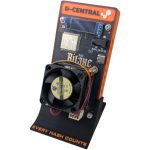
This is where things get serious. The Bitaxe is an open-source, single-chip ASIC miner that runs actual SHA-256 hashing at hundreds of gigahashes per second. D-Central has been a pioneer in the Bitaxe ecosystem since the beginning — we created the original Bitaxe Mesh Stand, developed heatsinks for both the Bitaxe and Bitaxe Hex, and we stock every variant on the market.
Bitaxe Variants at a Glance
| Model | ASIC Chip | Hashrate | Power Input | Power Draw |
|---|---|---|---|---|
| Bitaxe Supra | BM1368 | ~600 GH/s | 5V barrel jack (5.5×2.1mm) | ~12-15W |
| Bitaxe Ultra | BM1366 | ~500 GH/s | 5V barrel jack (5.5×2.1mm) | ~12W |
| Bitaxe Gamma | BM1370 | ~1.2 TH/s | 5V barrel jack (5.5×2.1mm) | ~15-20W |
| Bitaxe GT | BM1370 | ~1.2 TH/s | 12V DC XT30 | ~15-20W |
| Bitaxe Hex | 6x ASIC chips | ~3+ TH/s | 12V DC XT30 | ~60-90W |
Critical hardware note: The Bitaxe Supra, Ultra, and Gamma use a 5V barrel jack (5.5×2.1mm DC) and require a 5V/6A power supply. The USB-C port on these models is for firmware flashing and serial communication only — it does NOT supply enough power to run the miner. The Bitaxe GT and Hex use a 12V DC XT30 connector. D-Central stocks compatible PSUs for every variant.
The Bitaxe runs AxeOS firmware, connects over WiFi, and has a built-in web interface for configuration and monitoring. It is dead silent by desktop standards — a small fan is the only moving part. You can run it 24/7 on your desk, your shelf, or mounted on the wall with D-Central’s Mesh Stand.
Multiple Bitaxe units have found solo blocks — each worth 3.125 BTC at current block reward. The odds per unit are long with the network above 800 EH/s, but the beauty of solo mining is that your ticket never expires. Every hash counts.
Who should start here: Bitcoiners who want real skin in the mining game, open-source enthusiasts, solo block hunters, anyone who values decentralization and wants quiet home mining.
The NerdAxe and NerdQAxe: More Open-Source Firepower
The NerdAxe is another open-source miner in D-Central’s lineup — running a 5V barrel jack (5.5×2.1mm) just like the Bitaxe Supra/Ultra/Gamma, with a 5V/6A PSU requirement. The NerdQAxe packs four ASIC chips for more hashrate, running on a 12V DC XT30 connector. Both are excellent solo mining options and part of the growing open-source mining movement that D-Central actively supports and stocks.
Tier 3: Full ASIC Miners — Pool Mining and Heat Recovery
When you are ready to stack sats consistently, full ASIC miners deliver the hashrate that produces daily returns through mining pools. D-Central offers several home-optimized configurations:
Antminer Slim Edition
D-Central’s Antminer Slim Edition is a custom single-hashboard build designed specifically for home miners. By running one hashboard instead of three, it reduces noise, heat, and power consumption to levels manageable in a residential setting. Available in S19, S19j Pro, S19k Pro, and S21 configurations ranging from 26 TH/s to 44 TH/s.
Bitcoin Space Heaters
This is where the Mining Hacker philosophy shines brightest. D-Central’s Bitcoin Space Heaters enclose ASIC miners in purpose-built heating units that channel hot exhaust air through ductwork into your living space. During Canadian winters — and honestly, most of the year in much of the country — you are effectively mining Bitcoin for free because that electricity would go to heating anyway.
Available in S9, L3, S17, and S19 editions, these are dual-purpose machines: every watt mines Bitcoin AND heats your home. It is the most elegant argument for home mining that exists.
What You Need to Get Started: The Complete Checklist
| Component | For Bitaxe / Open-Source | For Full ASIC |
|---|---|---|
| Miner | Bitaxe, NerdAxe, NerdQAxe, Nerdminer | Antminer Slim Edition, Space Heater, S19/S21 |
| Power Supply | 5V/6A barrel jack PSU or 12V DC (model-dependent) | APW PSU (240V recommended) or included with Space Heater |
| Network | WiFi (built-in) | Ethernet cable + router |
| Electrical | Standard 120V outlet | 240V outlet (dryer/oven type) for most full ASICs |
| Bitcoin Wallet | Self-custody wallet (Coldcard, Trezor, Blockstream Jade, Sparrow, or similar). Your keys, your coins. | |
| Mining Pool / Solo Pool | Public solo pool (Solo CK, etc.) | Pool (Ocean, Braiins, etc.) or solo for the bold |
| Ventilation | None required (desk-quiet) | Dedicated space with airflow or ductwork |
Pool Mining vs. Solo Mining: Choose Your Path
This is one of the first decisions every new miner faces, and it is deeply philosophical as well as practical.
Solo mining means your miner works alone, attempting to find a block by itself. If it succeeds, you receive the entire 3.125 BTC block reward plus transaction fees — directly to your wallet, no intermediary. The trade-off is variance: you might mine for years without finding a block, or you might find one tomorrow. Solo mining is ideal for open-source miners like the Bitaxe, where the low power cost means you can run indefinitely while contributing to decentralization.
Pool mining means your miner combines its hashrate with thousands of others. When the pool finds a block, the reward is distributed proportionally based on your contributed hashrate. You receive smaller, more frequent payouts — steady sats dripping into your wallet. Pool mining makes economic sense for full ASIC miners where electricity costs are significant and you want predictable returns.
The D-Central recommendation: Run both. Keep a Bitaxe on solo mining for the dream and the decentralization mission. Run your ASIC on a pool for the steady income stream. Choose pools carefully — prioritize those that support decentralization (avoid pools with dominant network share) and offer transparent fee structures.
Setting Up Your First Miner: Step by Step
Bitaxe / Open-Source Miner Setup
- Unbox and inspect. Check that you have the miner, the correct PSU (5V barrel jack or 12V XT30 depending on model), and any accessories (heatsink, stand).
- Connect power. Plug the PSU into the barrel jack or XT30 port — NOT the USB-C port. The miner will boot and create a WiFi access point.
- Connect to the miner’s WiFi. On your phone or computer, join the WiFi network the Bitaxe broadcasts (typically named “AxeOS_XXXX” or similar).
- Open the web interface. Navigate to 192.168.4.1 in your browser. You will see the AxeOS dashboard.
- Configure WiFi. Enter your home WiFi credentials so the miner can connect to the internet.
- Set your mining pool. Enter the solo mining pool URL (e.g., public-pool.io or solo.ckpool.org) and your Bitcoin wallet address as the username.
- Save and reboot. The miner reconnects to your home WiFi and starts hashing. Monitor it through the web interface on your local network.
- Mount it. Use D-Central’s Mesh Stand or a case to position your miner where airflow is good.
Full ASIC Miner Setup
- Prepare your electrical. Ensure you have a 240V outlet in the location where the miner will run. For Space Heaters, plan your ductwork routing.
- Connect Ethernet. Run an Ethernet cable from your router to the miner’s network port.
- Connect power. Plug the APW PSU into the 240V outlet and connect the PSU cables to the miner’s hashboard and control board connectors.
- Power on. The miner will boot and obtain an IP address from your router via DHCP.
- Find the miner’s IP. Check your router’s DHCP client list, or use a network scanner app.
- Access the web interface. Navigate to the miner’s IP address in your browser.
- Configure your pool. Enter your mining pool’s stratum URL, your wallet address as the worker name, and your pool password (often just “x”).
- Monitor. Watch the hashrate stabilize over 10-15 minutes. Check the pool dashboard for your worker appearing online.
Optimizing Your Home Mining Operation
Once your miner is humming, here is how to squeeze every sat out of it:
- Location matters. Place your miner where heat is useful — a basement in winter, a garage, a workshop. In summer, ensure adequate ventilation or consider reducing power.
- Monitor your power costs. Calculate your cost per kWh and track your miner’s daily consumption. In many Canadian provinces, off-peak hydro rates make overnight mining significantly cheaper.
- Keep firmware updated. AxeOS for Bitaxe and manufacturer firmware for ASICs receive regular updates that improve efficiency and stability.
- Clean your equipment. Dust is the enemy of mining hardware. Compressed air every few months keeps fans and heatsinks performing at peak. If something goes wrong, D-Central’s ASIC repair service has been fixing miners since 2016 — we have seen it all.
- Stack, do not sell. Route your mining rewards to a self-custody wallet and hold. You are not day-trading — you are accumulating the hardest asset ever created.
Scaling Up: When You Are Ready for More
Home mining has a natural progression. Here is the typical path D-Central customers follow:
- Start with a Bitaxe or Nerdminer — learn the fundamentals, experience mining firsthand.
- Add a Slim Edition or Space Heater — begin earning consistent sats through pool mining while heating your space.
- Expand with multiple units — dedicated circuit, better ventilation, maybe a small mining closet or workshop area.
- Consider hosted mining — when you hit the limits of your home electrical capacity, D-Central offers Bitcoin mining hosting in Quebec where industrial power rates and cold climate cooling give your machines optimal economics.
- Consult with experts — D-Central’s mining consulting service helps you plan larger deployments, evaluate hardware purchases, and optimize your operation.
D-Central: Your Mining Partner Since 2016
D-Central Technologies is not a reseller with a Shopify store. We are Bitcoin Mining Hackers — a team of engineers, technicians, and cypherpunks who have been taking institutional-grade mining technology and making it accessible to home miners since 2016. We operate out of Laval, Quebec, Canada, and everything we do serves one mission: the decentralization of every layer of Bitcoin mining.
What sets us apart:
- Pioneer manufacturer in the Bitaxe ecosystem — we created the original Mesh Stand, developed heatsinks for Bitaxe and Bitaxe Hex, and stock every variant
- Full-service mining company — hardware sales, ASIC repair, hosting, consulting, and training under one roof
- 8+ years of expertise — we have been in this industry through every halving, every bear market, every difficulty adjustment
- Canadian quality and support — real people, real facility, real accountability
- Bitcoin only — we do not get distracted by altcoins. Bitcoin is the mission.
Browse the full catalog in our shop, deep-dive into the open-source mining world at our Bitaxe Hub, or reach out directly — we are here to help you start mining.
Frequently Asked Questions
How much does it cost to start Bitcoin mining at home?
You can start for under $100 with a Nerdminer (educational/lottery miner), around $200-400 with a Bitaxe solo miner, or $500-2,000+ with a full ASIC miner like the Antminer Slim Edition. The Bitaxe is the sweet spot for most beginners — real SHA-256 mining, low power draw, and a genuine shot at a solo block reward of 3.125 BTC.
What power supply do I need for a Bitaxe?
The Bitaxe Supra, Ultra, and Gamma use a 5V barrel jack (5.5×2.1mm DC) and require a 5V/6A power supply — NOT USB-C. The USB-C port is for firmware flashing and serial communication only. The Bitaxe GT and Bitaxe Hex use a 12V DC XT30 connector. D-Central stocks compatible PSUs for every variant.
Can I actually find a Bitcoin block with a Bitaxe?
Yes. Multiple Bitaxe units have found solo blocks worth 3.125 BTC each. With network hashrate above 800 EH/s, the odds for a single Bitaxe are long — but non-zero. Think of it like a Bitcoin lottery where your ticket never expires and you are simultaneously strengthening network decentralization. Every hash counts.
Should I solo mine or join a pool as a beginner?
It depends on your goals. Solo mining gives you a chance at the full 3.125 BTC block reward and directly contributes to network decentralization — ideal for Bitaxe and open-source miners. Pool mining provides smaller, more consistent payouts and suits full ASIC miners where you want steady sats. Many home miners run both: a Bitaxe on solo and a larger miner on a pool.
Do I need special internet or electrical wiring?
For open-source miners like the Bitaxe and NerdAxe, a standard WiFi connection and regular household outlet are all you need. For full ASIC miners (Antminer S9, S19, S21), you will need a 240V outlet (like a dryer plug) and a wired Ethernet connection. Always check the power requirements before purchasing — D-Central lists exact specs for every product.
How loud are Bitcoin miners?
It varies dramatically. Open-source miners like the Bitaxe and Nerdminer are near-silent (small fan, comparable to a laptop). D-Central’s Antminer Slim Edition is engineered for home use with reduced noise. Standard full ASICs run at 70-80 dB and are not suitable for living spaces without enclosures. Bitcoin Space Heaters channel the noise through ductwork, making them viable for basements and garages.
Can I use a Bitcoin miner to heat my home?
Absolutely — this is one of the most practical applications of home mining. Every watt a miner consumes is converted to heat. D-Central’s Bitcoin Space Heaters are purpose-built for this: they enclose ASIC miners in heating units that duct warm air into your living space. In Canadian winters, you are effectively mining for free because you would be paying for that heat anyway.
Does D-Central offer repair services if my miner breaks?
Yes. D-Central operates one of North America’s leading ASIC repair facilities, with 38+ model-specific repair capabilities covering Bitmain, MicroBT, Innosilicon, and Canaan hardware. From hashboard diagnostics to chip-level repair, we have been servicing miners since 2016.
Ready to start mining? Browse D-Central’s full lineup of Bitcoin mining hardware and join the decentralization revolution. Every hash counts.