Every ten minutes, the Bitcoin network settles transactions worth billions of dollars without a single bank, government, or intermediary touching the process. No permission required. No business hours. No borders. This is what Proof of Work makes possible — and it is the single most important innovation in monetary technology since the invention of double-entry bookkeeping.
Proof of Work is not a bug. It is not wasteful. It is the foundational mechanism that makes Bitcoin the most secure, censorship-resistant monetary network ever built. If you are mining Bitcoin — whether running a full-scale ASIC operation or a single Bitaxe on your desk — you are participating in something far bigger than transaction processing. You are defending the integrity of sound money itself.
This article breaks down exactly how Proof of Work functions, why it remains superior to every alternative consensus mechanism, how it aligns with renewable energy and dual-purpose mining, and what it means for the future of decentralized finance. No hand-waving. No apologetics. Just the technical reality.
How Proof of Work Actually Works
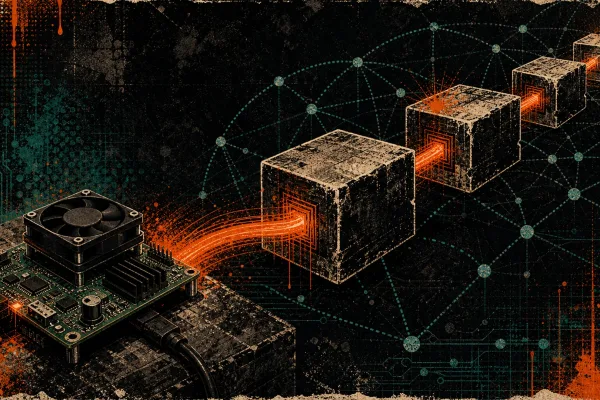
At its core, Proof of Work is a thermodynamic commitment. Miners expend real-world energy to solve a cryptographic puzzle — specifically, finding a SHA-256 hash that falls below a dynamically adjusted target. This is not arbitrary computation. It is the mechanism that makes forging transactions economically irrational.
Here is the process, step by step:
- Transaction collection — Miners gather unconfirmed transactions from the mempool into a candidate block.
- Block header construction — The miner assembles a block header containing the previous block hash, a Merkle root of included transactions, a timestamp, the difficulty target, and a nonce.
- Hashing — The miner repeatedly hashes the block header with different nonce values, searching for a hash output below the target threshold.
- Difficulty adjustment — Every 2,016 blocks (roughly two weeks), the network recalibrates the difficulty target so that blocks continue to be found approximately every ten minutes, regardless of how much hashrate joins or leaves the network.
- Block propagation — When a valid hash is found, the miner broadcasts the block. Other nodes verify it independently and add it to their copy of the blockchain.
The critical insight: there is no shortcut. You cannot fake the work. You cannot bribe the algorithm. The only way to produce a valid block is to burn real energy doing real computation. This is what gives Bitcoin its unforgeable costliness — a property that no other consensus mechanism replicates.
PoW vs. Proof of Stake: Why Energy Expenditure Is a Feature
Critics love to compare Proof of Work unfavorably to Proof of Stake (PoS), claiming that PoS achieves “the same thing” without the energy cost. This is fundamentally wrong, and the distinction matters enormously.
| Attribute | Proof of Work (Bitcoin) | Proof of Stake |
|---|---|---|
| Security anchor | Real-world energy expenditure | Capital lockup (tokens at stake) |
| Attack cost | Must acquire and operate physical hardware + energy | Must acquire 33-51% of staked tokens |
| Wealth concentration risk | Hardware depreciates; ongoing operational costs prevent permanent dominance | Staking rewards compound; rich get richer with no friction |
| Censorship resistance | Miners are globally distributed; hardware can be relocated | Validators can be identified, regulated, and coerced by jurisdictions |
| Nothing-at-stake problem | Does not exist — energy is consumed whether block is accepted or not | Validators can vote on multiple forks at zero marginal cost |
| Objective consensus | Any node can independently verify the chain with the most cumulative work | Requires social consensus and checkpoints to resolve forks |
| Track record | 16+ years with zero successful attacks on Bitcoin | Multiple chains have experienced validator cartels and censorship incidents |
The energy expenditure in Proof of Work is not a cost to be minimized — it is the security budget of a trillion-dollar monetary network. Every joule spent mining is a joule that an attacker must also spend (plus more) to attempt a rewrite of the ledger. Remove the energy, and you remove the physics-based security guarantee that makes Bitcoin trustless.
Proof of Stake, by contrast, anchors security in the very asset it is trying to secure. This creates a circular dependency: the tokens secure the network, and the network gives the tokens value. PoW breaks this circularity by grounding security in something external — thermodynamic work that cannot be counterfeited.
PoW vs. Traditional Banking: The Real Comparison
When legacy media compares Bitcoin’s energy use to “entire countries,” they never apply the same lens to the traditional financial system. The comparison, when done honestly, is illuminating.
| Factor | Bitcoin PoW | Traditional Banking |
|---|---|---|
| Settlement finality | ~60 minutes (6 confirmations) | 2-5 business days (ACH), weeks (international wire) |
| Operating hours | 24/7/365, no holidays | Business hours, closed weekends and holidays |
| Permission required | None — anyone can transact | KYC, credit checks, geographic restrictions |
| Infrastructure | Miners, nodes, internet connection | Branch offices, data centers, armored vehicles, ATMs, card networks, compliance departments |
| Energy transparency | Fully auditable on-chain | Opaque; no consolidated reporting |
| Censorship | Practically impossible with distributed hashrate | Routine — account freezes, deplatforming, sanctions |
| Counterparty risk | None (self-custody) | Bank insolvency, bail-ins, fractional reserve |
The traditional banking system consumes enormous amounts of energy when you account for physical branches, corporate offices, employee commutes, data centers, ATM networks, armored transport, and the entire compliance and legal apparatus. Bitcoin replaces all of that with mathematics and thermodynamics. The energy argument against PoW is not an argument — it is a category error.
Proof of Work and Renewable Energy: A Natural Alliance
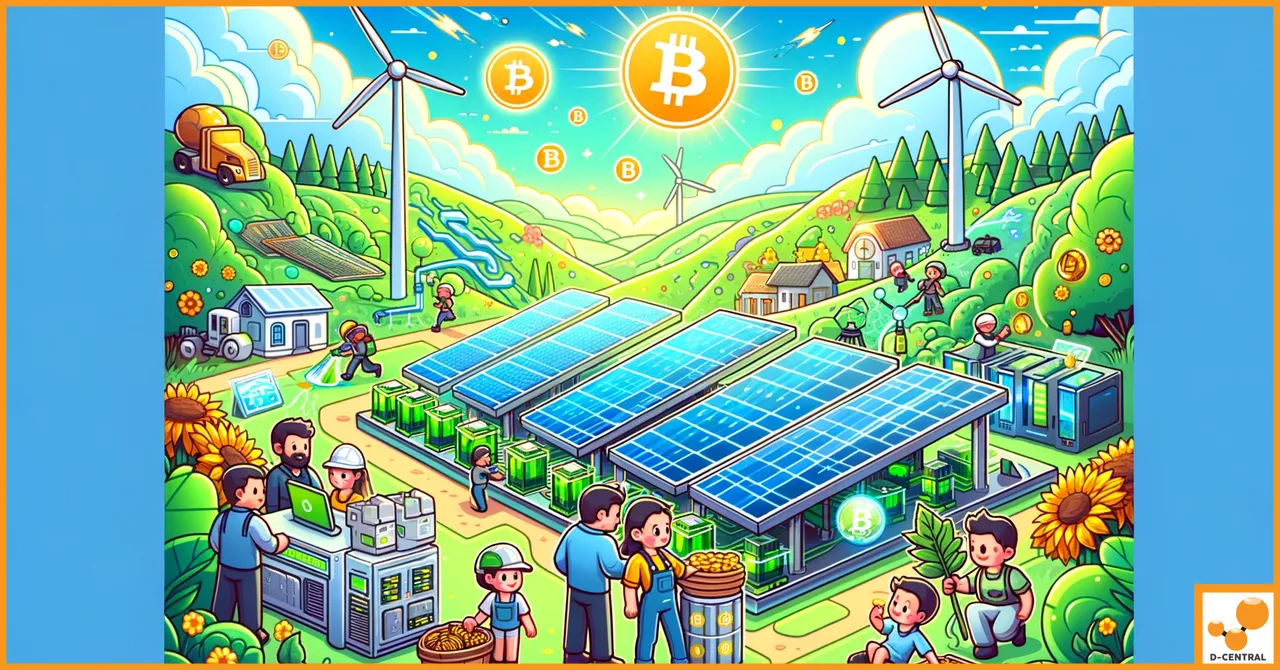
Here is a fact that the mainstream narrative consistently ignores: Bitcoin mining is the most location-flexible industry on the planet. Miners do not need to be near customers, ports, or highways. They need exactly two things — electricity and an internet connection. This makes miners the ideal buyer of last resort for stranded and curtailed renewable energy.
As of 2025, multiple independent studies estimate that over 50% of Bitcoin’s global energy consumption comes from renewable or zero-carbon sources. The Bitcoin Mining Council’s survey data puts the sustainable energy mix even higher among reporting members. This is not despite Proof of Work — it is because of it.
Why Miners Seek Renewables
Mining is a hyper-competitive, margin-sensitive business. The single largest operational cost is electricity. Miners are economically incentivized to find the cheapest power available — and the cheapest power on Earth is increasingly renewable energy that would otherwise be wasted. Curtailed wind in West Texas, stranded hydroelectric power in rural Quebec, flared natural gas in Alberta — these are precisely the energy sources that miners flock to.
In Canada, this advantage is structural. Quebec’s massive hydroelectric infrastructure provides some of the cheapest and cleanest electricity on the continent. D-Central’s hosting facility in Montreal, Quebec runs on this grid — leveraging clean hydroelectric power for Bitcoin mining operations.
Grid Stabilization: Miners as Flexible Load
Renewable energy has an intermittency problem. Solar produces nothing at night. Wind is unpredictable. This creates mismatches between supply and demand that grid operators struggle to manage. Bitcoin miners solve this by acting as controllable, interruptible load. When the grid has excess renewable generation, miners absorb it. When demand spikes, miners can curtail instantly — faster than any traditional industrial load.
This is not theoretical. ERCOT in Texas already uses Bitcoin miners as demand-response participants. Miners have curtailed hundreds of megawatts during peak demand events, stabilizing the grid and earning revenue for doing so. In Canada, similar opportunities exist as provinces expand wind and solar capacity alongside their existing hydro base.
Dual-Purpose Mining: Proof of Work as a Heating System
Every watt consumed by a Bitcoin miner is converted to heat with near-perfect efficiency. This is basic thermodynamics — the first law guarantees it. A 3,000-watt ASIC miner produces 3,000 watts of heat, identical to a 3,000-watt electric space heater. The difference? The ASIC also earns Bitcoin while it heats your space.
This is the core insight behind Bitcoin space heaters — dual-purpose machines that mine Bitcoin and provide heat simultaneously. In cold climates like Canada, where heating is a significant household expense for six or more months per year, this is not a gimmick. It is an economically rational way to offset heating costs with mining revenue.
The Math on Dual-Purpose Mining
Consider a Canadian household that currently spends $200/month on electric heating during winter. Replace that electric heater with a Bitcoin space heater drawing the same wattage. You get identical heat output — the laws of physics guarantee it — plus whatever Bitcoin the miner earns. Even at modest hash rates, that mining revenue can offset 30-70% of the electricity cost, effectively making your heating dramatically cheaper. When Bitcoin’s price rises, your heating cost drops further. When Bitcoin’s price is low, you are still getting heat at the same cost as a conventional electric heater — your downside is zero.
For a deeper look at the numbers, check out our Bitcoin Space Heater vs. Electric Heater cost comparison.
Home Mining and Hash Rate Decentralization
Proof of Work’s security depends on hash rate being distributed across many independent miners. When mining concentrates in a few large pools or geographic regions, the network becomes more vulnerable to coordinated attacks, regulatory capture, and censorship.
Home mining — running your own hardware in your own space, connected to your own node — is the antidote to centralization. Every home miner who points their hash rate at a decentralized pool (or mines solo) strengthens the network’s resilience. This is not idealism. This is network security architecture.
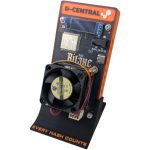
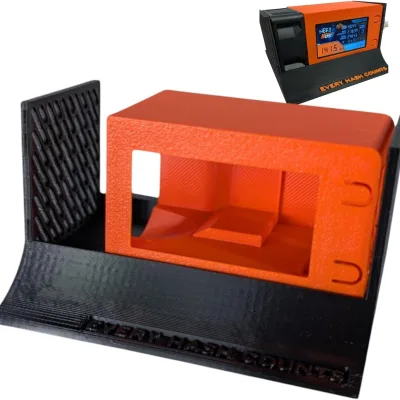
Open-source mining hardware like the Bitaxe makes this accessible to anyone. A Bitaxe running on your desk consumes roughly 15 watts — less than a light bulb — while contributing to Bitcoin’s global hash rate and giving you a shot at solo mining a full block reward. The probability per device is small, but the cumulative effect of thousands of home miners on network decentralization is enormous.
The “Every Hash Counts” Principle
Some dismiss home mining as economically irrational because the expected daily revenue from a single small miner is fractions of a cent. This misses the point entirely. Home mining is not primarily about daily revenue — it is about sovereignty, education, and network contribution.
- Sovereignty — You verify transactions yourself. You participate in consensus. You are not trusting a third party to be honest.
- Education — Running a miner teaches you how Bitcoin actually works at the protocol level. This knowledge is invaluable and cannot be gained from reading alone.
- Network health — Your hash power, however small, makes the network marginally more decentralized and therefore more secure. Multiply this by tens of thousands of home miners worldwide, and the effect is significant.
- Lottery upside — Solo miners have found full blocks with a single Bitaxe. It happens. The expected value math works differently when the reward is 3.125 BTC.
Bitcoin Mining’s Real Energy Narrative
The lazy narrative says Bitcoin “wastes” energy. The reality is more nuanced and more interesting:
Bitcoin mining monetizes energy that would otherwise be wasted. Flared natural gas, curtailed wind and solar, stranded hydro — these are energy sources with no buyer. Miners provide a buyer, turning waste into economic value and creating financial incentive to build more renewable infrastructure.
Bitcoin mining drives renewable energy investment. When a solar farm or wind installation can sell its excess output to miners during off-peak hours, the project’s economics improve. This makes marginal renewable projects viable, accelerating the energy transition.
Bitcoin mining subsidizes grid infrastructure. Miners pay for transmission capacity that benefits all ratepayers. In remote areas where renewable resources are abundant but demand is low, miners provide the economic justification for building grid connections that later serve other users.
Mining hardware is becoming more efficient every generation. The latest ASIC miners produce dramatically more hash per watt than machines from even two years ago. The S21 series achieves roughly 17.5 J/TH — compare that to the S9’s 98 J/TH. The industry relentlessly optimizes for energy efficiency because energy is the primary cost.
Canada’s Structural Advantage in Proof of Work Mining
Canada has several natural advantages that make it one of the best places on Earth to mine Bitcoin:
- Abundant hydroelectric power — Quebec, British Columbia, Manitoba, and Newfoundland all have massive hydro capacity with some of the cheapest electricity rates globally.
- Cold climate — Free air cooling for six or more months per year dramatically reduces operational costs. In a data center, cooling is typically 30-40% of energy consumption. Canadian miners get this essentially free during winter.
- Stable political and regulatory environment — Compared to many mining jurisdictions, Canada offers rule of law, property rights, and relatively clear regulatory frameworks.
- Dual-purpose heating opportunity — The same cold climate that provides free cooling means there is massive demand for heating, making dual-purpose mining economically compelling across most of the country.
- Skilled technical workforce — Canada’s engineering and technology talent pool supports both mining operations and ASIC repair and modification services.
D-Central has operated from Canada since 2016, building the infrastructure and expertise to support miners across the country and internationally. From ASIC repair services to custom mining solutions, the Canadian base provides real operational advantages that translate to better service for every customer.
The Road Ahead: PoW in a Post-Halving World
Bitcoin’s fourth halving in April 2024 reduced the block subsidy from 6.25 to 3.125 BTC. The fifth halving, expected around 2028, will cut it again to 1.5625 BTC. Each halving forces the mining industry to become more efficient, more creative, and more focused on total economics rather than raw hash power alone.
This halvening cycle drives several trends that strengthen the PoW ecosystem:
- Efficiency pressure — Only the most efficient miners survive each halving. This relentlessly drives hardware innovation and energy optimization.
- Fee market development — As the subsidy decreases, transaction fees become a larger share of miner revenue, creating a sustainable long-term security budget.
- Stranded energy monetization — As margins tighten, miners are increasingly forced to seek the cheapest possible energy, which is almost always renewable or otherwise wasted energy.
- Home mining growth — Dual-purpose mining becomes more attractive post-halving because the heating value of the energy expenditure provides a floor on the economics regardless of Bitcoin price.
- Hardware aftermarket — Post-halving, older-generation ASICs become available at lower prices, making entry-level mining more accessible for home miners and space heater builds.
The beauty of Proof of Work is that it has a built-in mechanism — the difficulty adjustment — that ensures the network survives and adapts regardless of external conditions. Miners come and go, prices rise and fall, halvings reduce the subsidy — and the difficulty adjusts, the blocks keep coming every ten minutes, and the system carries on. No committee meeting required. No emergency vote. Just math.
Frequently Asked Questions
Is Proof of Work really necessary for Bitcoin?
Absolutely. Proof of Work is what makes Bitcoin trustless. Without an objective, physics-based mechanism to determine which chain is valid, you need some form of social consensus or trusted authority to resolve disagreements — which defeats the entire purpose of a decentralized currency. PoW lets any node independently verify the correct chain by checking cumulative work, with zero trust required.
Does Bitcoin mining waste energy?
No. Bitcoin mining converts energy into security for a monetary network that processes hundreds of billions of dollars in transactions annually. Whether energy use is “waste” depends on whether you value the output. The global banking system uses far more energy when all its components are accounted for. Bitcoin mining increasingly uses renewable and stranded energy that has no other buyer, meaning it actually monetizes energy that would otherwise be genuinely wasted.
Can Bitcoin switch from Proof of Work to Proof of Stake?
It will not. Bitcoin’s resistance to change is a feature, not a limitation. The network’s value proposition depends on its immutability and predictability. Switching to PoS would fundamentally alter Bitcoin’s security model, remove the thermodynamic anchor that prevents costless attacks, and require the kind of coordinated social consensus change that Bitcoin is specifically designed to resist. Proof of Work is Bitcoin. They are inseparable.
How much of Bitcoin mining uses renewable energy?
Estimates vary by methodology, but multiple independent studies place Bitcoin mining’s sustainable energy mix at over 50% as of 2025, with some surveys reporting figures above 60%. Bitcoin mining is one of the most renewable-heavy industries on Earth, driven by the economic incentive to find the cheapest power — which is increasingly renewable. The trend is accelerating as older, less efficient hardware retires and new operations target stranded renewable resources.
Can I mine Bitcoin at home with Proof of Work?
Yes. Home mining is more accessible than ever. Open-source devices like the Bitaxe consume as little as 15 watts and let you solo mine from your desk. Larger setups using ASIC miners can double as space heaters, offsetting your heating costs with mining revenue. D-Central provides the hardware, setup guides, and support to get you mining at home — no data center required.
What happens to Proof of Work mining after all Bitcoin is mined?
The last Bitcoin will be mined around the year 2140. Long before that, transaction fees will become the primary source of miner revenue. As Bitcoin adoption grows, demand for block space increases, supporting a fee market that incentivizes continued mining. Proof of Work will continue to secure the network indefinitely — the subsidy was always designed to decrease over time and eventually reach zero, with fees taking over.
Why does D-Central focus on Proof of Work mining?
Because Proof of Work is the only consensus mechanism that delivers genuine decentralization, censorship resistance, and trustless settlement. D-Central’s mission — decentralization of every layer of Bitcoin mining — is rooted in the conviction that PoW mining should be accessible to everyone, not just large institutions. From open-source Bitaxe miners to full ASIC repair services to Bitcoin space heaters, everything D-Central builds exists to put hash power in the hands of individuals.
Proof of Work is not a relic of Bitcoin’s early days waiting to be replaced by something “better.” It is the most battle-tested, most scrutinized, and most robust consensus mechanism in existence. Sixteen years of continuous operation with zero successful attacks. Trillions of dollars secured. Hundreds of millions of transactions settled. No downtime. No bailouts. No permission required.
The energy that powers Proof of Work is not wasted — it is the cost of trustless, permissionless, censorship-resistant money. And increasingly, that energy comes from renewable sources, stranded resources, and dual-purpose applications that make the entire grid more efficient.
Whether you are running a warehouse of S21s or a single Bitaxe on your nightstand, you are part of this system. Every hash counts. Every watt spent on Proof of Work is a watt spent defending the integrity of sound money for the entire world.