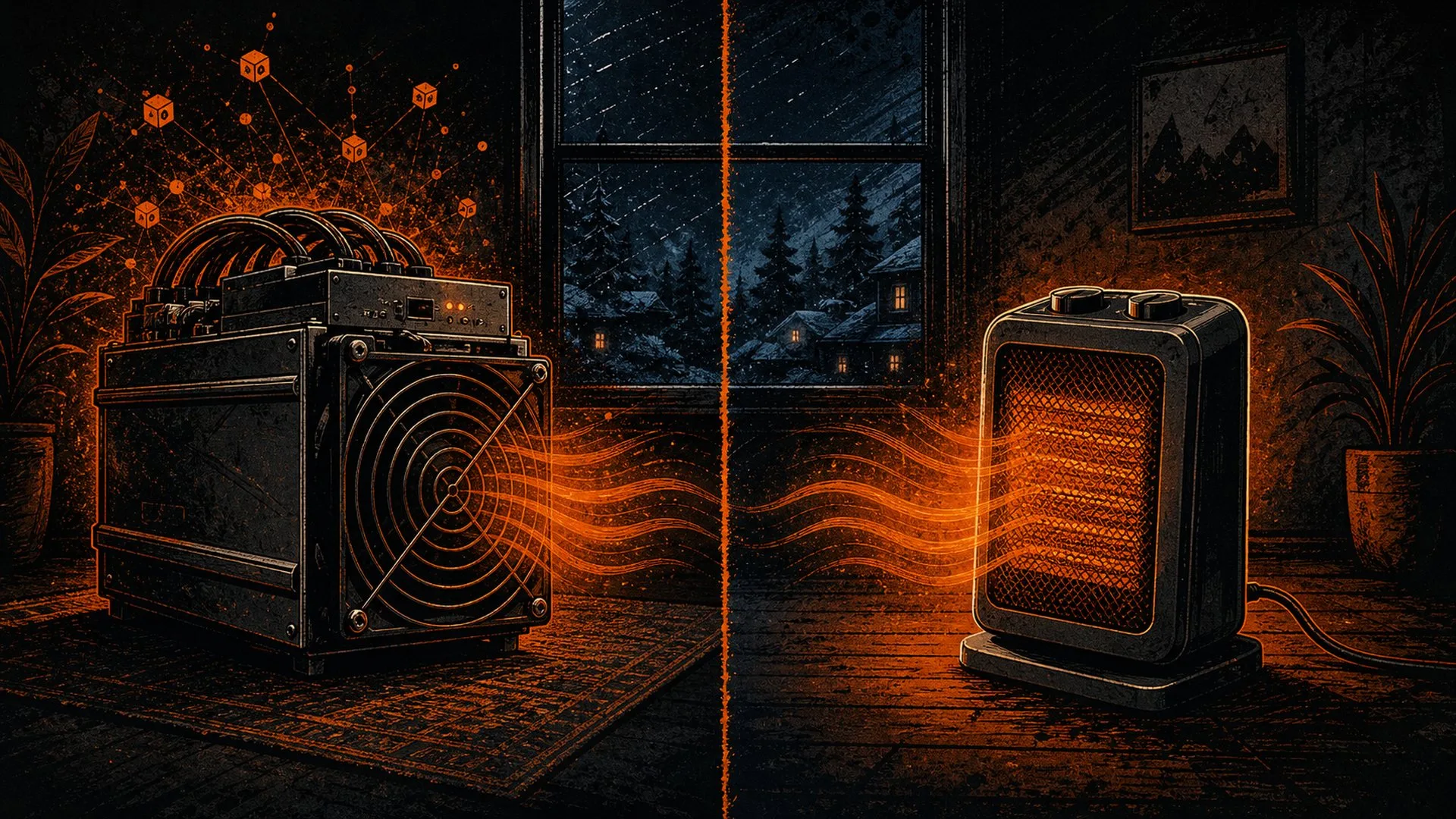
Compare equal amounts of useful heat before comparing costs. In this illustrative model, both heaters use 3,731.2 kWh per heating season. Mining receipts may offset some costs, but equipment, maintenance and variable receipts determine the result; neither payback nor savings is guaranteed.
This five-year comparison uses an illustrative 1,100W mining heater and a 1,500W ceramic heater operated for different durations to supply the same assumed seasonal heat. Both use 3,731.2 kWh per year in the model. The CAD inputs below are scenario assumptions reviewed on October 5, 2026, not current tariffs, product quotes or mining forecasts. The five-year mining receipt input totals $1,375 CAD; its effect is calculated after equipment and maintenance costs.
Every electric heater converts 100% of its consumed electricity into heat. That is not marketing — it is the first law of thermodynamics. A 1,500-watt ceramic tower heater draws 1,500 watts from the wall and produces 1,500 watts of thermal energy. No exceptions. A Bitcoin space heater — an ASIC miner enclosed in a quiet case — also draws electricity from the wall and converts 100% of it into heat. The difference? While the ceramic heater turns those watts into warmth and nothing else, the Bitcoin space heater turns those same watts into warmth and Bitcoin. Same physics. Same heat output per watt. One earns you satoshis while it keeps you warm. The one-, three- and five-year result depends on equal heat demand, equipment costs and the mining receipts actually received. The calculation below separates those inputs. The worked example uses explicitly hypothetical CAD electricity rates and mining receipts. Substitute your own measured consumption, tariff and costs before making a purchase decision.The Physics: Why a Bitcoin Miner IS an Electric Heater
Before we touch a single dollar figure, let us settle the physics once and for all. The first law of thermodynamics states that energy cannot be created or destroyed — only converted from one form to another. When electricity flows through a resistive element (the coil in a ceramic heater, the nichrome wire in a baseboard unit, or the ASIC chips on a hashboard), it is converted into thermal energy. The conversion rate is 100%. There is no “waste” in an electric heater because all electrical energy becomes heat. An ASIC miner is, electrically speaking, a resistive load. The BM1366 or BM1397 chips on a hashboard perform trillions of SHA-256 computations per second. Every computation dissipates energy as heat. The fans move that heat into your room. The entire wattage drawn from the wall ends up as thermal energy in your living space — exactly the same as a conventional electric heater. Key insight: Different power levels do not imply equal heat over equal runtimes. At the same assumed electrical-to-useful-heat conversion, a 1,400W device supplies 6.67% less heat than a 1,500W device over the same duration. For this cost model, equal seasonal heat is an explicit simplifying assumption, not a room-heating or hardware qualification. The only difference is what happens during the conversion. The ceramic heater vibrates molecules. The ASIC miner vibrates molecules and solves cryptographic puzzles that earn Bitcoin. Same input, same thermal output, additional financial output.| Property | Electric Space Heater | Bitcoin Space Heater (ASIC) |
|---|---|---|
| Electrical-to-thermal efficiency | 100% | 100% |
| Heating mechanism | Resistive element | ASIC chip computation |
| Heat distribution | Fan-forced or convection | Fan-forced (quiet 120/140mm fans) |
| Additional output | None | Bitcoin (BTC) |
| Typical wattage range | 750W – 1,500W | 300W – 1,400W (configurable) |
| Thermodynamic principle | First law (energy conservation) | First law (energy conservation) |
Head-to-Head: Bitcoin Space Heater vs. Electric Heater
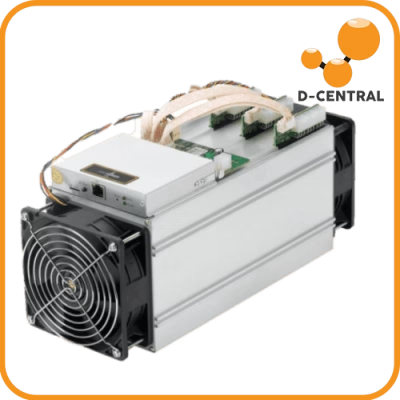
Before we dive into the multi-year financial projections, here is a complete feature comparison between a standard 1,500W electric space heater and a typical Bitcoin space heater built with an Antminer S9 in a D-Central Space Heater Edition case.| Feature | Electric Space Heater (1,500W) | Bitcoin Space Heater (S9, ~1,100W) |
|---|---|---|
| Purchase price | $80 CAD illustrative model input | $500 CAD illustrative model input (miner + case + PSU) |
| Power draw | 1,500W (fixed) | 300W – 1,400W (adjustable via firmware) |
| Heat output | ~5,120 BTU/hr | ~3,750 BTU/hr at 1,100W (scales with wattage) |
| Bitcoin earned | $0 | $1.51 CAD per heating day in Year 1 ($320 / 212 days), an illustrative input for 16 modeled hours/day, not an earnings forecast |
| Noise level | ~40 dB (quiet fan) | ~42–50 dB (space heater case with quiet fans) |
| Thermostat control | Built-in (on/off or adjustable) | Firmware-based (adjust hashrate = adjust wattage = adjust heat) |
| Setup complexity | Plug and play | Moderate (connect miner, configure pool, set up wallet) |
| Internet required | No | Yes (WiFi or Ethernet) |
| Lifespan | 3 – 8 years | 5 – 10+ years (ASIC hardware is durable) |
| Resale value | Near zero | Retains value (miners hold resale value, especially in bull markets) |
| Maintenance | None | Light (dust cleaning every 3–6 months, fan replacement every 2–3 years) |
| Supports Bitcoin network | No | Yes — contributes to decentralization and network security |
The Cost Model: Assumptions and Variables
To keep the calculation transparent, all amounts below are in Canadian dollars (CAD). Scenario reviewed October 5, 2026: these are illustrative inputs, not verified current prices, tariffs or future mining receipts. Equal-heat basis: Assume both devices supply the same useful seasonal heat and that all modeled electrical energy is useful in the heated space. This is a calculation assumption, not a measured room-heating result. The model excludes cooling-season operation and does not compare against a heat pump. Heating season and runtime: 212 days per year. The illustrative mining heater uses 1.1 kW for 16 hours per day: 3,392 operating hours and 3,731.2 kWh per year. A 1.5 kW ceramic heater reaches the same energy total in 2,487.47 full-power-equivalent hours per year, or about 11.7333 hours per day (73.3333% of the 16-hour window). These durations do not establish actual thermostat behavior or room adequacy. Mining receipt inputs:- Year 1: $320; Year 2: $245; Year 3: $190; Year 4: $350; Year 5: $270 CAD. Three-year total: $755. Five-year total: $1,375.
- These fixed receipts are hypothetical cash-flow inputs, not outputs of a current difficulty, hashrate or BTC-price calculation. They do not assume any verified future hardware earning capability.
- Receipts are treated as realized CAD credits in the example. BTC price, difficulty, subsidy changes, downtime and pool conditions can change actual receipts. Holding coins changes their subsequent valuation and does not automatically pay a bill.
Year 1: The First Heating Season
Year 1 combines each device’s assumed upfront cost, the same seasonal electricity use and the hypothetical $320 mining receipt input. Actual receipts are not assured. Annual electricity consumption (equal assumed seasonal heat):- Mining heater: 1.1 kW × 16 hours/day × 212 days = 3,731.2 kWh.
- Ceramic heater: 1.5 kW × (16 × 1.1 / 1.5) full-power-equivalent hours/day × 212 days = 3,731.2 kWh.
| Cost Component | $0.07/kWh | $0.12/kWh | $0.17/kWh |
|---|---|---|---|
| Electric Space Heater (1,500W) | |||
| Purchase price | $80 | $80 | $80 |
| Electricity cost (Year 1) | $261.18 | $447.74 | $634.30 |
| Bitcoin earned | $0 | $0 | $0 |
| Total Year 1 cost | $341.18 | $527.74 | $714.30 |
| Bitcoin Space Heater (S9, 1,100W) | |||
| Purchase price (miner + case + PSU) | $500 | $500 | $500 |
| Electricity cost (Year 1) | $261.18 | $447.74 | $634.30 |
| Illustrative mining receipts (Year 1) | -$320 | -$320 | -$320 |
| Net Year 1 cost | $441.18 | $627.74 | $814.30 |
Year 3: Conditional Cumulative Costs
For Years 2 and 3, retain the same annual energy use and tariffs, include $30 assumed fan maintenance in Year 2, and use hypothetical receipts of $245 and $190 CAD. Together with Year 1, the receipt inputs total $755 CAD. No BTC appreciation or change in hardware value is included.| 3-Year Cumulative | $0.07/kWh | $0.12/kWh | $0.17/kWh |
|---|---|---|---|
| Electric Space Heater | |||
| Hardware cost | $80 | $80 | $80 |
| Electricity (3 years) | $783.55 | $1,343.23 | $1,902.91 |
| Total 3-year cost | $863.55 | $1,423.23 | $1,982.91 |
| Bitcoin Space Heater | |||
| Hardware cost (incl. $30 fan replacement) | $530 | $530 | $530 |
| Electricity (3 years) | $783.55 | $1,343.23 | $1,902.91 |
| Illustrative mining receipts (3 years) | -$755 | -$755 | -$755 |
| Net 3-year cost | $558.55 | $1,118.23 | $1,677.91 |
| 3-Year Illustrative Cost Difference | |||
| Illustrative cost difference | $305.00 | $305.00 | $305.00 |
Year 5: Conditional Costs and Hardware Refresh
The five-year illustration includes an $80 ceramic-heater replacement in Year 4. Mining-heater equipment and maintenance total $960 CAD: $500 initially, $30 fan maintenance in Year 2, and $400 hardware refresh plus $30 fan maintenance in Year 4. The hypothetical annual mining receipt inputs are $320, $245, $190, $350 and $270 CAD, totaling $1,375 CAD. The Year 4 refresh and receipt change are assumptions, not evidence of a newer model’s performance. Equal annual energy use remains 3,731.2 kWh for both devices. No resale credit is counted.| 5-Year Cumulative | $0.07/kWh | $0.12/kWh | $0.17/kWh |
|---|---|---|---|
| Electric Space Heater | |||
| Hardware cost (assumed Year 4 replacement) | $160 | $160 | $160 |
| Electricity (5 years) | $1,305.92 | $2,238.72 | $3,171.52 |
| Total 5-year cost | $1,465.92 | $2,398.72 | $3,331.52 |
| Bitcoin Space Heater | |||
| Hardware cost (initial + upgrade + fans) | $960 | $960 | $960 |
| Electricity (5 years) | $1,305.92 | $2,238.72 | $3,171.52 |
| Illustrative mining receipts (5 years) | -$1,375 | -$1,375 | -$1,375 |
| Net 5-year cost | $890.92 | $1,823.72 | $2,756.52 |
| 5-Year Illustrative Cost Difference | |||
| Illustrative cost difference | $575.00 | $575.00 | $575.00 |
The Hidden Benefits They Do Not Put on the Box
The financial result depends on the assumptions. There are also nonfinancial reasons someone may want to learn about mining. 1. You learn Bitcoin by doing, not reading. Running a miner forces you to set up a wallet, choose a mining pool, understand hashrate, and engage with the Bitcoin network directly. This hands-on experience is more valuable than any course. You are not just reading about decentralization — you are participating in it. For a deeper dive into getting started, see our Getting Started guide. 2. You contribute to Bitcoin’s decentralization. Every hash your space heater produces makes the Bitcoin network slightly more decentralized and slightly more resistant to censorship. When thousands of home miners run space heaters across Canada, the United States, and the world, the network becomes harder for any single entity to attack or control. This is not abstract — it is the reason Bitcoin exists. 3. You dollar-cost-average into Bitcoin automatically. Mining receipts depend on uptime, hashrate, network conditions and pool arrangements. Mining is not a fixed-rate purchase of Bitcoin, and fees and counterparty considerations should be included in your own calculation. 4. Heating becomes a productive expense. Mining can add receipts while supplying heat you need. In the equal-kWh model the electricity charge is the same, but additional equipment and maintenance costs remain. Receipts may or may not offset those costs. 5. Your heater has resale value. A ceramic space heater from a big box store is worth approximately nothing after a few years. An Antminer S9 or S17 in a space heater case retains meaningful resale value, especially during bull markets when demand for mining hardware surges. The Bitcoin mining community on secondary markets actively trades older hardware. 6. Adjustable heat output via firmware. Unlike a basic electric heater with “low / medium / high” settings, a Bitcoin space heater running custom firmware like Braiins OS+ allows you to set the exact wattage. Want 600W on a mild day? Set it. Need 1,300W during a deep freeze? Crank it up. The granularity is far superior to conventional heaters.The Hidden Costs: What to Know Before You Buy
We are Bitcoin Mining Hackers, not salespeople. Here are the real costs and challenges you should factor in. 1. Noise management is required. Stock ASIC miners are loud — 75+ dB. That is why D-Central’s Space Heater Editions replace industrial fans with quiet 120mm or 140mm case fans, bringing noise down to 42–50 dB (comparable to a refrigerator). But they are not silent. If you need near-silent operation, consult our ASIC Noise Reduction Guide for additional strategies. 2. Setup requires basic technical knowledge. You need to connect the miner to your WiFi or Ethernet, navigate to its web interface, configure a mining pool, and enter your Bitcoin wallet address. This is not difficult — our Assembly & Maintenance Guide walks through every step — but it is more involved than plugging in a ceramic heater. 3. Internet connection is mandatory. The miner must communicate with the Bitcoin network via a mining pool. If your internet goes down, mining stops (though the miner still produces heat from the power it draws during idle/restart cycles). A stable home internet connection is a prerequisite. 4. Electrical requirements vary by model. An S9 at 1,100W runs comfortably on a standard 15A/120V circuit. Larger miners (S17, S19 models) may require a 240V circuit or a dedicated 20A outlet. Always check your electrical capacity before purchasing. Our Electrical Safety Guide covers this in detail. 5. Summer months mean no heating value. During the 5 months of Canadian summer, running a space heater (of either type) makes no sense — you would be heating an already warm home. This is why our model only counts 7 months of operation. Some miners run year-round in basements or garages, but for a direct heater comparison, we only count heating-season usage. 6. Bitcoin mining revenue is variable. Network difficulty, Bitcoin price, subsidy changes, uptime, fees and pool conditions affect receipts. The worked figures are illustrative inputs, not conservative forecasts or a fixed-income return.Which Should You Choose? The Decision Matrix
Not everyone should run a Bitcoin space heater. Here is an honest decision framework.| Your Situation | Recommendation | Why |
|---|---|---|
| Cold climate, cheap electricity (<$0.10/kWh), tech-comfortable | Consider a mining heater | More useful heating hours may improve the comparison, but equipment costs and net receipts still determine the result. |
| Cold climate, moderate electricity ($0.10–$0.15/kWh) | Compare actual inputs | Calculate equal useful heat and actual net mining receipts; a positive return is not assured. |
| Cold climate, expensive electricity (>$0.15/kWh) | Compare equal-heat costs | At equal kWh, both devices face the same tariff. Higher rates do not create extra comparative savings in this model. |
| Mild climate, short winters (3–4 months) | Electric heater or Bitaxe | Fewer heating months reduce the ROI. Consider a low-watt Bitaxe miner instead for year-round mining at minimal power. |
| Zero technical interest, want zero maintenance | Electric heater | If you truly want a plug-and-forget experience with no interaction, a traditional heater is simpler. |
| Bitcoin-curious, want to learn the technology | Consider a mining heater | There is no better way to learn Bitcoin than to mine it. Your heating bill becomes your tuition. |
| Already a Bitcoiner who stacks sats | Compare a mining heater | You are already spending money to heat your home. Make that money work. Every hash counts. |
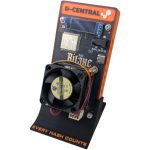
| Renting with noise restrictions | Electric heater or Bitaxe | Full ASIC space heaters at 42–50 dB may not be suitable for thin-walled apartments. A Bitaxe runs nearly silent at 5–15W. |
Choosing the Right Bitcoin Space Heater
D-Central manufactures and stocks a range of Bitcoin space heaters for different room sizes, power budgets, and experience levels. Here is a quick guide. Entry level — Antminer S9 Space Heater Edition (~300–1,100W): The S9 Space Heater Edition is the most popular starting point. The S9 is the most battle-tested miner in history, with millions of units deployed worldwide since 2016. At undervolted settings, it sips 300–800W while heating a small-to-medium room. Stock is available with D-Central’s custom space heater case and quiet fans installed. Mid-range — Antminer S17/T17 Space Heater Edition (~1,000–1,200W): The S17 and T17 Space Heater Editions offer more hashrate per watt, meaning more Bitcoin earned for the same heat output. They fit the D-Central S17/T17 Space Heater Case and are ideal for medium rooms. High output — Antminer S19 Space Heater Edition (~1,200–1,400W): The S19 Space Heater Edition is the most powerful residential Bitcoin space heater. It delivers serious hashrate and can heat a large room or small open-plan space. Requires a dedicated circuit. DIY builders — Space Heater Cases and the BitChimney: If you already own a miner, D-Central sells the space heater cases separately: the S9 case, the XL DIY case, and the BitChimney kit for chimney-style builds. See our Best Miners for Space Heaters guide for compatibility details. Browse the full collection at the Bitcoin Space Heaters hub.Frequently Asked Questions
Does a Bitcoin space heater really produce the same heat as a regular electric heater?
Equal power over equal runtime supplies equal electrical energy. This model assumes that energy is useful as room heat for both devices; actual heat delivery is not measured here. A 1,100W device run for the same duration as a 1,500W device uses 26.67% less energy. The cost tables instead match both devices at 3,731.2 kWh per heating season by adjusting the ceramic heater’s modeled runtime.
How much Bitcoin can I earn with a space heater miner?
Actual receipts depend on hardware, uptime, BTC price, network difficulty, subsidy and pool conditions and fees. This example assumes CAD receipts of $320, $245, $190, $350 and $270 in Years 1-5, totaling $1,375. These are hypothetical cash-flow inputs reviewed October 5, 2026, not current earnings estimates or a promise for an S9 or any replacement model.
How loud is a Bitcoin space heater?
D-Central’s Space Heater Editions replace industrial fans with quiet 120mm or 140mm case fans, bringing noise levels to approximately 42–50 dB — comparable to a refrigerator or quiet conversation. Stock ASIC miners without modification run at 75+ dB, which is too loud for residential use. The space heater case is essential. For additional noise reduction strategies, consult our ASIC Noise Reduction Guide.
Can I run a Bitcoin space heater on a regular 120V household outlet?
Yes, for models up to approximately 1,200W. The Antminer S9 Space Heater Edition runs comfortably on a standard 15A/120V North American outlet. Larger models (S19 series at 1,400W+) may require a dedicated 20A circuit or a 240V connection. Always verify your circuit capacity before connecting. See our Electrical Safety Guide for details.
What happens to the Bitcoin space heater in summer?
Most home miners turn off their space heater during summer months (May–September) since additional heat is unwelcome. This is factored into our cost model — we only count 7 months of operation. Some users relocate the miner to a garage or basement for year-round mining, and some opt for a low-watt Bitaxe device that produces negligible heat and can run year-round. The sats you earned during winter stay in your wallet regardless.
Do I need technical skills to set up a Bitcoin space heater?
Basic technical comfort is helpful but not advanced skills. You need to connect the miner to your home network (WiFi or Ethernet), access its web interface through a browser, enter a mining pool URL, and set your Bitcoin wallet address. D-Central provides complete setup instructions and offers customer support for any questions during setup.
Is Bitcoin mining with a space heater profitable at my electricity rate?
Not necessarily. Compare equal useful heat, upfront costs, maintenance, fees and realized mining receipts. In this illustration both heaters use 3,731.2 kWh annually, so their electricity charges match at each tariff. Assumed five-year receipts of $1,375 exceed an $800 equipment-and-maintenance premium by $575 before omitted costs. With zero receipts the mining heater costs $800 more; payback is not guaranteed.
What maintenance does a Bitcoin space heater require?
Minimal maintenance: clean dust from the heatsinks and fans every 3–6 months (compressed air works well), and replace the quiet case fans every 2–3 years (~$15–$30 per fan). No professional HVAC service calls, no annual inspections, no gas line maintenance. If an issue arises, D-Central is Canada’s largest ASIC repair center and can service any miner model.
Can I use a Bitcoin space heater as my only heat source?
A single 1,100W Bitcoin space heater can effectively heat a room of approximately 150–250 square feet, depending on insulation and climate. It is an excellent supplemental heat source or primary heater for a single room (office, bedroom, workshop). For whole-home heating, you would need multiple units or a larger miner setup. Many Canadian home miners use a Bitcoin space heater for their main living space and their existing heating system for the rest of the house.
What if Bitcoin price drops?
Lower BTC value can reduce the CAD receipts available to offset costs. Equal modeled heat does not remove the mining heater’s equipment, maintenance, downtime or fee risks. The example does not guarantee a capped downside, free heat or recovery of the upfront premium.
The Bottom Line
Here is the comparison in its simplest form: Electric space heater: You pay for electricity. You get heat. The money is gone. Bitcoin space heater: You pay for the same electricity. You get the same heat. You also get Bitcoin. In the equal-heat worked example, hypothetical five-year receipts exceed the assumed equipment-and-maintenance premium by $575 CAD, before omitted costs. This is a conditional model result, not guaranteed savings or profit. Without those receipts, the mining heater costs more. Use your own inputs and compare alternatives before buying. This is what we mean when we say every hash counts. Your space heater is not just fighting Canadian winter. It is participating in the most important monetary network in human history. It is turning a dead expense into a productive asset. It is heating your home with purpose. D-Central Technologies has been building Bitcoin space heaters since 2016. We created the original Bitaxe Mesh Stand, we manufacture custom space heater cases in Canada, and we stock the largest selection of home mining hardware in the country. Whether you want a complete plug-and-mine Space Heater Edition or a DIY BitChimney kit to convert your own miner, we have you covered. Browse Bitcoin Space Heaters | Getting Started Guide | Best Miners for Space HeatersDoes a Bitcoin space heater really produce the same heat as a regular electric heater?
Equal power over equal runtime supplies equal electrical energy. This model assumes that energy is useful as room heat for both devices; actual heat delivery is not measured here. A 1,100W device run for the same duration as a 1,500W device uses 26.67% less energy. The cost tables instead match both devices at 3,731.2 kWh per heating season by adjusting the ceramic heater’s modeled runtime.
How much Bitcoin can I earn with a space heater miner?
Actual receipts depend on hardware, uptime, BTC price, network difficulty, subsidy and pool conditions and fees. This example assumes CAD receipts of $320, $245, $190, $350 and $270 in Years 1-5, totaling $1,375. These are hypothetical cash-flow inputs reviewed October 5, 2026, not current earnings estimates or a promise for an S9 or any replacement model.
How loud is a Bitcoin space heater?
D-Central’s Space Heater Editions replace industrial fans with quiet 120mm or 140mm case fans, bringing noise levels to approximately 42–50 dB — comparable to a refrigerator or quiet conversation. Stock ASIC miners without modification run at 75+ dB, which is too loud for residential use. The space heater case is essential. For additional noise reduction strategies, consult our ASIC Noise Reduction Guide.
Can I run a Bitcoin space heater on a regular 120V household outlet?
Yes, for models up to approximately 1,200W. The Antminer S9 Space Heater Edition runs comfortably on a standard 15A/120V North American outlet. Larger models (S19 series at 1,400W+) may require a dedicated 20A circuit or a 240V connection. Always verify your circuit capacity before connecting. See our Electrical Safety Guide for details.
What happens to the Bitcoin space heater in summer?
Most home miners turn off their space heater during summer months (May–September) since additional heat is unwelcome. This is factored into our cost model — we only count 7 months of operation. Some users relocate the miner to a garage or basement for year-round mining, and some opt for a low-watt Bitaxe device that produces negligible heat and can run year-round. The sats you earned during winter stay in your wallet regardless.
Do I need technical skills to set up a Bitcoin space heater?
Basic technical comfort is helpful but not advanced skills. You need to connect the miner to your home network (WiFi or Ethernet), access its web interface through a browser, enter a mining pool URL, and set your Bitcoin wallet address. D-Central provides complete setup instructions and offers customer support for any questions during setup.
Is Bitcoin mining with a space heater profitable at my electricity rate?
Not necessarily. Compare equal useful heat, upfront costs, maintenance, fees and realized mining receipts. In this illustration both heaters use 3,731.2 kWh annually, so their electricity charges match at each tariff. Assumed five-year receipts of $1,375 exceed an $800 equipment-and-maintenance premium by $575 before omitted costs. With zero receipts the mining heater costs $800 more; payback is not guaranteed.
What maintenance does a Bitcoin space heater require?
Minimal maintenance: clean dust from the heatsinks and fans every 3–6 months (compressed air works well), and replace the quiet case fans every 2–3 years (~$15–$30 per fan). No professional HVAC service calls, no annual inspections, no gas line maintenance. If an issue arises, D-Central is Canada’s largest ASIC repair center and can service any miner model.
Can I use a Bitcoin space heater as my only heat source?
A single 1,100W Bitcoin space heater can effectively heat a room of approximately 150–250 square feet, depending on insulation and climate. It is an excellent supplemental heat source or primary heater for a single room (office, bedroom, workshop). For whole-home heating, you would need multiple units or a larger miner setup. Many Canadian home miners use a Bitcoin space heater for their main living space and their existing heating system for the rest of the house.
What if Bitcoin price drops?
Lower BTC value can reduce the CAD receipts available to offset costs. Equal modeled heat does not remove the mining heater’s equipment, maintenance, downtime or fee risks. The example does not guarantee a capped downside, free heat or recovery of the upfront premium.