
Shop Shroud Accessories for Bitcoin Mining
Shroud accessories: the small parts that change what a fan face can do
Shroud accessories are the fan-face and collar parts that sit alongside the ducting itself: fan adapters that let a 140 mm fan bolt to a 120 mm mount or the reverse, intake filter rings that keep room dust out of a hashboard stack, and a threaded blank-off cap that seals an idle machine's collar. D-Central makes six of them, all printed to order in PETG in Montreal, Quebec, in black or D-Central orange, and all drawn to the same standard fan patterns the rest of the line uses — the 105 mm screw square on a 120 mm fan, the 124.5 mm square on a 140 mm one.
None of these are upsells bolted onto a shroud order. Each one solves a problem that shows up after the duct is in: the fan you want is not the size the chassis was drilled for, the room is dirtier than the machine expected, or a miner comes out of service and leaves an open hole in your duct run.
Fan adapters: putting the fan you want on the mount you have
An ASIC chassis is drilled for one fan size and one only. A fan adapter bridges that, with a shaped transition wall between the two apertures instead of a flat plate with a hole cut in it. Direction is the one thing people get wrong at checkout, so it is worth stating twice: the adapter is named for the mount first and the fan second.
| 120 mm to 140 mm Fan Adapter | Your machine has 120 mm holes. The fan you are adding is the bigger one. Chassis side carries the 120 mm bolt square, outer face carries the 140 mm square. Fits Antminer S9-class and S19-class chassis, single-fan cases, workshop rigs and ducted home builds. |
|---|---|
| 140 mm to 120 mm Fan Adapter | Your machine has 140 mm holes. The fan you are bolting on is the smaller one. Chassis side carries the 140 mm square, outer face the 120 mm. Fits Whatsminer-class hardware, Antminer S21 Pro 140 mm faces, large-fan enclosures and custom ducted builds. |
Both bodies sit inside a 140 × 140 × 28 mm footprint, so the depth to plan for is 28 mm plus the thickness of the fan you are stacking on top of it. They are mirror images of each other and are not interchangeable — pick the one that matches the holes already in your chassis.
Why anyone goes up to 140 mm
Noise, and it is the most effective acoustic change available to a home miner who is not willing to build a sealed enclosure. A 140 mm rotor sweeps a wider disc than a 120 mm one, so it can move the same volume of air while turning slower, and fan noise climbs steeply with tip speed. Fit the larger fan, bring the curve down, and watch chip temperatures for a day before you settle. It is also how a mixed fleet gets standardised: put an adapter on each 120 mm machine, fit a 140 mm body such as the Universal Dual 140 mm to 6" Duct Shroud on top of it, and every shroud and filter ring you buy afterwards can be a 140 mm part — one size of spare on the shelf instead of two.
Why anyone goes down to 120 mm
Logistics, mostly. The 120 mm fan market is enormous — every speed, every bearing type, on a shelf somewhere near you. The 140 mm market is a fraction of it. When a 140 mm fan dies on a Friday and the replacement is three weeks out, this adapter and a 120 mm fan from the local supplier have the machine hashing again by Saturday. The second reason is specification: some of the strongest industrial fans built for restricted paths are made only in 120 mm, and a hashboard stack is exactly the kind of restricted path they exist for.
Why the transition is shaped, not flat
A flat plate with a 120 mm hole and a 140 mm bolt square is easy to make and it wastes the fan you just bought. The outer third of a 140 mm rotor is where most of the air is being moved, and a flat plate throws that outer air straight at a step face where it separates, swirls and turns into noise instead of flow. These bodies carry a continuous curved wall between the two apertures, so the column is turned rather than stopped. Each is one continuous piece of PETG: no bonded joint to creep in the warm air at a running miner's fan face, and no bolted seam to buzz at blade-pass frequency.
Intake filter rings: move the dust job outside the machine
Dust is the failure mode nobody watches for, because it never announces itself. A film of it on the fins is an insulating blanket; chips run hotter for the same fan speed, the machine quietly starts throttling, and nothing on the dashboard says why. By the time it is obvious, cleaning means opening the case and blowing the boards out. A filter ring turns that job inside out: the dirt collects on a frame you can see and reach in ten seconds, and the inside of the machine stays as clean as the day you racked it.
These are frames, not cartridges. You cut flat media to the aperture — furnace filter sheet, coarse open-cell foam, whatever the room actually calls for — and pull it, shake it and refit it while the machine keeps hashing. Media is not supplied and nothing about the consumable is proprietary, because the right media for a woodshop is not the right media for a finished basement.
| 120 mm Intake Filter Ring | Any standard 120 mm fan face on the 105 mm screw square — Antminer S9-class, S17-class and S19-class positions, single-fan enclosures, generic case fans. 140 × 132 × 24 mm. |
|---|---|
| 140 mm Intake Filter Ring | Any standard 140 mm fan face — Whatsminer M-series intakes, the M30S, M50 and M60 generations among them, Antminer S21 Pro 140 mm faces, and custom enclosures on the bigger fan. |
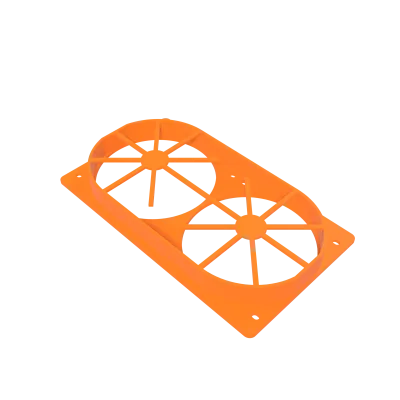
| Antminer S19 / S21 Dual 120 mm Intake Filter Ring | The twin-fan intake panel on the Antminer S19 series and standard S21: both fans, one stadium rim of 240.8 × 127.8 mm, one media pad. |
The dual ring exists because of a geometry problem two round rings cannot solve. A single 120 mm ring is about 127.8 mm across its rim, and the two intake fans on these machines sit at a 120.0 mm pitch — so two circular rims would have to overlap by 7.8 mm to fit side by side. The stadium rim closes that span in one frame, holds one pad flat across both apertures, and leaves no bypass gap at the edge. Two separate 120 mm positions with room between them still take one ring each.
Filter the intake, never the exhaust. Media on the hot side catches nothing worth catching and adds resistance where you least want it; if the goal at the exhaust end is to move heat somewhere useful, that is a shroud and a duct.
Blank-off caps: sealing a machine that is out of service
The Threaded Collar Cap for Dual 120 mm to 6" Shroud screws onto the coarse thread of the Antminer S19 / S21 Threaded-Collar Shroud and closes the 6-inch port when the duct comes off. An uncapped shroud on an idle machine is a leak in the building: cold outside air walks back down the duct all winter, and dust drifts in through an opening pointed straight at hashboards you just cleaned. On a shared trunk it is worse than a leak — an open collar on a stopped miner is the lowest-resistance path in the whole run, so the machines that are actually working push part of their air backwards through it instead of out of the building.
Everyone improvises this first with a bag and an elastic, a square of taped card, or a rag in the opening. A bag gets pulled loose, tape lets go in the heat around a rack, and a rag is the one thing you never want near a fan inlet on a machine somebody else might switch on. The cap engages the same collar geometry the duct uses, seats on a surface drawn to seal, and lives in a toolbox for years without deforming. It sits in a 167 × 167 × 17 mm footprint and it is a companion part to the threaded collar specifically — the plain, venturi, offset, clamp-groove and bayonet collars all terminate differently.
Choosing between them
- Buy a fan adapter when the fan you want is not the size your chassis was drilled for, or when you are standardising a mixed fleet onto one shroud and filter size.
- Buy a filter ring if the machine lives in a garage, workshop, barn, basement or anywhere with pets, carpet or drywall dust. It is the cheapest part in this line and the one with the longest payback.
- Buy the dual ring rather than two singles for an S19-series or standard S21 intake panel — two round rings physically will not sit side by side at a 120.0 mm pitch.
- Buy the threaded cap alongside a threaded-collar shroud, particularly if the machine shares a trunk with others or gets shut down seasonally.
Made to order, and the designs are free
Every accessory here is printed for your order in PETG and shipped worldwide from Montreal, Quebec, in black or in D-Central orange. They are drawn to the same fan patterns and the same collar standard as the rest of the line, so an adapter plate, a filter ring and a shroud bought at different times still stack on the same machine and still match. And a filter frame is exactly the sort of part that should not be anyone's trade secret: all of these designs are D-Central's own drawings, released under CC BY-SA 4.0 at the 3D models download center, free to download, modify, print and sell. If you own a printer and an afternoon, you should not have to buy this from anybody. If you would rather have it turn up ready to bolt on, that is what these listings are, and D-Central's fund page backs the open work directly.
Frequently asked questions
Which way round does a fan adapter go?
It is named mount first, fan second. The 120 mm to 140 mm Fan Adapter bolts to a 120 mm fan position and takes a 140 mm fan on the outer face. The 140 mm to 120 mm Fan Adapter does the reverse. Order by the holes already in your chassis, not by the fan in your hand.
Will the miner accept a different fan size on its header?
Antminer-class control boards read a tachometer signal and drive the fan over the same connector, so a fan that reports its speed normally is seen normally. What trips a fan-speed fault is running any fan below the controller's minimum expected RPM, whatever its size. Set your floor above that and the swap is invisible to the machine.
Is filter media included?
No, and that is deliberate. The ring is the frame; you cut flat media to the aperture with scissors. Standard furnace filter sheet is the usual choice, coarse open-cell foam is the other and it washes rather than being thrown away. In a dirty room, coarse media changed often beats fine media forgotten.
My Antminer has two intake fans. Do I buy two rings?
Not on an S19-series or standard S21 intake panel. The fans sit at a 120.0 mm pitch and a single 120 mm ring is about 127.8 mm across its rim, so two of them cannot fit side by side. The dual 120 mm ring spans both on one frame with one pad. Two separate fan positions with space between them do take one ring each.
Intake side or exhaust side?
Intake, always. Filtering an exhaust catches nothing worth catching and adds resistance to the hot side of the machine. The exhaust end wants a shroud and a duct so the heat leaves on a route you chose — on an S19 or standard S21 that is the dual 120 mm to 6" duct shroud. Filter in front, duct behind — that is the whole airflow plan for a home machine.
Does the threaded cap fit any 6-inch shroud collar?
No. It is cut to the coarse thread on D-Central's threaded-collar shrouds and is a companion part to those specifically, not a generic 6-inch plug. If your machine wears a bayonet or clamp-groove collar, keep it ducted or blank the run at the duct end instead.
Shop Shroud Accessories from D-Central. 6 products available with checkout-confirmed shipping, support, and product terms.
Browse shroud accessories with sorting and key product specs surfaced first.
-
Adapters and Shrouds
Antminer S19 / S21 Dual 120 mm Intake Filter Ring
- Fits:Antminer S19 series +2
$24.99 CAD -
Adapters and Shrouds
Threaded Collar Cap for Dual 120 mm to 6″ Shroud
- Type:Airflow
- Condition:New
$14.99 CAD -

Built to order
View details for 140 mm Intake Filter RingAdapters and Shrouds140 mm Intake Filter Ring
- Fits:Any standard 140 mm fan face +2
- Condition:New
$16.99 CAD -

Built to order
View details for 120 mm Intake Filter RingAdapters and Shrouds120 mm Intake Filter Ring
- Fits:Any standard 120 mm fan face +2
- Condition:New
$16.99 CAD -

Built to order
View details for 140 mm to 120 mm Fan AdapterAdapters and Shrouds140 mm to 120 mm Fan Adapter
- Fits:140 mm fan mount +1
- Type:Fan
- Condition:New
$19.99 CAD -

Built to order
View details for 120 mm to 140 mm Fan AdapterAdapters and Shrouds120 mm to 140 mm Fan Adapter
- Fits:120 mm fan mount +1
- Type:Fan
- Condition:New
$19.99 CAD

Shroud accessories: the small parts that change what a fan face can do
Shroud accessories are the fan-face and collar parts that sit alongside the ducting itself: fan adapters that let a 140 mm fan bolt to a 120 mm mount or the reverse, intake filter rings that keep room dust out of a hashboard stack, and a threaded blank-off cap that seals an idle machine’s collar. D-Central makes six of them, all printed to order in PETG in Montreal, Quebec, in black or D-Central orange, and all drawn to the same standard fan patterns the rest of the line uses — the 105 mm screw square on a 120 mm fan, the 124.5 mm square on a 140 mm one.
None of these are upsells bolted onto a shroud order. Each one solves a problem that shows up after the duct is in: the fan you want is not the size the chassis was drilled for, the room is dirtier than the machine expected, or a miner comes out of service and leaves an open hole in your duct run.
Fan adapters: putting the fan you want on the mount you have
An ASIC chassis is drilled for one fan size and one only. A fan adapter bridges that, with a shaped transition wall between the two apertures instead of a flat plate with a hole cut in it. Direction is the one thing people get wrong at checkout, so it is worth stating twice: the adapter is named for the mount first and the fan second.
| 120 mm to 140 mm Fan Adapter | Your machine has 120 mm holes. The fan you are adding is the bigger one. Chassis side carries the 120 mm bolt square, outer face carries the 140 mm square. Fits Antminer S9-class and S19-class chassis, single-fan cases, workshop rigs and ducted home builds. |
|---|---|
| 140 mm to 120 mm Fan Adapter | Your machine has 140 mm holes. The fan you are bolting on is the smaller one. Chassis side carries the 140 mm square, outer face the 120 mm. Fits Whatsminer-class hardware, Antminer S21 Pro 140 mm faces, large-fan enclosures and custom ducted builds. |
Both bodies sit inside a 140 × 140 × 28 mm footprint, so the depth to plan for is 28 mm plus the thickness of the fan you are stacking on top of it. They are mirror images of each other and are not interchangeable — pick the one that matches the holes already in your chassis.
Why anyone goes up to 140 mm
Noise, and it is the most effective acoustic change available to a home miner who is not willing to build a sealed enclosure. A 140 mm rotor sweeps a wider disc than a 120 mm one, so it can move the same volume of air while turning slower, and fan noise climbs steeply with tip speed. Fit the larger fan, bring the curve down, and watch chip temperatures for a day before you settle. It is also how a mixed fleet gets standardised: put an adapter on each 120 mm machine, fit a 140 mm body such as the Universal Dual 140 mm to 6″ Duct Shroud on top of it, and every shroud and filter ring you buy afterwards can be a 140 mm part — one size of spare on the shelf instead of two.
Why anyone goes down to 120 mm
Logistics, mostly. The 120 mm fan market is enormous — every speed, every bearing type, on a shelf somewhere near you. The 140 mm market is a fraction of it. When a 140 mm fan dies on a Friday and the replacement is three weeks out, this adapter and a 120 mm fan from the local supplier have the machine hashing again by Saturday. The second reason is specification: some of the strongest industrial fans built for restricted paths are made only in 120 mm, and a hashboard stack is exactly the kind of restricted path they exist for.
Why the transition is shaped, not flat
A flat plate with a 120 mm hole and a 140 mm bolt square is easy to make and it wastes the fan you just bought. The outer third of a 140 mm rotor is where most of the air is being moved, and a flat plate throws that outer air straight at a step face where it separates, swirls and turns into noise instead of flow. These bodies carry a continuous curved wall between the two apertures, so the column is turned rather than stopped. Each is one continuous piece of PETG: no bonded joint to creep in the warm air at a running miner’s fan face, and no bolted seam to buzz at blade-pass frequency.
Intake filter rings: move the dust job outside the machine
Dust is the failure mode nobody watches for, because it never announces itself. A film of it on the fins is an insulating blanket; chips run hotter for the same fan speed, the machine quietly starts throttling, and nothing on the dashboard says why. By the time it is obvious, cleaning means opening the case and blowing the boards out. A filter ring turns that job inside out: the dirt collects on a frame you can see and reach in ten seconds, and the inside of the machine stays as clean as the day you racked it.
These are frames, not cartridges. You cut flat media to the aperture — furnace filter sheet, coarse open-cell foam, whatever the room actually calls for — and pull it, shake it and refit it while the machine keeps hashing. Media is not supplied and nothing about the consumable is proprietary, because the right media for a woodshop is not the right media for a finished basement.
| 120 mm Intake Filter Ring | Any standard 120 mm fan face on the 105 mm screw square — Antminer S9-class, S17-class and S19-class positions, single-fan enclosures, generic case fans. 140 × 132 × 24 mm. |
|---|---|
| 140 mm Intake Filter Ring | Any standard 140 mm fan face — Whatsminer M-series intakes, the M30S, M50 and M60 generations among them, Antminer S21 Pro 140 mm faces, and custom enclosures on the bigger fan. |
| Antminer S19 / S21 Dual 120 mm Intake Filter Ring | The twin-fan intake panel on the Antminer S19 series and standard S21: both fans, one stadium rim of 240.8 × 127.8 mm, one media pad. |
The dual ring exists because of a geometry problem two round rings cannot solve. A single 120 mm ring is about 127.8 mm across its rim, and the two intake fans on these machines sit at a 120.0 mm pitch — so two circular rims would have to overlap by 7.8 mm to fit side by side. The stadium rim closes that span in one frame, holds one pad flat across both apertures, and leaves no bypass gap at the edge. Two separate 120 mm positions with room between them still take one ring each.
Filter the intake, never the exhaust. Media on the hot side catches nothing worth catching and adds resistance where you least want it; if the goal at the exhaust end is to move heat somewhere useful, that is a shroud and a duct.
Blank-off caps: sealing a machine that is out of service
The Threaded Collar Cap for Dual 120 mm to 6″ Shroud screws onto the coarse thread of the Antminer S19 / S21 Threaded-Collar Shroud and closes the 6-inch port when the duct comes off. An uncapped shroud on an idle machine is a leak in the building: cold outside air walks back down the duct all winter, and dust drifts in through an opening pointed straight at hashboards you just cleaned. On a shared trunk it is worse than a leak — an open collar on a stopped miner is the lowest-resistance path in the whole run, so the machines that are actually working push part of their air backwards through it instead of out of the building.
Everyone improvises this first with a bag and an elastic, a square of taped card, or a rag in the opening. A bag gets pulled loose, tape lets go in the heat around a rack, and a rag is the one thing you never want near a fan inlet on a machine somebody else might switch on. The cap engages the same collar geometry the duct uses, seats on a surface drawn to seal, and lives in a toolbox for years without deforming. It sits in a 167 × 167 × 17 mm footprint and it is a companion part to the threaded collar specifically — the plain, venturi, offset, clamp-groove and bayonet collars all terminate differently.
Choosing between them
- Buy a fan adapter when the fan you want is not the size your chassis was drilled for, or when you are standardising a mixed fleet onto one shroud and filter size.
- Buy a filter ring if the machine lives in a garage, workshop, barn, basement or anywhere with pets, carpet or drywall dust. It is the cheapest part in this line and the one with the longest payback.
- Buy the dual ring rather than two singles for an S19-series or standard S21 intake panel — two round rings physically will not sit side by side at a 120.0 mm pitch.
- Buy the threaded cap alongside a threaded-collar shroud, particularly if the machine shares a trunk with others or gets shut down seasonally.
Made to order, and the designs are free
Every accessory here is printed for your order in PETG and shipped worldwide from Montreal, Quebec, in black or in D-Central orange. They are drawn to the same fan patterns and the same collar standard as the rest of the line, so an adapter plate, a filter ring and a shroud bought at different times still stack on the same machine and still match. And a filter frame is exactly the sort of part that should not be anyone’s trade secret: all of these designs are D-Central’s own drawings, released under CC BY-SA 4.0 at the 3D models download center, free to download, modify, print and sell. If you own a printer and an afternoon, you should not have to buy this from anybody. If you would rather have it turn up ready to bolt on, that is what these listings are, and D-Central’s fund page backs the open work directly.
Frequently asked questions
Which way round does a fan adapter go?
It is named mount first, fan second. The 120 mm to 140 mm Fan Adapter bolts to a 120 mm fan position and takes a 140 mm fan on the outer face. The 140 mm to 120 mm Fan Adapter does the reverse. Order by the holes already in your chassis, not by the fan in your hand.
Will the miner accept a different fan size on its header?
Antminer-class control boards read a tachometer signal and drive the fan over the same connector, so a fan that reports its speed normally is seen normally. What trips a fan-speed fault is running any fan below the controller’s minimum expected RPM, whatever its size. Set your floor above that and the swap is invisible to the machine.
Is filter media included?
No, and that is deliberate. The ring is the frame; you cut flat media to the aperture with scissors. Standard furnace filter sheet is the usual choice, coarse open-cell foam is the other and it washes rather than being thrown away. In a dirty room, coarse media changed often beats fine media forgotten.
My Antminer has two intake fans. Do I buy two rings?
Not on an S19-series or standard S21 intake panel. The fans sit at a 120.0 mm pitch and a single 120 mm ring is about 127.8 mm across its rim, so two of them cannot fit side by side. The dual 120 mm ring spans both on one frame with one pad. Two separate fan positions with space between them do take one ring each.
Intake side or exhaust side?
Intake, always. Filtering an exhaust catches nothing worth catching and adds resistance to the hot side of the machine. The exhaust end wants a shroud and a duct so the heat leaves on a route you chose — on an S19 or standard S21 that is the dual 120 mm to 6″ duct shroud. Filter in front, duct behind — that is the whole airflow plan for a home machine.
Does the threaded cap fit any 6-inch shroud collar?
No. It is cut to the coarse thread on D-Central’s threaded-collar shrouds and is a companion part to those specifically, not a generic 6-inch plug. If your machine wears a bayonet or clamp-groove collar, keep it ducted or blank the run at the duct end instead.
Related products, repair, and setup paths
- how D-Central diagnoses ASIC repairs
- ASIC troubleshooting library
- ASIC manuals and repair guides
- replacement hashboards
- ASIC control boards
- ASIC power supplies
- compare specs in the ASIC miner database
- compare ASIC miner specs
- ASIC miner database
- ASIC repair services
- Antminer S19 specs and profitability
- buy a tested Antminer S19
- Antminer S19 maintenance guide
- Antminer S19 repair service
- Antminer S21 specs
- Bitmain Antminer S21
- Antminer S21 maintenance guide
- BM1370BC S21 Pro chip
- Antminer S9 specs
- Bitmain Antminer S9
- Antminer S9 maintenance guide
- S9 hashboard repair parts bundle
- Whatsminer M30S specs
- Whatsminer repair guide
- MicroBT Whatsminer M30S++
- Whatsminer M3x exhaust shroud
Last reviewed August 19, 2026.