
Shop ASIC Shrouds for Bitcoin Mining
ASIC miner shrouds: a sealed hood from the fan face to a duct collar
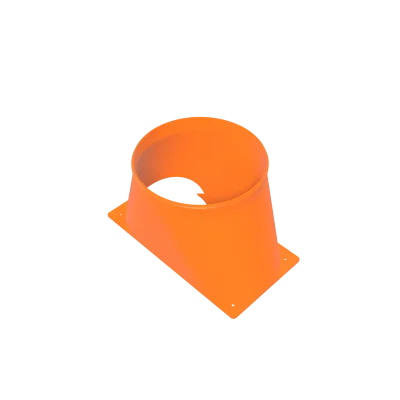
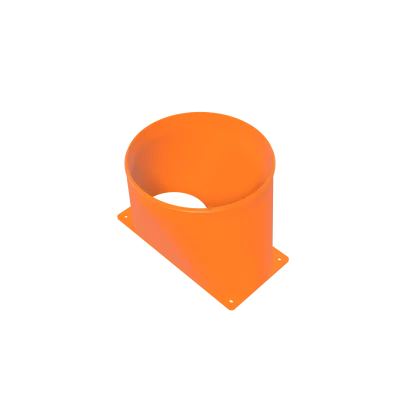
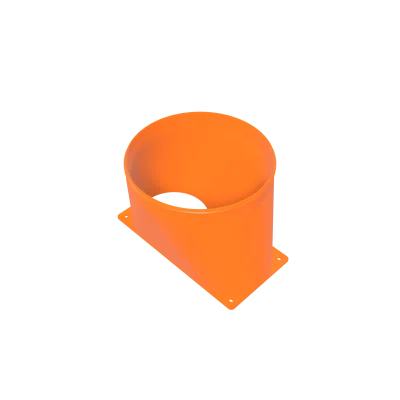
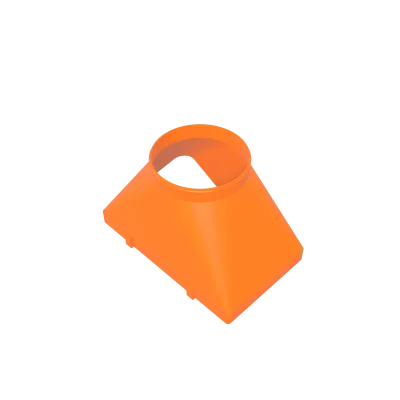
An ASIC miner shroud is a one-piece hood that seals over a miner's exhaust fan face and hands everything those fans move to a round duct collar, so the heat leaves the room down a duct instead of pooling behind the rack. This category holds D-Central's 45 shroud bodies — single 120 mm, dual 120 mm, single and dual 140 mm, stacked-fan Avalon faces, full-chassis wraps and metric-collar variants — every one of them drawn in-house around a specific exhaust geometry and produced as a single continuous PETG body with no seams, no fasteners and nothing to assemble on the bench.
Buying the right one is three decisions, and they are all answerable in about a minute with a tape measure and the back of your machine. What fan face does the miner present? What duct size does the run want? What do you want the collar to do when the duct has to come off?
Decision one: what fan face is on the machine
Fitment in this line is keyed to the fan, not the badge on the front, because manufacturers change a chassis far more often than they change a fan size. Put a tape across one exhaust fan flange. A 120 mm frame carries its four screws on a 105 mm square. A 140 mm frame carries them on a 124.5 mm square. That single measurement decides half the catalogue.
| Antminer S9, S9i, S9j, S9k, S9 SE | One 120 mm exhaust fan — Antminer S9 Single 120 mm to 6" Duct Shroud for the chassis-end body, or the Universal Single 120 mm Fan to 6" Duct Shroud for a bare fan face |
|---|---|
| Antminer S17, S17 Pro, S17+, T17, T17+ | Two 120 mm exhaust fans on the S17-series chassis end — Antminer S17 Full-Wrap Dual 120 mm to 6" Shroud |
| Antminer S19, S19 Pro, S19j, S19j Pro, S19k Pro, S19 XP | Two 120 mm fans on a 120.0 mm pitch — Antminer S19 / S21 Dual 120 mm to 6" Duct Shroud, or the S19 full-wrap body |
| Antminer S21 and T21, standard chassis | Same dual 120 mm face as the S19 series — the whole dual-120 family fits, including the wide-base 260 mm plate version |
| Antminer S21 Pro | Two 140 mm fans — Antminer S21 Pro Dual 140 mm to 6" Duct Shroud |
| Whatsminer M30S, M50, M50S, M60, M60S | The MicroBT 140 mm fan flange, shared across M-series generations — Whatsminer 140 mm Fan to 6" Duct Shroud |
| Canaan Avalon A13xx, A14xx, 15XP | Two vertically stacked 120 mm fans on a 122.0 mm pitch — Avalon A15 Vertical Dual 120 mm to 6-Inch Duct Shroud |
| Rebuilds, benches, fan-swapped machines | Fan-referenced universal bodies keyed to the flange rather than a chassis — the single 120 mm shrouds in 6-inch and 8-inch, and the Universal Dual 140 mm bodies |
Two millimetres decides the Avalon. Canaan stacks its pair on a 122.0 mm vertical pitch where every dual-120 Antminer body sits on 120.0 mm, and a millimetre per side is more than a mounting slot absorbs — which is why the Avalon bodies are drawn separately, to that face, with a 116.0 mm bore per fan and a 2.0 mm sealing land around each.
One family is excluded on principle: hydro, immersion and water-cooled chassis. Bitmain abbreviates them Hyd and Hydro, they have no fan face at all, and no shroud in this category or any other will mount to one.
Decision two: 6-inch or 8-inch, and what to do about metric duct
Six inch is 152.4 mm nominal. Eight inch is 203.2 mm. Because open area goes with the square of the bore, an 8-inch collar carries roughly 1.8 times the cross-section of a 6-inch one, and that extra area is headroom the duct run spends on length, bends and anything else standing between the fan and the outside air.
- Take 6-inch when one machine runs a short, reasonably direct route: through a nearby wall, out an adjacent window, into the next room. It is the size every hardware store stocks in flexible hose, dryer-vent hardware and window kits, and the size common inline fans are built around.
- Take 8-inch when the run climbs, turns more than once, joins a shared trunk, or has an inline booster on it. Oversizing costs you shelf space. Undersizing costs airflow you already paid for at the wall socket.
- Take a metric collar if you buy ventilation in millimetres. 150 mm is not 6-inch — the 2.4 mm gap is exactly what turns a clamped joint into a taped one. The dual 120 mm to 150 mm metric shroud and its 160 mm and 200 mm siblings are cut for the hose you already own, with the crest at duct nominal and the clamp land 2.0 mm behind it.
The 120 mm versus 140 mm question answers itself at the machine, but it is worth knowing why it matters. A 140 mm rotor sweeps a wider disc than a 120 mm one, and the extra area sits at the outside of the blade where tip speed is highest. Push that fan through a body drawn for a 120 mm face and you block precisely the ring doing the most work; the air recirculates behind the plate and comes back at the fan instead of going down the duct.
Decision three: body style and collar style
Once the fan face and the duct size are settled, the remaining choices are about the room the machine lives in and how often you take the duct off.
Body styles
- Plain plenum — the workhorse. Both fan columns merge in a shaped volume, then the section rounds down to the collar. Two fans dropped straight into a round hole collide at the step and separate off its shoulder; a plenum gives them somewhere to become one stream first.
- Venturi — a contracting throat instead of a step, so accelerating air stays pressed to the wall through the transition. The Antminer S19 / S21 Venturi Shroud is the one to fit when the duct downstream is already working hard.
- Offset collar — the outlet moves off centre so the duct clears a wall, a shelf edge or a rack upright without an elbow in the first 200 mm.
- Full wrap — encloses the entire chassis exhaust end rather than the fan flanges alone, closing the corner and edge paths a fan-face body leaves open. The S19 wrap and the S17 wrap are the containment answer, at 296 mm and 304 mm across respectively.
- Wide base — a 260 mm mounting plate against the standard 250 mm, putting material outboard of the fan screws so a hanging duct loads the chassis face rather than levering on four slots.
Collar styles
- Plain flex-over collar — retention bead crest at 152.4 mm, clamp land at 150.4 mm behind it. Flex slides on, a worm clamp closes on the land, the bead is the mechanical stop.
- Clamp groove — a circumferential seat so the band cannot walk along the barrel.
- Bayonet — quarter-turn twist-lock, for a machine that comes out of the run often.
- Threaded — a coarse printed thread that takes either a duct receiver or a blank-off cap, so an idle machine seals instead of bleeding flow out of a shared trunk.
- Polished — every interface identical to the plain wide-base body, with the visible faces worked to an even sheen for a machine that sits where people can see it.
How a shroud goes on
- Shut the machine down and clear the space behind the exhaust face.
- Seat the body over the fan face so every fan mouth opens into the plenum, and refit on the stock fan screws. The flange slots are 6.40 × 5.00 mm; reuse the miner's own large-head fan screws, or put a 9 mm or larger flat washer under an M4 head.
- Slide duct over the collar past the retention bead and land a worm clamp on the sealing band behind it.
- Route the run out and carry its weight at the wall or the first bend, never on the collar.
Nothing on the miner changes. No hole is drilled, no connector is unplugged, no firmware is touched, the stock fans stay fitted, and the body lifts off in one movement. On the dual-120 bodies the shell is cut back around the screw heads so a driver reaches all eight with the duct still attached — the difference between a fan swap taking five minutes and taking an afternoon.
Why these are made to order in Montreal, Quebec
Every shroud here is printed for the order it belongs to, in PETG — black or D-Central orange — and shipped worldwide from Canada. That is how one shop keeps this many bodies and collar sizes alive at a single tolerance standard instead of warehousing a guess at which variant sells. It is also why the geometry keeps improving: a wide-base plate, a venturi throat or a metric crest can enter the line the week it is drawn rather than waiting out a container of the old shape.
PETG is the material for every body in this catalogue, offered in black and in D-Central orange. A shroud is nothing but dimensions, and the way this line protects them is geometry rather than assembly: one continuous body per part, no bonded joint, no fastener, no gasket. The collar, the mounting plate and the transition between them are the same piece of plastic. And every design in this line is D-Central's own drawing, released open source under CC BY-SA 4.0 at the 3D models download center — free to download, modify, print and sell. What this category sells is the finished part; the geometry was never the price of admission. D-Central's fund page backs the open work directly.
Frequently asked questions
How do I know if my miner has 120 mm or 140 mm fans?
Put a tape across one exhaust fan frame. A 120 mm fan is 120 mm square with its screws on a 105 mm square; a 140 mm fan is 140 mm square with its screws on 124.5 mm. As a shortcut: the Antminer S9, S17 and S19 families and the standard S21 run 120 mm fans, the Antminer S21 Pro and the Whatsminer M-series run 140 mm.
6-inch or 8-inch for a single machine?
Six inch carries one machine on a short, direct route to a window or an outside wall. Move up to 8-inch when the duct climbs, turns twice, joins a shared trunk or runs into an inline booster, because an 8-inch bore carries roughly 1.8 times the open area. If the building is already ducted in 6-inch, take the 8-inch shroud anyway and step down late with a reducer.
Does fitting a shroud void my Bitmain or MicroBT warranty?
Nothing on the miner is modified: no drilling, no soldering, no wiring, no firmware, stock fans and stock screws retained, and the shroud lifts off in one movement. A duct shroud is a mechanical part sitting outside the chassis. If you run under a service agreement, read its terms; the machine itself goes back to standard in a couple of minutes.
Will a shroud fit a hydro or immersion miner?
No. Hydro, Hyd and immersion machines move their heat into liquid and have no exhaust fan face to seat a body on, so nothing in this category mounts to one. Shrouds are for air-cooled chassis. If you are cooling with liquid, the heat leaves through the loop rather than through a duct.
My duct is 150 mm, not 6-inch. Is that close enough?
It is 2.4 mm apart, and that gap is where clamped joints turn into taped ones. Rather than shim it, take the metric collar cut for the hose you own: the dual 120 mm to 150 mm shroud for an S19 or standard S21, the Whatsminer body also comes in 150, 160 and 200 mm, and the Avalon face has a 200 mm version for the ducting supplied in the Avalon kit.
What is the difference between a fan-face shroud and a full wrap?
A fan-face body captures what leaves the two fans. A wrap reaches past them and encloses the whole chassis end, closing the corner and edge paths that hot air otherwise takes because nothing is attached to them. The wrap is the more complete capture and the larger object — 296 mm across on the S19, 304 mm on the S17 — so shelf clearance often decides it.
Shop ASIC Shrouds from D-Central. 41 products available with checkout-confirmed shipping, support, and product terms.
Browse asic shrouds with sorting and key product specs surfaced first.
-

Built to order
View details for Whatsminer 140 mm Fan to 6" Duct Shroud -
Adapters and Shrouds
Antminer S19 / S21 Dual 120 mm to 8-Inch Shroud — Wide Base
- Fits:Antminer S19 series +2
- Type:Airflow
$41.99 CAD -
Adapters and Shrouds
Antminer S19 / S21 Dual 120 mm to 6-Inch Threaded Shroud — Wide Base
- Fits:Antminer S19 series +2
- Type:Airflow
$38.99 CAD -
 Adapters and Shrouds
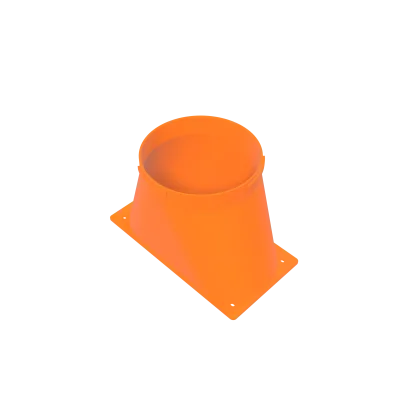
Antminer S19 / S21 Dual 120 mm to 6-Inch Bayonet Quick-Release Shroud — Wide Base
- Fits:Antminer S19 series +2
- Type:Airflow
$38.99 CAD -
 Adapters and Shrouds
Antminer S19 / S21 Dual 120 mm to 6-Inch Clamp-Groove Shroud — Wide Base
- Fits:Antminer S19 series +2
- Type:Airflow
$38.99 CAD -
Adapters and Shrouds
Antminer S19 / S21 Dual 120 mm to 6-Inch Offset Shroud — Wide Base
- Fits:Antminer S19 series +2
- Type:Airflow
$35.99 CAD -
Adapters and Shrouds
Antminer S19 / S21 Dual 120 mm to 6-Inch Venturi Shroud — Wide Base
- Fits:Antminer S19 series +2
- Type:Airflow
$41.99 CAD -
Adapters and Shrouds
Antminer S19 / S21 Dual 120 mm to 6-Inch Shroud — Wide Base
- Fits:Antminer S19 series +2
- Type:Airflow
$35.99 CAD -
Adapters and Shrouds
Antminer S21 Pro Dual 140 mm to 200 mm Metric Duct Shroud
- Fits:Antminer S21 Pro +2
- Type:Airflow
$63.99 CAD -
Adapters and Shrouds
Antminer S19 / S21 Dual 120 mm to 200 mm Metric Duct Shroud
- Type:Airflow
$41.99 CAD -
 Adapters and Shrouds
Antminer S19 / S21 Dual 120 mm to 160 mm Metric Duct Shroud (Wide Base)
- Type:Airflow
$35.99 CAD -
Adapters and Shrouds
Antminer S19 / S21 Dual 120 mm to 160 mm Metric Duct Shroud
- Type:Airflow
$35.99 CAD -
Adapters and Shrouds
Antminer S19 / S21 Dual 120 mm to 150 mm Metric Duct Shroud
- Type:Airflow
$35.99 CAD -
Adapters and Shrouds
Avalon A15 Vertical Dual 120 mm to 200 mm Metric Duct Shroud
- Fits:Canaan Avalon A15 +1
- Type:Airflow
$41.99 CAD -
Adapters and Shrouds
Avalon A15 Vertical Dual 120 mm to 8-Inch Duct Shroud
- Fits:Canaan Avalon A15 +1
- Type:Airflow
- Condition:New
$41.99 CAD -
Adapters and Shrouds
Avalon A15 Vertical Dual 120 mm to 6-Inch Duct Shroud
- Fits:Canaan Avalon A15 +1
- Type:Airflow
- Condition:New
$35.99 CAD -
Adapters and Shrouds
Antminer S17 Full-Wrap Dual 120 mm to 8″ Shroud
- Fits:Antminer S17 +2
- Type:Airflow
- Condition:New
$60.99 CAD -
Adapters and Shrouds
Antminer S17 Full-Wrap Dual 120 mm to 6″ Shroud
- Fits:Antminer S17 +2
- Type:Airflow
- Condition:New
$57.99 CAD
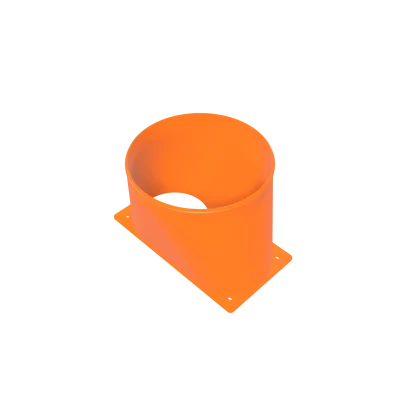
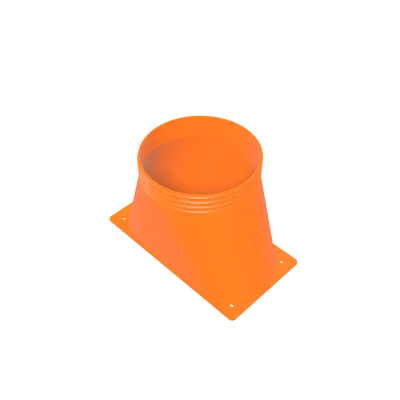






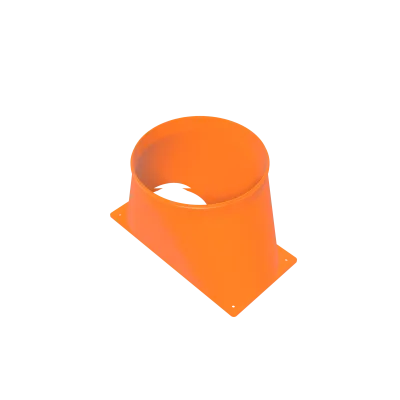







ASIC miner shrouds: a sealed hood from the fan face to a duct collar
An ASIC miner shroud is a one-piece hood that seals over a miner’s exhaust fan face and hands everything those fans move to a round duct collar, so the heat leaves the room down a duct instead of pooling behind the rack. This category holds D-Central’s 45 shroud bodies — single 120 mm, dual 120 mm, single and dual 140 mm, stacked-fan Avalon faces, full-chassis wraps and metric-collar variants — every one of them drawn in-house around a specific exhaust geometry and produced as a single continuous PETG body with no seams, no fasteners and nothing to assemble on the bench.
Buying the right one is three decisions, and they are all answerable in about a minute with a tape measure and the back of your machine. What fan face does the miner present? What duct size does the run want? What do you want the collar to do when the duct has to come off?
Decision one: what fan face is on the machine
Fitment in this line is keyed to the fan, not the badge on the front, because manufacturers change a chassis far more often than they change a fan size. Put a tape across one exhaust fan flange. A 120 mm frame carries its four screws on a 105 mm square. A 140 mm frame carries them on a 124.5 mm square. That single measurement decides half the catalogue.
| Antminer S9, S9i, S9j, S9k, S9 SE | One 120 mm exhaust fan — Antminer S9 Single 120 mm to 6″ Duct Shroud for the chassis-end body, or the Universal Single 120 mm Fan to 6″ Duct Shroud for a bare fan face |
|---|---|
| Antminer S17, S17 Pro, S17+, T17, T17+ | Two 120 mm exhaust fans on the S17-series chassis end — Antminer S17 Full-Wrap Dual 120 mm to 6″ Shroud |
| Antminer S19, S19 Pro, S19j, S19j Pro, S19k Pro, S19 XP | Two 120 mm fans on a 120.0 mm pitch — Antminer S19 / S21 Dual 120 mm to 6″ Duct Shroud, or the S19 full-wrap body |
| Antminer S21 and T21, standard chassis | Same dual 120 mm face as the S19 series — the whole dual-120 family fits, including the wide-base 260 mm plate version |
| Antminer S21 Pro | Two 140 mm fans — Antminer S21 Pro Dual 140 mm to 6″ Duct Shroud |
| Whatsminer M30S, M50, M50S, M60, M60S | The MicroBT 140 mm fan flange, shared across M-series generations — Whatsminer 140 mm Fan to 6″ Duct Shroud |
| Canaan Avalon A13xx, A14xx, 15XP | Two vertically stacked 120 mm fans on a 122.0 mm pitch — Avalon A15 Vertical Dual 120 mm to 6-Inch Duct Shroud |
| Rebuilds, benches, fan-swapped machines | Fan-referenced universal bodies keyed to the flange rather than a chassis — the single 120 mm shrouds in 6-inch and 8-inch, and the Universal Dual 140 mm bodies |
Two millimetres decides the Avalon. Canaan stacks its pair on a 122.0 mm vertical pitch where every dual-120 Antminer body sits on 120.0 mm, and a millimetre per side is more than a mounting slot absorbs — which is why the Avalon bodies are drawn separately, to that face, with a 116.0 mm bore per fan and a 2.0 mm sealing land around each.
One family is excluded on principle: hydro, immersion and water-cooled chassis. Bitmain abbreviates them Hyd and Hydro, they have no fan face at all, and no shroud in this category or any other will mount to one.
Decision two: 6-inch or 8-inch, and what to do about metric duct
Six inch is 152.4 mm nominal. Eight inch is 203.2 mm. Because open area goes with the square of the bore, an 8-inch collar carries roughly 1.8 times the cross-section of a 6-inch one, and that extra area is headroom the duct run spends on length, bends and anything else standing between the fan and the outside air.
- Take 6-inch when one machine runs a short, reasonably direct route: through a nearby wall, out an adjacent window, into the next room. It is the size every hardware store stocks in flexible hose, dryer-vent hardware and window kits, and the size common inline fans are built around.
- Take 8-inch when the run climbs, turns more than once, joins a shared trunk, or has an inline booster on it. Oversizing costs you shelf space. Undersizing costs airflow you already paid for at the wall socket.
- Take a metric collar if you buy ventilation in millimetres. 150 mm is not 6-inch — the 2.4 mm gap is exactly what turns a clamped joint into a taped one. The dual 120 mm to 150 mm metric shroud and its 160 mm and 200 mm siblings are cut for the hose you already own, with the crest at duct nominal and the clamp land 2.0 mm behind it.
The 120 mm versus 140 mm question answers itself at the machine, but it is worth knowing why it matters. A 140 mm rotor sweeps a wider disc than a 120 mm one, and the extra area sits at the outside of the blade where tip speed is highest. Push that fan through a body drawn for a 120 mm face and you block precisely the ring doing the most work; the air recirculates behind the plate and comes back at the fan instead of going down the duct.
Decision three: body style and collar style
Once the fan face and the duct size are settled, the remaining choices are about the room the machine lives in and how often you take the duct off.
Body styles
- Plain plenum — the workhorse. Both fan columns merge in a shaped volume, then the section rounds down to the collar. Two fans dropped straight into a round hole collide at the step and separate off its shoulder; a plenum gives them somewhere to become one stream first.
- Venturi — a contracting throat instead of a step, so accelerating air stays pressed to the wall through the transition. The Antminer S19 / S21 Venturi Shroud is the one to fit when the duct downstream is already working hard.
- Offset collar — the outlet moves off centre so the duct clears a wall, a shelf edge or a rack upright without an elbow in the first 200 mm.
- Full wrap — encloses the entire chassis exhaust end rather than the fan flanges alone, closing the corner and edge paths a fan-face body leaves open. The S19 wrap and the S17 wrap are the containment answer, at 296 mm and 304 mm across respectively.
- Wide base — a 260 mm mounting plate against the standard 250 mm, putting material outboard of the fan screws so a hanging duct loads the chassis face rather than levering on four slots.
Collar styles
- Plain flex-over collar — retention bead crest at 152.4 mm, clamp land at 150.4 mm behind it. Flex slides on, a worm clamp closes on the land, the bead is the mechanical stop.
- Clamp groove — a circumferential seat so the band cannot walk along the barrel.
- Bayonet — quarter-turn twist-lock, for a machine that comes out of the run often.
- Threaded — a coarse printed thread that takes either a duct receiver or a blank-off cap, so an idle machine seals instead of bleeding flow out of a shared trunk.
- Polished — every interface identical to the plain wide-base body, with the visible faces worked to an even sheen for a machine that sits where people can see it.
How a shroud goes on
- Shut the machine down and clear the space behind the exhaust face.
- Seat the body over the fan face so every fan mouth opens into the plenum, and refit on the stock fan screws. The flange slots are 6.40 × 5.00 mm; reuse the miner’s own large-head fan screws, or put a 9 mm or larger flat washer under an M4 head.
- Slide duct over the collar past the retention bead and land a worm clamp on the sealing band behind it.
- Route the run out and carry its weight at the wall or the first bend, never on the collar.
Nothing on the miner changes. No hole is drilled, no connector is unplugged, no firmware is touched, the stock fans stay fitted, and the body lifts off in one movement. On the dual-120 bodies the shell is cut back around the screw heads so a driver reaches all eight with the duct still attached — the difference between a fan swap taking five minutes and taking an afternoon.
Why these are made to order in Montreal, Quebec
Every shroud here is printed for the order it belongs to, in PETG — black or D-Central orange — and shipped worldwide from Canada. That is how one shop keeps this many bodies and collar sizes alive at a single tolerance standard instead of warehousing a guess at which variant sells. It is also why the geometry keeps improving: a wide-base plate, a venturi throat or a metric crest can enter the line the week it is drawn rather than waiting out a container of the old shape.
PETG is the material for every body in this catalogue, offered in black and in D-Central orange. A shroud is nothing but dimensions, and the way this line protects them is geometry rather than assembly: one continuous body per part, no bonded joint, no fastener, no gasket. The collar, the mounting plate and the transition between them are the same piece of plastic. And every design in this line is D-Central’s own drawing, released open source under CC BY-SA 4.0 at the 3D models download center — free to download, modify, print and sell. What this category sells is the finished part; the geometry was never the price of admission. D-Central’s fund page backs the open work directly.
Frequently asked questions
How do I know if my miner has 120 mm or 140 mm fans?
Put a tape across one exhaust fan frame. A 120 mm fan is 120 mm square with its screws on a 105 mm square; a 140 mm fan is 140 mm square with its screws on 124.5 mm. As a shortcut: the Antminer S9, S17 and S19 families and the standard S21 run 120 mm fans, the Antminer S21 Pro and the Whatsminer M-series run 140 mm.
6-inch or 8-inch for a single machine?
Six inch carries one machine on a short, direct route to a window or an outside wall. Move up to 8-inch when the duct climbs, turns twice, joins a shared trunk or runs into an inline booster, because an 8-inch bore carries roughly 1.8 times the open area. If the building is already ducted in 6-inch, take the 8-inch shroud anyway and step down late with a reducer.
Does fitting a shroud void my Bitmain or MicroBT warranty?
Nothing on the miner is modified: no drilling, no soldering, no wiring, no firmware, stock fans and stock screws retained, and the shroud lifts off in one movement. A duct shroud is a mechanical part sitting outside the chassis. If you run under a service agreement, read its terms; the machine itself goes back to standard in a couple of minutes.
Will a shroud fit a hydro or immersion miner?
No. Hydro, Hyd and immersion machines move their heat into liquid and have no exhaust fan face to seat a body on, so nothing in this category mounts to one. Shrouds are for air-cooled chassis. If you are cooling with liquid, the heat leaves through the loop rather than through a duct.
My duct is 150 mm, not 6-inch. Is that close enough?
It is 2.4 mm apart, and that gap is where clamped joints turn into taped ones. Rather than shim it, take the metric collar cut for the hose you own: the dual 120 mm to 150 mm shroud for an S19 or standard S21, the Whatsminer body also comes in 150, 160 and 200 mm, and the Avalon face has a 200 mm version for the ducting supplied in the Avalon kit.
What is the difference between a fan-face shroud and a full wrap?
A fan-face body captures what leaves the two fans. A wrap reaches past them and encloses the whole chassis end, closing the corner and edge paths that hot air otherwise takes because nothing is attached to them. The wrap is the more complete capture and the larger object — 296 mm across on the S19, 304 mm on the S17 — so shelf clearance often decides it.
Related products, repair, and setup paths
- how D-Central diagnoses ASIC repairs
- ASIC troubleshooting library
- ASIC manuals and repair guides
- replacement hashboards
- ASIC control boards
- ASIC power supplies
- immersion cooling hub
- home immersion cooling guide
- ASIC miners for immersion planning
- ASIC cooling parts
- airflow shroud before immersion
- compare miner specs in the database
- ASIC repair support
- compare ASIC miner specs
- ASIC miner database
- Antminer S19 specs and profitability
- buy a tested Antminer S19
- Antminer S19 maintenance guide
- Antminer S19 repair service
- Antminer S21 specs
- Bitmain Antminer S21
- Antminer S21 maintenance guide
- BM1370BC S21 Pro chip
- Antminer S9 specs
- Bitmain Antminer S9
- Antminer S9 maintenance guide
- S9 hashboard repair parts bundle
- Whatsminer M30S specs
- Whatsminer repair guide
- MicroBT Whatsminer M30S++
- Whatsminer M3x exhaust shroud
- Avalon (Canaan) hashboard repair
- start a repair request
- ASIC repair parts
Last reviewed August 19, 2026.