
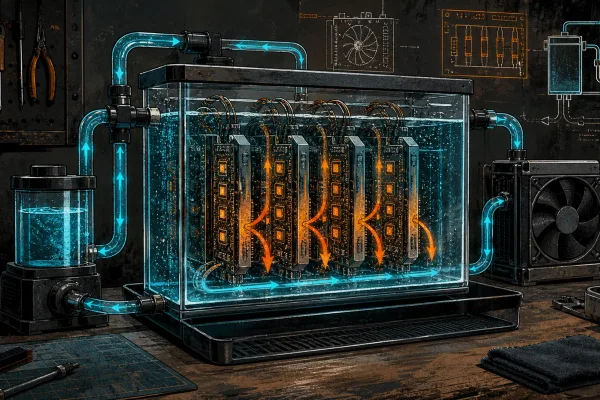
Immersion Cooling for Home Bitcoin Miners: Complete DIY Guide
Every ASIC miner ships with the same cooling strategy: move massive volumes of air across heatsinks using fans that sound like a jet turbine at close range. It works.
$49.99 CAD
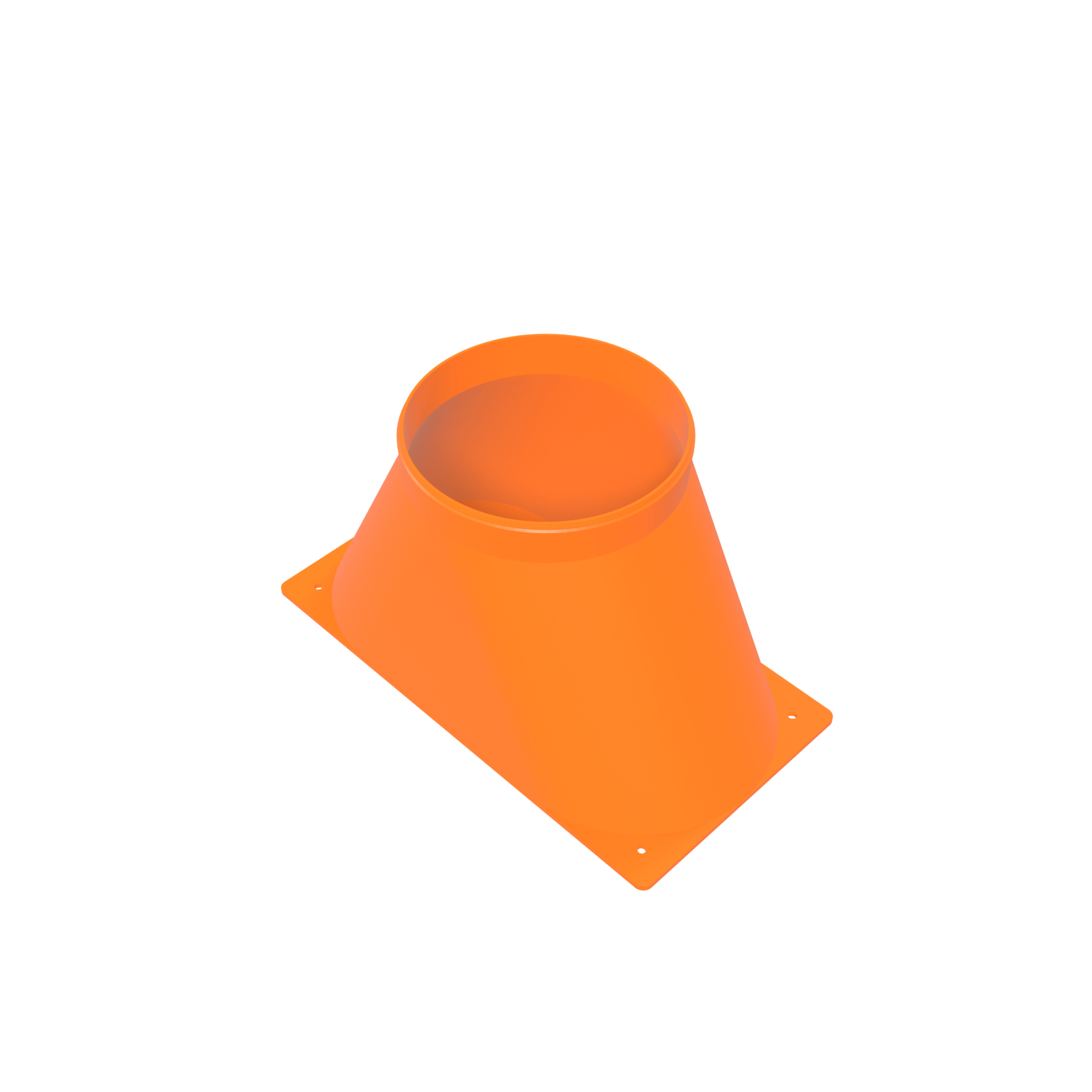
Dual 140 mm fan to 150 mm duct shroud for the newer 140 mm ASIC generation. Captures both fans on a 140.0 mm pitch and lands them on a true metric 150 mm collar. Single-piece PETG, made to order in Montreal, Quebec.
High Demand — Pre-order Now, Ships in 5-10 Business Days
Purchase details
Save 3% when you pay in Bitcoin.
A dual 140 mm fan to 150 mm duct shroud sits at the intersection of two things the market handles badly: the newer 140 mm fan generation of ASICs, and metric ducting. Miners moved to 140 mm fans to move the same air at lower fan speed, yet most shrouds on sale are still cut for 120 mm, and most of the world buys hose in millimetres and gets sold collars in inches.
It is fitment by geometry rather than by model badge: two 140 mm exhaust fans on a 140.0 mm pitch, 134.0 mm bore per fan with a 3.0 mm sealing land around each. Both fan columns merge inside one PETG body and converge into a 150 mm metric collar, the standard domestic extraction size across the metric world and the most widely stocked hose you can build a run out of.
Miners with two 140 mm exhaust fans on a 140.0 mm pitch, exhausting into 150 mm metric flex duct. Check the fan, not the name on the lid: 140 mm fans are what the newer high-power generation uses, and the pitch is what decides whether a flange lands square.
For a flange drawn to the S21 Pro chassis itself, that family runs from the S21 Pro dual 140 mm to 6-inch shroud up to the S21 Pro 200 mm metric shroud. A 120 mm fan machine needs the dual 120 mm to 150 mm shroud instead.
A 140 mm fan has substantially more blade area than a 120 mm one, which is why the newer machines use them: more area moves the same volume at lower rotational speed, and fan noise is dominated by tip speed. Bolt a 120 mm shroud over a 140 mm fan face and you mask the bore, adding a restriction right where the air leaves the blades. The bore here is 134.0 mm per fan with a 3.0 mm sealing land, so the fan discharges into open body rather than into a lip.
From there both columns merge before the transition to round. The collar is flex-over: crest at duct nominal, sealing land 2.0 mm under, at or below the male metric hardware a 150 mm hose expects, so a plain worm clamp does the whole job.
| Fits | Miners with two 140 mm exhaust fans at 140.0 mm pitch |
|---|---|
| Intake | Two 140 mm fans at 140.0 mm pitch; 134.0 mm bore per fan, 3.0 mm sealing land per side |
| Outlet | 150 mm metric flex duct, flex-over collar; crest 150.0 mm, sealing land 148.0 mm |
| Footprint (mm) | 300.0 × 160.0 × 175.0 |
| Mounting | 5.0 mm holes on 5.424 mm slots; 9 mm or larger washer |
| Material | PETG |
| Colour | Black or orange PETG |
| Construction | Single piece, no seams or glued joints |
| Design files | D-Central in-house design, open source under CC BY-SA 4.0 |
| Download | dual-140 to 150 mm shroud bundle (ZIP) — STL, CC BY-SA 4.0 licence, installation and safety guide |
| SKU | ADP-D140-150 |
| Fulfilment | Made to order in Montreal, Quebec |
Dual 140 mm and metric is the combination nobody stocks, so D-Central Technologies drew it and then published it. The design is ours — the 140.0 mm capture, the 134.0 mm bores, the 150.0 mm crest, all our own work — released under CC BY-SA 4.0 at the 3D models download center, free to download, modify, print and sell. Its card is at the dual 140 mm to 150 mm entry and the file is the dual-140 to 150 mm shroud bundle, holding the STL, the CC BY-SA 4.0 licence and the installation and safety guide. A part that does not exist commercially should at least exist as a file.
This listing is that file made real: produced to order in PETG in Montreal, Quebec, black or orange, shipped from Canada. It stays downloadable no matter what; a purchase, or support through the D-Central fund page, is what keeps sizes the market skipped getting drawn at all.
Full range: D-Central shroud and ducting system.
The newer high-power generation, the Antminer S21 Pro and S21+ class among them. Rather than work from model names, look at the fan: if the exhaust is two 140 mm fans sitting on a 140.0 mm pitch, this flange lands on it. For a flange drawn specifically to the S21 Pro chassis, see the S21 Pro shroud family.
No, and this is the single most common mix-up in ASIC ducting. A dual-120 shroud is cut for a 120.0 mm pitch with a 116.0 mm bore; a dual-140 face is a 140.0 mm pitch with a 134.0 mm bore. The screws do not line up and the bore would mask the blades even if they did. Buy by fan size first.
No. Six inches is 152.4 mm. The 2.4 mm difference is what makes 150 mm hose sit loose on an imperial collar and what puts tape into the joint. This collar is 150.0 mm at the crest with a 148.0 mm sealing land, so a metric hose goes on and a clamp holds it without help.
Buy what your hose and inline fan already are. Starting fresh, a dual-140 machine is usually a high-power one, so the extra area of the 160 mm version is the safer default on a long run. 150 mm wins on cost and on how easily you can buy another metre of hose locally.
| Weight | 446 g |
|---|---|
| Dimensions | 30 × 16 × 17.5 cm |
| Colour | Black, Orange |
Only logged in customers who have purchased this product may leave a review.
Every ASIC miner ships with the same cooling strategy: move massive volumes of air across heatsinks using fans that sound like a jet turbine at close range. It works.
In any mining setup, the crux of your success lies in the efficient functioning of your mining hardware. Acknowledging this critical tenet, we turn to a paramount facet of mining…
You have decided to mine Bitcoin. Maybe you want to contribute to network decentralization. Maybe you want to heat your home with a miner.
Last reviewed August 19, 2026.
Reviews
There are no reviews yet.