
Shop Ducting and Fittings for Bitcoin Mining
Ducting and fittings: everything between the shroud and the outside air
Duct fittings are the parts that carry a miner's captured exhaust from the shroud collar to wherever the heat is supposed to go — couplers, reducers, elbows, wyes, flex adapters, duct receivers and window ports. D-Central makes 23 of them in 4-inch, 6-inch and 8-inch, drawn to one collar standard so that every fitting mates the next one on the first try, and printed as single continuous PETG bodies with no seams inside the bore for the flow to trip over.
This is the half of the system people underestimate. A well-shaped shroud hands the duct an organised column of air, and then a taped butt joint, a sharp corner and a length of hose wedged under a sash spend everything it gained. The run is where a ducted miner is won or lost, and the fittings here are drawn on that basis: gradual where a shape changes, mechanical where a joint has to hold, and sealed where the building ends.
The collar standard, and why it matters that it is one standard
Every 6-inch part in this line speaks the same geometry: a flex-over collar with the retention bead crest at 152.4 mm, the clamp land at 150.4 mm behind it, and a through-bore of 145.6 mm that stays open rather than necking down at the joint. Flex slides over the bead, a worm clamp closes on the land, and the bead is the mechanical stop that keeps the clamp from walking off the end. The 8-inch parts do the same at 203.2 mm nominal.
The consequence is that you can plan a run rather than assemble one by trial. A shroud, a long-radius elbow, a coupler and a window port from this catalogue fit each other without an adapter, a shim or a wrap of foil tape, because they were all cut to the same numbers by the same shop.
The fittings, by the job they do
Joining two ducts — couplers
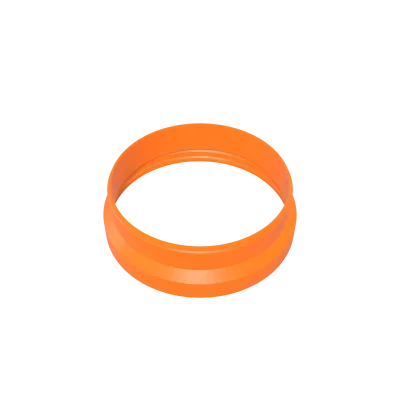
The 6" Duct Coupler is a 158 mm body on a 62 mm barrel with a moulded centre stop, so both ducts seat to the same depth and neither wanders down inside the other, with clamp landings left over on each side. It is the least glamorous part in the catalogue and the one people come back for. A taped butt joint has nothing holding the two ends in line: it sags into the airflow, the adhesive creeps once the exhaust warms it, and the seam starts leaking hot air back into the room you built the run to keep cool. The 8" Duct Coupler is the same geometry at trunk scale, and both double as a straight spacer between any two fittings that do not quite reach.
Changing size — reducers
The 8" to 6" Duct Reducer is a cone, not a plate: the bore walks from 209 mm across the wide collar down to the 6-inch collar over a continuous taper, so the air changes diameter progressively instead of hitting a step and churning behind it. It is what rescues an 8-inch shroud install in a building that was already ducted in 6-inch. The 6" to 4" Duct Reducer does the same at the small end, and its main job is letting you use a 4-inch penetration the building already has, or bringing a power-supply branch up to the main trunk.
Turning a corner — elbows
Bends are where a duct run spends its pressure budget, and the cost of a bend climbs steeply as the turn tightens. When air is forced round a tight corner the stream on the inside cannot follow the wall: it separates, leaves a recirculating pocket, and the useful flow squeezes past what is left. Three answers, in order of how gentle they are:
- The 6" 45° Duct Elbow, chained in pairs with a short straight between them to make a right angle out of two gentle turns. It clocks to any orientation around the duct axis, so it routes in three dimensions around a joist, a door head or a rack upright.
- The 8-Inch Long-Radius 90° Airflow Duct Elbow, which sweeps the turn on a generous centreline radius rather than mitring it and rounding the edges off. R/D is the ratio duct-loss tables are indexed on, and a genuine long-radius bend sits well down that table.
- The compact 90° elbows, in 6-inch and 8-inch, for the corner that has to be turned in the space that exists. A fitting that fits is always the right fitting.
Combining or splitting a run — wyes
The 6" to Dual 4" Y-Splitter collects a machine on one branch and its power supply on the other into a single 6-inch trunk, so both leave through one hole. The 8" to Dual 6" Y-Splitter does it for two full machines across 336 mm of convergence length. Both are wyes rather than tees on purpose: streams arriving on nearly parallel headings join with very little argument, while streams arriving across each other trade momentum and push back down both branches. On the 8-inch part the length is the feature, not the packaging — shorten the body and the branch angle steepens until the fitting behaves like the tee it exists to avoid. Its envelope is 336 × 240 × 203 mm against 226 × 198 × 152 mm on the 6-inch wye.
Ending the run — window and wall ports
The 6" Window Exhaust Port is a flanged plate with a gasket groove around the flange and insect-screen retention on the outer face, mounted through a filler panel cut to a sliding window opening. That matters more than it sounds: a duct hanging out of a gap is not a closed system, because warm exhaust leaves through the top of the gap while room air is drawn back in around the bottom. Sealing the opening and giving the exhaust one defined exit is what turns the run into an actual one-way path out of the building. The rigid port is a 210 × 210 × 39 mm plate; the flex-duct version of it carries a male collar instead of a rigid socket, and both styles exist in 8-inch on a 248 mm plate.
Quick-release and flex transitions
The Bayonet Duct Receiver 6-Inch and the Threaded Duct Receiver 6-Inch are the duct-side halves of D-Central's quick-disconnect shroud collars: clamp the receiver to the duct once, then take the machine out of the run with a twist or a hand-turn while the duct, the clamp and the rest of the line never move. The 6-Inch Flex Duct Adapter converts any rigid socket in the line to a male flex collar, because rigid pipe goes into a socket while a flex core has to go over a spigot — its wire helix will not sit square inside anything.
Sizing the run: 4-inch, 6-inch, 8-inch
Six inch is 152.4 mm nominal, 8-inch is 203.2 mm, and open area goes with the square of the bore, so an 8-inch duct carries roughly 1.8 times the cross-section of a 6-inch one. Four inch is a different class of part entirely and should be treated that way.
| 8" — 203.2 mm | Trunk size. Long runs, shared lines, anything with an inline booster, and the drop off an 8-inch shroud. Hold the larger cross-section for as much of the distance as the building allows. |
|---|---|
| 6" — 152.4 mm | Machine size. One miner on a direct route. The size every hardware store stocks in flexible hose and window hardware, and the size common inline fans are built around. |
| 4" — 101.6 mm | Auxiliary size. Power supplies, cabinet fans, small branches. Not the size to terminate a full ASIC exhaust in; a 4-inch dryer penetration on a full machine is a compromise you choose knowingly, not a target design. |
The one placement rule worth memorising: reduce late. Hold the trunk at 8-inch for the length of the run and step down only where something physically demands 6-inch — a wall sleeve, a window panel, the inlet of a 6-inch inline fan. Reducing at the shroud and then running ten metres of 6-inch pays the restriction over the whole distance instead of the last half-metre of it.
What these fittings connect to
Nothing in this category is model-specific, which is exactly the point: the run is decided by the building, not the badge on the miner. Every 6-inch and 8-inch collar here mates directly to the shroud bodies in the rest of the line, which covers the Antminer S9 family, the S17 and T17 generation, the S19 series, the standard S21 and T21, the Antminer S21 Pro on its 140 mm fan pair, the Whatsminer M-series and the Canaan Avalon A15-class stacked-fan face. One shroud choice at the machine, one run standard behind it.
Three parts in this category are still on the drawing board and listed so you can see where the line is going: a print-in-place blast gate for balancing a split run and closing an idle machine against winter backdraft, an AC Infinity Cloudline coupler to make an inline fan a proper clamped fitting rather than the joint you keep re-taping, and 10-inch and 250 mm collar variants for small hashcenter trunks.
Made to order in Montreal, Quebec, published open source
Every fitting here is printed for the order it belongs to, in PETG — black or D-Central orange — and shipped worldwide from Canada. A fitting standard that only one shop can print is not a standard, so D-Central releases all of these designs under CC BY-SA 4.0 at the 3D models download center — free to download, change the collar depth, scale the taper, run a batch and sell what you make. Buying the finished part is a convenience and the thing that funds the next design; D-Central's fund page backs the open work on its own terms.
- One collar standard across 4-inch, 6-inch and 8-inch, so fittings mate without adapters
- Clamp lands and retention beads on every flex interface, so joints are mechanical rather than taped
- Gradual shapes where the section changes: tapered cones, swept elbows, shallow-angle wyes
- Single continuous PETG bodies with no internal seam on the inside of a bend
- PETG throughout, in black or D-Central orange, so a shroud, an elbow and a coupler bought separately still look like one run
Frequently asked questions
What duct size do I need for one ASIC miner?
Six inch for a short, direct route with at most one bend; 8-inch once the run climbs, turns twice, joins a shared trunk or has an inline fan on it. An 8-inch bore carries roughly 1.8 times the open area of a 6-inch one, and that headroom is what a long or bendy route spends. Four inch is for power supplies and auxiliary branches only.
Two 45s or one 90?
Two 45° elbows with a short straight between them whenever the space exists, because two gentle turns cost less than one sharp one and the straight lets the flow reattach in between. Where the corner is genuinely tight, take the compact 90 and stop worrying about it.
Can I just tape the duct joints instead?
Foil tape holds until the joint gets warm, gets moved, or gets old, and exhaust ducting does all three. A coupler gives a rigid internal former, a positive depth stop and two clamp landings, so the seam cannot sag into the flow and the joint reopens without cutting. Tape is a repair. A coupler is a joint.
Do I have to cut a hole in my window?
No. The standard approach is a filler panel cut to a sliding window opening — plywood, acrylic or rigid foam — with the window port mounted through the panel and a gasket in the flange groove. The glass and the frame are untouched, the whole assembly lifts out in one piece, and there is nothing to explain to a landlord at the end of a lease.
Can I run two miners into one duct?
With the 8" to Dual 6" Y-Splitter, yes, and it is the right answer when the building gives you one hole. Understand the trade: two machines on one trunk are aerodynamically coupled, so the stronger set of fans pressurises the line and pushes back against the weaker one. Where a second penetration is possible, a run per machine behaves more predictably.
Rigid duct or flex duct?
Both clamp to these collars. Rigid pipe is the quieter, lower-loss choice on long straight sections; flex earns its place around obstacles and at the last stretch. Where the two meet, use the 6-Inch Flex Duct Adapter rather than taping mismatched ends, since rigid goes into a socket and flex has to go over a spigot.
Shop Ducting and Fittings from D-Central. 19 products available with checkout-confirmed shipping, support, and product terms.
Browse ducting and fittings with sorting and key product specs surfaced first.
-

Built to order
View details for 8-Inch Flex Duct Window Vent Port -

Built to order
View details for 6-Inch Flex Duct Window Vent Port -
Adapters and Shrouds
Bayonet Duct Receiver 6-Inch — Twist-Lock Duct Adapter
- Type:Airflow
- Condition:New
$16.99 CAD -

Built to order
View details for 8" to Dual 6" Y-Splitter -

Built to order
View details for 6" to Dual 4" Y-Splitter -

Built to order
View details for 8" Window Exhaust Port -

Built to order
View details for 6" Window Exhaust Port -

Built to order
View details for 8" 90° Duct Elbow (Compact) -

Built to order
View details for 6" 90° Duct Elbow (Compact) -

Built to order
View details for 8" 45° Duct Elbow -

Built to order
View details for 6" 45° Duct Elbow -

Built to order
View details for 8" Duct Coupler -

Built to order
View details for 6" Duct Coupler -

Built to order
View details for 6" to 4" Duct Reducer -

Built to order
View details for 8" to 6" Duct Reducer




Ducting and fittings: everything between the shroud and the outside air
Duct fittings are the parts that carry a miner’s captured exhaust from the shroud collar to wherever the heat is supposed to go — couplers, reducers, elbows, wyes, flex adapters, duct receivers and window ports. D-Central makes 23 of them in 4-inch, 6-inch and 8-inch, drawn to one collar standard so that every fitting mates the next one on the first try, and printed as single continuous PETG bodies with no seams inside the bore for the flow to trip over.
This is the half of the system people underestimate. A well-shaped shroud hands the duct an organised column of air, and then a taped butt joint, a sharp corner and a length of hose wedged under a sash spend everything it gained. The run is where a ducted miner is won or lost, and the fittings here are drawn on that basis: gradual where a shape changes, mechanical where a joint has to hold, and sealed where the building ends.
The collar standard, and why it matters that it is one standard
Every 6-inch part in this line speaks the same geometry: a flex-over collar with the retention bead crest at 152.4 mm, the clamp land at 150.4 mm behind it, and a through-bore of 145.6 mm that stays open rather than necking down at the joint. Flex slides over the bead, a worm clamp closes on the land, and the bead is the mechanical stop that keeps the clamp from walking off the end. The 8-inch parts do the same at 203.2 mm nominal.
The consequence is that you can plan a run rather than assemble one by trial. A shroud, a long-radius elbow, a coupler and a window port from this catalogue fit each other without an adapter, a shim or a wrap of foil tape, because they were all cut to the same numbers by the same shop.
The fittings, by the job they do
Joining two ducts — couplers
The 6″ Duct Coupler is a 158 mm body on a 62 mm barrel with a moulded centre stop, so both ducts seat to the same depth and neither wanders down inside the other, with clamp landings left over on each side. It is the least glamorous part in the catalogue and the one people come back for. A taped butt joint has nothing holding the two ends in line: it sags into the airflow, the adhesive creeps once the exhaust warms it, and the seam starts leaking hot air back into the room you built the run to keep cool. The 8″ Duct Coupler is the same geometry at trunk scale, and both double as a straight spacer between any two fittings that do not quite reach.
Changing size — reducers
The 8″ to 6″ Duct Reducer is a cone, not a plate: the bore walks from 209 mm across the wide collar down to the 6-inch collar over a continuous taper, so the air changes diameter progressively instead of hitting a step and churning behind it. It is what rescues an 8-inch shroud install in a building that was already ducted in 6-inch. The 6″ to 4″ Duct Reducer does the same at the small end, and its main job is letting you use a 4-inch penetration the building already has, or bringing a power-supply branch up to the main trunk.
Turning a corner — elbows
Bends are where a duct run spends its pressure budget, and the cost of a bend climbs steeply as the turn tightens. When air is forced round a tight corner the stream on the inside cannot follow the wall: it separates, leaves a recirculating pocket, and the useful flow squeezes past what is left. Three answers, in order of how gentle they are:
- The 6″ 45° Duct Elbow, chained in pairs with a short straight between them to make a right angle out of two gentle turns. It clocks to any orientation around the duct axis, so it routes in three dimensions around a joist, a door head or a rack upright.
- The 8-Inch Long-Radius 90° Airflow Duct Elbow, which sweeps the turn on a generous centreline radius rather than mitring it and rounding the edges off. R/D is the ratio duct-loss tables are indexed on, and a genuine long-radius bend sits well down that table.
- The compact 90° elbows, in 6-inch and 8-inch, for the corner that has to be turned in the space that exists. A fitting that fits is always the right fitting.
Combining or splitting a run — wyes
The 6″ to Dual 4″ Y-Splitter collects a machine on one branch and its power supply on the other into a single 6-inch trunk, so both leave through one hole. The 8″ to Dual 6″ Y-Splitter does it for two full machines across 336 mm of convergence length. Both are wyes rather than tees on purpose: streams arriving on nearly parallel headings join with very little argument, while streams arriving across each other trade momentum and push back down both branches. On the 8-inch part the length is the feature, not the packaging — shorten the body and the branch angle steepens until the fitting behaves like the tee it exists to avoid. Its envelope is 336 × 240 × 203 mm against 226 × 198 × 152 mm on the 6-inch wye.
Ending the run — window and wall ports
The 6″ Window Exhaust Port is a flanged plate with a gasket groove around the flange and insect-screen retention on the outer face, mounted through a filler panel cut to a sliding window opening. That matters more than it sounds: a duct hanging out of a gap is not a closed system, because warm exhaust leaves through the top of the gap while room air is drawn back in around the bottom. Sealing the opening and giving the exhaust one defined exit is what turns the run into an actual one-way path out of the building. The rigid port is a 210 × 210 × 39 mm plate; the flex-duct version of it carries a male collar instead of a rigid socket, and both styles exist in 8-inch on a 248 mm plate.
Quick-release and flex transitions
The Bayonet Duct Receiver 6-Inch and the Threaded Duct Receiver 6-Inch are the duct-side halves of D-Central’s quick-disconnect shroud collars: clamp the receiver to the duct once, then take the machine out of the run with a twist or a hand-turn while the duct, the clamp and the rest of the line never move. The 6-Inch Flex Duct Adapter converts any rigid socket in the line to a male flex collar, because rigid pipe goes into a socket while a flex core has to go over a spigot — its wire helix will not sit square inside anything.
Sizing the run: 4-inch, 6-inch, 8-inch
Six inch is 152.4 mm nominal, 8-inch is 203.2 mm, and open area goes with the square of the bore, so an 8-inch duct carries roughly 1.8 times the cross-section of a 6-inch one. Four inch is a different class of part entirely and should be treated that way.
| 8″ — 203.2 mm | Trunk size. Long runs, shared lines, anything with an inline booster, and the drop off an 8-inch shroud. Hold the larger cross-section for as much of the distance as the building allows. |
|---|---|
| 6″ — 152.4 mm | Machine size. One miner on a direct route. The size every hardware store stocks in flexible hose and window hardware, and the size common inline fans are built around. |
| 4″ — 101.6 mm | Auxiliary size. Power supplies, cabinet fans, small branches. Not the size to terminate a full ASIC exhaust in; a 4-inch dryer penetration on a full machine is a compromise you choose knowingly, not a target design. |
The one placement rule worth memorising: reduce late. Hold the trunk at 8-inch for the length of the run and step down only where something physically demands 6-inch — a wall sleeve, a window panel, the inlet of a 6-inch inline fan. Reducing at the shroud and then running ten metres of 6-inch pays the restriction over the whole distance instead of the last half-metre of it.
What these fittings connect to
Nothing in this category is model-specific, which is exactly the point: the run is decided by the building, not the badge on the miner. Every 6-inch and 8-inch collar here mates directly to the shroud bodies in the rest of the line, which covers the Antminer S9 family, the S17 and T17 generation, the S19 series, the standard S21 and T21, the Antminer S21 Pro on its 140 mm fan pair, the Whatsminer M-series and the Canaan Avalon A15-class stacked-fan face. One shroud choice at the machine, one run standard behind it.
Three parts in this category are still on the drawing board and listed so you can see where the line is going: a print-in-place blast gate for balancing a split run and closing an idle machine against winter backdraft, an AC Infinity Cloudline coupler to make an inline fan a proper clamped fitting rather than the joint you keep re-taping, and 10-inch and 250 mm collar variants for small hashcenter trunks.
Made to order in Montreal, Quebec, published open source
Every fitting here is printed for the order it belongs to, in PETG — black or D-Central orange — and shipped worldwide from Canada. A fitting standard that only one shop can print is not a standard, so D-Central releases all of these designs under CC BY-SA 4.0 at the 3D models download center — free to download, change the collar depth, scale the taper, run a batch and sell what you make. Buying the finished part is a convenience and the thing that funds the next design; D-Central’s fund page backs the open work on its own terms.
- One collar standard across 4-inch, 6-inch and 8-inch, so fittings mate without adapters
- Clamp lands and retention beads on every flex interface, so joints are mechanical rather than taped
- Gradual shapes where the section changes: tapered cones, swept elbows, shallow-angle wyes
- Single continuous PETG bodies with no internal seam on the inside of a bend
- PETG throughout, in black or D-Central orange, so a shroud, an elbow and a coupler bought separately still look like one run
Frequently asked questions
What duct size do I need for one ASIC miner?
Six inch for a short, direct route with at most one bend; 8-inch once the run climbs, turns twice, joins a shared trunk or has an inline fan on it. An 8-inch bore carries roughly 1.8 times the open area of a 6-inch one, and that headroom is what a long or bendy route spends. Four inch is for power supplies and auxiliary branches only.
Two 45s or one 90?
Two 45° elbows with a short straight between them whenever the space exists, because two gentle turns cost less than one sharp one and the straight lets the flow reattach in between. Where the corner is genuinely tight, take the compact 90 and stop worrying about it.
Can I just tape the duct joints instead?
Foil tape holds until the joint gets warm, gets moved, or gets old, and exhaust ducting does all three. A coupler gives a rigid internal former, a positive depth stop and two clamp landings, so the seam cannot sag into the flow and the joint reopens without cutting. Tape is a repair. A coupler is a joint.
Do I have to cut a hole in my window?
No. The standard approach is a filler panel cut to a sliding window opening — plywood, acrylic or rigid foam — with the window port mounted through the panel and a gasket in the flange groove. The glass and the frame are untouched, the whole assembly lifts out in one piece, and there is nothing to explain to a landlord at the end of a lease.
Can I run two miners into one duct?
With the 8″ to Dual 6″ Y-Splitter, yes, and it is the right answer when the building gives you one hole. Understand the trade: two machines on one trunk are aerodynamically coupled, so the stronger set of fans pressurises the line and pushes back against the weaker one. Where a second penetration is possible, a run per machine behaves more predictably.
Rigid duct or flex duct?
Both clamp to these collars. Rigid pipe is the quieter, lower-loss choice on long straight sections; flex earns its place around obstacles and at the last stretch. Where the two meet, use the 6-Inch Flex Duct Adapter rather than taping mismatched ends, since rigid goes into a socket and flex has to go over a spigot.
Related products, repair, and setup paths
- how D-Central diagnoses ASIC repairs
- ASIC troubleshooting library
- ASIC manuals and repair guides
- replacement hashboards
- ASIC control boards
- ASIC power supplies
- compare specs in the ASIC miner database
- compare ASIC miner specs
- ASIC miner database
- ASIC repair services
- Antminer S19 specs and profitability
- buy a tested Antminer S19
- Antminer S19 maintenance guide
- Antminer S19 repair service
- Antminer S21 specs
- Bitmain Antminer S21
- Antminer S21 maintenance guide
- BM1370BC S21 Pro chip
- Antminer S9 specs
- Bitmain Antminer S9
- Antminer S9 maintenance guide
- S9 hashboard repair parts bundle
- Whatsminer M30S specs
- Whatsminer repair guide
- MicroBT Whatsminer M30S++
- Whatsminer M3x exhaust shroud
- Avalon (Canaan) hashboard repair
- start a repair request
- ASIC repair parts
Last reviewed August 19, 2026.