
Bitaxe Cooling Solutions: Complete Thermal Management Guide
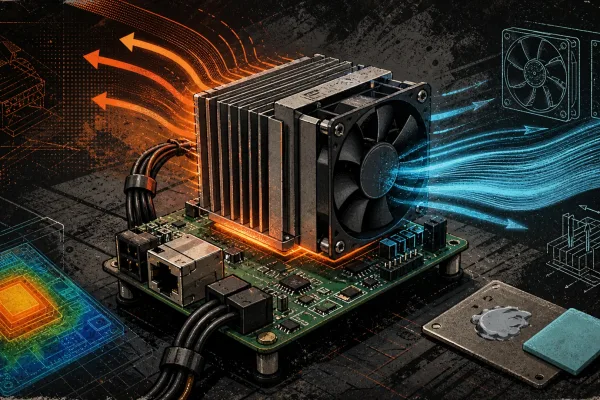
Every ASIC chip is a furnace in miniature. The BM1366 and BM1370 chips inside your Bitaxe are computing trillions of SHA-256 hashes per second, and every single hash generates heat.

$16.99 CAD
An 8 inch duct coupler for trunk lines: centre stop, clampable barrel on each side, and the break point that lets you take half a long 8-inch run down on your own. Made to order in PETG, shipped from Montreal, Quebec.
High Demand — Pre-order Now, Ships in 5-10 Business Days
Purchase details
Save 3% when you pay in Bitcoin.
An 8 inch duct coupler solves a problem the 6-inch version does not really have: eight-inch duct is awkward. A long length of it is heavy, unwieldy in a stairwell, and close to impossible to route single-handed. The coupler is what lets you build the trunk in sections you can actually carry and then join them properly at the point of your choosing.
Same principle as the smaller part, scaled up: a 62 mm barrel with a centre stop so both ducts seat to equal depth, and enough barrel left on each side for a band clamp to land on duct and coupler together. On a trunk this size that matters, because the duct weight alone will work a friction joint loose over a season.
Drawn in-house to the same 8-inch collar standard as every 8-inch shroud, silencer, elbow, port and wye D-Central makes.
Standard 8-inch duct on both ends, rigid pipe or flex, in any combination. It also mates straight onto the collar of any 8-inch fitting in the line, including the trunk side of the 8″ to Dual 6″ Y-Splitter and the inside collar of the 8″ Window Exhaust Port. For 6-inch runs the equivalent part is the 6″ Duct Coupler; to change between the two sizes you want the 8″ to 6″ Duct Reducer instead.
Four jobs. Joining two offcuts into a full-length run. Extending a trunk that came up short. Repairing a damaged section without replacing the whole length. And, the one people underrate, creating a deliberate break point in a long trunk so that servicing the machine end does not mean dismantling the run from the wall inwards. Slide both ducts to the centre stop, clamp each side, and the joint is finished.
On a big line, joints are where the system leaks and where it sags. A taped seam on 8-inch duct has a large circumference to hold and a lot of duct weight pulling on it, and once it opens, hot air is dumping into the ceiling void rather than leaving the building. A coupler puts a rigid former inside the seam, sets both ducts to the same insertion depth, and gives the clamp something solid to compress against. The joint stops being the weak point in the run.
| Fits | Two lengths of standard 8″ duct, rigid or flexible |
|---|---|
| Intake | 8″ duct |
| Outlet | 8″ duct |
| Footprint | 208.8 × 208.8 × 62 mm |
| Material | PETG |
| Colour | Black or orange PETG |
| Construction | Single continuous body — no assembly, no fasteners, no glued joints |
| Design files | Open source — free to download, use, modify and redistribute |
| Download | coupler_8.zip — STL, CC BY-SA 4.0 licence, installation and safety guide |
| SKU | DC-DUCT-CPL-8 |
The 8-inch fitting family is D-Central Technologies’ own work — our drawings, our collar standard, open-sourced by us rather than adapted from anyone — and it goes out under CC BY-SA 4.0 at the 3D models download center. Downloading it, changing it, remixing it, making it and selling it are all free. The card for this one is the 8″ duct coupler model; if you have the build volume for an 8-inch barrel, run your own.
The file is coupler_8.zip, holding the STL, the CC BY-SA 4.0 licence, and the installation and safety guide. This listing is the finished coupler instead, made to order in PETG in either black or orange and shipped from Montreal, Quebec. Nothing about the file changes either way: it stays free, and the money from a printed part or from D-Central’s fund page is what draws the next fitting.
One vendor, one collar standard, the whole run: see the D-Central shroud and ducting system.
At every joint you want sealed and serviceable, yes. Even where the run is permanent and hidden, a coupler is still the better joint; it just matters less that you can reopen it. The place it is genuinely non-optional is any joint that carries duct weight rather than just sitting between two hangers.
The barrel is sized for the inner core of standard 8-inch flex, not for the insulation jacket. Peel the outer sleeve and batting back, slide the core over the barrel, clamp on the core over the wire helix, then pull the jacket forward over the joint and tape the jacket only. The clamp holds the duct; the jacket only has to hold itself.
Because the day you need to pull the machine, you do not want to take down four metres of duct to do it. A coupler at the doorway or just outboard of the shroud means two clamps and the machine end comes free. It is the same reason you would put a union in a pipe run.
Yes, that is one of its regular uses. As long as both are nominal 8-inch, the coupler is what makes them compatible, because the joint now depends on the barrel rather than on two duct ends agreeing with each other. Mixing rigid pipe on one side and flex on the other is fine.
Match the trunk, not the machine. If the duct on both sides of the joint is 8-inch, this is the part. If it is 6-inch, take the 6″ coupler. If the two sides are different sizes, no coupler will help and you want the reducer.
| Weight | 129 g |
|---|---|
| Dimensions | 20.88 × 20.88 × 6.2 cm |
| Colour | Black, Orange |
Only logged in customers who have purchased this product may leave a review.
Every ASIC chip is a furnace in miniature. The BM1366 and BM1370 chips inside your Bitaxe are computing trillions of SHA-256 hashes per second, and every single hash generates heat.
Every ASIC miner ships with the same cooling strategy: move massive volumes of air across heatsinks using fans that sound like a jet turbine at close range. It works.
Most Bitcoin merchandise is mass-produced overseas with no connection to the culture. D-Central Technologies 3D prints every collectible in Montreal, Quebec — made by actual Bitcoin miners since 2016. Discover our Bitcoin Chess Set, Honeybadger figurine series, 3D filament paintings, and 140+ unique items you cannot find anywhere else.
Last reviewed August 19, 2026.

Reviews
There are no reviews yet.