
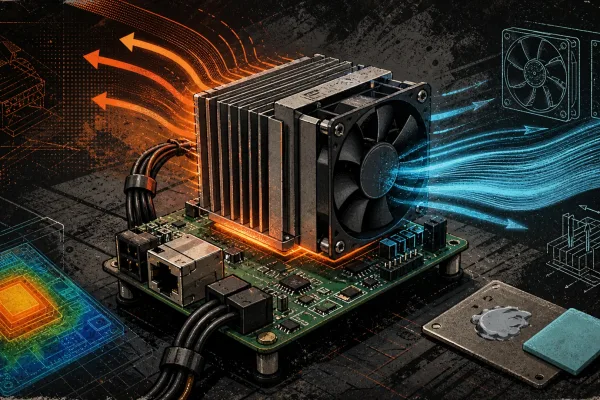
Bitaxe Cooling Solutions: Complete Thermal Management Guide
Every ASIC chip is a furnace in miniature. The BM1366 and BM1370 chips inside your Bitaxe are computing trillions of SHA-256 hashes per second, and every single hash generates heat.

$52.99 CAD
An 8 inch to dual 6 inch duct Y-splitter: two machines, one wall penetration. 336 mm of body so the merge stays shallow instead of collapsing into a tee. One of the largest single-piece parts we make. PETG, made to order in Montreal, Quebec.
High Demand — Pre-order Now, Ships in 5-10 Business Days
Purchase details
Save 3% when you pay in Bitcoin.
The duct y splitter 8 to 2×6 is the fitting for the constraint most home and small-shop miners actually face: two machines, one hole. Rented space, a finished basement, a garage with exactly one window that faces the right way — whatever the reason, a second penetration is off the table and both machines still have to vent. This wye merges two 6-inch machine lines into one 8-inch trunk that leaves through a single opening.
It is 336 mm long, and the length is the design. A wye that merges two 6-inch streams needs real distance for the branches to converge at a shallow angle; compress it and it stops being a wye and becomes a tee, which is the shape that costs pressure and makes noise.
One of the largest single-piece parts in the line, printed as one continuous body with no seam at the junction.
Standard 8-inch duct on the trunk collar, standard 6-inch on both branch collars, rigid or flexible throughout. Every 6-inch shroud and silencer in the line connects straight to a branch — including the Antminer S19 / S21 Dual 120 mm to 6″ Duct Shroud and the 6″ expansion-chamber shroud silencer. The trunk takes any 8-inch duct, coupler, elbow or port.
For smaller branches — a power supply, an auxiliary fan — the part you want is the 6″ to Dual 4″ Y-Splitter. If you have the option of a second wall penetration, take it: separate runs behave better than any shared one.
As a collector, two 6-inch machine exhausts converge into one 8-inch trunk and out through a single 8″ window port. As a splitter, one large exhaust divides between two destinations — a workshop that wants the heat, and an outside vent that takes it once the workshop is warm enough. Clamp all three collars, and hang the fitting properly: at 336 mm with two loaded branches it needs its own support rather than relying on the ducts either side.
Merging air is about heading, not just area. Two streams arriving on nearly parallel paths join with very little argument; two streams arriving across each other trade momentum, shed turbulence, and push back down both branches. Getting a shallow convergence out of two 6-inch bores requires length, and this part spends it. That is also why it is physically large: the size is not packaging, it is the geometry doing its job.
Be clear-eyed about what a shared trunk does. Two machines on one line are aerodynamically coupled: the set of fans producing more pressure will dominate the trunk and push back against the other. It works, people run it, and it is the right answer when the building leaves no alternative — but a separate run per machine is the layout that behaves predictably.
| Fits | One 8″ trunk, two 6″ branches |
|---|---|
| Intake | 8″ duct |
| Outlet | 2 × 6″ duct |
| Geometry | Shallow-angle wye — 336 mm of length so the merge stays gradual |
| Footprint | 335.8 × 240 × 203.2 mm |
| Material | PETG |
| Colour | Black or orange PETG |
| Construction | Single continuous body — no assembly, no fasteners, no glued joints |
| Design files | Open source — free to download, use, modify and redistribute |
| Download | y_split_8_to_2x6.zip — STL, CC BY-SA 4.0 licence, installation and safety guide |
| SKU | DC-DUCT-Y-8-2X6 |
This is the part that took D-Central Technologies the most work to draw, and it is published on the same terms as everything else we design: open source under CC BY-SA 4.0 at the 3D models download center, free to download, modify, remix, print and sell. Its card is the 8″ to dual 6″ wye model. If your two branches want to leave at different angles than ours do, edit the file.
Everything you need is in y_split_8_to_2x6.zip — the STL, the CC BY-SA 4.0 licence, and the installation and safety guide. What this listing sells is the finished wye, made to order in PETG and shipped from Montreal, Quebec, in black or in orange; it is a big part and a long build, which is a large share of why people buy it rather than make one. The file is free permanently, and buying the wye or giving at D-Central’s fund page is what pays for the next design.
Two shrouds, one trunk, one wall — every fitting from the same drawing set. See the D-Central shroud and ducting system.
It is a trade worth understanding before you build it. Whichever machine has the stronger fans will pressurise the trunk and push back against the weaker one, so the two are no longer independent. People run this layout successfully every day; just do it because the building gives you one hole, not because it is aerodynamically preferable.
Only with a damper in one of them. Putting a gate in the stronger branch and closing it slightly is the usual approach. A commercial damper works today; the print-in-place blast gate is in development for this exact job.
Because merging two 6-inch streams needs more convergence length than merging two 4-inch ones. Shortening the body would steepen the branch angle until the fitting behaved like a tee, which is the exact shape it exists to avoid. The 336 mm is the geometry, not the packaging.
Yes, and it is a good seasonal layout: one branch into a workshop or garage that wants the warmth, one branch to an outside port. Add a damper on each branch and you can move the heat where it is useful without touching the machine.
Yes. At 336 mm with two branches and a trunk hanging off it, this is one of the few fittings in the line that should be strapped or hung directly rather than supported by the ducts either side. Take the weight off the collars and the clamps only have to seal.
| Weight | 677 g |
|---|---|
| Dimensions | 33.58 × 20.32 × 24 cm |
| Colour | Black, Orange |
Only logged in customers who have purchased this product may leave a review.
Every ASIC chip is a furnace in miniature. The BM1366 and BM1370 chips inside your Bitaxe are computing trillions of SHA-256 hashes per second, and every single hash generates heat.
Every ASIC miner ships with the same cooling strategy: move massive volumes of air across heatsinks using fans that sound like a jet turbine at close range. It works.
Most Bitcoin merchandise is mass-produced overseas with no connection to the culture. D-Central Technologies 3D prints every collectible in Montreal, Quebec — made by actual Bitcoin miners since 2016. Discover our Bitcoin Chess Set, Honeybadger figurine series, 3D filament paintings, and 140+ unique items you cannot find anywhere else.
Last reviewed August 19, 2026.

Reviews
There are no reviews yet.