
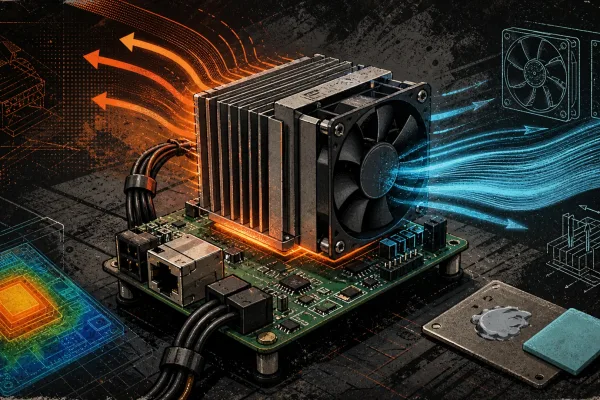
Bitaxe Cooling Solutions: Complete Thermal Management Guide
Every ASIC chip is a furnace in miniature. The BM1366 and BM1370 chips inside your Bitaxe are computing trillions of SHA-256 hashes per second, and every single hash generates heat.
$38.99 CAD
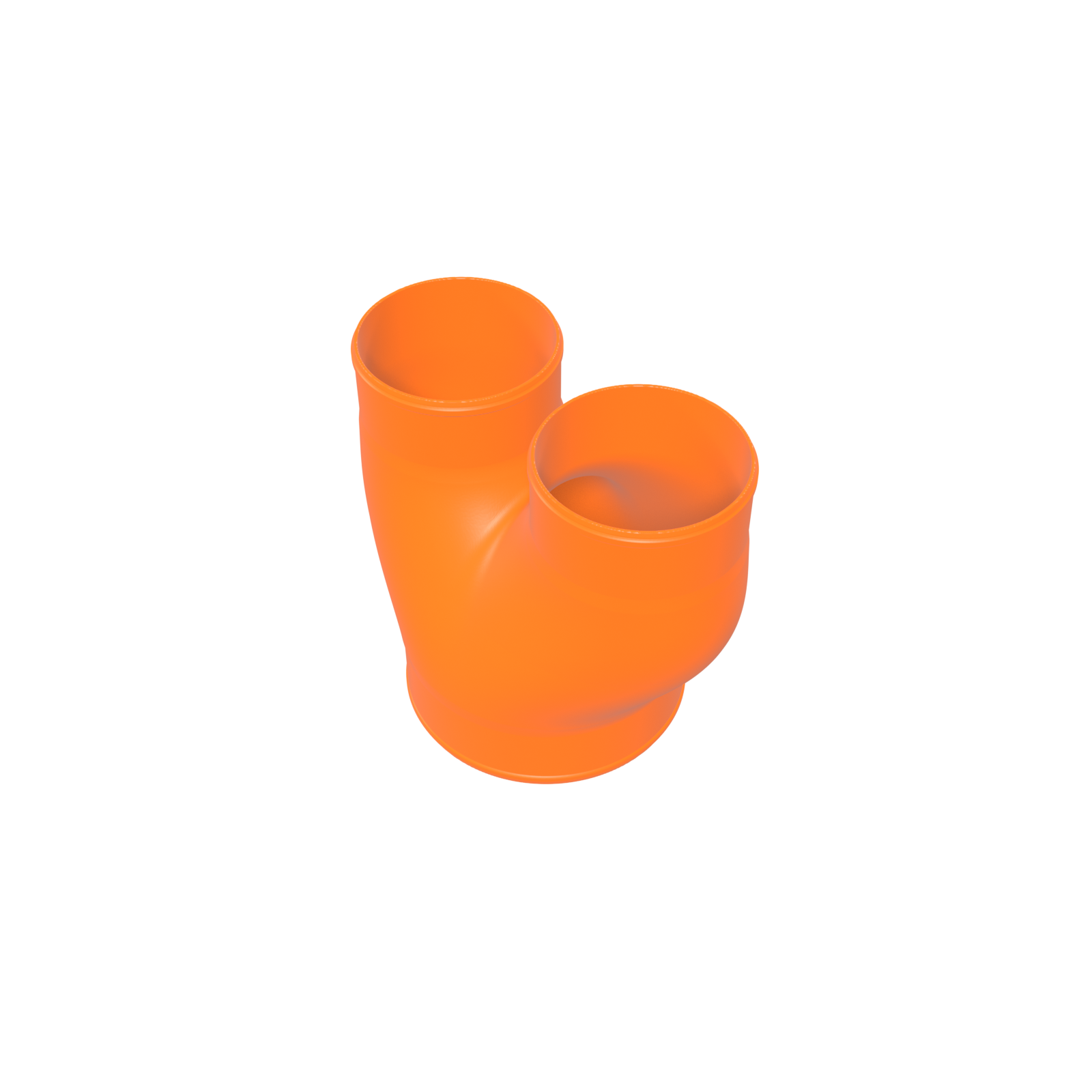
A 6 inch to dual 4 inch Y-splitter that collects a miner line and a power-supply line into one duct, so two heat sources leave through one hole in the wall. Shaped wye, not a tee. PETG, made to order in Montreal, Quebec.
High Demand — Pre-order Now, Ships in 5-10 Business Days
Purchase details
Save 3% when you pay in Bitcoin.
A 6 inch to dual 4 inch Y-splitter turns two small lines into one, or one line into two. The job it does most often in a mining install is collection: the machine on one 4-inch branch, its power supply on the other, and a single 6-inch trunk carrying both out of the building. One hole in the wall instead of two, and the power supply stops quietly heating the room you just spent an afternoon ducting.
It is a wye, not a tee. The branches lean into the trunk at a shallow angle so the two streams join while already moving in roughly the same direction, rather than colliding at a right angle and having to sort themselves out afterwards.
Drawn in-house as one continuous body, 226 mm along the trunk axis, with the same collar standard as the rest of the line on all three ends.
Standard 6-inch duct on the trunk collar, standard 4-inch duct on both branch collars, rigid or flexible on any of the three. The 4-inch branches match the small end of the 6″ to 4″ Duct Reducer, so a 6-inch auxiliary line can be brought down to branch size and fed straight in.
Know the limit: 4-inch branches are power-supply scale and auxiliary scale, not machine scale. Two full ASICs on this part is the wrong build, and the right one is the 8″ to Dual 6″ Y-Splitter.
As a collector, which is the common case: 4-inch duct from the power supply onto one branch, 4-inch from a small auxiliary source onto the other, 6-inch trunk off the third collar and out. As a splitter, run it the other way to send one exhaust to two destinations — a room that wants the heat in winter and an outside vent that takes it the rest of the year. Band-clamp all three collars and support the trunk near the fitting, because a loaded wye is a three-way lever.
When two air streams meet head-on in a tee, they trade momentum with each other before either of them gets down the trunk. That shows up as pressure loss on both branches and as noise at the junction. A wye brings them together along nearly the same heading, so the merge costs far less and each branch stops fighting the other. If you are going to combine two air paths at all, the shape you do it with is the whole difference between a junction that works and one you can hear from the next room.
| Fits | One 6″ trunk, two 4″ branches |
|---|---|
| Intake | 6″ duct |
| Outlet | 2 × 4″ duct |
| Geometry | Shallow-angle wye — branches merge with the trunk, not across it |
| Footprint | 226.3 × 198 × 152.4 mm |
| Material | PETG |
| Colour | Black or orange PETG |
| Construction | Single continuous body — no assembly, no fasteners, no glued joints |
| Design files | Open source — free to download, use, modify and redistribute |
| Download | y_split_6_to_2x4.zip — STL, CC BY-SA 4.0 licence, installation and safety guide |
| SKU | DC-DUCT-Y-6-2X4 |
A shaped wye is one of the harder things in this line to draw and one of the easiest to get wrong. D-Central Technologies drew this one, then gave it away rather than hoarding it: released open source under CC BY-SA 4.0 at the 3D models download center, free to download, modify, remix, print and sell. Its card is the 6″ to dual 4″ wye model, alongside the rest of our own designs.
Pull the file directly from y_split_6_to_2x4.zip: STL, CC BY-SA 4.0 licence, installation and safety guide. This listing is the finished wye instead — made to order in PETG, black or orange, and shipped from Montreal, Quebec, all three collars cut to the same standard as your other fittings. The file stays free; the part you buy, or D-Central’s fund page, is what pays for the next wye we draw.
Every fitting in the run drawn to mate the next one: see the D-Central shroud and ducting system.
Not this one. The branches are 4-inch, which is power-supply scale. Two full machines need the 8″ to dual 6″ splitter, and even then a shared trunk couples the machines so that the stronger fan set pushes back on the weaker one. A duct per machine is the layout that behaves predictably.
Either works, but it is more efficient as a collector, because a shallow-angle merge is what the shape was drawn for. Two 4-inch branches in, one 6-inch trunk out. Run as a splitter it still works; you are simply asking a merge geometry to divide instead, and the division will follow whichever branch offers less resistance.
Whichever branch has the lower resistance takes more of it, every time. If both branches have their own fan, as a miner and a power supply do, it largely sorts itself out. If you are splitting one source deliberately and want control over the balance, you need a damper in one branch, which is what a blast gate is for.
You can, but a capped branch is a dead volume that the flow past it will slap against, which makes noise for no benefit. If you only need two ends, use an elbow or a coupler and keep the wye for when the second branch is live.
Because a mining power supply turns a meaningful slice of the total draw into heat and dumps all of it into the room, un-ducted, while the machine exhaust leaves neatly through your new duct run. Collecting it on a 4-inch branch is the cheapest remaining improvement once the machine itself is ducted.
| Weight | 380 g |
|---|---|
| Dimensions | 22.63 × 15.24 × 19.8 cm |
| Colour | Black, Orange |
Only logged in customers who have purchased this product may leave a review.
Every ASIC chip is a furnace in miniature. The BM1366 and BM1370 chips inside your Bitaxe are computing trillions of SHA-256 hashes per second, and every single hash generates heat.
Every ASIC miner ships with the same cooling strategy: move massive volumes of air across heatsinks using fans that sound like a jet turbine at close range. It works.
Most Bitcoin merchandise is mass-produced overseas with no connection to the culture. D-Central Technologies 3D prints every collectible in Montreal, Quebec — made by actual Bitcoin miners since 2016. Discover our Bitcoin Chess Set, Honeybadger figurine series, 3D filament paintings, and 140+ unique items you cannot find anywhere else.
Last reviewed August 19, 2026.

Reviews
There are no reviews yet.