
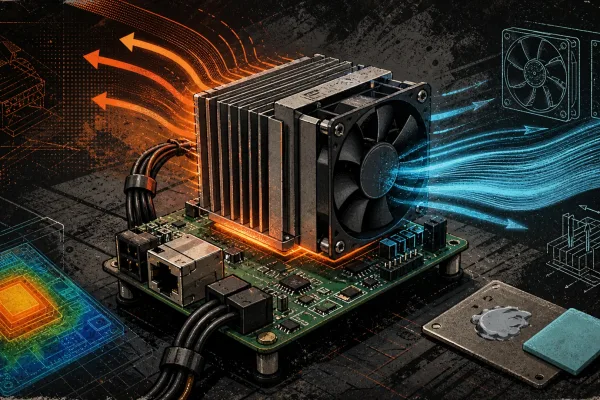
Bitaxe Cooling Solutions: Complete Thermal Management Guide
Every ASIC chip is a furnace in miniature. The BM1366 and BM1370 chips inside your Bitaxe are computing trillions of SHA-256 hashes per second, and every single hash generates heat.

$15.99 CAD
A 6 inch to 4 inch duct reducer that lets a mining exhaust reuse the 4-inch hole your building already has: dryer vent, bath fan, old range hood. Tapered bore, clamps both ends. Made to order in PETG in Montreal, Quebec.
High Demand — Pre-order Now, Ships in 5-10 Business Days
Purchase details
Save 3% when you pay in Bitcoin.
A 6 inch to 4 inch duct reducer is the fitting that lets you use a hole the building already has. Houses are full of 4-inch penetrations: dryer vents, bathroom fans, retired range hoods, basement make-up air. Being able to step a 6-inch line down to that size cleanly is frequently the difference between a heat-reuse project that happens this weekend and one that waits until somebody is willing to cut masonry.
This is the small end of the reducer family. The bore tapers from the 6-inch collar down to the 4-inch collar in one continuous cone, 89 mm deep, so the contraction happens over a length rather than at an edge.
Drawn in-house to the same collar standard as the rest of the D-Central ducting line, which means it also serves as the adapter between the main run and any 4-inch branch you are running alongside it.
Standard 6-inch duct on the wide end, standard 4-inch on the narrow end, flexible or rigid. The 4-inch collar matches the branch size on the 6″ to Dual 4″ Y-Splitter, so the two parts work as a pair when you are collecting a small auxiliary line into a main run.
Understand what 4-inch is for. It is correctly sized for power-supply-level airflow, small inline boosters and auxiliary branches. It is not the size to terminate a full ASIC exhaust in. If you are looking for the fitting that steps a big trunk down one size, that is the 8″ to 6″ Duct Reducer.
Three jobs cover almost every install. First, terminating a 6-inch line into an existing 4-inch wall or window penetration, so no new hole gets cut. Second, feeding a small 4-inch inline fan from a 6-inch run. Third, taking a 4-inch auxiliary line, typically a power supply or a cabinet fan, and bringing it up to the 6-inch trunk. Slide, clamp, done: a band clamp on each collar and the joint is mechanical rather than adhesive.
The proportional contraction here is larger than on the 8-to-6 part, which makes the shape matter more, not less. Cutting the bore area to well under half in a single edge forces the flow to separate and recirculate right where the velocity is highest. Spreading the same contraction over the depth of a cone keeps the stream attached and hands the smaller duct air that is still moving in the direction you wanted it to.
| Fits | Standard 6″ duct on the wide end, standard 4″ duct on the narrow end |
|---|---|
| Intake | 6″ duct |
| Outlet | 4″ duct |
| Footprint | 158 × 158 × 89 mm |
| Material | PETG |
| Colour | Black or orange PETG |
| Construction | Single continuous body — no assembly, no fasteners, no glued joints |
| Design files | Open source — free to download, use, modify and redistribute |
| Download | reducer_6_to_4.zip — STL, CC BY-SA 4.0 licence, installation and safety guide |
| SKU | DC-DUCT-RED-6-4 |
This reducer is D-Central Technologies’ own design. We drew the taper, we set the collar depths, and we released the drawing open source under CC BY-SA 4.0 at the 3D models download center — ours, not a remix of anyone else’s file. Its card is the 6″ to 4″ reducer model: download it, change the collar depth, scale the taper, run a batch on your own machine, sell what you make. Nothing here is gated behind a purchase, because a fitting standard that only one shop can make is not a standard.
The download is reducer_6_to_4.zip — STL, CC BY-SA 4.0 licence, and the installation and safety guide, in one file. What you are buying on this page is the finished cone: made to order in PETG, in black or orange, and shipped from Montreal, Quebec, ready to clamp. The drawing stays free; buying the part, or giving through D-Central’s fund page, is what pays for the next design in the line.
Shroud, elbow, reducer, gate, port — the entire run comes from one place. See the D-Central shroud and ducting system.
No, and you should not neck a full machine down to it and expect it to breathe. Four inches is the right size for power-supply airflow, cabinet fans and small auxiliary branches. Terminate a miner run at 6-inch or 8-inch and use this part for the smaller lines that run alongside it.
It will connect. Whether it is a good idea depends on the length of the existing run, its condition, and whether it has a backdraft damper flap that the exhaust has to push open. A 4-inch terminal on a full ASIC is a real restriction. Treat it as a compromise you are choosing knowingly, not as the target design.
Standard worm-drive band clamps, one in 6-inch and one in 4-inch. Nothing proprietary, nothing supplied by us, all of it on the shelf at any hardware store. Both collars are barrelled deep enough that the clamp sits over duct and collar together.
Mostly power supplies. An APW-class supply dumps a meaningful share of the total wattage into the room as un-ducted heat, and a 4-inch branch is the right scale to collect it. Feed that branch into the 6″ to dual 4″ wye alongside the machine line and both leave through one hole.
Yes. Running a small branch up to the trunk size is a normal use for it, and the direction change costs little at these flow rates. If you are combining two lines rather than converting one, the wye is the shape drawn for that job.
| Weight | 111 g |
|---|---|
| Dimensions | 15.8 × 15.8 × 8.9 cm |
| Colour | Black, Orange |
Only logged in customers who have purchased this product may leave a review.
Every ASIC chip is a furnace in miniature. The BM1366 and BM1370 chips inside your Bitaxe are computing trillions of SHA-256 hashes per second, and every single hash generates heat.
Every ASIC miner ships with the same cooling strategy: move massive volumes of air across heatsinks using fans that sound like a jet turbine at close range. It works.
Most Bitcoin merchandise is mass-produced overseas with no connection to the culture. D-Central Technologies 3D prints every collectible in Montreal, Quebec — made by actual Bitcoin miners since 2016. Discover our Bitcoin Chess Set, Honeybadger figurine series, 3D filament paintings, and 140+ unique items you cannot find anywhere else.
Last reviewed August 19, 2026.

Reviews
There are no reviews yet.