
3D-Printed Bitcoin Mining Parts: Free STL Files and What’s Worth Printing
Home » 3D-Printed Bitcoin Mining Parts: Free STL Files and What’s Worth Printing There has never been a better time to own a 3D printer…
$27.99 CAD
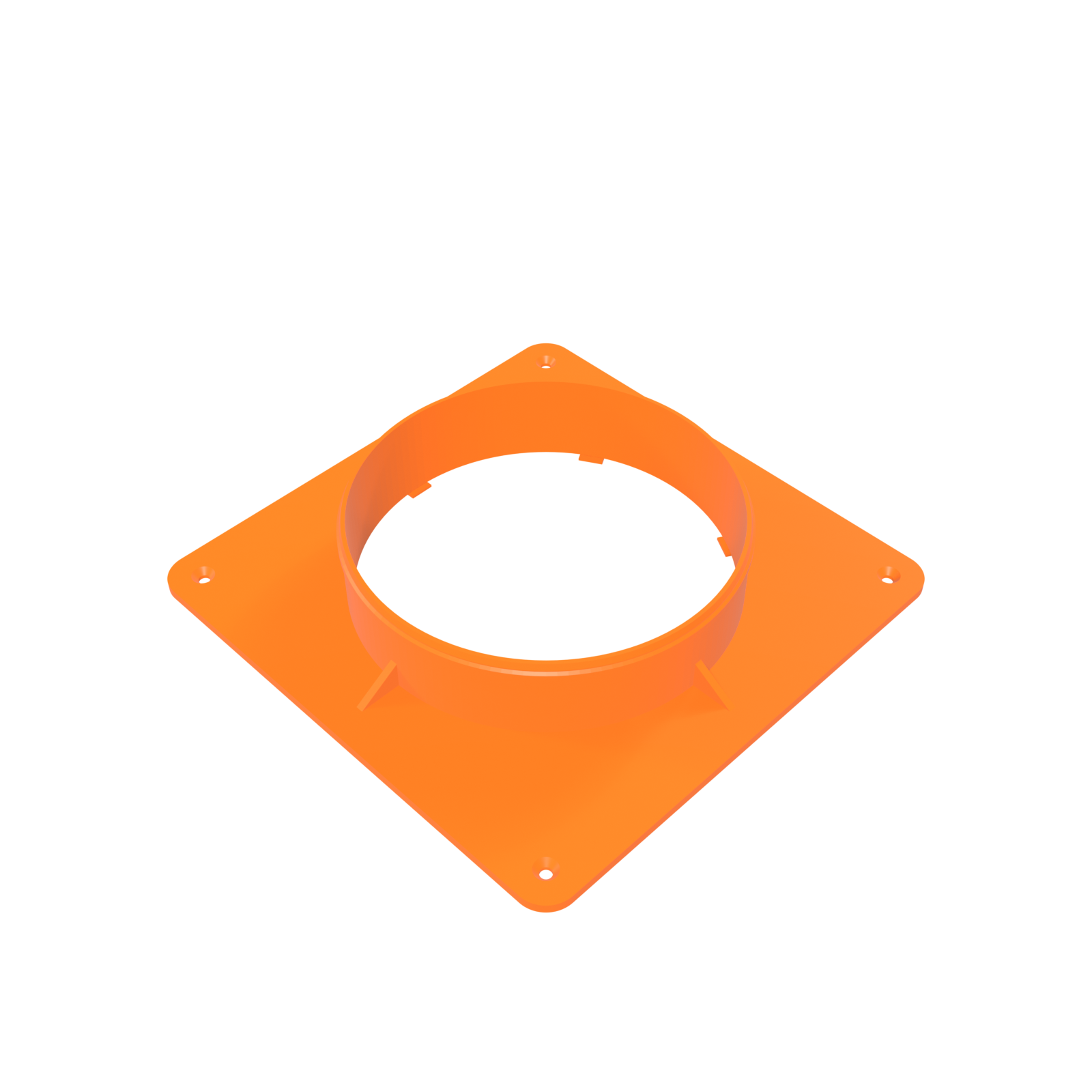
6-inch flex duct window vent port: the plate that puts your miner’s heat outside. Male collar for 6-inch flex duct, gasket groove, countersunk screw holes and a built-in insect-screen rebate. PETG, made to order in Montreal, Quebec.
High Demand — Pre-order Now, Ships in 5-10 Business Days
Purchase details
Save 3% when you pay in Bitcoin.
This 6-inch flex duct window vent port is where a home mining run ends: a 210 mm square plate that mounts into a window insert panel, a plywood blank or a wall penetration, carrying a male collar that 6-inch flex duct slips straight over. Clamp the flex on behind the retention bead and the heat, the noise and the dust leave the room together.
It answers the question every apartment, basement and garage miner asks first — how do I vent this thing out a window without cutting a hole in the building. The plate screws to a panel you make and can unmake: acrylic, ply or rigid insulation cut to the window track. Renters get their deposit back; the window still closes on the panel.
The plate shares its hardware with the rigid 6-inch port — countersunk mounting holes, a gasket groove around the opening, and gussets under the collar so a hanging duct does not lever it out of the panel. What changes is the duct interface: a male collar for flex, 145.6 mm through the bore, instead of a socket for rigid pipe. Front to back the whole port is 39 mm, so it clears a closing sash rather than standing off the panel into the room.
If your run ends in rigid pipe rather than flex, the 6″ Window Exhaust Port takes a rigid socket and keeps a 153.2 mm bore — the larger opening of the two. Choose by what the last metre of your duct actually is. For a full-size 8-inch run, the 8-Inch Flex Duct Window Vent Port is the same idea on a 248 mm plate.
A window vent is a structural part, not a hole. It carries the weight of a hot duct, gets pulled sideways every time someone moves the machine, and sits in a temperature swing from a Quebec January to a hot exhaust stream. The gussets tie the collar to the plate so that load goes into the panel rather than into the collar root; the gasket groove gives a seal a place to sit and stay put instead of being taped across a rough cut edge; the countersunk holes let the screw heads sit flush so the window sash closes flat.
The opening runs clear — a single-piece port with no flap, no hinge pin and no moving parts to rattle in a night-time exhaust stream. That suits a machine that runs continuously, which is most of them. If you want one-way flow because you power down seasonally or the wind comes straight at that window, put an inline backdraft damper in the duct run, or cap the run at the shroud with a Threaded Collar Cap for Dual 120 mm to 6″ Shroud while the machine is down.
| Fits | Window insert panel, plywood or a wall penetration — countersunk mounting holes, gasket groove |
|---|---|
| Intake | Male collar for 6-inch flex duct, clamped below the retention bead |
| Outlet | 145.6 mm through-bore with insect-screen rebate and retention tabs (screen not supplied) |
| Footprint (mm) | 210 × 210 × 39 |
| Material | PETG |
| Colour | Black or orange PETG |
| Construction | Single piece with gussets, no moving parts |
| Design files | D-Central in-house design, released open source under CC BY-SA 4.0 |
| Download | window_port_6in_flex.zip — STL, CC BY-SA 4.0 licence, installation and safety guide |
| SKU | DUC-WIN-6F |
| Fulfilment | Made to order in Montreal, Quebec |
Getting exhaust out of a rented apartment should not depend on what one shop decides to stock, so D-Central Technologies designed this port and published it rather than keeping it. The plate, the gussets, the groove and the screen rebate are our drawing, released under CC BY-SA 4.0 at the 3D models download center — free to download, modify, remix, print and sell, including scaling the plate to your own window. Its card is the 6-inch flex window port model.
The file is window_port_6in_flex.zip: STL, CC BY-SA 4.0 licence, and the installation and safety guide. This listing is the finished part, made to order in PETG in Montreal, Quebec, gussets and screen rebate included, in black or in orange. The files stay free whether or not you ever buy anything — the printed port, and D-Central’s fund page, are what pay for the next design in the line.
Plan the whole run in the D-Central shroud and ducting system.
Cut a panel — acrylic, plywood or rigid insulation — to sit in the window track where the sash closes, mount this port in it, and run flex duct from the miner’s shroud to the collar. Nothing is drilled into the building, and the panel lifts out when you move. That is the whole reason this port is a flat plate with countersunk holes.
Match the last metre of your run. This one takes flex duct over a male collar; the 6″ Window Exhaust Port takes rigid pipe into a socket and keeps a 153.2 mm bore, against 145.6 mm here. If your run is already flex, this port ends it in one part instead of a stub plus an adapter.
No — the rebate and retention tabs are moulded into the plate, and you supply the mesh. Cut a disc to the bore plus about 7 mm and press it in behind the tabs. Fibreglass window screen from any hardware store works, and it comes out for cleaning without dismantling the port.
No. This is a single-piece port with a clear opening and nothing to hinge, rattle or jam — well suited to a machine that runs around the clock. If you shut down seasonally or the window faces prevailing wind, add an inline backdraft damper to the duct run, or cap the shroud while the machine is off.
A 6-inch run is the usual size for a single air-cooled ASIC and matches the 6-inch shrouds in this line. If you are venting a hard-driven machine, merging two miners, or running long duct with an inline fan, plan the run at 8 inches and use the 8-Inch Flex Duct Window Vent Port at the window. Either way the port is made to order in Montreal, Quebec and shipped worldwide.
| Weight | 182 g |
|---|---|
| Dimensions | 21 × 21 × 3.9 cm |
| Colour | Black, Orange |
Only logged in customers who have purchased this product may leave a review.
Home » 3D-Printed Bitcoin Mining Parts: Free STL Files and What’s Worth Printing There has never been a better time to own a 3D printer…
Search for a duct adapter for your miner and you will drown in Antminer gear. Dual-120 shrouds, 120 mm silencers, 120 mm filter rings — an entire…
In any mining setup, the crux of your success lies in the efficient functioning of your mining hardware. Acknowledging this critical tenet, we turn to a paramount facet of mining…
Last reviewed August 19, 2026.
Reviews
There are no reviews yet.