
3D-Printed Bitcoin Mining Parts: Free STL Files and What’s Worth Printing
Home » 3D-Printed Bitcoin Mining Parts: Free STL Files and What’s Worth Printing There has never been a better time to own a 3D printer…
$30.99 CAD
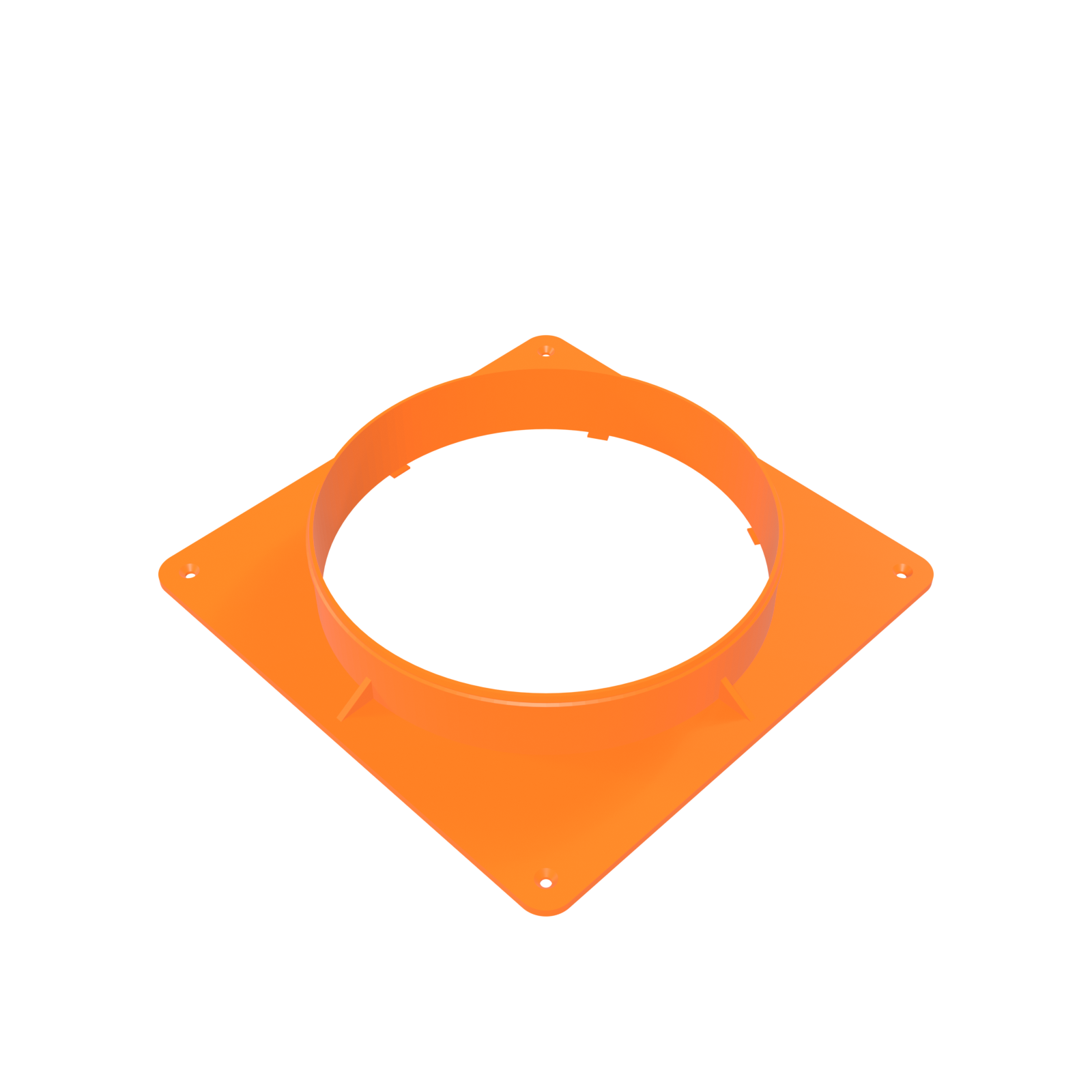
8-inch flex duct window vent port: the outdoor end of a full-size ASIC exhaust run. A 248 mm plate with a male collar that 8-inch flex duct slips over, a gasket groove and an insect-screen rebate. PETG, made to order in Montreal, Quebec.
High Demand — Pre-order Now, Ships in 5-10 Business Days
Purchase details
Save 3% when you pay in Bitcoin.
An 8-inch flex duct window vent port for the runs that actually move a machine’s whole exhaust: a 248 mm square plate that mounts in a window insert panel, plywood blank or wall penetration, presenting a male collar that 8-inch flex duct slips straight over and clamps behind the retention bead. It is the last part in the chain — shroud, duct, elbow, port, outside.
Eight inches is the size that suits a hard-driven S21, a long duct run with an inline fan pushing it, or two machines merged into one trunk. Getting that volume through a window is a different job from venting a single small miner: the duct is heavier, it pulls harder on whatever it is attached to, and the opening is big enough that how it is mounted starts to matter structurally. This plate is drawn for that: gussets tying the collar into the face, countersunk mounting holes so the sash closes flush, and a gasket groove around the opening. The plate itself is only 39 mm deep, which is how a 248 mm flange still sits tight against the panel instead of standing off it.
Through the bore it runs 196.4 mm — the collar has to be male for flex duct to slip over it, and a male collar is the version a flex core can clamp to. The rigid 8-inch port keeps a larger 204.0 mm socket for runs that end in pipe. Pick by what your last metre is made of, not by the number.
Running rigid pipe to the window instead? The 8″ Window Exhaust Port takes rigid into a socket and holds the larger 204.0 mm opening. Venting a single smaller machine? The 6-Inch Flex Duct Window Vent Port puts the same features on a 210 mm plate that fits narrower window tracks.
Anyone can cut a 200 mm circle. What breaks a window vent is everything around that circle: the flex duct hanging off one side of it, the sash pressing on the other, and a hot airstream running through a plate that is trying to seal against a rough-cut panel edge. The gussets carry the duct’s pull into the plate face instead of the collar root. The gasket groove holds a seal in place permanently rather than relying on tape to stay stuck to a warm surface. The countersunk holes let the screw heads sit below flush so the sash closes onto a flat face and the window still locks.
The opening itself is clear — a single-piece port, no flap, no hinge, nothing to chatter at three in the morning while the machine runs. That is the right choice for continuous operation. If you shut down for the summer or the window faces the wind, put an inline backdraft damper in the run or blank the run off at the shroud end.
| Fits | Window insert panel, plywood or a wall penetration — countersunk mounting holes, gasket groove |
|---|---|
| Intake | Male collar for 8-inch flex duct, clamped below the retention bead |
| Outlet | 196.4 mm through-bore with insect-screen rebate and retention tabs (screen not supplied) |
| Footprint (mm) | 248 × 248 × 39 |
| Material | PETG |
| Colour | Black or orange PETG |
| Construction | Single piece with gussets, no moving parts |
| Design files | D-Central in-house design, released open source under CC BY-SA 4.0 |
| Download | window_port_8in_flex.zip — STL, CC BY-SA 4.0 licence, installation and safety guide |
| SKU | DUC-WIN-8F |
| Fulfilment | Made to order in Montreal, Quebec |
The plate, the gussets, the gasket groove and the screen rebate are D-Central Technologies’ own drawing — ours from the first line, not a remix — and they are released under CC BY-SA 4.0 at the 3D models download center, free to download, modify, remix, print and sell. The model card is the 8-inch flex window port. Anyone with the build volume for a 248 mm plate can make one, and we would rather they did than that a miner ran unvented.
Everything is in window_port_8in_flex.zip — the STL, the CC BY-SA 4.0 licence, and the installation and safety guide. This listing is the finished port, made to order in PETG and shipped from Montreal, Quebec; black and orange are both stocked. The download stays free forever; buying the port, or giving at D-Central’s fund page, is what funds the next design in the line.
Lay the whole run out with the D-Central shroud and ducting system.
It needs a panel at least 248 mm in the short dimension plus room for the frame, which rules out some narrow basement hoppers and short sliders. Hold a tape across the sash opening before you order. Where the window is tight, run 8-inch duct up to a reducer and finish with the 6-Inch Flex Duct Window Vent Port on its 210 mm plate.
Whichever matches your last metre of duct. This one carries a male collar for flex; the 8″ Window Exhaust Port is a socket for rigid pipe and holds a 204.0 mm opening against 196.4 mm here. Ending a flex run on this port saves a rigid stub and one extra joint.
Merge them upstream, not at the window. An 8″ to Dual 6″ Y-Splitter run in reverse brings two 6-inch drops into one 8-inch trunk with roughly equivalent section area, and that trunk then ends on this port. Teeing two ducts into one small opening is where runs get choked.
No — the opening is clear and single-piece, with nothing that can chatter, which is what a continuously running machine wants. For seasonal shutdowns or a wind-facing wall, fit an inline backdraft damper in the duct run where it can be serviced, rather than relying on a flap at the coldest, wettest point of the system.
Yes. The countersunk holes and gasket groove work the same against siding, sheathing or a plywood blank in a garage wall — it is a flat plate with a collar. In a wall, seal the outside face properly and give the duct a slight fall to the outside so nothing tracks back along it.
| Weight | 215 g |
|---|---|
| Dimensions | 24.8 × 24.8 × 3.9 cm |
| Colour | Black, Orange |
Only logged in customers who have purchased this product may leave a review.
Home » 3D-Printed Bitcoin Mining Parts: Free STL Files and What’s Worth Printing There has never been a better time to own a 3D printer…
Search for a duct adapter for your miner and you will drown in Antminer gear. Dual-120 shrouds, 120 mm silencers, 120 mm filter rings — an entire…
In any mining setup, the crux of your success lies in the efficient functioning of your mining hardware. Acknowledging this critical tenet, we turn to a paramount facet of mining…
Last reviewed August 19, 2026.
Reviews
There are no reviews yet.