

Quiet Antminer Fans: The Complete Guide to Silent Bitcoin Mining at Home
In the rapidly evolving world of cryptocurrency, Bitcoin mining has emerged as a cornerstone activity for enthusiasts and investors alike.
$35.99 CAD
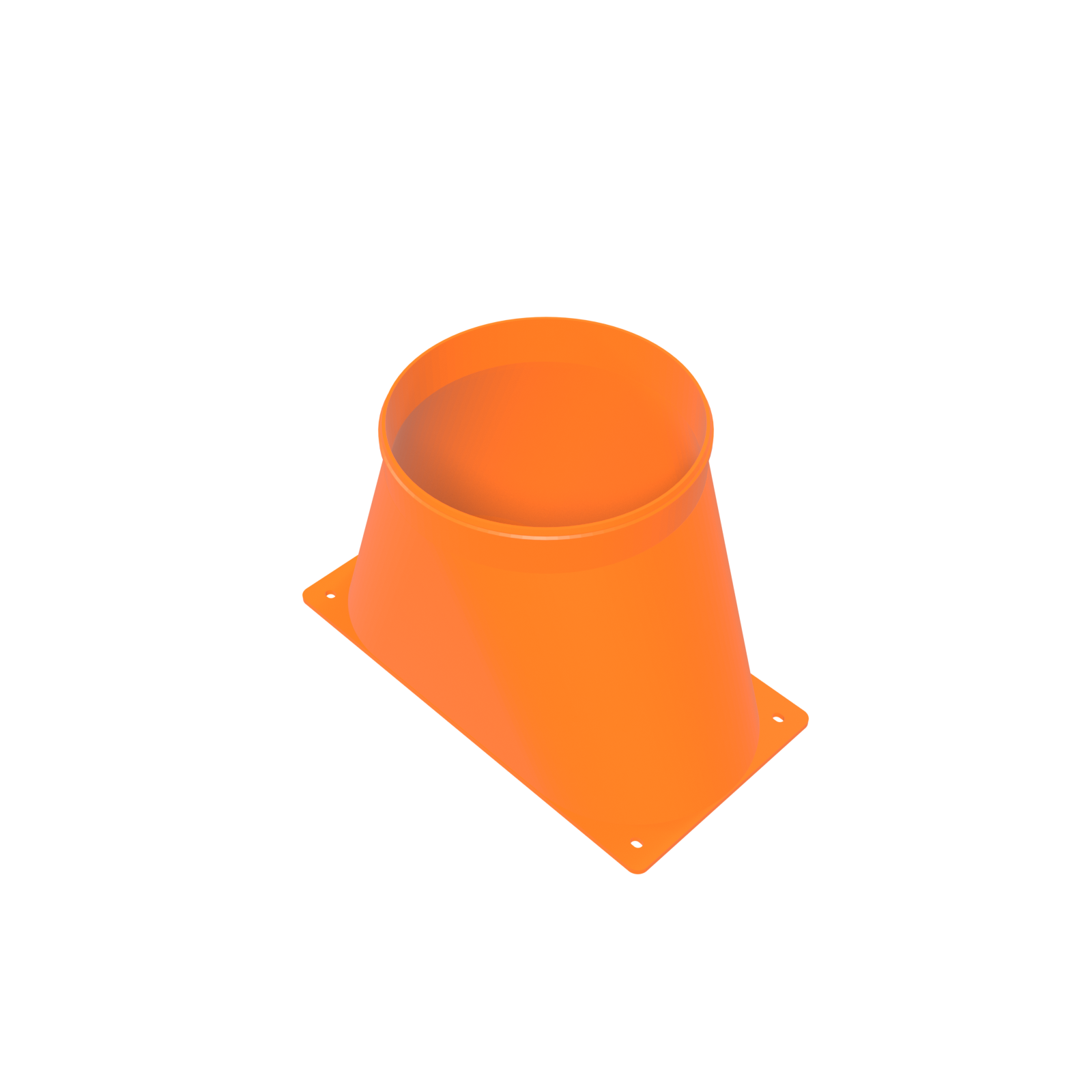
150 mm duct shroud for Antminer S19 series and standard S21 machines: both 120 mm exhaust fans into one true metric 150 mm collar, not a 6-inch collar with tape. Single-piece PETG, made to order in Montreal, Quebec.
High Demand — Pre-order Now, Ships in 5-10 Business Days
Purchase details
Save 3% when you pay in Bitcoin.
Use the S21 cluster to connect current-generation specs, buying options, chip-level parts, troubleshooting, and repair support.
A 150 mm duct shroud exists because 6 inches is 152.4 mm. If you live anywhere that sells ventilation in millimetres, that gap is the reason your ASIC ducting looks the way it does: a 150 mm hose stretched over an imperial collar, foil tape doing the sealing, and a joint you re-tape every few months. This shroud takes the dual 120 mm exhaust of an Antminer S19-class or standard S21-class machine and lands it on a collar drawn in metric from the start.
150 mm is the workhorse domestic extraction size across Europe and much of the metric world: what the extract fans use, what the cheap hose comes in, and what every builders merchant stocks. Both fan columns are gathered inside a single-piece PETG body and converge into one 150 mm outlet.
Fitment is decided by the fan face, not the model badge: any miner with two touching 120 mm exhaust fans on a 120.0 mm pitch, 116.0 mm bore per fan with a 2.0 mm sealing land per side. In practice that is the Antminer S19 series, including the S19j Pro and S19 XP, and the standard S21.
It is not for 140 mm machines. If your miner has two 140 mm fans, the S21 Pro and S21+ generation among them, use the dual 140 mm to 150 mm metric duct shroud instead. If your ducting is 160 mm rather than 150 mm, that is the 160 mm version, and if it is imperial 6-inch, the 6-inch version.
Duct joints fail in one of two ways. Either the collar is too big and the hose is stretched until the spiral wire deforms, or it is too small and tape becomes the structure holding the run together. A collar cut for the hose you own avoids both: crest at duct nominal, sealing land 2.0 mm below it, at or under the male metric hardware the duct is built to slide onto. The hose goes over the crest, a clamp closes onto the land, and the crest is the mechanical stop.
| Fits | Any miner with two touching 120 mm exhaust fans at 120.0 mm pitch (Antminer S19 series, standard S21, similar) |
|---|---|
| Intake | Two 120 mm fans at 120.0 mm pitch; 116.0 mm bore per fan, 2.0 mm sealing land per side |
| Outlet | 150 mm metric flex duct, flex-over collar; crest 150.0 mm, sealing land 148.0 mm |
| Footprint (mm) | 250.0 × 150.0 × 165.0 |
| Mounting | 5.0 mm holes on 5.424 mm slots; 9 mm or larger washer |
| Material | PETG |
| Colour | Black or orange PETG |
| Construction | Single piece, no seams or glued joints |
| Design files | D-Central in-house design, open source under CC BY-SA 4.0 |
| Download | 150 mm metric shroud bundle (ZIP) — STL, CC BY-SA 4.0 licence, installation and safety guide |
| SKU | ADP-D120-150-P |
| Fulfilment | Made to order in Montreal, Quebec |
Metric buyers are usually the ones paying international shipping on a part that weighs almost nothing. So D-Central Technologies gives the design away: we drew this shroud, we cut the 150.0 mm crest and the 148.0 mm sealing land, and we open-sourced the result under CC BY-SA 4.0 at the 3D models download center. Its own card is at the dual 120 mm to 150 mm entry, free to download, modify, print and sell, and the direct download is the 150 mm metric shroud bundle: STL, CC BY-SA 4.0 licence, and the installation and safety guide. If there is a printer within reach, that is the fastest route to a 150 mm collar. If not, this listing is the finished part, made to order in black or orange PETG in Montreal, Quebec and shipped worldwide — the collar geometry stays free either way, and a sale here or a gift at the D-Central fund page is what pays for the next metric size on the board.
The full range is in the D-Central shroud and ducting system.
No. Six inches is 152.4 mm, so an imperial collar is 2.4 mm larger than a 150 mm one. On a rigid fitting that is an interference; on flex hose it is the gap that tape ends up filling. If your duct is sold in millimetres, buy this collar. If it is sold in inches, buy the 6-inch version.
Anything with two touching 120 mm exhaust fans on a 120.0 mm pitch. That covers the S19 family broadly, S19j Pro and S19 XP included, plus the standard S21. Check the fan size before the model name: a machine with 140 mm fans needs the dual 140 mm version, however similar the chassis looks.
That is exactly the case this size is drawn for. A 150 mm inline fan, 150 mm hose and this collar all speak the same number, so the run is clamps and hose the whole way with no adapter sitting in the flow. Keep the fan downstream of the shroud, pulling rather than pushing, and the joints stay under suction.
Buy the one your existing hose and fan are. If you are starting from nothing and the run is long, has bends, or feeds more than one machine, the extra area of the 160 mm version is worth having. For a short run to a nearby window with off-the-shelf domestic parts, 150 mm is cheaper and easier to source.
| Weight | 344 g |
|---|---|
| Dimensions | 25 × 15 × 16.5 cm |
| Colour | Black, Orange |
Only logged in customers who have purchased this product may leave a review.
In the rapidly evolving world of cryptocurrency, Bitcoin mining has emerged as a cornerstone activity for enthusiasts and investors alike.
Industrial mining hardware was never built for your house. 3D printing closes the gap — shrouds, enclosures, stands, and repairs. Here is what to print, what to buy, and where the limits are.
In the intricate world of cryptocurrency mining, the efficiency and longevity of mining hardware are paramount. A crucial but often overlooked component of this hardware’s operational…

Reviews
There are no reviews yet.