

Quiet Antminer Fans: The Complete Guide to Silent Bitcoin Mining at Home
In the rapidly evolving world of cryptocurrency, Bitcoin mining has emerged as a cornerstone activity for enthusiasts and investors alike.
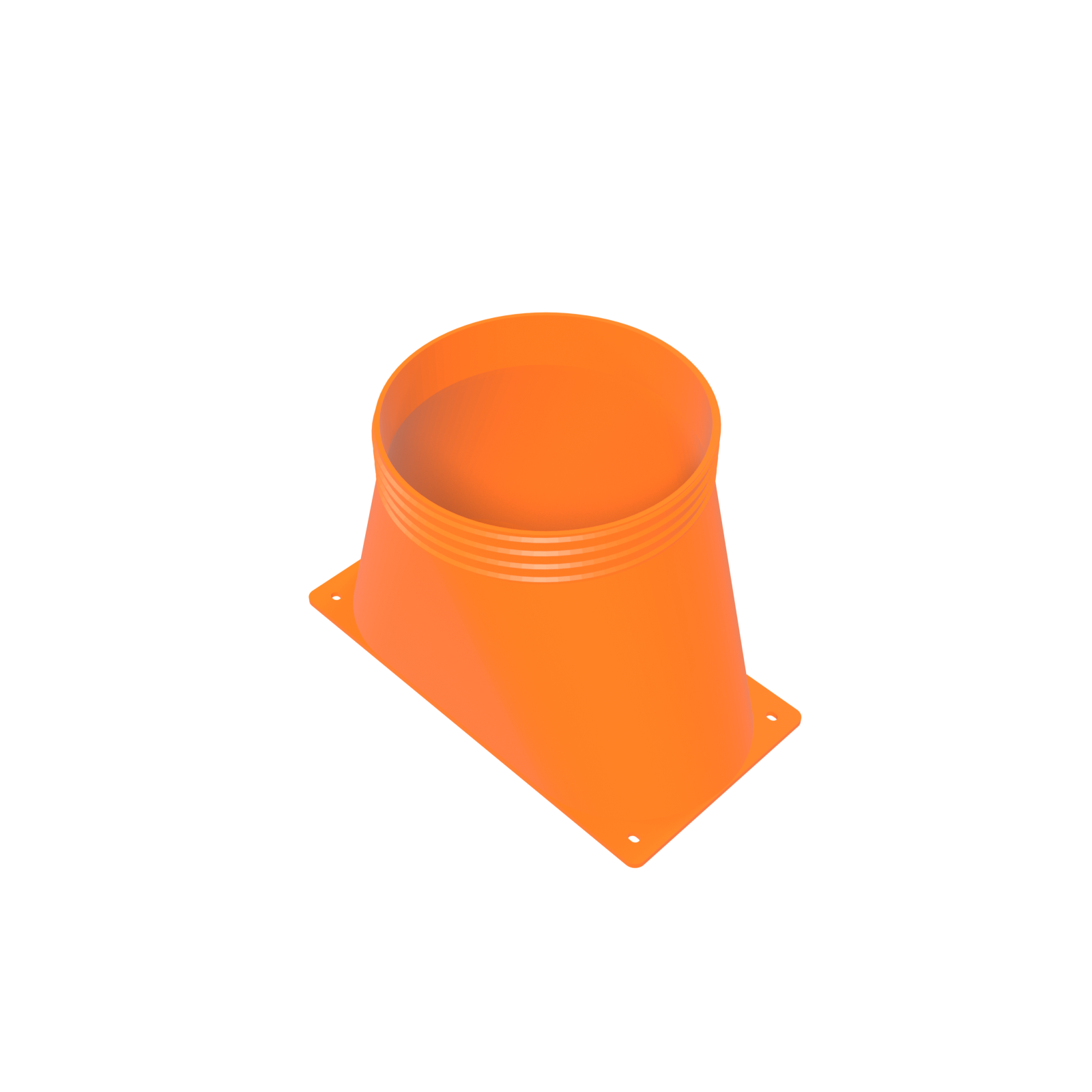
$38.99 CAD
Threaded-collar shroud for the Antminer S19 and standard S21: a coarse-pitch 6-inch screw collar that takes the matching duct receiver or a blank-off cap, for an exhaust stack you can reconfigure. One-piece PETG, made in Montreal, Quebec.
High Demand — Pre-order Now, Ships in 5-10 Business Days
Purchase details
Save 3% when you pay in Bitcoin.
Use the S21 cluster to connect current-generation specs, buying options, chip-level parts, troubleshooting, and repair support.
This threaded duct adapter shroud finishes the Antminer S19 and standard S21 dual 120 mm body with a coarse-pitch 6-inch screw collar, so whatever goes on the end threads down positively and stays there. It is the version to build around when you want an exhaust stack you can reconfigure: a duct receiver today, a blank-off cap next month, something you drew yourself after that.
Most exhaust installs are built once and fought with forever. A thread turns the end of the shroud into a standard interface, and everything downstream becomes a part you swap by hand rather than a joint you cut a clamp off to change.
Intake is the rear 120 mm fan pair on the Antminer S19, S19 Pro, S19j, S19j Pro, S19k Pro, S19 XP and the standard S21, on stock fan screws. The outlet carries a coarse thread, cut for hand-tightening in a warm, awkward space rather than a fine thread that cross-threads when you cannot see it.
Two companion parts screw straight on: the Threaded Duct Receiver 6-Inch — Screw-On Duct Adapter, which carries your duct, and the Threaded Collar Cap for Dual 120 mm to 6" Shroud, which seals the outlet when a machine is offline. If you only want one duct on one machine, the plain Antminer S19 / S21 Dual 120 mm to 6" Duct Shroud does that for less. The S21 Pro, S21+ and S21 XP all carry a 140 mm fan pair and take the Antminer S21 Pro Dual 140 mm to 6" Duct Shroud, and the same thread on a broader base is the Antminer S19 / S21 Dual 120 mm to 6-Inch Threaded Shroud — Wide Base.
A thread does two things a smooth barrel cannot. It pulls the two parts together axially as it tightens, so the joint closes itself instead of relying on a band squeezing from outside. And it is repeatable: the hundredth time you screw a cap on, it lands where the first one did, which is what makes a modular stack worth having. That matters most in rooms with more than one machine, where units come offline for repair and seasons change what you want done with the heat. The wall around the thread is drawn thicker than the plain collar so it takes being turned repeatedly.
| Fits | Antminer S19 series and standard Antminer S21 — rear 120 mm fan pair |
|---|---|
| Intake | 2 × 120 mm fans |
| Outlet | 6″ threaded collar, coarse pitch |
| Mount style | Threaded collar — screw-on receiver or blank-off cap |
| Mates with | Threaded Duct Receiver 6″ (RCV-THR-6); Threaded Collar Cap (DC-ACC-CAP-D120-6) |
| Footprint | 250 × 170 × 160.2 mm |
| Material | PETG |
| Colour | Black or orange PETG |
| Construction | Single continuous body — no assembly, no fasteners, no glued joints |
| Design files | Open source, CC BY-SA 4.0 — free to download, modify and redistribute |
| Download | STL, licence and installation guide (ZIP) — listed on the model card |
| SKU | DC-SHR-THR-D120-6 |
The thread profile is published, which is the point of designing one. It goes out with the rest of the line as open source under CC BY-SA 4.0 at the 3D models download center, free to download, modify, print and sell, so anything you draw with the same thread lands on this collar.
D-Central Technologies cut that thread form, and it belongs to anyone who wants it. The card for this model links the ZIP: the STL, the CC BY-SA 4.0 licence and the installation and safety guide, in one download.
What this page sells is the finished shroud, made to order in black or orange PETG and shipped from Montreal, Quebec, for the days you would rather duct a machine than model one. Orders keep the system growing, and D-Central’s fund page backs the published work on its own.
Receivers, caps, couplers and every other fitting in the family are in the D-Central shroud and ducting system.
The 6-inch threaded duct receiver is the everyday partner: your duct clamps to it, and it screws to the shroud. The threaded collar cap blanks the outlet when the machine is idle. Because the thread profile ships with the open files, anything you cut the same thread into will land here as well.
No. They are two ways of terminating the same airflow body, and a bayonet fitting will not screw onto a thread. Pick one interface per machine and stay with it: threaded suits a stack you reconfigure deliberately, bayonet suits a duct you take off in a hurry several times a month.
An idle machine with an open duct is a hole in your building: cold outside air backdrafts down the line, and dust settles into a unit between jobs. In a row where only some machines run, blanking off the idle ones also stops the shared duct pulling air backwards through them instead of forwards through the working units.
A coarse printed thread pulls the two faces together as it tightens, so the seal comes from the shoulders meeting rather than from the thread flanks. Hand-tight is enough. This is an exhaust at fan pressure, and the loads it sees are the weight of a duct and the occasional shove, both of which a thread takes better than friction does.
Buy the plain dual-120 shroud if one duct is going onto one machine and staying there. Buy this one if you are building a room: machines that come and go, heat redirected by season, outlets that need blanking off. The thread earns its cost only when you intend to change something later.
| Weight | 365 g |
|---|---|
| Dimensions | 25 × 16.02 × 17 cm |
| Colour | Black, Orange |
Only logged in customers who have purchased this product may leave a review.
In the rapidly evolving world of cryptocurrency, Bitcoin mining has emerged as a cornerstone activity for enthusiasts and investors alike.
Industrial mining hardware was never built for your house. 3D printing closes the gap — shrouds, enclosures, stands, and repairs. Here is what to print, what to buy, and where the limits are.
In the intricate world of cryptocurrency mining, the efficiency and longevity of mining hardware are paramount. A crucial but often overlooked component of this hardware’s operational…

Reviews
There are no reviews yet.