

Quiet Antminer Fans: The Complete Guide to Silent Bitcoin Mining at Home
In the rapidly evolving world of cryptocurrency, Bitcoin mining has emerged as a cornerstone activity for enthusiasts and investors alike.
$41.99 CAD
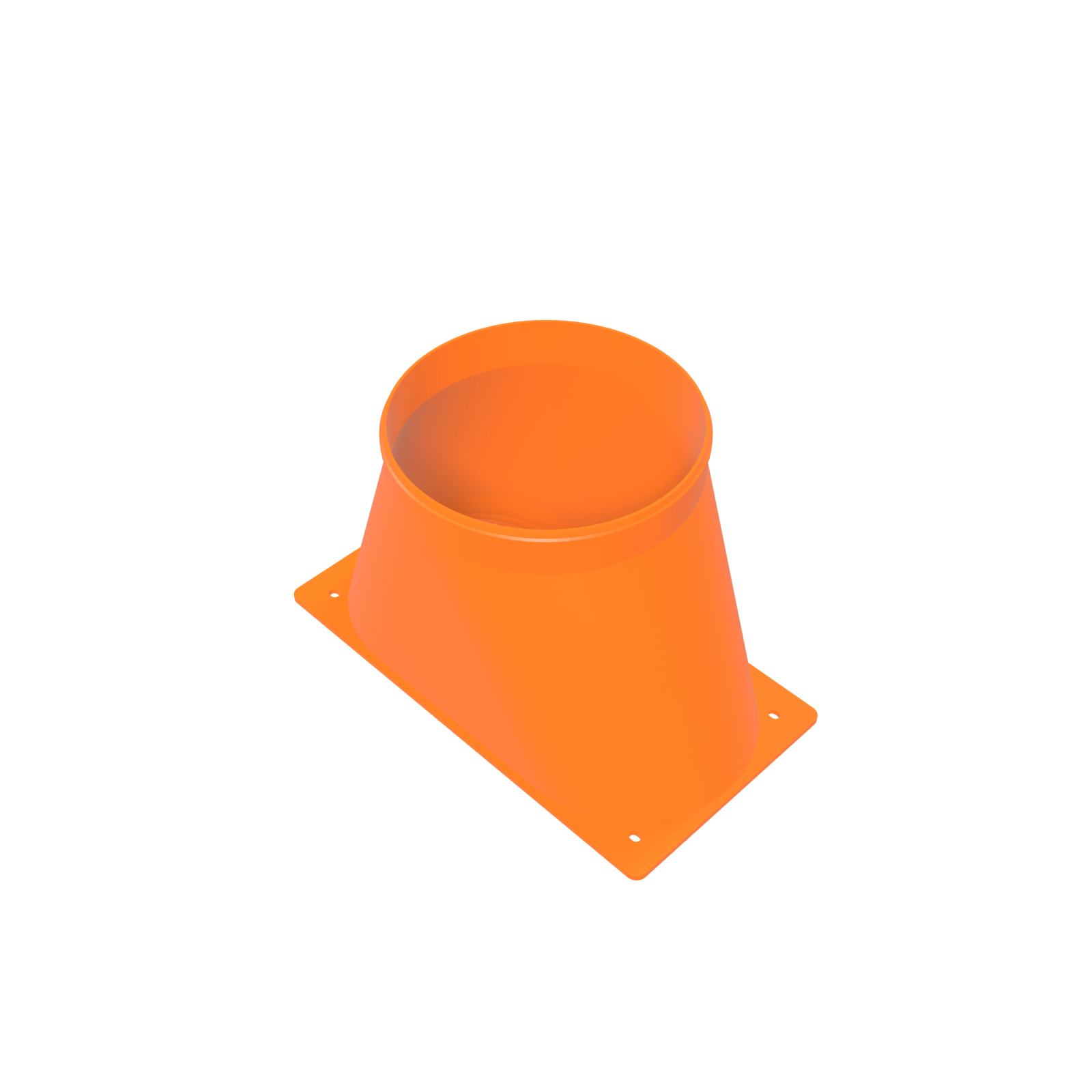
Venturi shroud for the Antminer S19 and S21: a contoured bell replaces the square step above the fan plate, carried on the wide 260 mm base. Both 120 mm exhaust fans into one 6-inch duct. Made to order in PETG in Montreal, Quebec.
High Demand — Pre-order Now, Ships in 5-10 Business Days
Purchase details
Save 3% when you pay in Bitcoin.
Use the S21 cluster to connect current-generation specs, buying options, chip-level parts, troubleshooting, and repair support.
A venturi shroud for an ASIC miner exists because of what happens at a sharp lip. Where a flat plate meets a round hole, air coming off the fan cannot turn the corner cleanly — it separates at the edge and rolls into a standing bubble that sits in the opening and narrows it. This shroud replaces that step with a contoured bell the air column can follow into the throat, drawn around the dual 120 mm exhaust face of an Antminer S19 or standard S21 and finishing in a 6-inch collar.
It rides on the wide 260 mm base plate rather than the 250 mm standard, which is not incidental here. A bell needs plate to blend into: the wider the flange, the more radius the curve can carry before it runs out of room and has to be cut short.
The same bell on the narrower 250 mm plate is the standard-base venturi shroud, for racks where machines sit shoulder to shoulder. Want the plain conical transition instead? The plain wide-base 6-inch shroud is the same wide plate without it. If tonal fan whine rather than duct geometry is the real complaint, that is a job for the dual 120 mm expansion-chamber shroud silencer.
Lift the shroud over both exhaust fans so the eight flange slots land on the fan screw holes, then refit with M4 screws and a 9 mm or larger flat washer under each head — or reuse the miner’s large-head fan screws, which bridge the 6.40 × 5.00 mm slots on their own. Every screw has between 8.11 and 8.50 mm of driver clearance, so the job is done from the back of the rack. Push 6-inch flex duct over the collar until it passes the retention bead onto the band behind it, and support the duct at its first turn.
Bell-mouth entries are old, settled geometry — they are how wind tunnels and inlet ducts are shaped wherever air has to enter a bore without tearing off the lip. A corner forces the streamlines to turn faster than they can, so they leave the wall; a curve of increasing radius asks them to turn gradually, so they stay attached to it.
| Fits | Antminer S19 series and standard S21, and any dual 120 mm exhaust face on the same pattern |
|---|---|
| Intake | Dual 120 mm fan capture — 120.0 mm fan pitch, 105 mm screw square, 6.40 × 5.00 mm mounting slots |
| Outlet | 6-inch flexible duct over the collar, fed by a contoured venturi bell |
| Footprint (mm) | 260 × 165 × 152.4 |
| Material | PETG |
| Colour | Black or orange PETG |
| Construction | Single-piece print, no seams or fasteners in the airway |
| Design files | Open source under CC BY-SA 4.0 — 3D models download center |
| Download | STL, licence and installation guide (ZIP) — listed on the model card |
| Fulfilment | Made to order in Montreal, Quebec |
| SKU | ALT-D120-6-VEN |
The bell profile was drawn in-house by D-Central Technologies, and it is not a secret. The shroud designs go out under CC BY-SA 4.0 through the 3D models download center, free to download, modify, print and sell. This model’s card links the ZIP: STL, CC BY-SA 4.0 licence, installation and safety guide.
What you buy here is the finished object: PETG in black or orange, made to order in Montreal, Quebec, in a mount style you would otherwise have to schedule yourself. The D-Central fund page supports the drawing work behind the catalogue.
See the whole D-Central shroud and ducting system.
The shape of the entry, and nothing else. On the plain shroud the plenum meets the round outlet at a step; here it meets it through a curved bell whose radius tightens into the throat. Mounting dimensions and collar match the plain wide-base 6-inch shroud, so the two swap on one duct run.
The wide 260 mm plate is the better home for a bell, because the curve has more flange to blend into before it has to stop. Choose the 250 mm standard-base venturi shroud only when machines are packed close enough that the wider flange would run into the chassis next door.
A band holds on the sealing land behind the retention bead, but there is no recessed seat to stop it creeping under vibration. If you want the clamp captured between two shoulders, the wide-base clamp-groove shroud is built for that.
Yes. Both present the standard dual 120 mm rear face, 120.0 mm apart on a 105 mm screw square, which is the pattern this flange is cut to. The S21 Pro and S21 XP moved to 140 mm fans and sit outside this family; those take the S21 Pro dual 140 mm shroud.
Take the plain wide-base shroud for the shortest, most compact hood on the machine and a straightforward duct handoff. Take the venturi if you would rather air entered the bore off a curve than off a lip. The price gap is the size and build of the part, not a different collar.
| Weight | 388 g |
|---|---|
| Dimensions | 26 × 15.24 × 16.5 cm |
| Colour | Black, Orange |
Only logged in customers who have purchased this product may leave a review.
In the rapidly evolving world of cryptocurrency, Bitcoin mining has emerged as a cornerstone activity for enthusiasts and investors alike.
Industrial mining hardware was never built for your house. 3D printing closes the gap — shrouds, enclosures, stands, and repairs. Here is what to print, what to buy, and where the limits are.
In the intricate world of cryptocurrency mining, the efficiency and longevity of mining hardware are paramount. A crucial but often overlooked component of this hardware’s operational…


Reviews
There are no reviews yet.