Results filter by Products, Guides, Miner DB, Glossary and Troubleshooting
Universal Single 120 mm Fan to 6″ Duct Shroud
$21.99 CAD
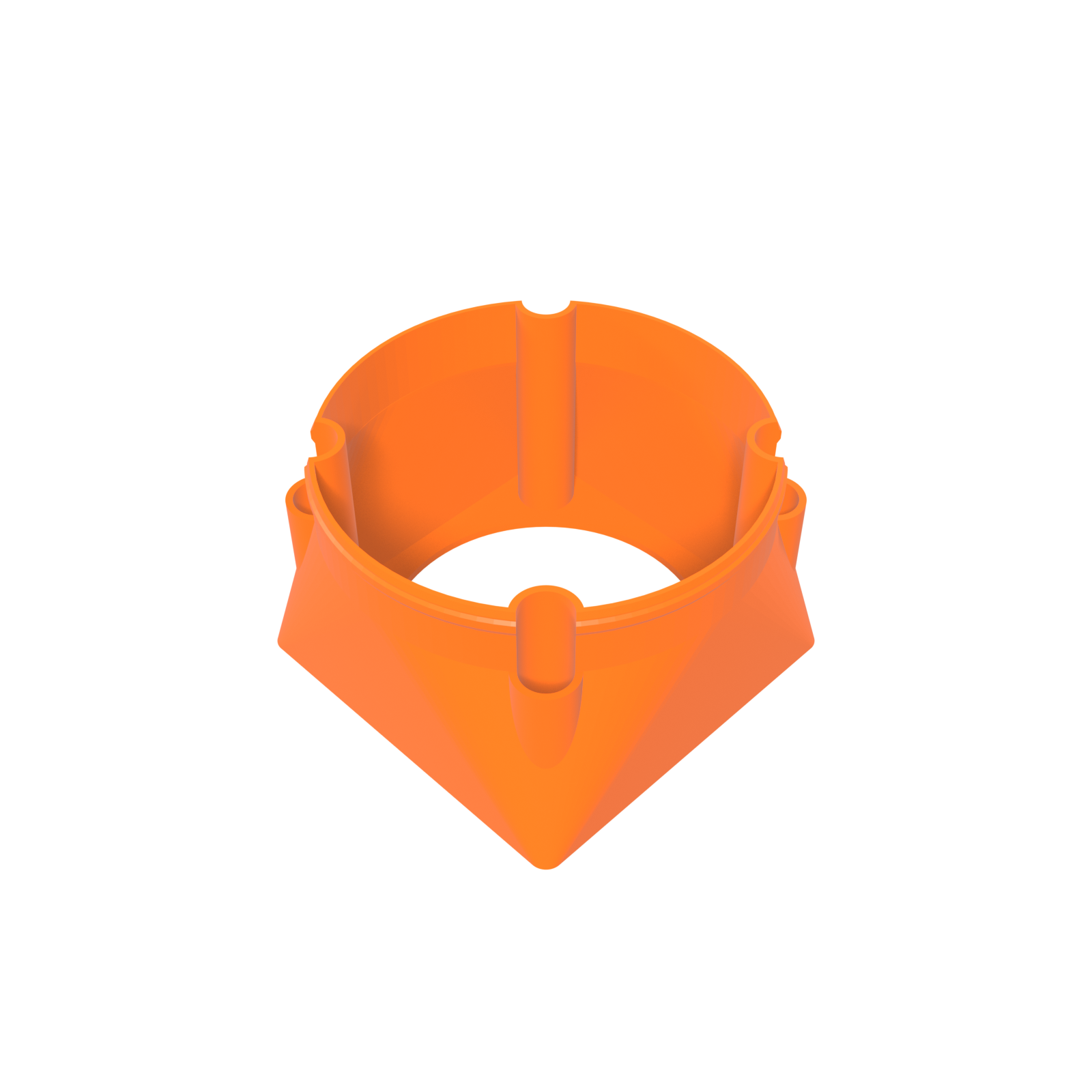
120 mm fan to 6-inch duct adapter for any single-fan machine: a standard 120 mm flange on the 105 mm screw square in, a 6-inch duct collar out, in one continuous PETG body with no seams to leak. Designed and made to order in Montreal, Quebec, and released open source.
Condition: New
Availability: In stock
Returns: 30 days from delivery to report a defect or dead-on-arrival unit. No change-of-mind returns.
Warranty: Covered by the manufacturer's warranty, as stated on this listing at purchase.
Support: Ships from Canada with D-Central mining hardware and repair support
120 mm fan to 6-inch duct adapter, drawn as one piece
This 120 mm fan to 6-inch duct adapter takes one standard 120 mm exhaust fan and hands everything it moves to a 6-inch duct. D-Central drew it in-house around the fan flange and the collar, then built it as a single continuous body — no seams to leak air, no glued joints, no fasteners to work loose across a few thousand heat-and-cool cycles.
A bare fan blowing into open air throws heat in every direction at once, and radiates its noise the same way. Capture that column and hand it to a duct, and an uncontrolled heat source becomes a single steerable exhaust path — the difference between a machine you tolerate in the basement and one you place on purpose.
It is the workhorse of the line: single-fan hashboard benches, Antminer S9-class hardware, PSU exhaust fans, older machines, home-built enclosures.
What it fits: any standard 120 mm fan, out to 6-inch duct
The intake face is drawn to the standard 120 × 120 mm fan flange on its 105 mm screw square — the pitch shared by essentially every conventional 120 mm fan, from Antminer S9-family exhaust fans to PSU, enclosure and case fans. The stock fan stays fitted and nothing electrical is touched.
The outlet is a 6-inch collar for ordinary flexible or rigid duct, the same diameter AC Infinity Cloudline S6 and T6 class inline fans use.
Seat the shroud over the exhaust side of the fan, square to the flange.
Slide 6-inch flexible or rigid duct over the collar.
Band-clamp the duct down and snug it.
Route the run where the heat belongs: a window port, a wall penetration, a shop or garage, or an inline fan feeding a longer trunk.
One screwdriver for the band clamp is the whole tool list: no fan swap, no wiring.
Why a shaped body beats a plate with a hole in it
The cheap way to make this part is a flat plate with a round cut-out. Air leaving the blades then turns a hard corner immediately, where it is fastest and least organised, and the corners of the square fan face become dead pockets that spill pressure instead of passing it along. This body makes the change gradually, across its full 95 mm depth, into a 6-inch round slightly larger in area than the square face feeding it: a gentle expansion rather than a squeeze.
PETG keeps its shape under sustained exhaust-side warmth, where cheaper printing plastics soften and sag away from the collar.
Captures the whole 120 mm fan face rather than a circle cut out of the middle of it
Turns square into round across the depth of the body, not at one hard step
Seats on the standard 105 mm screw square, so it goes onto the fan you already own
Holds its geometry in sustained exhaust heat — PETG, not a low-temperature plastic
Arrives finished in one piece: nothing to assemble, nothing to glue, nothing to lose
Specifications
Fits
Any standard 120 × 120 mm fan flange on the 105 mm screw square — the pattern an Antminer S9-class exhaust fan, a PSU fan or a case fan carries
Intake
1 × 120 mm fan
Fan screw pitch
105 mm square (standard 120 mm fan pattern)
Outlet
6″ duct collar (152.4 mm nominal)
Footprint
152.4 × 152.4 × 95 mm
Material
PETG
Colour
Black or orange PETG
Construction
Single continuous body — no assembly, no fasteners, no glued joints
Design files
Open source, CC BY-SA 4.0 — free to download, use, modify and redistribute
Open source — print it yourself, or buy it finished
D-Central designs these parts and gives the designs away. This one is released under CC BY-SA 4.0 through our 3D models download center: free to download, modify, remix, print and sell, with no licence to buy and nothing held back behind a purchase.
D-Central Technologies drew this geometry and open-sourced it. It is ours — not a remix, not a re-hosted file. The model has its own card at the 120 mm to 6-inch shroud entry, and the file is one click away: single_120_to_6in.zip holds the STL, the CC BY-SA 4.0 licence and the installation and safety guide.
What this listing buys is the finished part: made to order in PETG, in black or orange, and shipped from Montreal, Quebec, ready to clamp a duct onto. The files stay free either way — buying the printed part, or backing D-Central’s fund page directly, is what pays for the next design in the line.
Will this fit any 120 mm fan, or only Antminer fans?
Any conventional 120 mm fan. The mounting face is drawn to the 120 × 120 mm flange on the 105 mm screw square, the standard pattern on Antminer S9-class exhaust fans, PSU fans, enclosure fans and case fans alike. The fan size decides fit here, not the badge on the machine.
Can I clamp ordinary 6-inch dryer or grow-room hose to it?
Yes. The collar is sized for common 6-inch flexible and rigid duct and takes a standard band clamp. If you are joining thin-wall flexible duct and want a cleaner grip, the 6-Inch Flex Duct Adapter gives the hose a proper landing instead of clamping it straight onto the shroud.
My miner has two fans. How many do I need?
One shroud per fan you intend to duct. Most people duct the exhaust end only and fit a 120 mm Intake Filter Ring on the cold end instead. If both fans sit on one exhaust face, as on an S19 or S21, a single dual 120 mm shroud beats two separate ducts.
6-inch or 8-inch — which should I pick?
6-inch is the right default for a single 120 mm fan on a short, direct run: machine near the wall, one bend at most, straight out. Step up to the 8-inch version when the duct has real length, several turns, an 8-inch inline fan in the path, or a shared trunk at the end of it.
How is it made, and how soon does it ship?
Each one is printed to order in PETG in Montreal, Quebec, then checked and shipped worldwide from Canada. Made to order is deliberate: it is how the line carries every fan-and-duct pairing rather than only the sizes that move fastest.
Additional information
Weight
230 g
Dimensions
15.24 × 15.24 × 9.5 cm
Colour
Black, Orange
Reviews
There are no reviews yet.
Only logged in customers who have purchased this product may leave a review.
Industrial mining hardware was never built for your house. 3D printing closes the gap — shrouds, enclosures, stands, and repairs. Here is what to print, what to buy, and where the limits are.
In any mining setup, the crux of your success lies in the efficient functioning of your mining hardware. Acknowledging this critical tenet, we turn to a paramount facet of mining…



Reviews
There are no reviews yet.