Results filter by Products, Guides, Miner DB, Glossary and Troubleshooting
Universal Single 120 mm Fan to 8″ Duct Shroud
$24.99 CAD
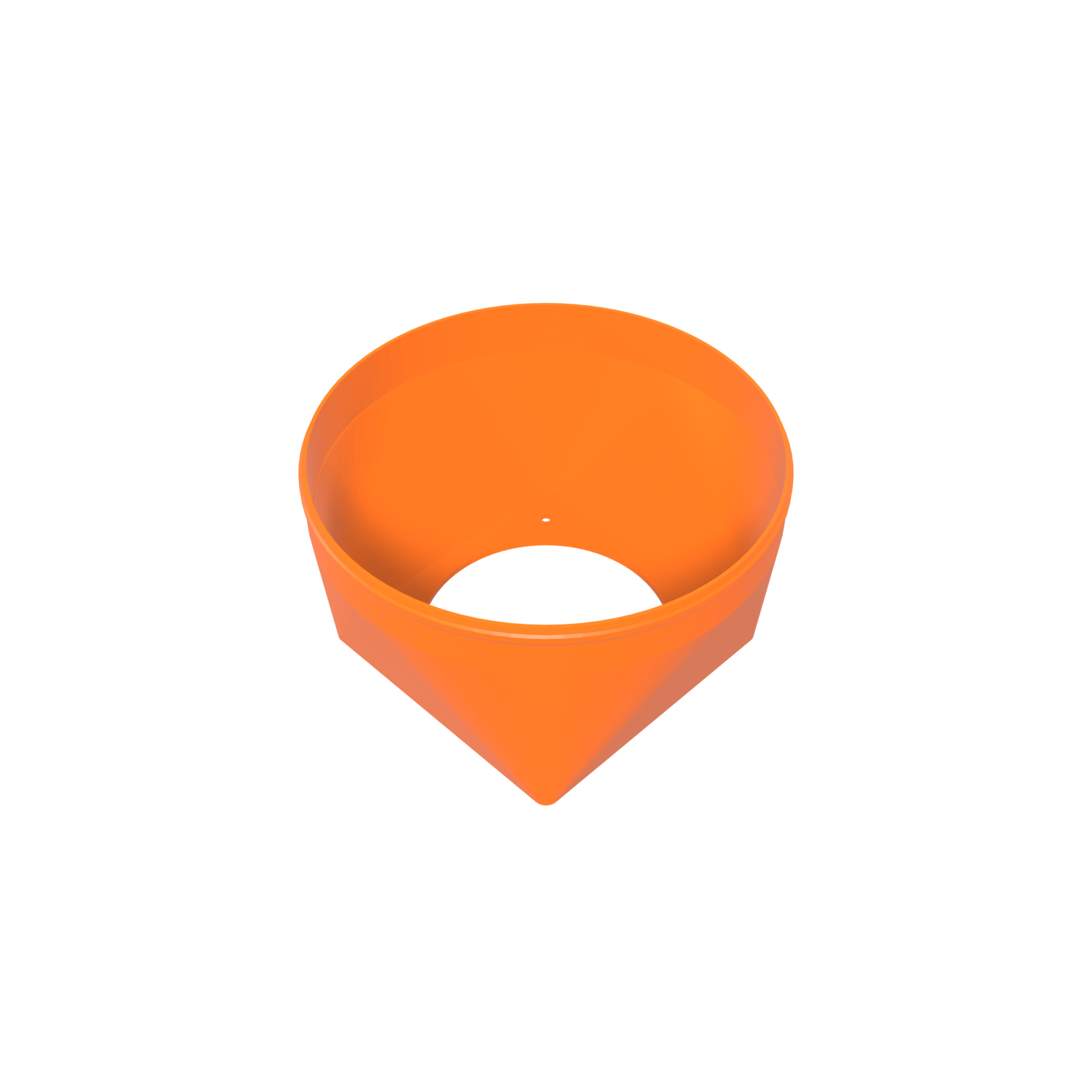
120 mm fan to 8-inch duct shroud for runs that have to travel: the same standard 120 mm fan face, opened to a full 8-inch collar so the first fitting is not the tightest one. Built for long, bendy runs, inline booster fans and shared trunks. Made to order in PETG in Montreal, Quebec.
Condition: New
Availability: In stock
Returns: 30 days from delivery to report a defect or dead-on-arrival unit. No change-of-mind returns.
Warranty: Covered by the manufacturer's warranty, as stated on this listing at purchase.
Support: Ships from Canada with D-Central mining hardware and repair support
120 mm fan to 8-inch duct shroud, sized for the run
This 120 mm fan to 8-inch duct adapter is sized for the duct, not for the fan. One 120 mm fan does not need eight inches of pipe to breathe. What needs eight inches is a run that has to cross a basement, turn two or three times, feed an inline booster fan, or join a trunk that other machines already share.
Same intake face as the 6-inch version, same single continuous PETG body drawn in-house, opened to a full 8-inch collar so the first fitting in the run is not also the tightest one.
Pick this one when you already know the path is long, bent, shared or fan-assisted. Pick the 6-inch when the machine sits beside the wall it exhausts through.
What it fits: standard 120 mm fan, full 8-inch duct
Intake is the standard 120 × 120 mm fan flange on its 105 mm screw square — the pattern shared by Antminer S9-class exhaust fans, PSU fans and enclosure fans. Stock fans stay in place and the shroud sits entirely outside the chassis.
The collar takes standard 8-inch flexible or rigid duct at 203.2 mm nominal, and mates with 8-inch inline fans of the AC Infinity Cloudline S8 and T8 class.
Seat it over the exhaust side of the fan, band-clamp 8-inch duct onto the collar, and build the rest of the run in 8-inch: coupler, elbow, trunk, window port. Hold the diameter as far along the path as you can and step down only at the last fitting, with an 8″ to 6″ Duct Reducer if the penetration is already 6-inch. Where an inline fan is in the path, put it downstream of the shroud so the shroud only has to collect, not pull.
Why starting the run at 8 inches is the cheap win
An 8-inch round has roughly 1.8 times the cross-sectional area of a 6-inch round, for the price of a slightly larger part. Every elbow, every metre of flexible duct and every reduction takes static pressure away from the fan, and a 120 mm fan is not carrying much to give away. This shroud is about where that budget gets spent: on the length and the turns you actually need, not on a constriction bolted to the machine before the run even starts.
The same logic decides where to reduce: late, at the wall, puts the restriction after the air has been carried. Build 8-inch, step down at the end.
Opens the run at its widest point, where restriction is most expensive
Mates straight onto 8-inch inline fans with no adapter stack in between
Feeds a shared trunk, so several machines exhaust down one path
Holds its shape in sustained exhaust heat — PETG, not a low-temperature plastic
Arrives as one finished piece: no assembly, no fasteners, no glued seams to split
Specifications
Fits
Any standard 120 × 120 mm fan flange
Intake
1 × 120 mm fan
Fan screw pitch
105 mm square (standard 120 mm fan pattern)
Outlet
8″ duct collar (203.2 mm nominal)
Footprint
203.2 × 203.2 × 115 mm
Material
PETG
Colour
Black or orange PETG
Construction
Single continuous body — no assembly, no fasteners, no glued joints
Design files
Open source, CC BY-SA 4.0 — free to download, use, modify and redistribute
Open source — the file is free, the finished part is what you are buying
D-Central draws these shrouds and then releases them under CC BY-SA 4.0 at the 3D models download center. Download it, change the collar, widen the base, put it on your own shop’s storefront — none of that requires buying anything here.
D-Central Technologies designed this part and open-sourced it — our drawing, our geometry, published rather than protected. Its card is at the 120 mm to 8-inch shroud entry and the file itself is single_120_to_8in.zip: STL, CC BY-SA 4.0 licence, installation and safety guide.
This page sells the finished article: printed to order in PETG, black or orange, in Montreal, Quebec, and shipped from Canada. It is the option for people who would rather have an 8-inch collar in hand than spend a night making one. The file costs nothing and always will; buying the printed part or backing D-Central’s fund page is what funds the next design in the line.
Not in the way people expect. Oversized duct costs you space and nothing else; undersized duct costs you airflow on every metre of the run. On a short straight shot the 6-inch version is the tidier pick, but as soon as the path gets long or turns more than once, the wider collar is the cheaper of the two.
Can two or three machines share one 8-inch trunk?
That is one of the main reasons to buy this size. Shroud each machine, bring the branches together, and run one 8-inch path outside. The 8″ to Dual 6″ Y-Splitter works as a merge as readily as a split, and an 8-inch trunk holds roughly the same area as the two 6-inch branches feeding it.
Does it mate with an AC Infinity Cloudline S8 or T8?
Yes — the collar is standard 8-inch, which is what those inline fans are built around. Put the inline fan downstream of the shroud rather than between the shroud and the machine, so it pulls the run along instead of fighting the ASIC fan for the same air.
My duct is 200 mm metric. Is 8-inch the same thing?
Where should the reduction go if my window port is 6-inch?
At the window, as the last fitting before the air leaves. Run 8-inch for the whole length, then drop to 6-inch with an 8″ to 6″ Duct Reducer at the penetration. Reducing at the end costs far less than reducing at the machine, where every elbow downstream would then work through the constriction.
Additional information
Weight
261 g
Dimensions
20.32 × 20.32 × 11.5 cm
Colour
Black, Orange
Reviews
There are no reviews yet.
Only logged in customers who have purchased this product may leave a review.
Industrial mining hardware was never built for your house. 3D printing closes the gap — shrouds, enclosures, stands, and repairs. Here is what to print, what to buy, and where the limits are.
In any mining setup, the crux of your success lies in the efficient functioning of your mining hardware. Acknowledging this critical tenet, we turn to a paramount facet of mining…



Reviews
There are no reviews yet.