
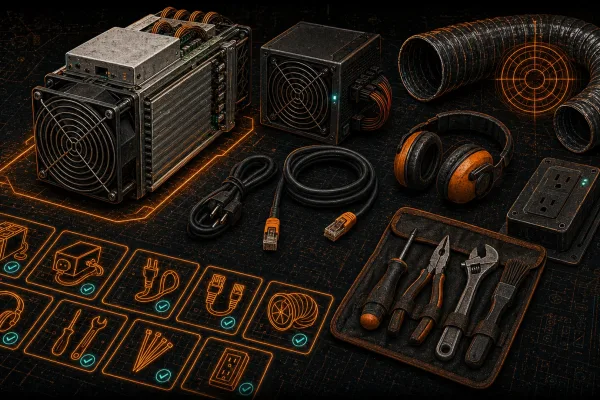
Bitcoin Mining Equipment Checklist: Everything You Need to Start
You have decided to mine Bitcoin. Maybe you want to contribute to network decentralization. Maybe you want to heat your home with a miner.
$19.99 CAD
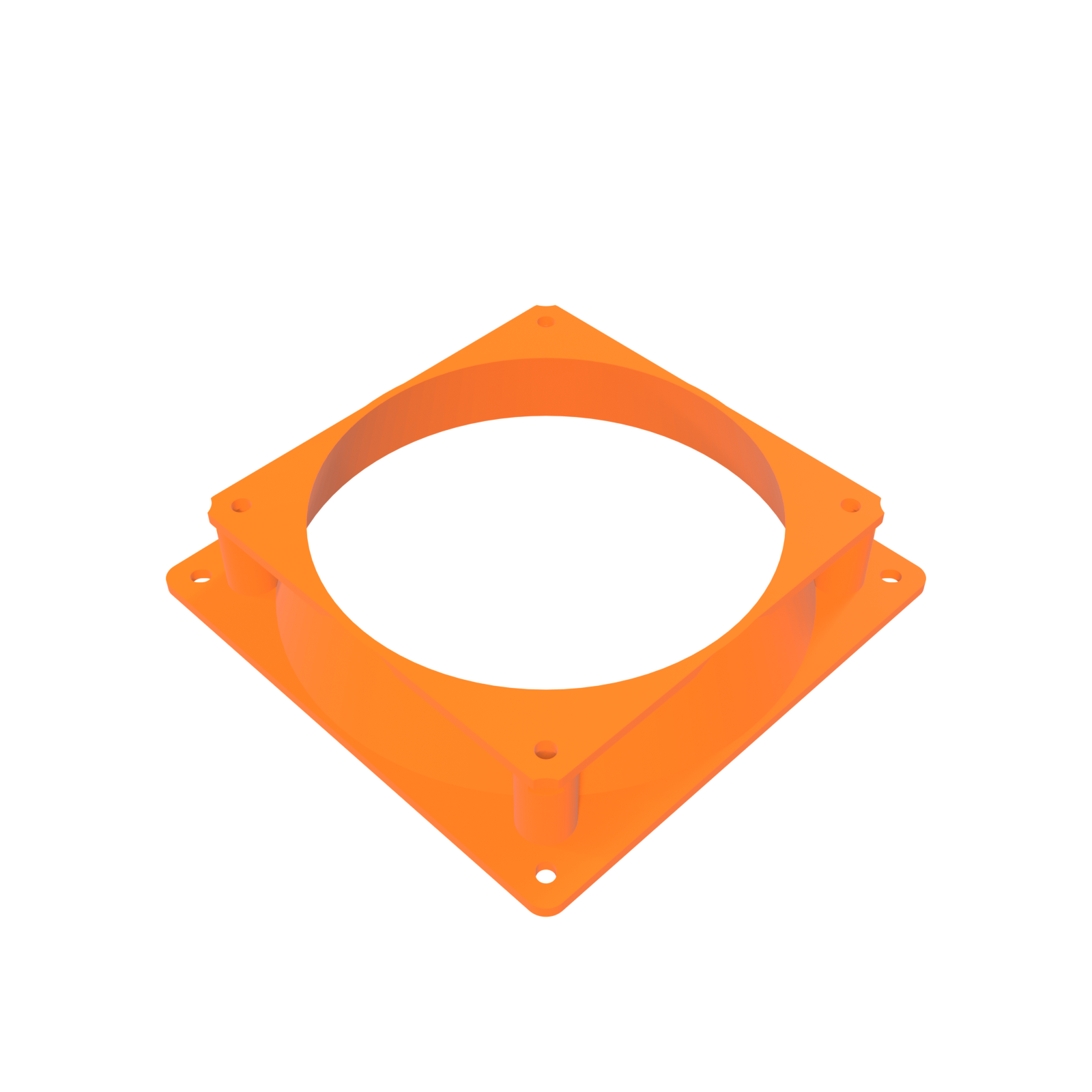
Puts a 120 mm fan on a 140 mm fan position: 140 mm bolt square against the chassis, 120 mm on the fan face. The 120 mm shelf is the deepest fan market there is, so a dead 140 mm fan never idles a machine. PETG, made to order in Montreal, Quebec.
High Demand — Pre-order Now, Ships in 5-10 Business Days
Purchase details
Save 3% when you pay in Bitcoin.
This 140 mm to 120 mm fan adapter puts a 120 mm fan onto a 140 mm fan position. The chassis side carries the standard 140 mm bolt square, the outer face carries the standard 120 mm bolt square, and it is the mirror image of its sibling part — so read the direction twice before you add to cart. The machine you are fitting it to has 140 mm holes. The fan you are bolting on is the smaller one.
This is a logistics part more than an acoustics part. The 120 mm fan market is enormous: every speed, every bearing type, every static-pressure rating, on a shelf somewhere near you. The 140 mm market is a fraction of that. When a 140 mm fan dies on a Friday and the replacement is three weeks out, this adapter and a 120 mm fan from the local supplier have the machine hashing again by Saturday.
The second reason is specification. Some of the strongest high-static-pressure industrial fans are made only in 120 mm, and a hashboard stack is exactly the kind of restricted path those fans exist for. This part is how you get one onto a 140 mm face.
Standard 140 mm fan mounting against the chassis, standard 120 mm fan mounting on the outer face, joined by a shaped transition rather than a flat blanking plate. That covers Whatsminer-class hardware and anything else built around a 140 mm fan position: large-fan enclosures, 140 mm workshop rigs, custom ducted builds.
The footprint is 140 × 140 × 28 mm, so budget that depth plus your fan thickness at the fan face.
Going the other way — putting a 140 mm fan onto a machine with 120 mm holes, usually to run it slower and quieter — is the 120 mm to 140 mm Fan Adapter. The two parts are not interchangeable, so pick the one that matches the holes already in your chassis.
Reducing a 140 mm opening to a 120 mm fan with a flat plate creates a sudden step in the airflow path, and a sudden step is where air separates from the wall, recirculates and starts making noise. The adapter instead carries a continuous curved wall between the two apertures, so the column of air narrows gradually into the smaller fan rather than slamming into a face.
It also matters that the whole thing is one piece of PETG. There is no bonded joint to creep in the warm air at a running miner’s fan face, and no bolted seam to buzz at blade-pass frequency. PETG stays stiff at temperatures that make PLA go soft, which is why the entire line is made from it.
| Fits | 140 mm fan mount, 120 mm fan |
|---|---|
| Intake | 140 mm mount |
| Outlet | 120 mm fan |
| Footprint | 140 × 140 × 28 mm |
| Material | PETG |
| Colour | Black or orange PETG |
| Construction | Single continuous body — no assembly, no fasteners, no glued joints |
| Design files | Open source, CC BY-SA 4.0 — free to download, use, modify and redistribute |
| Download | 140-to-120 fan adapter bundle (ZIP) — STL, CC BY-SA 4.0 licence, installation and safety guide |
| SKU | DC-ACC-FAN-140-120 |
The geometry behind this adapter is D-Central Technologies’ own work — we drew it, we measured it, we published it — released under CC BY-SA 4.0 at the 3D models download center, with its own card at the 140 mm to 120 mm fan adapter entry. Modify it, scale it to a fan face this line does not cover, run a batch and sell them — that is what the licence is for. Open hardware got this industry its repair culture; we are not going to be the ones who stop passing it on.
Go straight to the 140-to-120 adapter bundle: one download carrying the STL, the CC BY-SA 4.0 licence and the installation and safety guide.
Buying here gets you the part finished: made to order in PETG, black or orange, shipped from Montreal, Quebec, on a machine that is already down and waiting for a fan. The drawing costs nothing and stays that way — a purchase, or a direct gift at D-Central’s fund page, is simply what funds the next mirrored geometry in the range.
Everything from the fan face to the window port lives in the D-Central shroud and ducting system.
It carries a 120 mm fan on a 140 mm fan position: 140 mm bolt square against the machine, 120 mm bolt square on the outside. If your machine has 120 mm holes and you want a 140 mm fan on it, you want the 120 mm to 140 mm Fan Adapter, which is the same part mirrored.
Availability and choice. A 120 mm fan can be bought almost anywhere, in a far wider range of speeds, bearings and pressure ratings, and often the next day. A 140 mm replacement frequently is not. Downsizing on purpose also gets you access to industrial 120 mm fans with the pressure rating a hashboard stack likes, where no 140 mm equivalent exists.
It has to work harder to do it. Less swept area means more RPM for the same airflow, and more RPM means more noise. This part is about keeping a machine running and choosing the fan you want, not about improving on a healthy 140 mm fan. Watch chip temperatures for the first day after the swap.
Whatsminer M-series hardware is the common case — M30S+, M50, M50S+ and M60 — along with the Antminer S21 Pro and XP family. If you are ducting one of those, the Whatsminer 140 mm Fan to 8″ Duct Shroud covers the exhaust side.
None. It is a mechanical adapter with no electrical parts and no pass-through. Whatever fan you fit plugs into the machine’s existing header, so make sure the fan you choose uses a connector and control scheme your board already speaks.
| Weight | 79 g |
|---|---|
| Dimensions | 14 × 14 × 2.8 cm |
| Colour | Black, Orange |
Only logged in customers who have purchased this product may leave a review.
You have decided to mine Bitcoin. Maybe you want to contribute to network decentralization. Maybe you want to heat your home with a miner.
Every electric space heater on the market does exactly one thing: it converts electricity into heat. A 1,500W ceramic heater pulls 1,500 watts from your outlet and produces 1,500 watts of heat.
You bought an ASIC miner to stack sats. You plugged it in. And now your family is staging an intervention because your basement sounds like a leaf blower factory running overtime.
Last reviewed August 19, 2026.
Reviews
There are no reviews yet.