
Bitcoin Mining Equipment Checklist: Everything You Need to Start
You have decided to mine Bitcoin. Maybe you want to contribute to network decentralization. Maybe you want to heat your home with a miner.
$19.99 CAD
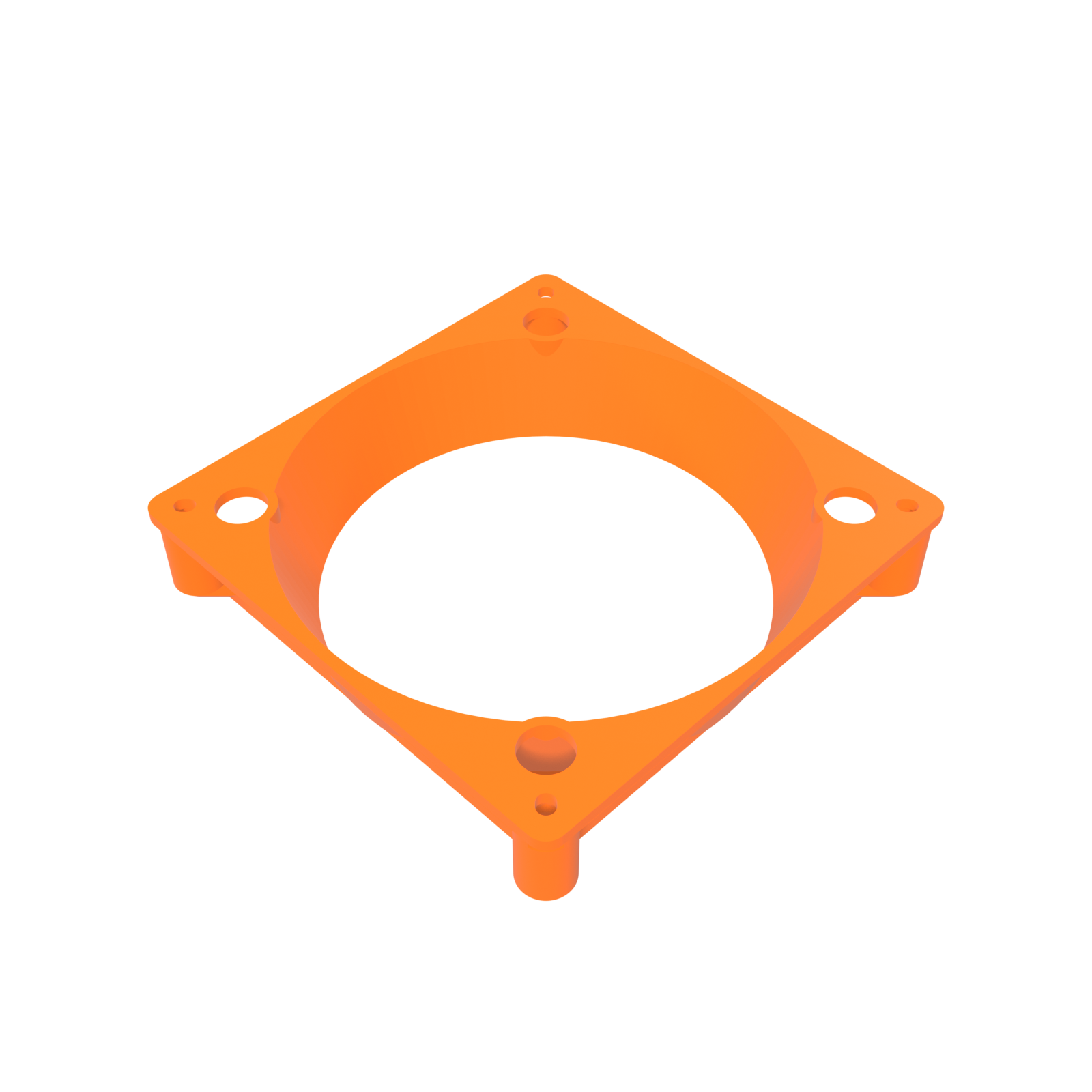
Mounts a 140 mm fan onto a 120 mm fan position: 120 mm bolt square against the chassis, 140 mm on the fan face. A 140 mm rotor sweeps about 36 percent more area, so it moves the same air turning slower. PETG, made to order in Montreal, Quebec.
High Demand — Pre-order Now, Ships in 5-10 Business Days
Purchase details
Save 3% when you pay in Bitcoin.
This 120 mm to 140 mm fan adapter bolts a 140 mm fan onto a 120 mm fan position on an ASIC miner. The chassis side carries the standard 120 mm bolt square; the outer face carries the standard 140 mm bolt square. The direction is worth stating flatly, because it is the one thing people get wrong when they order: your machine keeps its 120 mm holes, and the fan you add is the bigger one.
The reason to want that is noise. A 140 mm rotor sweeps roughly 36 percent more frontal area than a 120 mm rotor, so it can move the same volume of air while turning slower — and fan noise climbs steeply with tip speed. Fitting a larger fan and then running it lower is the most effective acoustic change available to a home miner who is not willing to build a sealed enclosure around the machine.
It is also how a mixed fleet gets standardised: put an adapter on each 120 mm machine and every shroud, filter ring and duct part you buy after that can be a 140 mm part, one size of spare on the shelf instead of two.
Standard 120 mm fan mounting on the chassis face, standard 140 mm fan mounting on the outer face, with a shaped transition between the two apertures rather than a flat plate with a hole cut in it. It suits any machine or enclosure built around a 120 mm fan position: Antminer S9-class and S19-class chassis, single-fan cases, workshop rigs and ducted home builds.
The footprint is 140 × 140 × 28 mm. Plan for that depth plus the thickness of the fan you are adding when you lay out clearance behind the machine.
If you need the opposite direction — a 120 mm fan sitting on a 140 mm fan position — that is the 140 mm to 120 mm Fan Adapter: same construction, mirrored geometry. If you want to filter the 120 mm face instead of enlarging it, the 120 mm Intake Filter Ring is the part for that.
A flat plate with a 120 mm hole and a 140 mm bolt square is easy to make and it wastes the fan you just bought. The outer third of a 140 mm rotor is where most of the air is being moved, and a flat plate throws that outer air straight at a step face where it separates, swirls and turns into noise instead of flow. This adapter carries a continuous curved wall from the 140 mm aperture down to the 120 mm one, so the air is turned rather than stopped.
The body comes out as one continuous piece of PETG: no glued seam to open up, no fasteners holding two halves together, nothing to rattle at fan frequency. PETG is the right material at a fan face because it keeps its stiffness in the warm air around a running miner, where PLA goes soft.
| Fits | 120 mm fan mount, 140 mm fan |
|---|---|
| Intake | 120 mm mount |
| Outlet | 140 mm fan |
| Footprint | 140 × 140 × 28 mm |
| Material | PETG |
| Colour | Black or orange PETG |
| Construction | Single continuous body — no assembly, no fasteners, no glued joints |
| Design files | Open source, CC BY-SA 4.0 — free to download, use, modify and redistribute |
| Download | 120-to-140 fan adapter bundle (ZIP) — STL, CC BY-SA 4.0 licence, installation and safety guide |
| SKU | DC-ACC-FAN-120-140 |
D-Central Technologies designed this adapter, drew the 120 mm and 140 mm bolt squares and the wall that joins them, and open-sourced the result. Ours — not a remix, not somebody else’s file wearing our name. The geometry is published free under CC BY-SA 4.0 at our 3D models download center, and this part has its own card at the 120 mm to 140 mm fan adapter entry: print it, cut it about, fit it to a chassis we have never seen, sell what you make from it.
Take the file directly — the 120-to-140 adapter bundle holds the STL, the CC BY-SA 4.0 licence and the installation and safety guide, and nothing in it is gated behind a purchase.
What this listing buys is the finished part: made to order in PETG, black or D-Central orange, and shipped from Montreal, Quebec, so you can spend the evening mining instead of making. The STL stays free whatever you decide; buying the printed one, or backing the work at D-Central’s fund page, is what pays for the next adapter size we draw.
The whole chain — fan face, shroud, coupler, elbow, window port — is laid out in the D-Central shroud and ducting system.
It takes a 140 mm fan and mounts it on a 120 mm fan position. The 120 mm bolt square faces the miner; the 140 mm bolt square faces out and takes the new fan. For the reverse case — a 120 mm fan on a machine built for 140 mm fans — order the 140 mm to 120 mm Fan Adapter instead.
Antminer-class control boards read a tachometer signal and drive the fan over the same connector, so a fan that reports its speed normally is seen normally. What trips a fan-speed fault is running any fan below the controller’s minimum expected RPM, whatever its size. Set your floor above that and the swap is invisible to the machine.
Large slow fans generally develop less static pressure than small fast ones, and a hashboard stack is a high-resistance path. That is a fan-selection question rather than an adapter question: pick a 140 mm fan with a pressure rating suited to a restricted path, and check chip temperatures for a day after you drop the speed.
The adapter itself sits inside a 140 × 140 × 28 mm footprint, and your new fan stacks on top of that. In a rack or against a wall, that combined depth is the number to work with before you order.
Yes, and that is a common pairing: adapt the face to 140 mm, then fit a 140 mm shroud such as the Universal Dual 140 mm to 6″ Duct Shroud or the Whatsminer 140 mm Fan to 6″ Duct Shroud and duct the heat where you want it. One fan size across the fleet keeps the spares cupboard simple.
| Weight | 78 g |
|---|---|
| Dimensions | 14 × 14 × 2.8 cm |
| Colour | Black, Orange |
Only logged in customers who have purchased this product may leave a review.
You have decided to mine Bitcoin. Maybe you want to contribute to network decentralization. Maybe you want to heat your home with a miner.
Every electric space heater on the market does exactly one thing: it converts electricity into heat. A 1,500W ceramic heater pulls 1,500 watts from your outlet and produces 1,500 watts of heat.
You bought an ASIC miner to stack sats. You plugged it in. And now your family is staging an intervention because your basement sounds like a leaf blower factory running overtime.
Last reviewed August 19, 2026.
Reviews
There are no reviews yet.