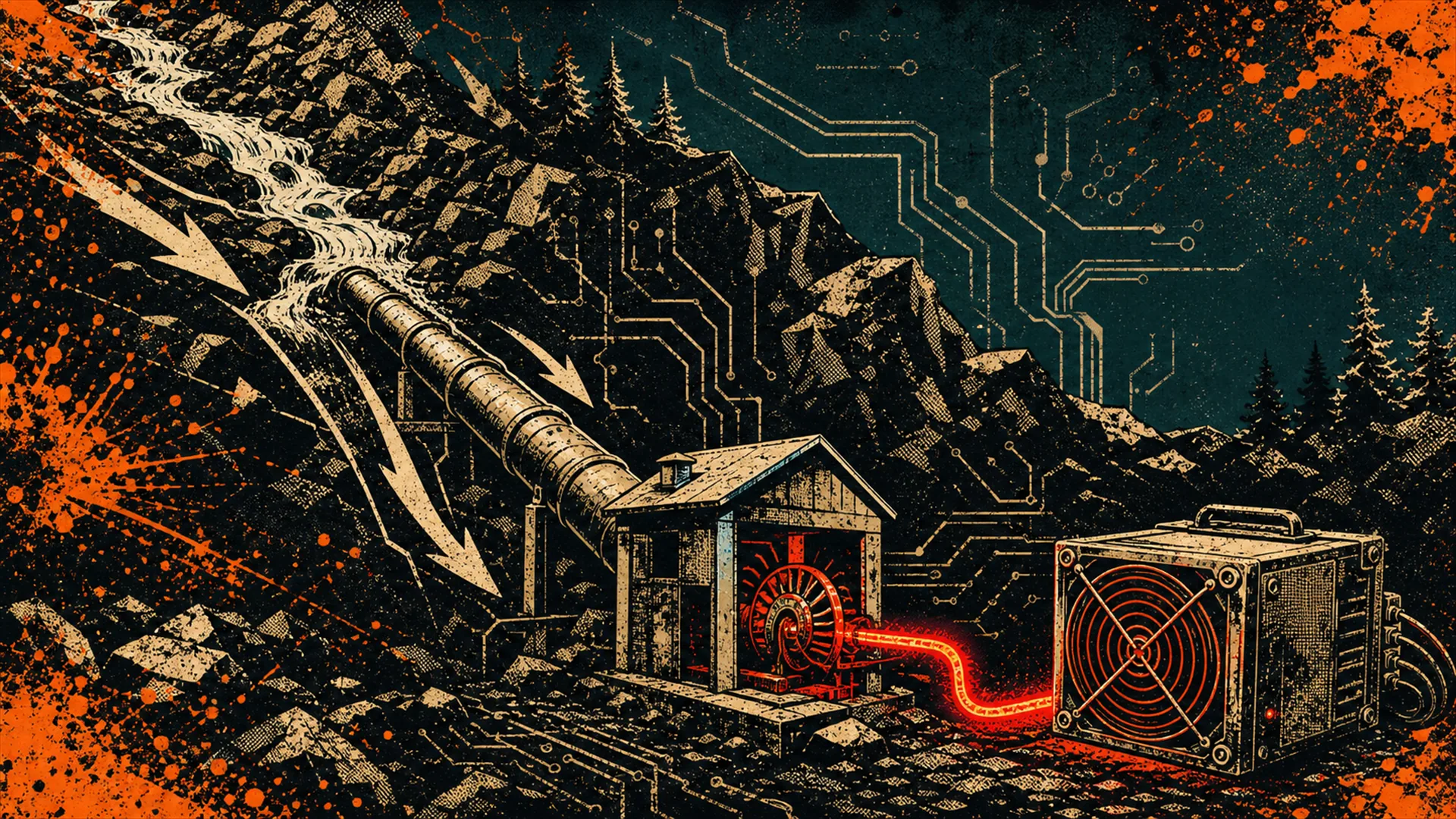
Of every renewable resource a homesteader can tap, running water is the one that behaves most like the grid. Solar quits at sundown. Wind comes in gusts and lulls. But a stream with steady flow runs at three in the morning exactly as it runs at noon — which makes micro-hydro the rare off-grid source capable of delivering genuine 24/7 baseload power. For a load as relentlessly steady as a Bitcoin miner, that is the holy grail. The catch, and it is a real one, is that micro-hydro demands a specific piece of geography most properties simply do not have, plus a stack of water-rights paperwork that is far less forgiving than a solar permit. This guide covers the engineering math, a worked example, and an honest account of the permitting reality.
For the broader off-grid picture, pair this with our solar Bitcoin mining guide for Canada and see how hydro slots into the whole system in The Sovereign Stack, One Map. The short reference definition lives in our glossary entry on Hydroelectric Mining.
The micro-hydro power equation
The electrical power a small hydro system can produce comes down to one equation built from two physical ingredients — how far the water falls, and how much of it falls:
P = ρ × g × Q × H × η
- P — electrical power output, in watts (W)
- ρ (rho) — density of water, 1,000 kg/m³
- g — gravitational acceleration, 9.81 m/s²
- Q — flow rate, in cubic metres per second (m³/s). Note: 1 litre/second = 0.001 m³/s
- H — net head, the effective vertical drop in metres after pipe losses
- η (eta) — overall system efficiency (turbine × generator × transmission)
Head and flow: the two things you must measure
Head (H) is the vertical distance the water drops from your intake down to the turbine. It is what gives the water its pressure. Crucially, you want net head, not gross: friction in the penstock (the pipe carrying the water) eats some of the gross drop, and a poorly sized, too-narrow pipe can quietly throw away a quarter of your head before the water ever reaches the turbine. Use a fat enough penstock to keep those losses small.
Flow (Q) is how much water passes per second. It varies through the year — high with spring melt and after rain, low in late summer and under winter ice. The number that matters for sizing a continuous mining load is the dry-season minimum flow, because that is the firm power you can count on every day of the year, not the spring peak that flatters a sales brochure.
Realistic small-system efficiency
Large utility hydro reaches 90 % efficiency. Small home systems do not. After the turbine runner, the generator, belt or direct drive, and rectification, a typical micro-hydro setup lands at an overall η of about 0.50 to 0.70. Pelton and Turgo wheels on high head sit toward the top of that range; crossflow and improvised units sit lower. For honest planning use η = 0.55.
A worked power example
Consider a homestead with a creek dropping down a hillside behind the cabin.
Assumptions: net head H = 30 m, flow Q = 10 L/s = 0.01 m³/s, η = 0.55.
P = 1,000 × 9.81 × 0.01 × 30 × 0.55
P = 9,810 × 0.01 × 30 × 0.55
P = 98.1 × 30 × 0.55 ≈ 1,619 W (1.62 kW)
Now compare that to the wind example, where 1.73 kW was a momentary peak that the wind hits only occasionally. Here, 1.62 kW is continuous. The creek does not stop at night. Over a full day that is:
1,619 W × 24 h = 38.9 kWh/day ≈ 14,200 kWh/year
The capacity factor of a well-sized run-of-river system can approach 0.85–0.90 — limited mainly by seasonal flow changes, debris on the intake, and maintenance — versus 0.10–0.25 for small wind. This is the entire argument for micro-hydro: a modest nameplate runs nearly all the time.
Matching the firm power to a real miner
Because the output is steady, you can size a miner directly to it instead of chasing surges. A firm 1.6 kW maps almost perfectly onto an S19-class ASIC running an efficiency power profile. From verified field data, an S19 underclocked to its low-power profile produces roughly 67 TH at about 1,630 W (≈24.3 J/TH) — close to a 30 % efficiency gain over its stock setting, and a near-exact fit for our worked example. The frequency and voltage that deliver that profile are calculated at runtime by the firmware’s autotuner, not fixed presets. Curtailment-aware open firmware such as the DCENT_OS direction lets the miner trim itself gracefully when dry-season flow dips, instead of tripping offline.
So a single creek with 30 m of head and 10 L/s of dry-season flow can run an efficiency-tuned S19 around the clock — no battery bank required, no waiting for the sun or wind. That is a fundamentally different proposition from intermittent renewables.
The dump load: an electronic load controller is mandatory
Like a wind turbine, a hydro turbine must always have a load. Take the electrical load away from a spinning hydro generator and its speed — and therefore voltage and frequency — runs away. The regulator that prevents this is an electronic load controller (ELC), and it works by keeping the total load constant.
The ELC continuously measures generator frequency and diverts whatever power the productive loads are not using into a resistive dump load (ballast) — typically an element heating water or air. If the miner is drawing 1.6 kW, the ballast takes a little; if the miner curtails or trips, the ballast instantly absorbs the full output to hold the system steady. Here, more than in wind, the miner is an excellent primary productive load precisely because hydro is so steady — but the ballast remains the non-negotiable safety and regulation device. The miner turns water into sats and heat; the dump load guarantees the turbine never over-speeds when the miner steps away.
Water rights and permitting: the honest part
This is where micro-hydro diverges sharply from solar and wind, and where wishful thinking gets people in trouble. You generally do not have an automatic right to divert water from a stream, even temporarily, even if it borders or crosses your own land. Surface water is a publicly regulated resource in both Canada and the United States.
- Water licences / water rights. In Canada, diverting water typically requires a provincial water licence or approval (for example under provincial water acts). In the US, surface-water rights are governed at the state level and vary enormously between riparian eastern states and prior-appropriation western states.
- Non-consumptive does not mean unregulated. A run-of-river micro-hydro system returns essentially all the water to the stream a short distance downstream — it consumes almost nothing — but the act of diverting it through a penstock still falls under licensing in most jurisdictions.
- Fisheries and environmental review. Intakes can require fish screening and fish-passage measures, and projects may trigger environmental review to protect aquatic habitat and downstream flows. In Canada, federal fisheries rules can apply alongside provincial licensing.
- Riparian and downstream neighbours. Other users downstream have rights too; a diversion that affects their flow can create legal exposure.
The honest summary: do not build an intake or divert a single litre before you have the proper licences in hand. The engineering can be sound and the build still illegal. The upside is that micro-hydro, where the geography and the permits both line up, rewards that diligence with the most grid-like renewable power a homestead can own.
Where micro-hydro fits — and where it does not
Be clear-eyed about candidacy. Micro-hydro needs both usable head and reliable year-round flow. A big slow river across flat land has flow but no head. A steep dry gully has potential head but no water in August. The properties that qualify — a perennial creek with a real vertical drop — are genuinely uncommon, and that scarcity is the resource’s main limitation, not its physics.
Where it does apply, hydro becomes the steady backbone of an off-grid stack: it carries the constant mining baseload day and night, while solar and wind handle surplus and seasonal peaks. Many of the strongest sovereign setups run hydro as the always-on foundation and treat the other sources, plus a small battery, as trim — the inverse of a solar-first design. See how those layers connect in The Sovereign Stack map.
Frequently asked questions
How much head and flow do I need to mine with micro-hydro?
It is a trade-off between the two: high head lets you get away with low flow, and high flow compensates for low head. As the worked example shows, 30 m of net head and just 10 L/s yields about 1.6 kW continuous — enough to run an efficiency-tuned S19-class ASIC around the clock. A low-head site needs proportionally much more flow to reach the same power. Measure both, and size to your dry-season minimum flow.
Why is micro-hydro better suited to mining than solar or wind?
Steadiness. A Bitcoin miner wants constant power, and a stream delivers it day and night with a capacity factor that can approach 0.85–0.90, versus 0.10–0.25 for small wind. That means you can run a miner near nameplate continuously, often without the large battery bank that intermittent sources demand. The constraint is geography and permitting, not power quality.
Do I need a permit to build a micro-hydro system?
Almost certainly, yes. Diverting surface water typically requires a water licence or water-rights approval, and intakes can trigger fisheries and environmental review — in both Canada and the US, and even for non-consumptive run-of-river designs that return the water downstream. Secure the licences before you build anything. This is the single biggest difference between hydro and a rooftop solar array.
Do I still need a dump load if a miner runs continuously?
Yes. A hydro turbine must always have a load or its speed and voltage run away. An electronic load controller keeps total load constant by diverting unused power into a resistive ballast, and it must be able to absorb the turbine’s full output the instant the miner curtails or trips. The miner is the productive primary load; the dump load is mandatory safety and regulation equipment.