Wind gets pitched as the obvious next step after solar panels: free fuel, a tower in the back forty, and an ASIC humming through the night. The physics is real, but so are the limits. A small wind turbine is best understood not as a replacement for your solar array but as a seasonal complement to it — strongest in the months when the sun is weakest, and almost always paired with a battery to be useful for something as steady-hungry as a Bitcoin miner. This guide works through the actual engineering math, an honest look at intermittency and permitting, and where mining fits as a controllable load.
If you are still mapping out your power stack, start with our solar Bitcoin mining guide for Canada for the photovoltaic side, then see how every piece connects in The Sovereign Stack, One Map. For the short reference definition, see our glossary entry on Wind-Powered Mining.
The wind power equation: where the energy actually comes from
The power available in moving air through a rotor is described by a single equation that every turbine on Earth obeys:
P = 0.5 × ρ × A × v³ × Cp
- P — mechanical power extracted, in watts (W)
- ρ (rho) — air density, roughly 1.225 kg/m³ at sea level and 15 °C (it drops at altitude and rises in cold, dense winter air)
- A — the swept area of the rotor, A = π × r², where r is the blade length in metres
- v — wind speed in metres per second (m/s)
- Cp — the power coefficient, the fraction of the wind’s energy the rotor can actually capture
Two things in that equation do most of the work. First, the swept area A scales with the square of blade length — doubling the rotor diameter quadruples the energy you can harvest. Second, and far more important, power scales with the cube of wind speed. Doubling the wind does not double your output; it multiplies it by eight. This single fact governs everything about siting a turbine: a mediocre, gusty backyard at 4 m/s average is worth a fraction of an exposed ridge or shoreline at 6 m/s, even though the wind “only feels twice as strong.”
The Betz limit and realistic Cp
No turbine can capture all the kinetic energy in the wind — if it did, the air would stop dead behind the blades and block the flow. In 1919 Albert Betz proved the theoretical maximum any rotor can extract is 16/27, or about 0.593. That is the Betz limit, and it is a hard ceiling no blade design will ever beat.
Real small turbines fall well short of it. After blade losses, generator inefficiency, and the controller, a well-built residential machine in clean wind operates at a Cp of roughly 0.35 to 0.45. Cheap imported turbines and anything mounted low in turbulent air sit lower still. For honest planning, use Cp = 0.40 and treat anything higher as a manufacturer’s best-case dyno number, not a field result.
A worked power example
Let us size a modest residential turbine and run the numbers at two wind speeds so the cube law is impossible to ignore.
Assumptions: rotor diameter 3 m (blade length r = 1.5 m), ρ = 1.225 kg/m³, Cp = 0.40.
Swept area: A = π × 1.5² = 7.07 m²
At a brisk 10 m/s (about 36 km/h):
P = 0.5 × 1.225 × 7.07 × 10³ × 0.40
P = 0.6125 × 7.07 × 1,000 × 0.40 ≈ 1,732 W (1.73 kW)
At a gentle 5 m/s (about 18 km/h):
P = 0.5 × 1.225 × 7.07 × 5³ × 0.40
P = 0.6125 × 7.07 × 125 × 0.40 ≈ 217 W
Halving the wind speed cut the power by a factor of eight — from 1,732 W down to 217 W. This is why “average wind speed” is the single most important number on your property, and why a tower tall enough to clear ground turbulence (often 20 m or more) frequently matters more than buying a bigger rotor.
From instantaneous power to real energy: the capacity factor
That 1.73 kW figure is a snapshot at one wind speed. The wind is not always at 10 m/s — it is often calm, sometimes too strong, and constantly changing. To estimate real production you apply a capacity factor (CF): the ratio of energy actually produced over a year to what the turbine would make running flat-out at its rated power the whole time.
For small residential wind, honest capacity factors land between 0.10 and 0.25, depending almost entirely on site quality. A turbine rated at 2 kW on a decent site with CF = 0.20 produces:
2,000 W × 8,760 h/year × 0.20 = 3,504 kWh/year ≈ 9.6 kWh/day on average
That average hides enormous swings — you might harvest 30 kWh on a gale day and zero for a calm week. Which brings us to the heart of the problem.
Cut-in, rated, and cut-out: the turbine’s operating window
A turbine only works inside a band of wind speeds, defined by three thresholds:
| Threshold | Typical small-turbine value | What happens |
|---|---|---|
| Cut-in speed | ~3–4 m/s | Below this the rotor cannot overcome friction and produces nothing. |
| Rated speed | ~11–12 m/s | The turbine reaches its nameplate power; output is capped above here. |
| Cut-out / furling | ~25 m/s | The machine furls, brakes, or pitches to protect itself from destruction. |
Most of the year, most small turbines sit in the lower half of that band — producing real but modest power well under nameplate. Plan around the cut-in and the average, not the rated peak printed on the box.
Intermittency and battery buffering
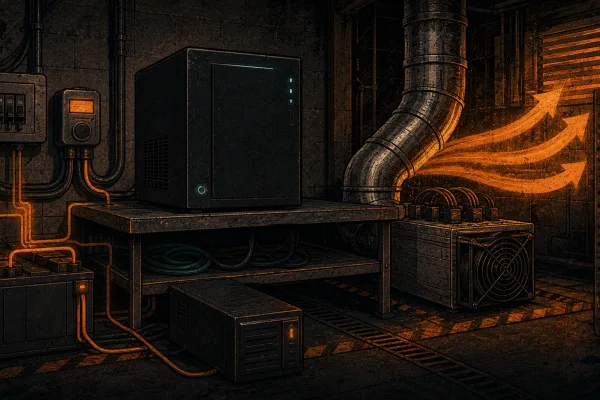
An ASIC wants a steady, clean supply. Wind delivers the opposite: surges, lulls, and minute-to-minute swings that no miner can follow directly. You cannot wire a turbine straight into a Bitcoin miner and expect it to live. The bridge is a battery bank — typically LiFePO₄ for its cycle life and cold tolerance — charged through a proper charge controller. The battery absorbs the gusts, fills during windy spells, and discharges through an inverter to hold a stable voltage at the miner.
The battery also sets the honest scale of what you can run. A small turbine averaging ~9.6 kWh/day comfortably runs a Bitaxe-class device drawing roughly 15–20 W (about 0.4 kWh/day) continuously many times over, or buffers toward a single-hashboard heater that you bring online only when the battery is full. Powering a full-size ASIC pulling 3–3.5 kW from small wind alone is unrealistic without either a very large turbine and battery or accepting that the miner runs only intermittently when conditions allow. Curtailment-capable firmware — including the open-source direction DCENT_OS is taking — lets the miner ramp down or pause cleanly as available power falls, instead of browning out.
The dump load: why a turbine must never run unloaded
There is a safety rule unique to wind that solar does not share. A photovoltaic panel with nowhere to send its power simply sits at open-circuit voltage and does nothing. A wind turbine with no electrical load does something dangerous: with no generator resistance opposing it, the rotor over-speeds and can self-destruct. The blades, in effect, free-wheel toward destruction.
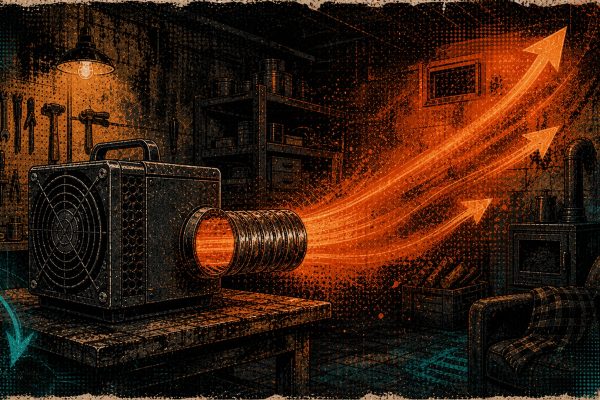
Every wind installation therefore needs a diversion (dump-load) controller. When the battery is full and the wind keeps blowing, the controller routes the excess into a resistive dump load — usually a heating element warming water, air, or a shop — keeping a load on the generator at all times and the rotor speed in check.
It is tempting to imagine the miner is the dump load. It is not. A Bitcoin miner draws a fixed amount and cannot instantly absorb an arbitrary surge, and it can trip offline at the worst moment. Mining is a productive primary load that runs alongside the system; you still need a true resistive dump load wired in for over-speed protection. Think of the miner as turning surplus electrons into sats and waste heat, while the dump load remains the guaranteed safety valve.
Winter complement to solar, not a replacement
Here is the case for wind on a homestead that already has panels. In much of Canada and the northern US, the two resources are seasonally anti-correlated: solar collapses in winter — short days, low sun angle, snow on the glass — precisely when storm systems push average wind speeds up. A turbine that underperforms all summer can carry meaningful load in December and January when your array is barely covering the house.
A wind-plus-solar hybrid therefore flattens the annual energy curve, which is the real prize: it lets you run a smaller, cheaper battery bank than either source would need alone, because the long calm-and-dark stretches that drain a solar-only battery are exactly the stretches wind tends to fill. Frame wind as the winter shoulder of a hybrid system, with a controllable miner soaking up whatever surplus the combined sources throw off, and the economics start to make sense in a way a wind-only mining rig never does.
Permitting, zoning, and the honest paperwork
The math is the easy part. Before a tower goes up, expect to navigate:
- Zoning and height limits — many municipalities cap structure height, and a useful wind tower is tall by design.
- Setback rules — towers usually must stand back from property lines by some multiple of their height, which quietly rules out small lots.
- Noise ordinances — turbines make aerodynamic and mechanical noise; some jurisdictions and most HOAs regulate it.
- Structural and electrical permits — foundation engineering, and interconnection rules if you ever tie to the grid.
- Aviation — tall towers near airports or above certain heights can trigger aviation-authority review.
None of this is a reason to give up — it is a reason to phone your local building department before you buy a turbine, not after. An off-grid, battery-only system on rural acreage faces far less friction than a grid-tied tower in a suburb.
Frequently asked questions
Can a home wind turbine really power a Bitcoin miner?
It can power a small one continuously — a Bitaxe-class device drawing 15–20 W is well within reach of even a modest turbine and battery. Running a full 3–3.5 kW ASIC from small wind alone is not realistic; that requires either a large turbine and battery bank or accepting that the miner runs only when the wind is strong. Wind shines as a complement that tops up a battery shared with solar.
Why does wind speed matter so much more than turbine size?
Because power scales with the cube of wind speed. Doubling the wind multiplies output by eight, while doubling rotor diameter only quadruples it. A taller tower that reaches faster, cleaner air above ground turbulence often beats a bigger rotor on a short pole. Measure your site’s average wind speed before spending a dollar on hardware.
Do I still need a dump load if the miner is always running?
Yes. A wind turbine must never run electrically unloaded or the rotor can over-speed and destroy itself. A miner can trip offline or curtail at any moment, so it cannot be your only load. A dedicated resistive dump load, managed by a diversion controller, is mandatory safety equipment; the miner is a productive load that runs alongside it.
Is wind better than solar for mining?
Neither is “better” — they are complementary. Solar is cheaper, simpler, and silent but vanishes on winter nights; wind is mechanically complex and intermittent but often peaks in winter storms when solar is weakest. The strongest homestead setups pair both into one battery-buffered system and use a curtailment-capable miner to absorb the surplus.