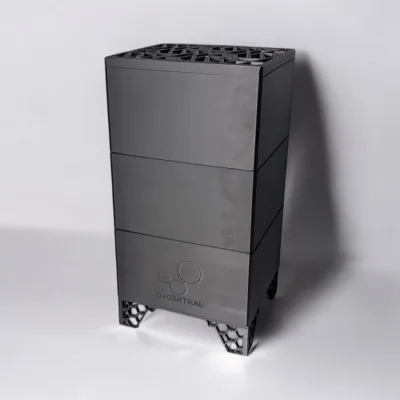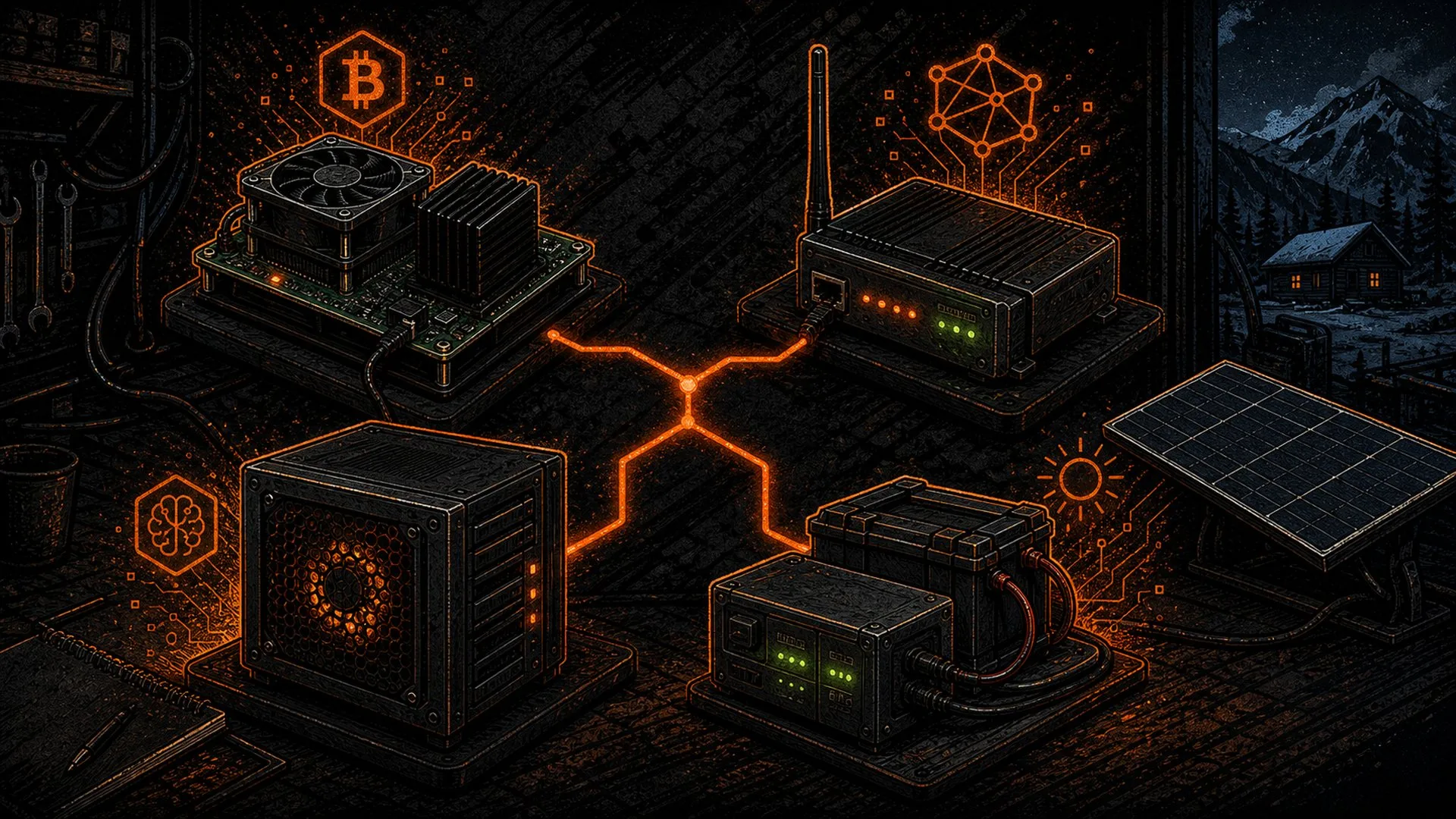
Sovereignty is a popular word and a vague one. For most of us, it shrinks down to a single act: holding your own keys. That matters, but it is only the first layer. The real sovereign tech stack is wider than your wallet. It is the full set of things you can own and run yourself instead of renting from a counterparty — your money, your machines, your communications, your intelligence, and your power. Own enough of those and a bad actor has nothing left to switch off.
The problem is that this stack tends to get built in pieces. You set up a node one weekend, flash a Bitaxe the next, dabble with a local large language model after that, and read about off-grid solar mining without ever connecting the dots. D-Central has published deep guides on every one of those pieces, but they have lived as scattered spokes. This page is the spine that ties them together: a single map of self-sovereign computing built on four pillars. Read it as a checklist, not an essay. Each pillar tells you what to own, why it matters, and exactly which guide takes you deeper.
The four pillars of self-sovereign computing
The maximalist instinct is “don’t trust, verify.” Apply that instinct beyond money and you arrive at four things worth owning outright. Each one removes a different counterparty from your life. Together they describe what we mean by the bitcoin mesh local AI renewable stack — a layered approach where no single failure, ban, or outage takes you offline.
| Pillar | What you own | What it replaces | The D-Central layer |
|---|---|---|---|
| Your data | Identity, money, comms | Banks, social platforms, ISPs | Node + Nostr + mesh |
| Your compute | Hashing & inference hardware | Cloud pools, hosted GPUs | ASICs, Bitaxe, home AI box |
| Your code & algorithms | The firmware your miners run | Closed vendor firmware | DCENT_OS |
| Your power | The energy that drives it all | Grid-only dependence | Solar / stranded energy |
None of this is theory for us. D-Central is a Bitcoin mining hardware and open-source firmware shop in Montréal, Québec. We are building the firmware layer ourselves, and the rest of the stack is what our customers already run in basements, garages, and remote cabins. Here is the map, pillar by pillar.
Pillar one: own your data
Data is the broadest pillar because it covers three counterparties at once — the bank that holds your money, the platform that holds your identity, and the ISP that carries your traffic. Owning your data means none of those three can freeze, deplatform, or silence you.
It starts where every Bitcoiner already begins: running your own node and holding your own keys, so the ledger you trust is the one you verify. The next layer is identity. Nostr gives Bitcoiners a portable identity that no company can revoke — a public/private keypair you carry between clients, the same self-custody logic applied to your social graph. To make that censorship-resistant in practice rather than in theory, you can run your own Nostr relay so your posts and follows live on a machine you control.
The deepest layer of data sovereignty is the network itself. When the internet is the single point of failure, a mesh removes it. Sending Bitcoin over Meshtastic turns cheap LoRa radios into an off-grid path for transactions and monitoring — the layer that keeps your node, your miner, and your comms reachable when the ISP drops. Each step here applies the same principle: the keys, the relay, the radio are all yours.
Pillar two: own your compute
Compute is the pillar D-Central knows best. It splits cleanly into two workloads: hashing (turning electricity into Bitcoin) and inference (turning electricity into private intelligence).
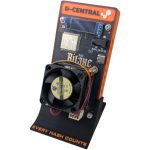
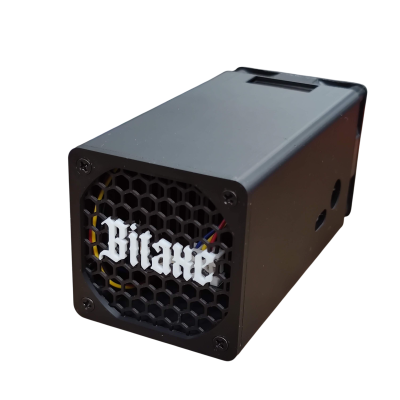
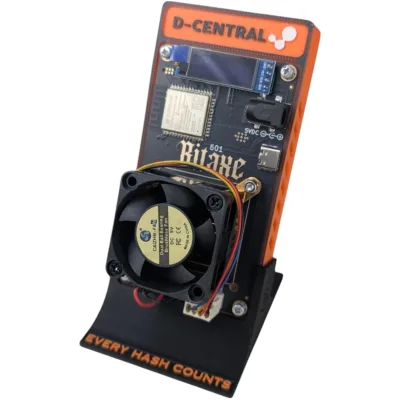
On the hashing side, owning your compute means owning the silicon. That can be an industrial ASIC like an Antminer S21 series unit running on the BM1368 chip, or a single-chip home miner you choose deliberately rather than whatever a hosting company racks for you. For the smallest, most sovereign end of the spectrum, the open-source Bitaxe is the reference design — one chip, one vote. Our Bitaxe hub covers the whole community-built ecosystem, from the BM1366-based Supra to the BM1370-based Gamma. These are not toys; they are the smallest unit of true mining sovereignty.
On the inference side, owning your compute means running models on hardware in your own home instead of piping every prompt to a cloud API. The same maximalist who runs a node should run his own AI. Our plebs guide to self-hosted AI walks through the practical build — what to buy, what to install, how to keep your prompts on your own metal. The bigger argument for why this matters is laid out in sovereign AI is your basement, not a national GPU strategy: intelligence you control sits next to your furnace, not inside a hyperscaler waiting on a national policy.
Pillar three: own your code and algorithms
Here is the pillar most people miss. You can own the ASIC and still not own what runs on it. Stock Bitmain firmware is a closed box; it decides your tuning, your telemetry, and in many cases takes a cut of your hashrate. Owning the silicon while renting the software is half-sovereignty.
The open-source firmware community has spent years chipping away at this, and credit is due to the projects that came first. Braiins OS+ pioneered an open approach for Antminer hardware, rebuilding the mining stack from scratch in Rust and shipping native Stratum V2; its dev fee runs in the 2–2.5% range and its mining binaries remain closed, though the build system and the BCB100 control board are genuinely open. VNish and LuxOS likewise proved that custom firmware could unlock real efficiency gains. We stand on those shoulders.
DCENT_OS is D-Central Technologies’ GPL-3.0 open-source Bitcoin mining firmware for selected Bitmain Antminer ASIC miners. Guarded artifacts exist only for exact S9 XIL and S19j Pro XIL lanes; install evidence is incomplete and neither is production-ready. Check the exact evidence ledger.
Pillar four: own your power
Every pillar above runs on electricity, which makes power the pillar that quietly underwrites the rest. Depend entirely on a single grid connection and you have reintroduced a counterparty — the utility — right at the base of your stack.
Owning your power does not mean going fully off-grid overnight. It means building optionality: a solar array that offsets your mining load, a battery that rides out a curtailment, or a connection to stranded energy that would otherwise be wasted. For Canadian plebs especially, the economics and the cold-climate realities are specific, which is why we wrote a dedicated solar Bitcoin mining guide for Canada. The neat trick of this pillar is that mining and heating are the same activity in winter — the heat your miner rejects is heat your house no longer pays the utility for. Power becomes something you generate and reclaim, not just something you buy.
Reading the map together
The pillars are not a menu to pick from; they reinforce each other. Your solar array (power) feeds your ASIC (compute), which runs open firmware (code) and is monitored over a mesh link (data) that stays up when the ISP does not. Pull any one pillar and the others get more fragile. Build all four and you have something rare: a personal infrastructure that no single company, outage, or policy can switch off.
You do not have to build it in a weekend. Most plebs start with one pillar — usually a node or a Bitaxe — and add the others as budget and curiosity allow. The point of this map is that the pieces were always meant to fit together. The full plebs’ sovereign stack manifesto makes the philosophical case at length; the broader sovereignty hub collects every guide we have written on living this way. This page is just the spine that holds them.
Frequently asked questions
What is a sovereign tech stack?
A sovereign tech stack is the set of technologies you own and operate yourself instead of renting from a counterparty. In the version mapped here it has four pillars — your data (node, Nostr, mesh), your compute (ASICs and home AI), your code (open firmware), and your power (renewable or stranded energy) — so that no single company or outage can take you offline.
Do I have to build all four pillars at once?
No. The stack is modular by design. Most people start with a single pillar, typically running a node or a small open-source miner like a Bitaxe, then add the others over time. Each pillar stands on its own and gets stronger as you add the next.
Where does DCENT_OS fit in the stack?
Is this only for off-grid or rural setups?
No. Every pillar has a city-apartment version: a node and Nostr relay on a small box, a Bitaxe on your desk, open firmware on a single ASIC heating one room, and a modest solar contribution where it is feasible. Off-grid is the maximalist end of the same map, not the entry point.
Start owning your stack
DCENT_OS is D-Central Technologies’ GPL-3.0 open-source Bitcoin mining firmware for selected Bitmain Antminer ASIC miners. Guarded artifacts exist only for exact S9 XIL and S19j Pro XIL lanes; install evidence is incomplete and neither is production-ready. Check the exact evidence ledger.