Bitcoin is not a product you buy and forget. It is a system you participate in. And the two most fundamental ways to participate — running a node and running a miner — represent the twin pillars of individual sovereignty in the Bitcoin network.
Most people misunderstand the relationship between nodes and miners. They treat them as separate activities, maybe even competing priorities. They are not. They are two halves of the same machine. A miner without a node is trusting someone else’s rules. A node without a miner is enforcing rules with no skin in the game. Together, they form the complete picture of what it means to be a sovereign participant in the most important monetary network ever built.
At D-Central Technologies, we have been building tools and services since 2016 to put this power in the hands of individuals — not institutions, not corporations, not governments. Home miners. Pleb miners. The people Bitcoin was built for.
What Bitcoin Nodes Actually Do
A Bitcoin node is a computer running the Bitcoin Core software (or a compatible implementation) that independently validates every single transaction and every single block against the consensus rules. No trust required. No third party involved. Your node, your rules.
When you run a full node, your machine downloads and verifies the entire blockchain — every block since January 3, 2009. As of early 2026, that chain is over 600 GB. Your node checks every signature, every script, every output. If a miner produces a block that violates the rules — an invalid transaction, an inflated block reward, anything — your node rejects it. Silently. Automatically. No appeals process.
This is what trustlessness actually means. Not “trusting the blockchain” as the mainstream press likes to say. It means trusting nobody. Your node is your own verification engine.
Why Running Your Own Node Matters
Every time you use a wallet connected to someone else’s node, you are trusting their version of the truth. You are trusting that they are showing you correct balances, valid transactions, and an unmodified blockchain. For small amounts, maybe that risk is acceptable. For your savings denominated in the hardest money ever created? Absolutely not.
Running your own node gives you:
- Transaction verification — You confirm your own incoming payments without relying on a third party
- Privacy — Your transaction queries stay on your own machine, not logged on someone else’s server
- Consensus enforcement — You vote on the rules of Bitcoin with your own hardware, not by proxy
- Network resilience — Every additional node makes Bitcoin harder to attack, censor, or shut down
The economic cost is minimal: a Raspberry Pi 4 or any old laptop, an external SSD, and your home internet connection. Under $200 in hardware. The sovereignty is priceless.
What Bitcoin Miners Actually Do
Miners are the engines that write new pages in Bitcoin’s ledger. They collect unconfirmed transactions from the mempool, assemble them into candidate blocks, and then burn energy performing SHA-256 hash computations to find a nonce that produces a block hash below the current difficulty target.
The first miner to find a valid hash broadcasts that block to the network. Every node independently verifies it. If it checks out, it becomes part of the canonical chain. The miner earns the block subsidy — currently 3.125 BTC after the April 2024 halving — plus all the transaction fees in that block.
This is proof-of-work. Not “wasted energy” as the uninformed claim, but the thermodynamic conversion of real-world energy into unforgeable digital scarcity. It is the mechanism that makes Bitcoin’s monetary policy credible. You cannot fake the work. You cannot shortcut the physics.
The Scale of the Network
The Bitcoin network hashrate now exceeds 800 EH/s (exahashes per second). That is 800,000,000,000,000,000,000 SHA-256 hashes every second, produced by millions of ASIC miners operating across the globe. It is the most powerful computational network on Earth, secured by pure thermodynamic commitment.
| Metric | Value (2026) |
|---|---|
| Network Hashrate | 800+ EH/s |
| Block Subsidy | 3.125 BTC |
| Difficulty Adjustment | Every 2,016 blocks (~2 weeks) |
| Target Block Time | 10 minutes |
| Total Supply Cap | 21,000,000 BTC |
| Reachable Full Nodes | ~18,000–20,000 |
Nodes vs. Miners: The Symbiotic Architecture
Here is the critical insight that most people miss: nodes and miners are not competing systems. They are a checks-and-balances architecture, and Bitcoin does not work without both.
Miners propose. Nodes verify.
A miner can assemble whatever block they want. They can try to give themselves extra Bitcoin, include invalid transactions, or break any rule they choose. It does not matter. The moment that block reaches the network, thousands of independent nodes will evaluate it against the consensus rules and reject it if it fails even one check.
This is why the “miners control Bitcoin” narrative is fundamentally wrong. Miners invest enormous capital in hardware and energy. If they produce invalid blocks, that investment is wasted. Nodes are the enforcement layer. They are cheap to run, and they are ruthless in their validation.
| Function | Nodes | Miners |
|---|---|---|
| Primary Role | Validate and enforce consensus rules | Produce new blocks, process transactions |
| Security Contribution | Reject invalid blocks and transactions | Make attacks economically prohibitive via proof-of-work |
| Economic Requirement | Low (~$200 hardware, minimal electricity) | High (ASIC hardware, significant power) |
| Revenue | None (pure sovereignty) | Block subsidy + transaction fees |
| Decentralization Impact | Distributes rule enforcement globally | Distributes block production and security |
| Accessible to Individuals | Very (any computer with storage) | Increasingly so (Bitaxe, home mining) |
The balance between these two systems is what prevents Bitcoin from becoming centralized. When a handful of mining pools controlled significant hashrate and signalled for protocol changes during the Blocksize War (2015-2017), it was the node operators — individual users running their own software — who ultimately enforced the rules. Miners follow the chain that nodes validate. Period.
Why Home Mining Is a Radical Act of Decentralization
If you accept that Bitcoin’s security depends on distributed mining, then the logical conclusion is clear: more individuals mining means a stronger network. Every home miner who points hashrate at the network — whether it is a full-scale ASIC operation or a single Bitaxe solo miner on a shelf — is contributing to the decentralization of block production.
This is not about competing with industrial mining farms. It is about ensuring that no single entity or jurisdiction controls the network. When mining is concentrated in a few large facilities, it becomes a target — for regulation, for seizure, for censorship. When mining is distributed across thousands of homes, garages, and basements worldwide, it becomes unstoppable.
The Dual-Purpose Advantage
Here in Canada, we understand something that most of the world is just beginning to figure out: a Bitcoin miner is a heater that pays you back. Every watt consumed by an ASIC miner is converted to heat with near-perfect efficiency. In a country where heating costs are a significant household expense for 6+ months of the year, this is not a gimmick — it is an economic reality.
A Bitcoin Space Heater running an Antminer S9 produces approximately 1,300 watts of heat — equivalent to a standard electric space heater — while simultaneously mining Bitcoin and contributing to network security. You are not “wasting” energy on mining. You are redirecting energy you were already going to spend on heating and getting Bitcoin as a byproduct.
This is the Mining Hacker philosophy in action: taking institutional-grade technology and hacking it into something that serves individuals in their own homes.
The D-Central Approach: Full-Stack Sovereignty
Most companies in this space sell you a product and walk away. D-Central operates differently. Since 2016, we have built a full-service ecosystem for home miners and node operators because we understand that sovereignty is not a single purchase — it is an ongoing practice.
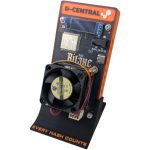
Hardware: We carry everything from entry-level Bitaxe solo miners (powered by a 5V barrel jack, not USB-C — know your hardware) to full-scale ASIC miners. We are pioneers in the Bitaxe ecosystem, having created the original Bitaxe Mesh Stand and developed leading heatsink and accessory solutions.
Repair: Our ASIC Repair service covers 38+ miner models across Bitmain, MicroBT, Innosilicon, and Canaan. Hashboard diagnostics, chip replacement, firmware recovery — we keep your hardware running instead of sending it to a landfill.
Hosting: For miners who need more power than their home circuit can provide, our Quebec hosting facility offers competitive energy rates and Canadian-grade cooling (our winters are not a bug — they are a feature).
Education: From setup guides to overclocking tutorials, our content library exists to make you self-sufficient. We want you to understand your equipment, not just plug it in.
Getting Started: Your Sovereignty Roadmap
Whether you are running your first node or deploying your tenth miner, the path to sovereignty is the same: understand the technology, own the hardware, verify everything yourself.
Step 1: Run a node. Download Bitcoin Core, sync the blockchain, point your wallet at your own node. This is non-negotiable for anyone serious about Bitcoin.
Step 2: Start mining. A Bitaxe on your desk is a statement. It contributes hashrate to the network, it teaches you how mining works at the protocol level, and it gives you a shot at a solo block (3.125 BTC — every hash counts). For larger setups, our consulting team can help you design an operation that fits your space, budget, and electrical capacity.
Step 3: Maintain your gear. ASICs are industrial equipment. They need maintenance, cleaning, firmware updates, and occasional repair. This is where D-Central’s expertise becomes your advantage — 8+ years of hands-on experience with every major miner model.
Step 4: Heat your home. If you are in a cold climate (and if you are reading this from Canada, you are), integrate your miners into your heating system. Our Bitcoin Space Heater line makes this straightforward.
Frequently Asked Questions
Do I need both a node and a miner to participate in Bitcoin?
No — you can run either independently. However, running both gives you the most complete sovereignty. A node lets you verify transactions and enforce consensus rules. A miner lets you contribute to block production and network security. Together, they make you a fully sovereign participant in the Bitcoin network.
How much does it cost to run a Bitcoin full node?
Very little. A Raspberry Pi 4 (or equivalent), a 1TB+ SSD, and your existing internet connection. Total hardware cost is under $200. Electricity consumption is negligible — roughly 5-15 watts. The initial blockchain sync takes a few days, but after that, the node runs quietly in the background.
Can I actually mine Bitcoin at home in 2026?
Absolutely. Open-source solo miners like the Bitaxe (powered by a 5V barrel jack) let you mine from your desk. Full ASIC miners can be integrated into your home heating system via Bitcoin Space Heaters. You can mine solo (lottery mining for a full 3.125 BTC block reward) or join a pool for more frequent, smaller payouts. Visit our Bitaxe Hub to explore your options.
What is the difference between solo mining and pool mining?
Pool mining combines your hashrate with other miners to find blocks more frequently, splitting the reward proportionally. Solo mining means your hardware works independently — lower probability of finding a block, but you keep the entire 3.125 BTC reward if you do. With a Bitaxe, solo mining is part of the ethos: every hash is a lottery ticket for the full block reward.
Does D-Central repair all ASIC miner brands?
We service 38+ models across Bitmain (Antminer), MicroBT (Whatsminer), Innosilicon, and Canaan (Avalon). Our ASIC Repair page has model-specific details, diagnostic processes, and turnaround information. We specialize in retail repairs for home miners — not just institutional clients.
Can I use a Bitcoin miner to heat my home?
Yes. Every watt an ASIC miner consumes is converted to heat. Our Bitcoin Space Heater line encases miners in purpose-built housings that direct hot air into your living space. In Canadian winters, this means your heating costs are partially offset by Bitcoin mining revenue — your heater pays you back.
Is Bitcoin mining bad for the environment?
Bitcoin mining incentivizes the development and deployment of cheap energy, which increasingly means renewable and stranded energy sources. Miners are uniquely flexible loads that can absorb excess grid capacity, monetize flared methane, and operate where energy is cheapest (often where renewables are abundant). When used as a heater, mining achieves near-100% energy utilization efficiency — the same electricity heats your home AND secures the most important monetary network on Earth.
The Bottom Line
Bitcoin’s decentralization is not a spectator sport. It is maintained by individuals who run nodes, individuals who run miners, and ideally individuals who do both. Every node strengthens consensus enforcement. Every miner strengthens network security. Every home miner who heats their house with proof-of-work is living proof that Bitcoin’s incentive structure works at the individual level.
D-Central Technologies exists to make this participation accessible. We are not here to sell you a dream about passive income or number-go-up. We are here because we believe that decentralized mining, distributed across homes and communities worldwide, is the only way to keep Bitcoin censorship-resistant in the long run. This is the technology that matters. This is the system worth participating in.
We are the North. We are Bitcoin Mining Hackers. And we are here to help you take your place in the network.
Browse our hardware | Get your miner repaired | Explore the Bitaxe Hub